AI Customer Engagement Software for DTC Brands
read
·

The fastest way to lose paid-social revenue isn't always a weak ad. It's an unanswered buying question underneath a strong one. That's why AI customer engagement software has moved beyond ticket deflection. In 2026, 66% of customer service organizations were using AI agents, compared with 39% in 2025, a 27-point year-over-year increase, according to industry adoption data on AI customer support.
For DTC brands, the practical shift is bigger than a support-team trend. A comment asking about sizing, a DM requesting a discount, or a public complaint under a conversion campaign can influence the next sale, the quality of the ad experience, and the cost of recovering intent. The useful category label is AI employees, because the job now includes moderation, qualification, follow-up, and revenue attribution.
Table of Contents
Why AI Customer Engagement Software Became a Revenue Tool
Paid social creates conversations in public and private spaces. Instagram DMs, Facebook comments, TikTok threads, website chat, and post-purchase questions all sit on top of acquisition spend. If nobody answers, the brand loses more than a support interaction. It may lose the buying signal, the chance to send a checkout link, and the context needed to connect the conversation to an order.
The adoption curve supports that operational change. The same industry data says 79% of organizations in a PwC AI agent survey reported that AI agents were already being adopted in their companies. That doesn't mean every deployment works. It does mean DTC operators are no longer evaluating automation as a novelty. They're deciding which customer-facing work should run continuously and which moments still require a person.
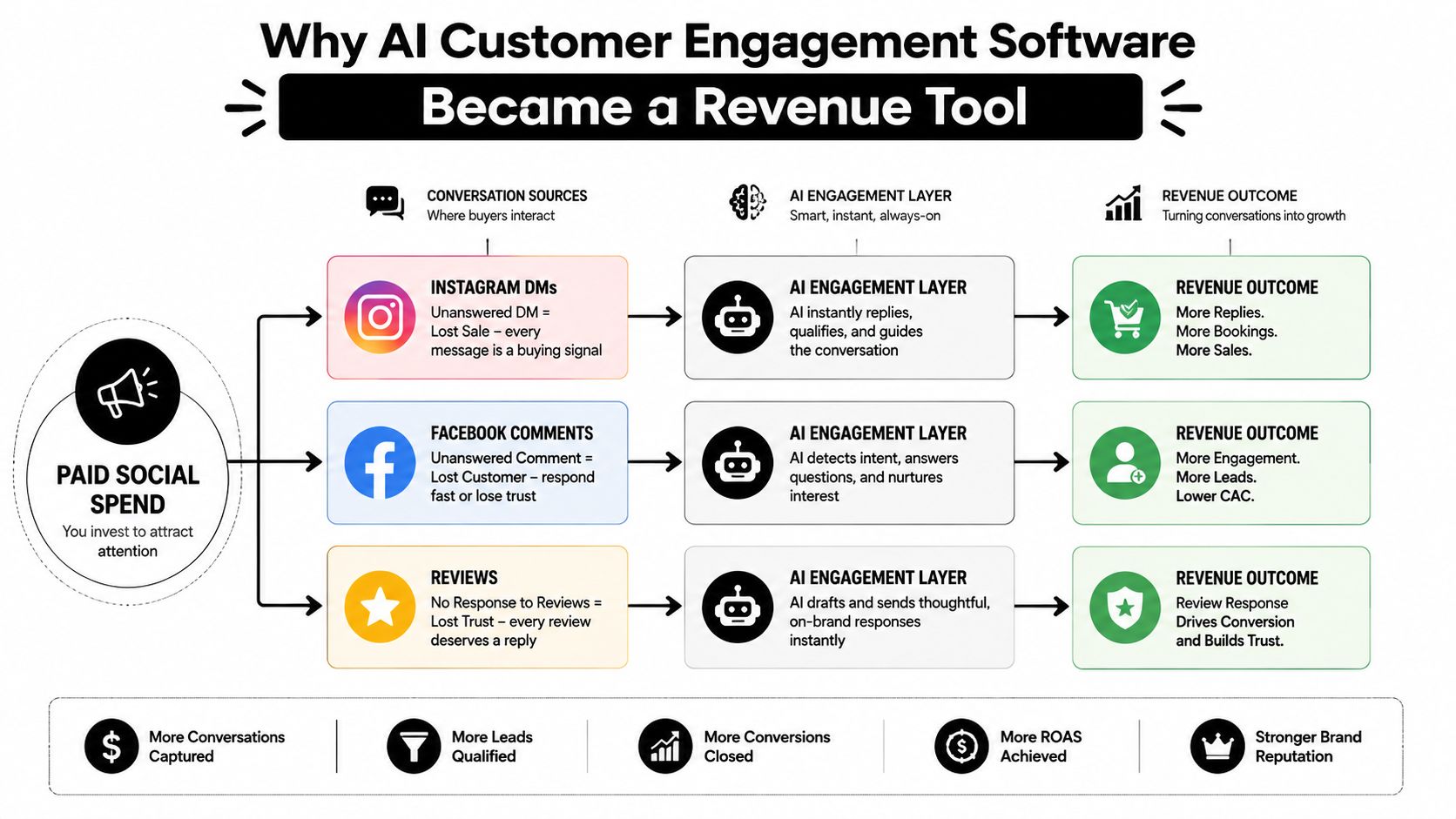
The paid-social operating layer
A conventional chatbot answers a known question. An AI employee can follow a buying path:
Detect a product or offer question.
Answer in the approved brand voice.
Ask a useful qualification question.
Apply the right discount or product guidance.
Send a checkout route.
Escalate when the customer needs judgment.
Log the outcome for attribution.
That workflow turns engagement into revenue operations. It also explains why the broader market is attracting sustained investment. One 2025 forecast estimates the AI for customer service market at USD 12.06 billion in 2024 and USD 47.82 billion by 2030, with a projected 25.8% compound annual growth rate, as reported in Freshworks' overview of AI and customer-service ROI.
The paid-social reality adds constraints. Meta's messaging policy provides a 24-hour customer-service window after a user action, and that window resets when the person acts again, according to the documented messaging-window policy. Your workflow has to recognize that timing instead of treating every DM as an open-ended marketing channel.
A better buying lens
Score platforms on four practical dimensions:
Engagement depth: Can the AI hold a multi-turn conversation and move intent toward checkout?
Moderation rigor: Can it hide spam, scams, and harmful comments before they damage a campaign?
Attribution: Can it connect a recovered conversation to a Shopify order and the original paid-social context?
Security and reliability: Can procurement verify access controls, data handling, uptime, and auditability?
Teams looking to connect customer behavior with commercial decisions can also review these AI-driven customer insights, especially when building a closed loop between interaction signals and sales action. For a channel-specific operating view, see Exerta's guide to real-time customer engagement.
The right outcome isn't a vendor list. It's a scorecard that shows whether a platform can protect paid-social performance, recover demand, and prove what happened after the reply.
The Four Evaluation Criteria That Actually Matter
Feature lists make weak buying documents. A DTC operator needs four tests that can be applied to every platform, during the same demo, with the same sample conversations.
1. Engagement depth
Ask the platform to handle a conversation that changes direction. A shopper starts with “How long is shipping?”, asks whether a discount applies, then wants a product recommendation. A useful AI employee should preserve context, answer within approved rules, qualify intent, and route the person to checkout or a human.
A one-message FAQ response isn't enough. Test follow-up questions, uncertain wording, product comparisons, and requests that require escalation. If the platform loses context after the second turn, it may reduce repetitive work but won't function as a revenue operator.
2. Moderation rigor
Moderation must work inside the channel, not in a separate report reviewed later. Test profanity, spam links, fake payment requests, competitor bait, and a legitimate complaint that should remain visible. On TikTok, advertisers can filter comments using defined rules, hide unsuitable comments, turn comments off, and analyze comments in Ads Manager, according to TikTok's advertiser comment-control documentation.
The standard is controlled action. Hide what violates the rule. Reply when a response can help. Escalate sensitive claims. Preserve an audit trail so the media buyer can understand what changed beneath an ad.
3. Revenue attribution
Attribution separates a busy inbox from a useful system. Ask whether the platform can connect a DM or comment to a Shopify order, discount code, checkout event, and campaign context. Then ask how it handles assisted conversions, repeat conversations, cancellations, and human handoffs.
A practical test is simple. Give the platform three conversations with different outcomes, then inspect the report. You should be able to see which interaction produced revenue, which needed a person, and which ended without a purchase.
4. Security and reliability
Security isn't a procurement footnote. Customer conversations may include contact details, order information, health-related questions, or payment-related requests. Verify the vendor's certification posture, role-based permissions, retention controls, encryption, subprocessors, and incident process before granting access to production pages.
Use a five-point score for each pillar. A vendor that scores 1 through 5 on engagement depth, moderation rigor, attribution, and security gives you a comparable total instead of a demo-driven decision. Teams building the surrounding workflow can use this workflow automation software framework to document approvals, escalation paths, and reporting ownership.
AI Employees Versus Chatbots Versus Human Moderation
These three approaches solve different problems. Treating them as interchangeable creates unnecessary cost and weak handoffs.
Capability | AI Employees | Traditional Chatbots | Human Moderation |
|---|---|---|---|
Multi-turn selling | Can qualify intent, handle objections, and route toward checkout | Usually limited to predefined answers and paths | Strong judgment, but manual |
Comment moderation | Can apply rules continuously across supported channels | Often needs separate moderation logic | Handles nuance well, but queue size limits coverage |
Response consistency | Uses approved brand rules and escalation paths | Consistent for known intents | Varies by person, shift, and training |
Revenue recovery | Can send links, follow up, and log outcomes | Usually stops at information delivery | Can sell effectively, but costs more per interaction |
Best use | High-volume engagement and repeatable revenue workflows | FAQ deflection | Exceptions, sensitive cases, and crisis moments |
Where AI employees win
AI employees fit conversations with repeatable logic and meaningful volume. They can answer a product question, check offer eligibility, qualify a lead, and hand off a high-intent shopper without requiring a person to monitor every thread. Their weak point is data quality. Poor product feeds, outdated policies, and inconsistent brand rules produce confident but unusable replies.
A good implementation starts with approved answers, prohibited claims, escalation triggers, and real conversation examples. It then reviews failed outcomes, not just successful containment.
Where chatbots still work
Traditional chatbots remain useful when the objective is narrow. A website bot that answers shipping questions or points shoppers to a returns policy can reduce repetitive work with limited setup. It breaks when the buyer changes intent, asks for an exception, or moves from information to purchase.
A specialist may help a team define that architecture. Resources about an AI chatbot agency can be useful for comparing build, training, and maintenance responsibilities before a brand commits to a narrow bot.
Where humans remain necessary
Human moderators handle ambiguity, reputational risk, clinical concerns, and unusual payment or identity issues. They also make the final call when a public complaint could become a wider brand problem. The trade-off is coverage. A person can't watch every channel, every hour, during every campaign spike.
The strongest stack blends the three. AI employees handle volume and revenue paths. Chatbots handle simple deflection. Humans handle edge cases and approvals. Exerta's AI social media agent overview is relevant for teams assessing how that blend can operate across public comments and private messages.
Pricing Models and the Hidden Cost Traps
A proposal can look affordable until the campaign calendar changes. DTC brands should model cost against conversation volume, channel mix, and the number of clients or storefronts an agency manages.
Pricing Model | How It Bills | Best For | Watch For |
|---|---|---|---|
Per-seat | Charges for users or agents | Small teams with stable staffing | Scaling cliffs when more people need access |
Usage-based | Charges by conversation, action, or usage unit | Brands with predictable interaction volume | Overage rates and unclear unit definitions |
Volume-tiered | Sets bands for monthly conversation volume | Teams that want budget visibility | Sudden reassignment after a launch or catalog expansion |
Per-seat pricing
Per-seat pricing looks clean when two people manage the inbox. It becomes less attractive when a brand adds media buyers, agency users, customer-support leads, and approval owners. A Black Friday launch can create a temporary need for wider access, yet the contract may charge for every named user throughout the term.
For a skincare brand spending $40K per day on Meta and handling 3,000 comments per launch, seat count isn't the right cost driver. Conversation volume and moderation coverage are. Ask whether read-only users, agency collaborators, and temporary reviewers count as paid seats.
Usage pricing
Usage billing rewards efficiency when volume stays predictable. It can punish a viral post when DM volume triples in one day. Contracts often define a “conversation” broadly, so clarify whether bot-to-bot handshakes, automated follow-ups, retries, and failed delivery attempts count.
A jewelry label handling 400 comments per day may prefer usage billing if the volume stays stable. It should still request a sample invoice based on a normal day, a product launch, and a negative-comment spike.
Volume tiers
Volume tiers offer more predictability, but the band can change after a catalog expansion, new channel activation, or seasonal promotion. An agency managing 20 clients should model each client separately, then calculate the combined effect of simultaneous bursts.
Paste this formula into a spreadsheet:
Monthly platform fee + estimated conversations × effective per-conversation cost + integration and managed-service add-ons
Flag these clauses:
Auto-renewal: Check whether renewal moves to list price without a new negotiation.
Conversation definition: Confirm whether automated handshakes and follow-ups count.
Channel multipliers: Check whether TikTok DMs cost more than Instagram comments.
Overage rules: Identify the rate and approval process before a cap is exceeded.
For a current view of Exerta's packaging, review the Exerta pricing page, then compare the total against your own launch calendar rather than a quiet-month average.
Security, Compliance, and Reliability Checklist
A paid-social tool can access public pages, private conversations, customer data, and commerce workflows. Procurement should treat it like operational infrastructure, not a scheduling plug-in.
Start with SOC 2 Type II as the baseline for reviewing control design and operating effectiveness. Telehealth-adjacent brands should ask how the system handles HIPAA exposure. Brands serving EU and California shoppers should document GDPR and CCPA consent, access, deletion, and retention workflows. If payment information can enter a DM, clarify PCI scope and ensure the AI isn't collecting data it doesn't need.
Reliability under campaign pressure
Uptime needs a plain-language test. 99.9% uptime allows 43 minutes of monthly downtime, which can overlap with a product launch or a major ad push. That availability figure and the need to evaluate reliability against service quality are discussed in the AI customer support KPI framework.
Ask for an uptime SLA of 99.95% or higher, with service credits and a clear incident process. Confirm whether channel outages, third-party API failures, and delayed webhooks are included or excluded.
Buyer checklist
Identity: SSO, role-based access, and separate permissions for agencies, media buyers, and moderators.
Auditability: Logs showing who approved, changed, sent, hid, or escalated an interaction.
Data controls: Retention windows, deletion workflows, encryption details, and model-training opt-outs.
Residency: Storage and processing locations for EU, Canadian, and US customer records.
Incident response: Breach notification timelines, escalation contacts, and subprocessor lists.
Recovery: Backup procedures, replay handling, and behavior during channel outages.
Run two tests before signing. First, conduct a tabletop incident drill with the vendor's customer success contact. Second, use a sandbox to test a spoofed payment request, a social-engineering attempt, and a sensitive customer complaint.
Shared logins, vague encryption language, missing audit logs, and training on customer chats without an explicit opt-out should stop the review. Security is part of the conversion workflow because a single unsafe reply can create operational and reputational cost.
Three Advertiser Scenarios You Can Apply Today
The best use cases start with a specific bottleneck. They don't begin with “automate everything.” They begin with a campaign, a channel, and an outcome that a media buyer can inspect.
Skincare launch
A seven-figure skincare brand runs Meta Advantage+ campaigns and TikTok Spark Ads. During a launch, an AI employee triages 1,200 comments, answers discount questions, identifies high-intent DMs, and routes complex conversations to a live agent.
The useful design choice is separation. Public comments receive short, approved answers. Private messages receive qualification and checkout support. A human sees the buyer who asks about a regimen, allergy concern, or unusual delivery request.
The forecast input is 14% of at-risk carts recovered during a single weekend. Use that as a scenario variable, then replace it with your own Shopify-attributed result after testing.
Telehealth subscription flow
A telehealth subscription brand uses the same structure but adds clinical escalation rules. The AI employee can collect basic intent and identify a potential red flag, then stop and route the conversation to a qualified reviewer. It should never improvise a clinical answer to keep a conversation moving.
The operating benefit is queue control. Nurses spend less time sorting low-risk inquiries and more time reviewing qualified leads and sensitive cases. A forecast can model a 60% reduction in compliance-review backlog, but the brand should validate that result through a controlled workflow and documented review criteria.
For teams building adjacent creative, advertorial generation tips can help structure claims and handoff points before those messages enter a regulated approval process.
Agency portfolio management
A performance agency manages 20 Shopify clients with two media buyers. Each client has different offers, policies, products, and escalation rules. The agency uses AI employees to standardize reply logic, pass UTM and discount-code context into attribution, and trigger post-purchase prompts through its lifecycle stack.
The result isn't fewer replies for the media buyers. They can compare recovered revenue, response quality, and unresolved intent across accounts without rebuilding the reporting model for each client. A practical forecast should include the client-retention KPI lift required to justify the workflow, then tie it to account margin and renewal data.
Start with one campaign. Define the eligible conversation, the human handoff, the revenue event, and the review window. Don't scale until the logs show that the AI is protecting the brand as well as moving buyers.
How Exerta Stacks Up and When to Choose It
Exerta is an AI employee platform for paid-social and website engagement. Its live channels are Facebook, Instagram, TikTok, and website chat. SMS, email, and voice are planned next. The workflow focuses on replies, moderation, qualification, checkout routing, escalation, and Shopify-attributed recovery.
Its public performance claims include 250+ brands, a 15% average sales lift, $2M+ in recovered revenue, and 99.9% uptime. Treat those as vendor-reported operating figures, not a substitute for your own test. The platform's security materials describe SOC 2 Type II as in progress, so procurement teams should verify the current posture before approval.
Capability | Exerta AI Employees | Traditional Chatbots | Human Moderation |
|---|---|---|---|
Paid-social conversations | Handles comments and DMs across live channels | Usually supports narrower scripted paths | Requires separate monitoring and assignment |
Website chat | Answers objections, captures leads, and routes intent | Handles FAQs and basic lead forms | Strong for complex conversations |
Moderation | Applies rules to spam, scams, and negativity | Often needs separate configuration | Uses judgment but depends on staffing |
Revenue workflow | Sends offers or checkout routes and attributes recovery to Shopify orders | Commonly stops at information | Can close sales but requires manual logging |
Access model | Designed for AI employees rather than per-agent seat expansion | Often priced by seats or usage | Cost grows with coverage and headcount |
Reliability review | Vendor reports 99.9% uptime | Varies by provider and plan | Depends on schedules and staffing |
Situations where it fits
Choose Exerta when your brand or agency:
Runs meaningful Meta or TikTok spend.
Receives buying questions in comments and DMs.
Needs moderation and sales recovery in the same workflow.
Uses Shopify-attributed revenue as the decision metric.
Wants to start without adding a moderator for every new campaign or client.
Exerta's comparison with another social automation approach can help buyers map differences in workflow depth, attribution, and channel operations. The decision should still come from a live test using your own product feed, policies, campaign comments, and escalation rules.
A different category may fit better for low-volume accounts, highly specialized support queues, or regulated organizations that require on-premises deployment. The platform needs to match the operating constraint, not just the demo.
Exerta provides AI employees for Facebook, Instagram, TikTok, and website chat, with comment moderation, DM replies, sales recovery, and Shopify attribution in one workflow. Test it against a live campaign and review the conversation logs, escalation quality, and recovered revenue at Exerta.