AI Social Media Agent: What It Is and How It Works
read
·

The surprising part of paid social isn't that people ignore ads. It's that they often make their buying decision in the comments before they ever reach the product page. A useful comment can pull another prospect into the conversation, while an unanswered shipping question or visible scam complaint can weaken the ad that paid to create the attention.
That makes an AI social media agent revenue infrastructure, not a customer-service widget. It watches the public comment surface, responds in direct messages, moderates risk, and connects buying intent to a measurable next action. Exerta calls this category AI employees because the operating model goes beyond scripted automation. The system handles repeatable work across Facebook, Instagram, TikTok, and website chat, while people focus on creative, offers, escalations, and strategy.
For DTC brands and agencies running Meta and TikTok campaigns, the question is practical: how much revenue is leaking between the impression, the comment, the DM, and checkout?
Table of Contents
The Comment Section Is Part of Your Ad
Most media buyers optimize the creative, audience, landing page, and checkout flow. Then they treat the comment section as a separate community-management queue. That split creates a blind spot.
A prospect who sees an ad can also see questions about sizing, delivery, ingredients, refunds, or discount eligibility. They can see how quickly the brand answers. They can see whether other buyers received useful information or only generic replies. The comment feed becomes a public layer of product proof and objection handling, even when the campaign team never designed it that way.
A 2024 SSRN study found that posts receiving bot-generated comments experienced higher user engagement. The effect depended on both the bot's identity and the quality of the comment content, with attractive, relevant comments containing social cues providing the strongest mechanism for increasing engagement (the SSRN study on bot-generated comments).
That finding changes the role of the agent. It shouldn't delete obvious spam or answer “thanks” beneath every positive comment. It should identify which conversations can help another buyer, then respond with information that feels relevant to the thread.
Unanswered questions create a hidden acquisition cost
Suppose a prospect asks whether a product works for a specific use case. If the question sits unanswered, the ad has paid to generate interest but the brand has failed to complete the next selling action. A human moderator may answer later, but the buyer may already have moved on.
The same issue appears with negative comments. A complaint about late delivery may be legitimate and deserve escalation. A repetitive scam reply may need hiding. A product objection may be worth answering publicly because the response helps everyone reading the thread. These cases require classification, not one blanket rule.
Practical rule: Treat every ad comment as either a trust asset, a buying signal, a service case, or a moderation risk. Route it accordingly.
An AI employee provides that routing layer beneath each paid post. It can answer routine questions in the approved brand voice, send high-intent conversations into DMs, and leave sensitive cases for a human. The setup also creates a record of what people ask before they buy, which turns the comment section into free ad research.
The operational difference matters during launches and creative spikes. A manual team has finite coverage. A simple bot has narrow rules. An AI social media agent can apply context across the conversation and handle the public surface as part of the funnel.
AI Employees Versus Chatbots and Human Moderators
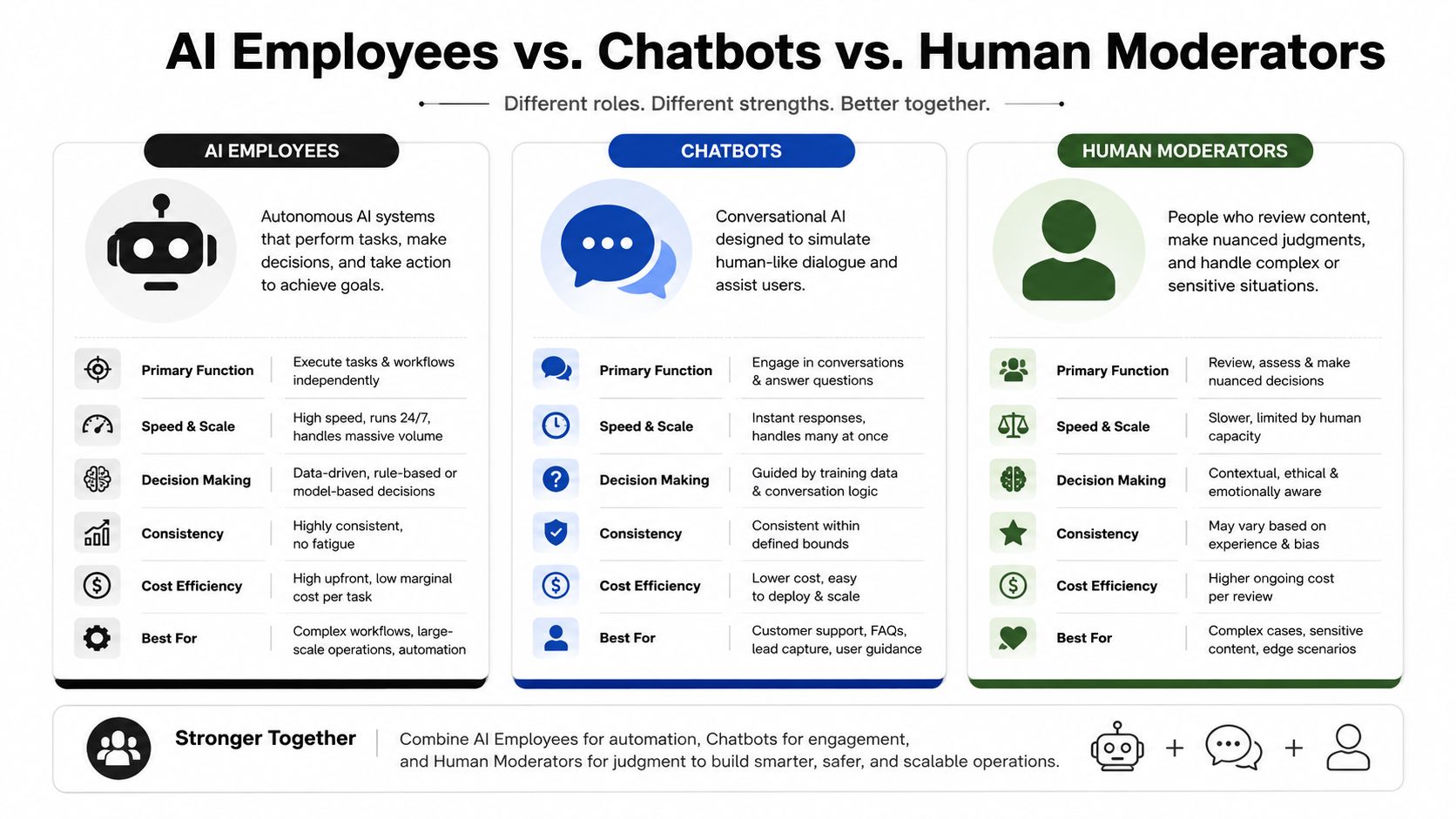
An AI social media agent is revenue infrastructure, not just another reply tool. It sits between a scripted chatbot and a human moderation queue, covering the gaps that can leave paid traffic underused. A chatbot handles a defined path. A moderator supplies judgment. An AI employee connects intent, context, response, and escalation across the public thread.
A legacy chatbot follows a decision tree. The customer selects an option, receives a predefined answer, and gets routed when the script ends. That works for narrow tasks, such as collecting a basic field or displaying a fixed policy. It fails when a buyer combines objections, phrases a question unexpectedly, or refers to an earlier message.
Human moderators bring judgment and empathy, but their coverage follows schedules, priorities, and queue capacity. A sudden comment spike forces the team to choose which threads come first. Buyers then see inconsistent response times, uneven brand tone, and unanswered questions during the period when the ad is still generating interest.
AI employees handle the middle layer. They can work continuously from approved company knowledge, respond conversationally, classify intent, and escalate cases that exceed defined risk or complexity thresholds. The result is not full autonomy. It is a routing system that reserves human attention for cases where judgment affects trust or revenue.
The differences that matter to media buyers
Operating model | Response behavior | Main limitation |
|---|---|---|
Scripted chatbot | Follows fixed paths and approved responses | Loses context outside the decision tree |
Human moderator | Uses judgment and can manage sensitive cases | Coverage depends on staffing and queue volume |
AI employee | Classifies intent, responds in context, and routes exceptions | Requires strong rules, testing, and oversight |
Teams evaluating the broader support category can consult the complete 2026 AI support guide. For paid social, the buying criteria are more specific: can the system separate a product question from a public complaint, a sales signal, or content that should be hidden?
Automated comments can influence engagement when identity and content quality work together, while generic replies may add activity without helping a buyer decide. That makes conversational quality and context more important than message volume.
When evaluating any social media chatbot framework, test whether it distinguishes a product question from a public complaint before checking message metrics. Exerta can be assessed on the same operational criteria: whether it reduces repetitive work, preserves thread context, supports approval controls, and routes sensitive cases to people. A capable system protects the value of the traffic already purchased and records the questions that affect conversion.
Three Core Jobs an AI Social Media Agent Handles
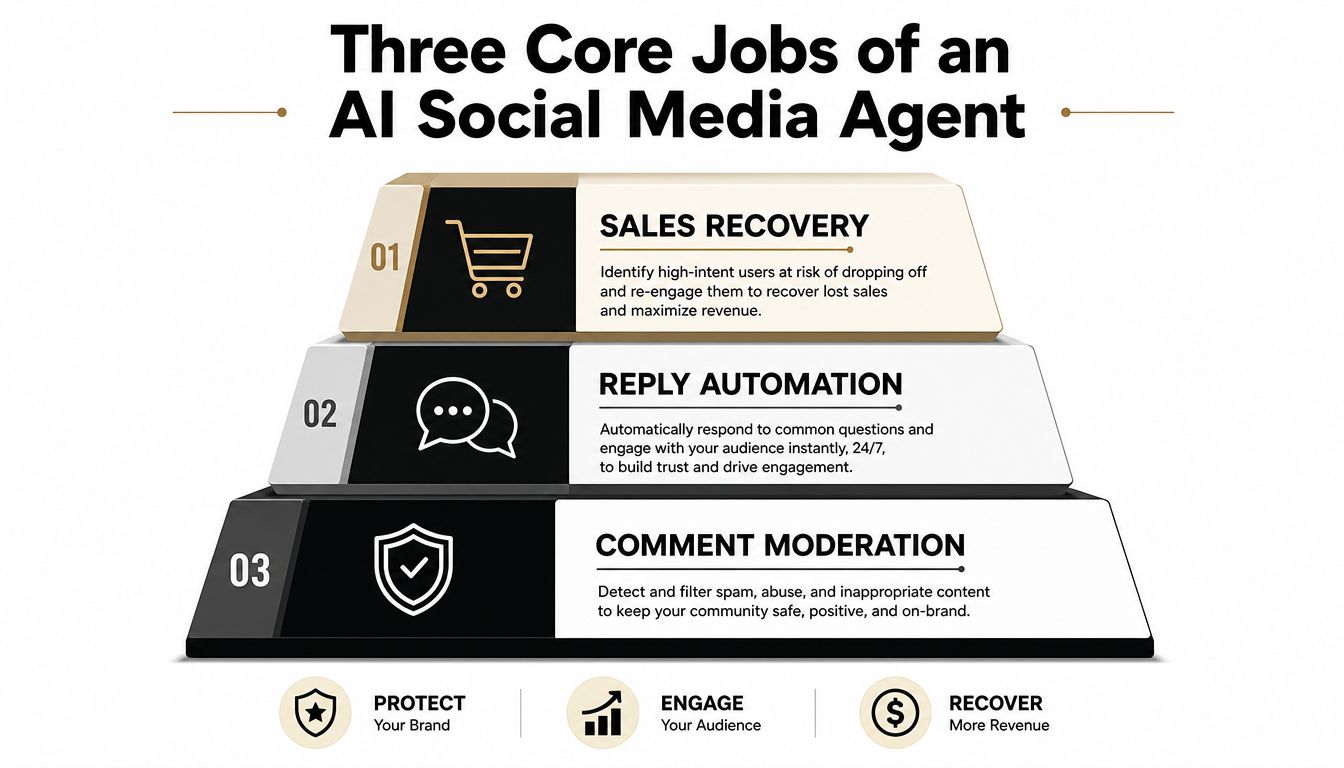
An AI social media agent creates value through three connected jobs: moderation, reply automation, and sales recovery. Separating them helps teams configure workflows and measure where the money comes from.
Moderation protects the traffic you already bought
Moderation starts with classification. The agent should distinguish scams, bot replies, profanity, repeated promotion, legitimate criticism, and real customer questions. Each class needs a different action.
Hide obvious abuse: Remove content that distracts buyers or creates a brand-safety problem.
Preserve legitimate criticism: Route complaints to a human instead of treating every negative statement as harmful.
Surface buyer questions: Keep useful objections visible and answer them where other prospects can benefit.
TikTok's advertising experience includes controls for filtering comments by advertiser-defined rules, hiding unsuitable comments, turning comments off, and analyzing comments in a dashboard (TikTok's comment management guidance). An AI employee adds an interpretation layer, so the team can apply policy to meaning and context rather than relying only on keywords.
Reply automation keeps intent active
A buyer asks about price, shipping, ingredients, compatibility, or a discount. The agent answers using approved information and can direct the person to a relevant page or DM flow. The same-day application is straightforward: review the campaign's common objections, load the correct answers, and define which questions require human approval.
Research published by 2025 reported a mean social media engagement score of 3.38 on a 5-point scale among respondents interacting with AI-powered chatbots. The same research linked customer engagement directly to information quality, system quality, and service quality (the research on AI-powered chatbot engagement). The lesson is operational. Fast replies only help when the answers are accurate and the system behaves reliably.
Sales recovery turns conversation into a tracked action
Sales recovery detects signals such as “where can I buy,” “does this come in another size,” or “can I use this discount?” It then moves the conversation toward a checkout link, product recommendation, or human-assisted close.
That workflow should record the initiating comment or DM, the response, the destination link, and the resulting purchase where the commerce connection supports it. Teams comparing broader agent workflows can also review Crescade's growth agent product for ideas on how agent-based systems structure growth tasks.
These jobs compound. Moderation keeps the thread usable. Reply automation answers the objection. Sales recovery gives the interested buyer a direct path to purchase. Exerta's explanation of what an AI employee actually does all day is a useful way to map those actions to recurring workflows rather than isolated features.
Designing Around the 24-Hour DM Window
Meta's messaging policy imposes a hard timing constraint. After a customer message on Instagram or Messenger, a business has 24 hours to send free-form replies, and each new customer message resets the clock. Outside that window, only Meta-approved message types are allowed (Meta's 24-hour messaging window explanation).
That rule changes the architecture. A team can't treat DM follow-up as a batch task for the end of the day. The agent needs to receive the event, identify the customer's intent, select a compliant action, and reply while the conversation is active.
Build the workflow around customer actions
The window can open after actions such as sending a message, clicking a call-to-action button, engaging with a Click-to-Messenger ad, using a plugin, opening an m.me link, or reacting. Each new customer action resets the countdown, while additional brand messages don't extend it (the documented Messenger conversation mechanics).
A practical flow looks like this:
Capture the event: Record the comment, reaction, ad interaction, or inbound message with its channel and campaign context.
Classify the intent: Separate product questions, support issues, discount requests, and purchase-ready signals.
Respond immediately: Answer with approved information, then provide the relevant link or ask the next useful question.
Watch the clock: If the customer replies, refresh the conversation state. If the window closes, route the thread through the permitted message path.
Escalate exceptions: Send complaints, refunds, sensitive claims, and unclear requests to a person.
The agent should never assume that a delayed queue is harmless. A customer asking about size may be ready to purchase, but a response after the usable window can remove the brand's ability to send a normal follow-up.
Exerta's guide to the 24-hour DM window is useful when translating policy into workflow requirements. The implementation priorities are webhook reliability, low queue latency, clear channel attribution, and a policy-aware fallback.
How Moderation Protects Ad Performance
A strong ad can lose force because of the conversation beneath it. Media buyers recognize the pattern: targeting stays stable, the creative remains unchanged, and performance weakens after a visible accusation, scam reply, or unresolved complaint takes over the thread.
Buyers use comments as informal product research. They scan for answers, objections, and signs that the brand responds when something goes wrong. That makes moderation a form of merchandising. The goal isn't to erase every negative opinion. The goal is to keep the buying environment useful, honest, and readable.
A Harvard Business School study found that campaigns with automated moderation and engagement produced substantially higher monetary return per dollar spent across two field experiments and four online studies (the Harvard Business School study on automated moderation). The study also found that the benefit depends on the platform's transparency design, which matters for how brands explain and govern moderation actions.
Hide risk without hiding customer reality
The wrong moderation rule removes every complaint containing a negative word. That approach can suppress legitimate feedback and leave the brand blind to recurring product problems. A better policy uses categories and confidence thresholds, with human review for ambiguous cases.
For an ecommerce campaign, the first launch pass might route:
Scam and impersonation replies to automatic hiding.
Repeated promotional spam to automatic hiding.
Shipping complaints to a support queue and a public acknowledgment when appropriate.
Product objections to a helpful public answer.
Threats, harassment, or sensitive claims to immediate escalation.
The agent should log the reason for each action. That audit trail lets the team review false positives, adjust rules, and compare comment quality with campaign outcomes. It also prevents the moderation layer from becoming an invisible black box.
Performance principle: A moderation system should protect conversion conditions, not merely reduce visible comment volume.
Always-on coverage matters because paid traffic doesn't follow office hours. A human team can manage priority threads, but an AI employee can monitor the live feed continuously and apply the same policy during launch windows, evenings, and weekends.
Brands that need a wider framework for brand reputation protection should connect moderation data to campaign reporting. Track which comments were hidden, which received replies, which started DMs, and which led to a measurable downstream action. That turns brand safety from a subjective review into an operating input for media buying.
Setting Up AI Employees for Your Brand
Configuration determines whether an AI employee sounds like part of the brand or like an automated interruption. Start with the material your team already trusts: product pages, shipping rules, return policies, approved claims, ad copy, and examples of good customer replies.
Brand voice training shouldn't mean adding a list of adjectives. Define how the agent handles uncertainty, what it must never claim, which words customers use, and how it should respond when information is missing. Give it examples of concise answers, public replies, private follow-ups, and escalation notes.
Set boundaries before increasing coverage
The first launch should focus on predictable questions and clear moderation cases. Keep sensitive areas behind approval rules until the team has reviewed enough real conversations to trust the routing.
Brand voice: Define tone, vocabulary, claims, formatting, and prohibited responses.
Platform integration: Connect Facebook, Instagram, TikTok, and website chat with campaign and conversation context.
Response rules: Specify when to answer publicly, move to DM, send a link, or escalate.
Testing: Run representative questions, slang, typos, objections, and adversarial content through the workflow.
Monitoring: Review replies, hidden comments, escalations, and attributed outcomes continuously.
Multilingual moderation requires special care. Recent research on commercial moderation APIs found systematic misclassification involving group-targeted hate speech and linguistic variation across providers. It also argues that AI moderation can disproportionately restrict expression in the Global South because Western-centric systems struggle with local language and context (research on linguistic variation in content moderation).
That risk affects more than translation quality. Dialect-heavy comments, culturally specific criticism, activist language, and slang can all look suspicious to a model that lacks local context. Test moderation by language and market, not only by English examples. When confidence is low, route to human review instead of hiding the comment automatically.
Attribution needs equal attention. Store the originating post, ad, comment, DM, response path, link, and purchase event where available. A recovered order may involve an ad impression, a public answer, a later DM, and a website visit. Without conversation-level logging, the team can count sales but can't explain which engagement created the opportunity.
Teams building a broader operating model can review marketing AI program data while defining their own governance, measurement, and escalation standards.
What Changes When You Deploy AI Employees
The operating shift is simple to describe. Instead of asking a social media manager to watch several comment feeds, a support agent to check DMs, and a media buyer to infer whether any of it influenced sales, the brand assigns repeatable engagement work to AI employees and keeps humans responsible for judgment.
Exerta reports deployment across 250+ brands, a 15% average sales lift, $2M+ in recovered revenue, and 99.9% uptime. Those are product-reported figures, so a serious buyer should validate the measurement window, attribution rules, channel mix, and baseline before using them in a forecast.
The decision comes down to leakage
If comments and DMs influence purchases, four changes matter:
More coverage: Routine questions receive answers when they appear, not only when a person reaches the queue.
Better allocation: Human moderators spend time on complaints, edge cases, and policy decisions instead of repetitive replies.
Cleaner campaigns: Spam and harmful content are routed according to defined rules, protecting the environment around paid traffic.
Clearer reporting: Conversation logs connect engagement with links, handoffs, and recovered orders.
The system also creates shared learning across Facebook, Instagram, TikTok, and website chat. A recurring question about delivery can inform the next ad, landing page, FAQ, or product explanation. SMS, email, and voice are planned next for Exerta, which will extend the same operating logic beyond the channels live today.
The practical test is not whether an AI social media agent can generate a reply. It's whether the agent can take the correct action, within the platform's rules, in the right tone, and leave enough evidence for a media buyer to evaluate incremental value.
If your team spends on Meta or TikTok and still treats comments as an afterthought, automation isn't a cosmetic upgrade. It addresses a gap between attention and revenue that manual coverage and rigid scripts often leave open.
Exerta deploys AI employees across Facebook, Instagram, TikTok, and website chat to moderate comments, answer DMs, and recover revenue from buying conversations. Visit Exerta to see how the platform can connect your paid-social engagement to faster responses and attributable sales.