Facebook Ad Comment Moderation Playbook
18 min read
read
·

Your winning Facebook ad is converting, but the comments are becoming a liability. Buyers ask whether the product fits, competitors drop links, customers complain about delivery, and spam sits beside genuine purchase signals. Your team starts late, works through the thread manually, and still misses comments that needed a fast answer.
That's not a community-management problem sitting next to paid media. It's part of the ad experience. Facebook ad comment moderation decides what prospects see, which objections get answered, and whether a public thread builds confidence or drains it. Treat every comment as a routing decision: hide, reply, escalate, or leave visible with a reason.
Table of Contents
Why the Comment Section Shapes Ad Performance
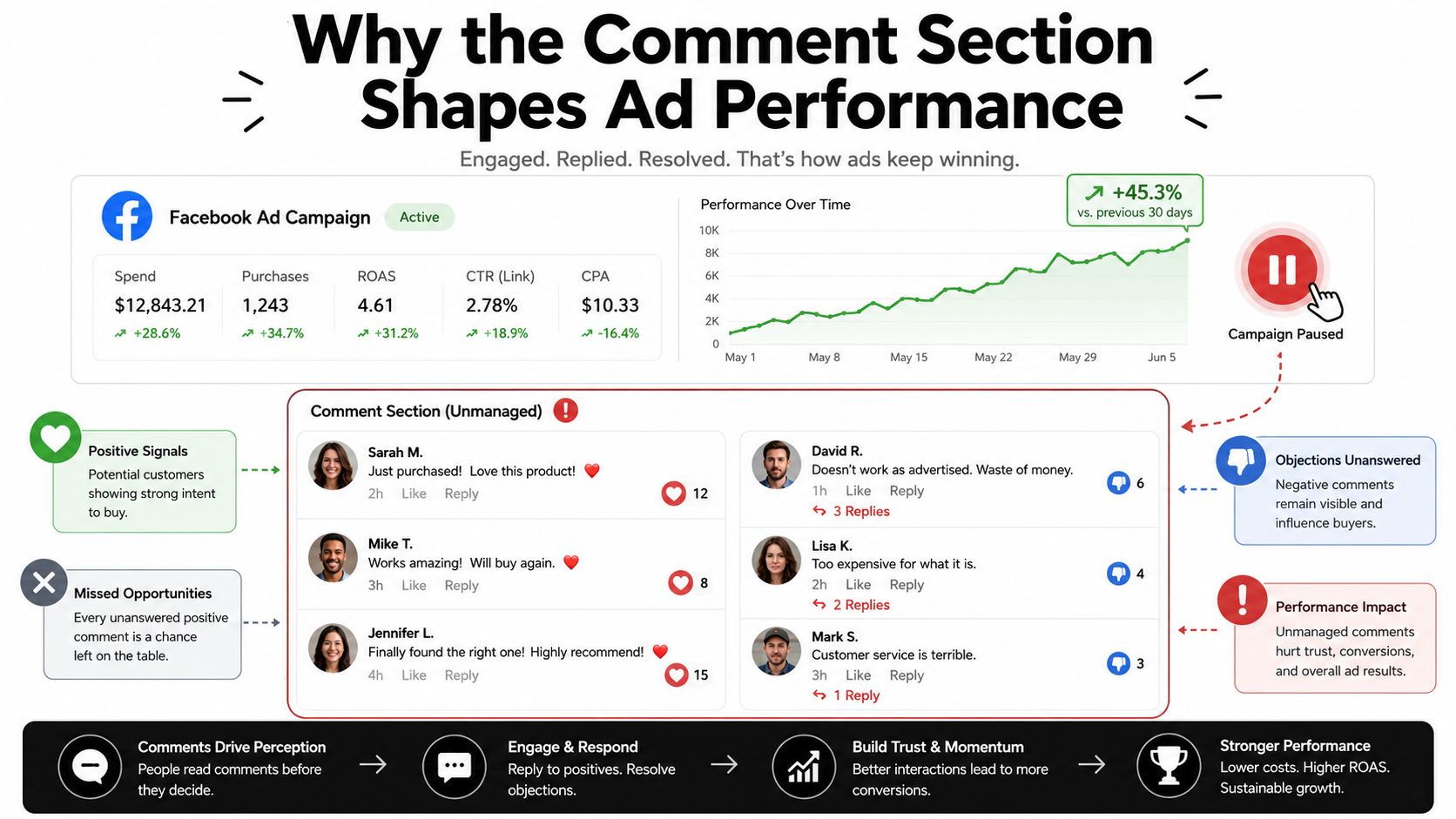
A buyer clicks an ad, opens the comments, and sees three unanswered questions about delivery, one complaint about a damaged order, and a suspicious support link. The creative may promise a clear outcome, but the thread now creates doubt and redirects purchase intent away from your store. Facebook ad comment moderation determines whether each comment becomes visible proof, a resolved objection, hidden noise, or a case for human review.
Paid comments serve three functions at once: a conversion layer, a support surface, and a brand-safety control. Treat every comment as a routing decision across hide, reply, and escalate, then connect that decision to both the customer experience and measurable ad economics.
The three pressure points
Unanswered questions suppress confidence. Questions about sizing, ingredients, delivery, compatibility, or returns often signal buying intent. If nobody responds, the next reader sees interest without resolution. A public reply can turn the thread into product education and give future buyers an answer before they ask.
Visible complaints change the tone of the ad. A legitimate complaint about damaged goods or a missing order can draw attention away from the offer. Do not hide it because it is negative. Acknowledge the issue publicly when appropriate, move order details into support, and escalate when the response requires account access or a policy decision.
Spam and scams distort relevance. Fake discounts, copied links, bot promotions, and abusive replies make the ad look less trustworthy. They also consume moderator time while genuine objections wait. Hide obvious fraud quickly, but send uncertain cases to a human instead of allowing automation to make a permanent judgment.
A Harvard Business School field study offers stronger evidence than informal community advice. During its control period, 7,099 comments were submitted and 1,557 company replies were issued, compared with 8,803 comments and 1,734 replies during the treatment period. The study reported that the intervention significantly increased the hiding of negative comments, while positive comments showed no significant difference in hiding rates between groups, with b = 1.67 and a 95% confidence interval of [-1.40, 6.71]. The paid-social lesson is practical: a moderation policy can change what users see at scale without automatically removing positive engagement. Read the field study on automated comment moderation.
A 2025 industry analysis reported that 16.7% of analyzed comments were hidden across 118.4 million comments, and that nearly 30% of comments on Meta ads were hidden for spam or toxicity. It also reported that only 57.5% of hidden comments were spam, leaving 42.5% as real interactions filtered out. That limit matters: aggressive automation can remove useful buyer signals. The analysis associated moderation on Meta ads with a 7.35% increase in ROAS and a 33% decrease in CPC, making comment handling relevant to media buyers as well as brand managers. Review the analysis of automated comment hiding and ad outcomes.
Set an action for every comment. Hide clear spam, reply to answerable questions, and escalate cases involving orders, safety, privacy, or uncertain intent. If the team cannot explain why a comment was hidden, answered, or sent to human review, the system is inconsistent. Use this guide to Facebook ad comments for operating detail, and track the resulting decisions against response time, qualified engagement, conversion rate, ROAS, and CPC. Speed matters only when the decision rules are clear.
Build Clear Moderation Rules and Actions
A moderation policy should work like an executable matrix, not a brand document nobody opens during a busy launch. Write the trigger, action, service-level agreement, and approval boundary before the ad starts spending.
Use five actions:
Hide: Remove the comment from public view while preserving it for internal review where the platform allows.
Delete: Remove content that violates your policy and has no customer-service value, such as a scam link or explicit abuse.
Reply publicly: Answer a genuine question or objection with approved information.
Escalate to support: Move order-specific, refund, delivery, or account issues into a private support workflow.
Escalate to legal: Route regulated claims, threats, allegations, privacy issues, and high-risk language to senior review.
Define categories before volume arrives
Spam is irrelevant promotion, repeated copy, unrelated offers, or automated posting. Hide it, then delete when it adds no useful context.
Scam content includes fake checkout links, impersonation, counterfeit offers, and requests for payment or personal information. Hide immediately, preserve the evidence, and escalate if the account or customer could be at risk.
Off-topic comments don't relate to the product, offer, or customer experience. Leave normal conversation visible unless it violates a stated rule. Hiding criticism just because it's uncomfortable creates poor judgment and can remove valuable context.
Profanity needs context. A mild frustrated expression isn't the same as a targeted slur, threat, or harassment. Hide or delete targeted abuse, and escalate threats.
Competitor mentions aren't automatically harmful. A buyer asking how your product differs deserves a polite, factual reply. Don't attack the competitor or make an unverified comparison.
Product objections include price, quality, fit, ingredients, use cases, and expected results. Reply with verified facts and invite a specific follow-up.
Shipping complaints need a public acknowledgment when useful, then a support handoff. Never request an order number or address in public.
Refund requests require ticket handling. Don't promise an outcome unless the policy and an authorized reviewer support it.
Genuine sales questions deserve the fastest public response. Answer with approved details, a product link, or the next buying step.
Facebook Ad Comment Action Matrix
Comment Category | Recommended Action | SLA | Approval Required |
|---|---|---|---|
Spam | Hide, then delete if irrelevant | Immediate | AI employee can act under approved rules |
Scam or fake link | Hide immediately and escalate | Immediate | Human review for account or customer risk |
Off-topic | Leave visible unless abusive or disruptive | Routine review | Moderator judgment |
Targeted profanity or threat | Hide or delete, escalate threats | Immediate | Senior reviewer for threats |
Competitor mention | Reply factually | Same business day | Approved template or moderator |
Product objection | Reply with verified facts | Fast queue | AI employee may draft, moderator approves sensitive claims |
Shipping complaint | Acknowledge and escalate to support | Fast queue | Support owner |
Refund request | Escalate to support | Fast queue | Authorized support reviewer |
Genuine sales question | Reply publicly and route purchase intent | Highest priority | Approved facts and offer rules |
Set approval boundaries by risk, not by who happens to be online. An AI employee can hide a confirmed scam pattern, classify a routine question, and draft a response from approved facts. A junior moderator can resolve ordinary product questions. A senior reviewer should handle regulated claims, threats, legal allegations, privacy exposure, and exceptions to refund or compensation policy.
Rules without thresholds create different customer experiences across shifts. For a practical spam policy and implementation ideas, see this resource on stopping spam comments on Facebook ads. Your team should also log the original text, action, reason, reviewer, and timestamp so a disputed decision can be audited instead of reconstructed from memory.
Choose the Right Moderation Operating Model
The operating model determines whether your rules survive a high-spend period. Three common choices exist: fully manual teams, basic keyword bots, and AI employees operating under human oversight.
Fully manual teams offer strong context when the queue is manageable. A trained moderator can distinguish a genuine complaint from trolling, understand the campaign offer, and choose an appropriate tone. The weakness appears during launches, weekends, and overnight periods. Human capacity is finite, and a queue that grows faster than reviewers can process it leaves the most visible comments untouched.
Basic keyword bots respond quickly, but they treat language as a match rather than a decision. A rule for “discount” may catch a legitimate buyer asking about an offer. A rule for “link” may hide a helpful product answer. A keyword system also can't reliably distinguish a scam from a legitimate competitor mention because it lacks the surrounding context.
Compare the tradeoffs
Dimension | Fully Manual Teams | Basic Keyword Bots | AI Employees With Human Oversight |
|---|---|---|---|
Decision quality | Strong context when reviewers are available | Weak context, high risk of false positives | Contextual first pass with defined human boundaries |
Response speed | Limited by staffing and shifts | Fast for exact matches | Fast classification, hiding, and draft replies |
Escalation control | Depends on training and handoffs | Usually crude or absent | Rules can route sensitive categories to owners |
Auditability | Requires disciplined logging | May record limited actions | Every action should be logged and reviewable |
Operating cost per thousand comments | Rises with volume and coverage needs | Lower, but errors carry cost | Variable, with human review focused on risk |
The strongest setup uses AI employees as the first-pass layer, not as an unaccountable replacement for judgment. They can detect patterns, classify comments, hide confirmed harmful content, and prepare replies from approved information. Human moderators should approve ambiguous cases, review customer complaints, and handle sensitive escalation.
Approval boundary: Automation can handle repeatable policy decisions. It should not make final calls on legal exposure, regulated claims, crisis signals, or promises that affect a customer's money or health.
An AI employee still needs an action log for policy review and internal accountability. It also needs a clear fallback when confidence is low, the comment contains personal data, or the customer asks for an exception. Exerta is one example of an AI employee platform that can moderate and reply across Facebook, Instagram, TikTok, and website chat, with human escalation workflows and logged actions. For a broader evaluation framework, use this guide to Facebook comment moderation tools and score each option against your own queue volume, risk categories, and reviewer capacity.
Create an Always-On Triage and Escalation Workflow
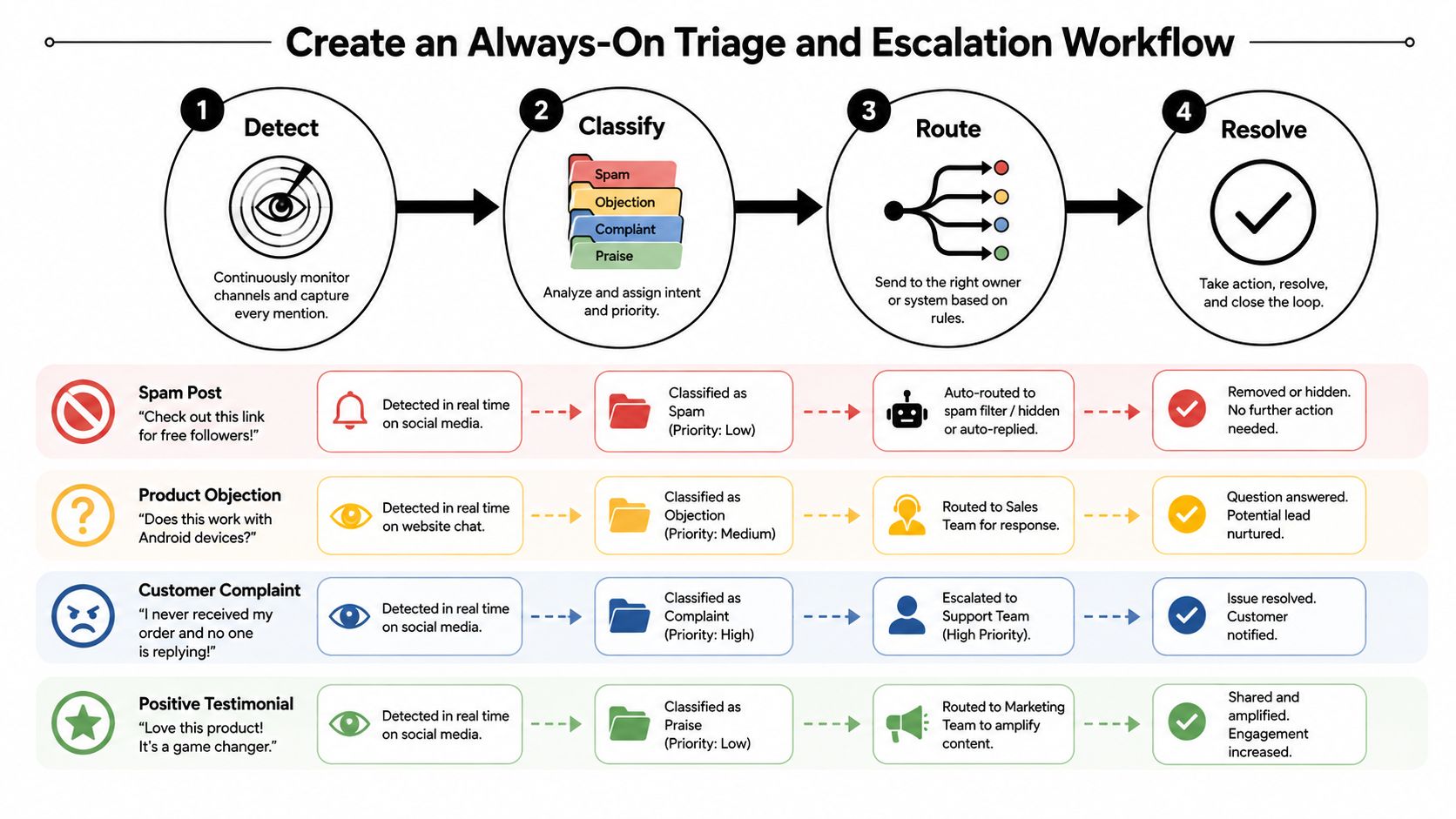
A reliable workflow has four stages: detect, classify, route, and resolve. Run it continuously. Independent moderation data across 11,963,934 comments from 5,562 brand accounts over 18 months found that 76.5% of comments received no reply, hide, or delete action. The same dataset reported that paid posts attracted 2.5x more negative comments than organic posts despite representing only 12% of total volume, and that brands using automation actioned 27% of comments versus 8% for brands without automation. Use the independent moderation dataset for capacity planning.
Detect and classify
Detection starts when a new comment enters the queue. Capture the ad, campaign, comment text, commenter intent, sentiment, keywords, links, and any previous interaction. Don't rely on scheduled review windows. The same dataset found hostility was effectively constant across the day, which means overnight coverage needs a fallback rather than a promise that someone will check later.
Classification should answer four questions:
Is the comment harmful, commercial, service-related, or sales-oriented?
Does it contain a link, personal data, threat, or regulated claim?
Can an approved fact answer it?
Who owns the next action?
A clear spam post promoting a competitor is easy to route. Hide it immediately if it contains an unrelated promotion or suspicious link. Don't hide a buyer who asks how your product compares. Send that legitimate question to a factual reply template instead.
A product objection about price stays visible. Reply with the verified value proposition, current offer terms, and a useful question such as whether the buyer wants the smallest available option. Don't invent savings, outcomes, or urgency.
Route and resolve
A shipping-damage complaint goes to support. The public reply should acknowledge the issue without asking for private order information. The handoff should include the comment, ad name, customer profile reference, purchase status if known, sentiment, requested resolution, and the action already taken.
A sales-intent comment asking for a quote gets the highest priority. Set a 15-minute service-level rule for these comments. If nobody is available, use an approved after-hours reply that provides the next step without promising immediate human contact.
For any escalation, use a structured handoff:
Context: Ad, offer, and comment thread
Intent: Purchase, objection, complaint, refund, or risk
Evidence: Link, screenshot, order reference, or policy trigger
Action taken: Visible reply, hide, private handoff, or no action
Owner: Support, sales, legal, or senior moderator
Deadline: Required response time and after-hours path
Meta's messaging policy uses a 24-hour customer-service window, meaning a business can reply within 24 hours of the person's last message. Messages after that window generally need an approved message type or another user action to reopen the thread. Review the explanation of Meta's 24-hour messaging window. Build your comment-to-DM process around that limit instead of assuming a public reply can always continue privately.
The same workflow should support content planning and response ownership. Teams that need a broader publishing process can reference how to plan social media posts to coordinate calendars, responsibilities, and review steps.
TikTok includes comment controls that let advertisers filter by their own rules, hide unsuitable comments, turn comments off, and review comments in a dashboard. Its Ads Manager also supports keyword moderation and appeals when keywords are rejected and an ad group receives Partial Disapproval or Disapproval. Review TikTok's comment management controls and its keyword moderation and appeals process. Keep the routing logic consistent across platforms, but adapt the action to each platform's controls.
For escalation ownership and response paths, document how to handle escalated issues before the next campaign launches.
Protect Brand Voice With Templates and Controls
A reply template should reduce decision time without turning every answer into a script. Build the system from four controlled assets: verified facts, response templates, prohibited claims, and handoff rules.
Start with a factual core. Include the product name, supported use cases, available options, current offer terms, shipping policy, refund policy, and approved contact path. Every fact needs an owner and a review date. If the team can't verify a statement, the AI employee shouldn't send it.
Build each reply in three parts
The factual core answers the immediate question. A sizing response should state the relevant sizing information. A shipping response should state the published delivery policy. A refund response should route the customer instead of making an unauthorized promise.
The tone dial matches the ad creative. A playful product ad may support a lighter reply. A clinical or premium offer needs restrained language. Tone can change the phrasing, but it can't change the facts.
The open question moves the conversation forward. Ask what the buyer is trying to solve, which option they're considering, or whether they want help choosing. Don't use an open question to distract from a complaint that needs resolution.
Regulated categories need an explicit prohibited-claims list. Block health-outcome promises, income guarantees, unsupported financial claims, and before-and-after language unless the relevant reviewer has approved the exact wording and context. Escalate any comment that asks the brand to confirm a medical, financial, or legal outcome.
Set the approval boundary
Component | Definition | Approval Boundary |
|---|---|---|
Verified fact | A current statement supported by internal policy or product documentation | AI employee may use it |
Reply template | Approved structure for a repeatable question | Send verbatim when context matches |
Tone dial | Permitted style range for the campaign | Moderator checks if the thread is sensitive |
Prohibited claim | Language the system must not make | Escalate to senior or legal review |
Handoff rule | Trigger and owner for unresolved risk | Human action required |
Send a template verbatim only when the comment matches the defined use case. Paraphrase when the buyer's wording requires context or when a direct copy would sound evasive. Escalate when the customer asks for a policy exception, alleges harm, exposes personal data, or introduces a regulated claim.
Store one active template set. Retire old versions instead of leaving moderators to choose between similar replies. A weekly owner review should remove expired offers, update policy language, and record why a template changed. Teams building a more deliberate public response style can use these brand voice examples as a reference point, then adapt the principles to their own approved facts.
Measure Moderation and Advertising Impact
Moderation reporting and advertising reporting answer different questions. Put them in one operating view, but keep the layers separate so a higher hide rate doesn't get mistaken for better campaign performance.
Layer one tracks moderation health
Track hide rate, false-positive rate, missed policy violations, repeat offenders, and brand-safety incidents. The hidden-comment analysis cited earlier found that 42.5% of hidden comments were real interactions, which makes false-positive review essential rather than optional. Use the moderation analysis when setting a false-positive review process.
Don't optimize for the highest possible removal rate. Optimize for correct decisions. Sample hidden comments, especially those triggered by broad keywords, and ask whether a buyer lost useful information or whether the thread required removal.
Layer two tracks response operations
Measure first-response time, resolution time, escalation rate, reviewer override rate, queue age, and sales-intent response compliance. A fast first response means little if support receives no usable context or if moderators repeatedly override the same automated decision.
Segment by ad, campaign, platform, intent, and shift. Paid posts can create a heavier negative-comment workload than organic posts, so a blended account average can hide the actual operating burden.
Layer three tracks advertising outcomes
Track CTR, CPC, CPM, hook rate, conversion rate, ROAS, and conversion quality for each ad. Tag moderation activity against the same ad and time period. Don't claim that hiding a comment caused a performance change unless your test design supports that conclusion.
A comment spike can raise workload while a creative change affects CPM. More hides may appear alongside worse performance without causing it. Compare matched ads, document the timing of policy changes, and use controlled tests where practical. The 2025 analysis associated moderation with a 7.35% ROAS increase and a 33% CPC decrease on Meta ads, but your dashboard should treat those figures as reported industry evidence, not a guaranteed outcome for every account. Review the reported Meta ad performance associations.
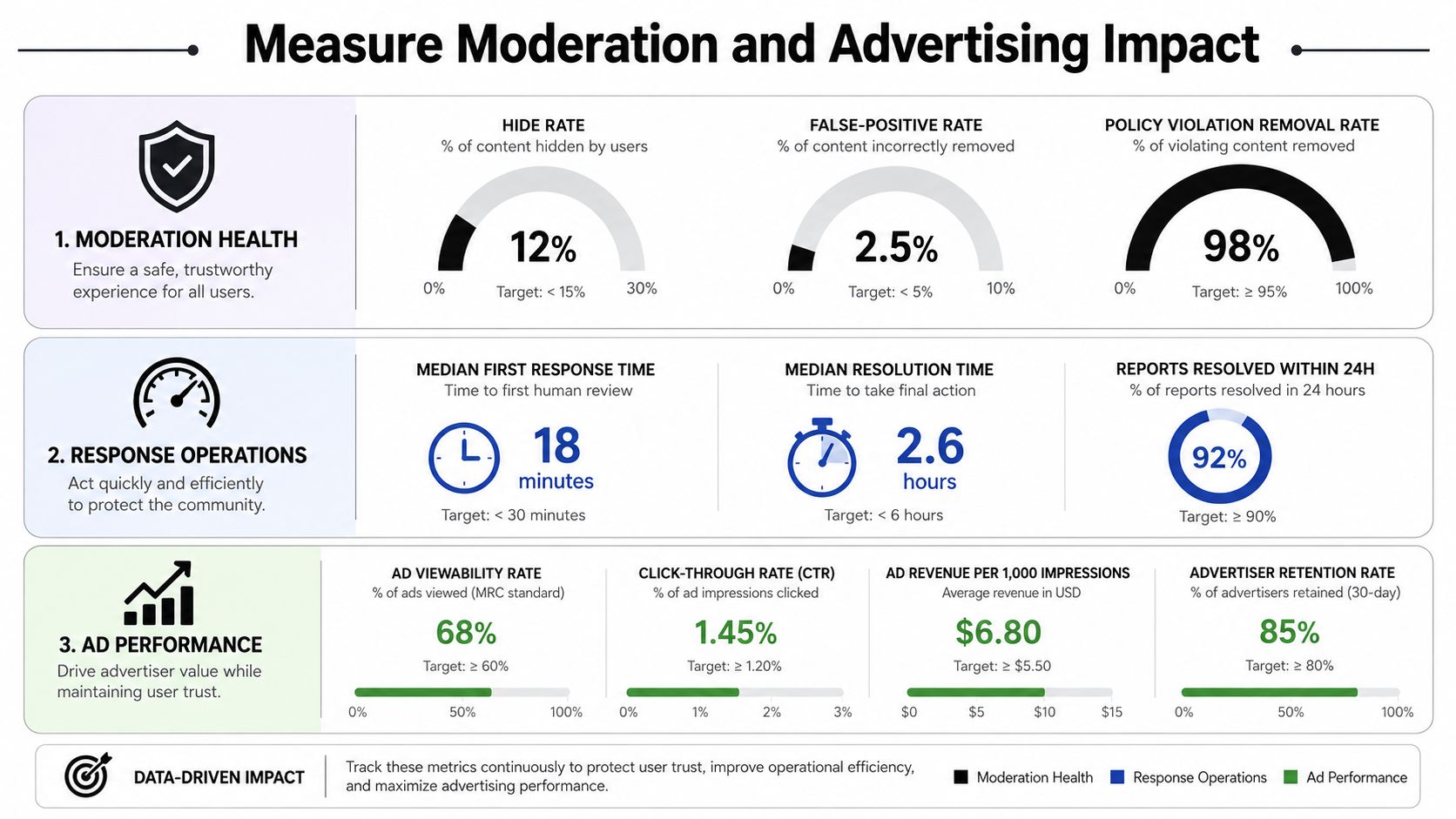
Review the dashboard weekly. Set alerts for a sudden rise in scam content, missed policy violations, response-time breaches, or reviewer overrides. Keep one view for moderation health, one for response operations, and one for ad outcomes. Media buyers, support leads, and compliance reviewers can then work from the same event log without arguing over a blended score.
Use moderation tags alongside creative tests. A team exploring AI-powered Facebook ad testing should tag comment themes and moderation actions by creative, not just by campaign. That reveals whether a hook attracts useful questions, repeated objections, or harmful noise.
Launch Your Facebook Comment Moderation System
You can launch a controlled first version in the same day. Don't wait for a perfect taxonomy. Start with the categories that create the most risk and revenue loss.
Same-day checklist
Draft the policy. Define spam, scams, abuse, objections, complaints, refunds, competitor mentions, and sales intent.
Assign five actions. Every category gets a hide, delete, reply, support, or legal path.
Write the reply library. Add verified facts, offer rules, shipping language, refund routing, and after-hours wording.
Configure routing. Put the rules into your automation or AI employee tool, with confidence limits and human approval for sensitive cases.
Name escalation owners. Give support, sales, legal, and senior moderation a clear queue and response expectation.
Wire the dashboard. Separate moderation health, response operations, and ad performance.
Run a live test. Use a safe test comment for each category before the ad receives meaningful traffic.
The system needs maintenance after launch. Review templates weekly. Audit false positives monthly. Keep automation-to-human handoff boundaries explicit. Name one person accountable for moderation quality, not just response volume.
Facebook ad comments can't be fully disabled through the platform experience in the same way as ordinary post settings. Advertisers generally manage ad comments by hiding or deleting individual comments, using keyword or profanity filters, or applying moderation tools. Review the practical limits of Facebook ad comment controls. Your workflow must therefore assume that comments will appear and define what happens next.
A reporting layer also helps agencies present moderation alongside media outcomes without mixing operational events with performance claims. For teams that need white-label reporting for Facebook Ads, keep moderation actions visible as annotations on the relevant ad and reporting period.
The standard is not “remove every negative comment.” The standard is make the right routing decision quickly, preserve legitimate customer speech, protect buyers from harmful content, and measure what changed.
Exerta deploys AI employees that classify, hide, and reply to Facebook, Instagram, and TikTok ad comments, with website chat coverage and human escalation controls. Visit Exerta to see how you can turn comment moderation into a logged workflow that protects brand safety while recovering buyer intent.