8 Brand Voice Examples for Ads, DMs, and Chat
19 min read
read
·

Your comment section is part of the ad. Buyers judge the product, the offer, and the company by what happens after they ask a public question. They see whether your brand answers clearly in comments, follows up inside DMs, and handles objections in website chat. A polished landing page can't compensate for a vague reply under a paid post.
The practical standard is simple: use short sentences, specific facts, honest urgency, and one clear next step. “We'd love to help” creates work for the buyer. “Yes, we ship to Canada within 2 days. Use SHIP2CA for free shipping over $50” removes it.
Consistent presentation has been linked to a 10% to 20% revenue increase, while a branding research summary reports that 68% of organizations say consistency contributed at least 10% to revenue growth. Yet only 30% said their guidelines were widely used and recognized internally, according to the same research family (branding statistics and consistency research). The gap isn't a creative problem. It's an operating problem.
The eight brand voice examples below show what to say, where each style works, and when an AI employee should hand the conversation to a person. The same principles also apply when you batch AI ad creative for product catalogs, because every new ad creates more conversations to manage.
Table of Contents
1. Direct Response Commands Action With Numbers
Direct-response voice leads with the answer, then gives the buyer a measurable reason to act. It replaces broad adjectives such as “fast,” “affordable,” or “popular” with delivery times, prices, offer terms, and a single instruction.
A public comment might read:
Comment: Do you ship to Canada?
Reply: Yes. Orders ship within 2 days. Use code SHIP2CA for free shipping over $50.
That reply works because it resolves the question in the first word. It gives a service fact, a condition, and an action. There's no invitation to start another round of questions.
The same voice can move a high-intent visitor forward in a DM:
“You viewed checkout. Claim 20% off your first order. This link is valid for 24 hours.”
On website chat, a proof point can open the conversation:
“Our AI employees answered 847 customer questions this week. What can we help you solve?”
Use this style for product availability, shipping, discounts, checkout recovery, and lead qualification. It also fits direct-response campaigns built around measurable outcomes, provided every number reflects a current, verifiable fact (direct response marketing strategies).
Build a factual reply library
Start with your best-converting human replies. Upload them as examples for the AI employee, then add the facts that can change, such as stock, delivery windows, discount conditions, and eligibility rules.
Lead with the answer: Put “Yes,” “No,” the price, or the next step first.
Use one action: Send one checkout link, booking link, or qualification step.
Refresh changing facts: Update inventory, offers, and delivery details weekly.
Track outcomes: Review Exerta's dashboard to see which number-driven replies recover revenue.
The trade-off is precision. Direct response fails when the system uses stale stock counts or invents urgency. Set escalation rules for missing information, unusual requests, and any offer the AI employee can't verify.
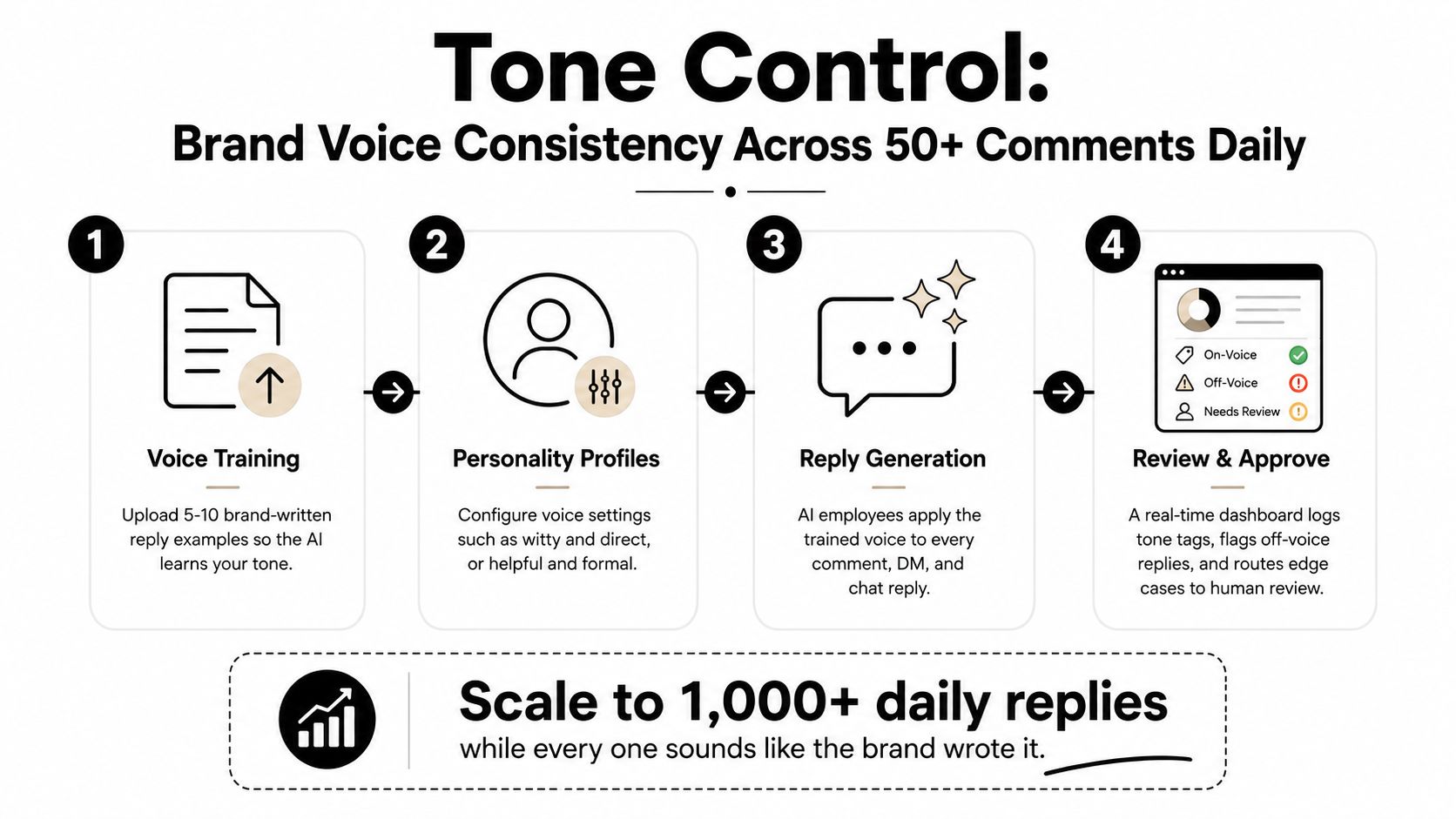
2. Tone Control Keeps Daily Replies Consistent
A brand can sound casual, formal, technical, or educational. The operational requirement is consistency. If one reply sounds like a founder and the next sounds like legal support, buyers experience two brands inside one comment thread.
A luxury beauty company might write:
“Absolutely. Our serum works best when applied to damp skin. Book a consultation to find your routine.”
A fitness app can be more relaxed:
“Yep, that's exactly the type of question we built this for. Check your inbox. I sent the full breakdown.”
A B2B software company may need technical efficiency:
“Great catch. We released that feature in version 2.3 last month. Contact support and they'll enable it for your account today.”
Each reply has a different personality, but all three answer directly and provide a next step. The mistake is treating “consistent” as “identical.” Instagram comments can be lighter than website chat, while the underlying vocabulary, promises, and service posture remain stable.
Train for voice, not just tone labels
“Be friendly” doesn't give an AI employee enough information. Five strong examples show sentence length, greeting style, vocabulary, punctuation, and the level of detail your customers expect. Add examples of what the brand should never say.
Use approval workflows for price negotiations, complaints, product exceptions, and sensitive support issues. Exerta can help teams scale engagement without scaling headcount while keeping human review where judgment matters.
Upload winning examples: Start with five replies that already convert or resolve questions.
Tag edge cases: Mark complaints, refunds, negotiations, and escalation language.
Review live conversations: Use the mobile dashboard while campaigns are active.
Compare execution: Test AI replies against manual replies for similar questions.
The trade-off is speed versus nuance. Automation keeps personality from drifting across high-volume campaigns, but a person should own emotionally charged or commercially unusual conversations.
3. Micro-Copy Moves Interest Toward Checkout
“Interested” isn't a conversion. It's a signal that the buyer needs one useful answer before taking the next step. The best micro-copy recognizes that signal, supplies the missing fact, and makes checkout easy.
Under a product image, a buyer asks, “How much?” A useful reply is:
“It's $47 today with free shipping. Grab it here: [checkout link]. Only 8 left in stock.”
If the buyer asks about delivery, answer the location and timing:
“Yes, we ship to Miami. Shipping is $8 flat rate and delivery takes 2 to 3 days. Want to order? [checkout link]”
If there's no response after 18 hours, the follow-up can reconnect the conversation:
“Your cart is still waiting. Use SHIP2MIAMI for free shipping if you complete checkout today: [re-engagement link]”
Meta gives brands a 24-hour window to reply to a customer DM before the conversation locks, so response timing needs to sit inside the workflow, not in someone's memory (Meta ad moderation and DM guidance).
Map intent to a branch
A lead-generation business can use the same structure:
“Is this available in my state?”
“Yes. It takes 2 minutes to check eligibility and receive your quote: [qualification link]”
A telehealth team needs more care:
“I'm not sure this works for sensitive skin.”
“That's a valid question. Check the reviews here, or reply with your concerns: [review link]”
Don't let the AI employee guess at medical suitability, eligibility, or stock. Create branches that ask a qualifying question first, then send the relevant link.
Use Exerta's dashboard to compare urgency phrasing, checkout links, and qualification flows. The useful result isn't the cleverest sentence. It's knowing which reply moves a real conversation forward.
4. Moderation Copy Protects the Brand Without Sounding Defensive
Moderation voice should be firm in public and respectful in private. Hiding spam is a technical action, but the private reply determines whether a confused buyer feels ignored or a legitimate customer receives a path to resolution.
For a comment containing several competitor links, use a clear rule:
“We noticed your comment included external links. For safety, we hide those on ads. Feel free to DM us directly if you have questions about our product.”
A negative accusation needs restraint:
“Sorry to hear that. We're not aware of an issue matching this description. DM us with the details and our team will review it.”
A shipping complaint is different:
“I waited 10 days. This is unacceptable.”
That isn't automatically spam or negativity to suppress. Route it to a human moderator who can check tracking, explain the delay, or discuss a refund. Exerta's moderation playbook for Meta ads provides a practical framework for separating harmful content from valid criticism.
Separate content rules from service rules
Start with obvious spam links and profanity. Review escalations for two weeks, then add nuance based on what your team sees. A telehealth account might hide public requests for personal medical advice and send:
“For medical guidance, please book a consultation: [scheduling link]. Our provider can review your situation privately.”
The distinction matters because automated moderation can improve advertising outcomes. A Harvard Business School paper covering six studies, including field experiments on Trustpilot, Instagram, and Facebook, found that automated moderation of harmful comments causally improved conversion rates, return on ad spend, and other advertising outcomes (Harvard Business School research on automated moderation).
Log every action: Use the audit trail to inspect hidden comments and private replies.
Route high stakes issues: Complaints and support requests should reach a person before an automated answer goes live.
Create client profiles: Agencies need separate moderation rules for DTC, telehealth, insurance, and other accounts.
Review efficiency: Compare ad-spend efficiency before and after a sustained moderation workflow.
5. Community Voice Builds Belonging in Comment Threads
A transactional reply answers the current question. A community reply also recognizes the relationship around it. That can mean acknowledging a repeat buyer, highlighting a customer story, or inviting an advocate to contribute.
A repeat customer writes, “Ordering again.”
“Yes, this is your fourth order. Thanks for sticking with us. Here's 15% off as a thank-you: [checkout link]”
A new buyer asks, “Is this high quality or cheap?”
“Sarah M. just posted before-and-after photos in our community. Check her story here: [community link].”
An advocate says, “I recommend this to everyone.”
“We love that energy. Tag us in your photos. We feature customer wins in our newsletter every Friday.”
The response feels personal because it connects the person to other customers, not because it adds exaggerated praise. For subscription brands, the same approach can support retention:
“Our November cohort says yes. 89% renew. Join here and see why: [subscription link]”
Personalization needs boundaries
Segment the knowledge base by new customer, repeat customer, advocate, and subscriber. Connect Shopify attribution so the team can see which community-focused replies contribute to recovered revenue. Exerta's guidance on using your comment section as free ad research supports treating conversations as customer insight, not just moderation work.
Celebrate milestones: Build workflows for first purchase, repeat orders, and renewals.
Use verified stories: Link only to approved testimonials, reviews, and community posts.
Protect privacy: Don't reveal order history or personal details in public.
Escalate sensitive moments: A complaint from a loyal customer deserves human attention.
The trade-off is warmth versus overfamiliarity. “Your fourth order” can delight a buyer when the data is accurate. It can feel invasive when the customer didn't expect the brand to mention it publicly. Keep private history private unless the customer has already made it part of the conversation.

6. Objection Handling Turns Price Resistance Into Clarity
Objection copy shouldn't argue with the buyer. It should acknowledge the concern, provide a comparison or explanation, and offer a low-friction next step.
For a premium water bottle, a buyer says, “That's $200. Insane.”
“Totally fair. Compare the upfront cost with replacing lower-cost bottles at $10 to $15 per year. Ours includes hydration technology, stainless construction, and a lifetime warranty. Here's the full breakdown: [product comparison link]”
The response works because it doesn't call the buyer wrong. It explains what the price covers and lets the buyer decide.
For shipping skepticism:
“Our shipping cost is $8 flat. We show the exact product price with and without shipping in the FAQ: [FAQ link].”
For a weight-loss lead:
“Results depend on adherence. Our clients average 8 pounds in 12 weeks. Review examples for your body type, then book a free call if you have questions: [results link]”
The last example should use only approved, substantiated claims. If a business can't verify the result, the AI employee must not repeat it.
Build objection branches
Collect the objections your team sees most often, then pair each with evidence. Price can lead to a comparison. Fit can lead to sizing guidance or testimonials. Shipping can lead to exact costs and delivery terms. A lead-gen prospect who says, “I don't have time for a consultation,” may need:
“The quote takes 2 minutes and has no commitment. See if you qualify: [quote link]”
Use workflow branches rather than one universal rebuttal.
Use customer language: Train from replies that produced sales, not corporate scripts.
Test evidence types: Compare a cost breakdown with a customer example.
Respect a no: Don't keep pushing after a clear refusal.
Escalate regulated objections: Telehealth and financial concerns need approved responses.
The goal isn't to force agreement. It's to move the buyer from an unclear objection to an informed decision.
7. Compliance Copy Sounds Human When the Rules Are Built In
Compliance language becomes awkward when teams add it at the end. Build the required disclosure into the reply structure, then keep the surrounding sentence direct and useful.
A telehealth response can say:
“Yes, after a consultation with one of our licensed providers. This isn't medical advice. Ready to book? [scheduling link]”
A solar lead-generation reply might read:
“Average savings are $12,000 over 25 years based on your region. Actual savings vary by usage and incentives. Get a personalized quote: [quote link]”
For Medicare-related insurance questions:
“Yes, during Open Enrollment from October 15 to December 7. We'll help you compare. We're not affiliated with Medicare. [Learn more link]”
These examples combine the next step with the required boundary. They don't bury the buyer in legal language, and they don't let a conversational tone remove an important disclosure.
Create approved response paths
Legal teams should approve the templates before launch. Then map keywords and conversation states to the right response. A telehealth DM about blood thinners could say:
“We'll flag this for your consultation. Please bring a current medication list. This isn't medical advice, and your provider will confirm during your visit.”
The AI employee should not diagnose, promise eligibility, or answer a question outside the approved scope. Route those cases to a licensed or qualified person.
Pre-approve core templates: Have legal review the language and required links.
Attach disclosures automatically: Trigger them for medical, financial, and insurance terms.
Keep an audit trail: Export logs when your compliance process requires evidence.
Review for human tone: Refresh robotic language only after legal approval.
For agencies, separate compliance profiles by client and industry. A template approved for a supplement brand shouldn't move into a telehealth account without review.
8. Urgency and Scarcity Work Only When They're True
Urgency can turn indecision into action, but false urgency damages trust quickly. Use live inventory, actual sale dates, verified incentive deadlines, and the platform's real messaging window.
For inventory:
“Yes, 4 left. Orders placed in the next 90 minutes ship today: [checkout link]”
For a DM offer sent at 10 a.m.:
“This deal is available in this chat for 24 hours. Want the blue one? [checkout link]”
If the buyer returns after the window expires:
“That offer expired. Here's a new link valid for 2 hours: [checkout link]”
TikTok provides advertiser controls for filtering by custom rules, hiding unsuitable comments, turning comments off, and analyzing comments in a dashboard. Its platform materials also describe technology-based moderation for uploaded content, with flagged content reviewed by moderators around the clock and 93.0% of removed content in that report taken down in less than 24 hours (TikTok brand safety and comment controls). Those controls don't replace a truthful brand voice. They create the operating environment in which your rules run.
Set limits around pressure
A flash-sale reply can be specific:
“The sale ends tonight at midnight Eastern Time. Use code FLASH20 for 20% off: [checkout link]”
A solar lead can reference a verified deadline:
“Your state incentive ends in 47 days. Get a free quote before the deadline: [quote link]”
For high-ticket coaching, social proof may be less aggressive:
“Our November cohort has limited availability. Apply here and we'll confirm whether it's a fit: [application link]”
Use live data: Connect stock, offer dates, and eligibility deadlines to approved sources.
Cap frequency: Don't show the same urgency message repeatedly to one person.
Test wording: Compare “4 left” with another truthful stock message and review conversions.
Vary natural cycles: Restocks, seasonal offers, and limited editions need different language.
Use Exerta's reminder advertising example to shape follow-ups without turning every interaction into a countdown. The best urgency reply gives the buyer a reason to act and enough information to trust that reason.
8-Point Brand Voice Comparison
Approach | Implementation complexity | Resource requirements | Expected outcomes | Ideal use cases | Key advantages |
|---|---|---|---|---|---|
Direct Response: Command Action With Numbers | Medium, template-driven, needs accurate metrics | Verified performance data, conversion templates, weekly number refresh | Faster, measurable reply-to-conversion lift | DTC ecommerce, lead-gen, telehealth, subscription; comments & DMs | Clear CTAs with concrete metrics; high short-term conversion |
Tone Control: Brand Voice Consistency Across 50+ Comments Daily | Medium, train voice profiles and escalation rules | 5–10 brand examples, ongoing monitoring, approval workflows | Consistent voice at scale; reduced tone drift | Agencies, multi-brand operators, fast-growth ecommerce; all channels | Preserves brand personality; scalable moderation replacement |
Micro-Copy for Sales Recovery: From "Interested" to "Purchased" in 3 Replies | High, intent detection, dynamic links, conditional flows | Clean product data, checkout links, workflow builder, attribution tracking | Recovered revenue and faster conversions (24/7) | DTC ecommerce, lead-gen, telehealth, coaching; DMs & chat | Automates recovery flows; links intent to checkout; measurable ROI |
Moderation Copy: Hide Spam and Negativity Without Sounding Defensive | Low–Medium, rule configuration and escalation | Moderation rules, human reviewers for edge cases, audit trail | Fewer ad negatives, improved ad performance, brand safety | Paid ads, high-traffic posts, regulated industries | Protects ad spend and brand safety; private replies maintain goodwill |
Community Voice: Building Belonging in Comment Threads | Medium–High, personalization and history tracking | Customer data sync, cohort segmentation, UGC/testimonial assets | Higher LTV, increased organic engagement and advocacy | Subscriptions, coaching, community-driven D2C, agencies | Scales personalized recognition; boosts retention and organic reach |
Objection Handling: Turning "That's Expensive" Into "That Makes Sense" | Medium, detection plus rebuttal library and testing | Product comparisons, rebuttal templates, A/B testing, escalation paths | Fewer lost deals; higher close rates, off-hours objection resolution | DTC ecommerce, high-ticket coaching, lead-gen, telehealth | Resolves common hesitations quickly; data-driven rebuttals |
Compliance Copy: Regulatory Language That Doesn't Sound Like Legal | High, legal review and conditional disclosure logic | Pre-approved legal templates, compliance workflows, PHI/PII controls, audit logs | 100% compliant replies, audit-ready logs, reduced regulatory risk | Telehealth, financial services, Medicare, regulated B2B | Ensures regulatory compliance while preserving natural tone |
Urgency and Scarcity: Moving "Maybe" to "Buy Now" Without Sounding Desperate | Medium, inventory sync, frequency capping, variant testing | Real-time stock data, sale windows, workflow rules, frequency caps | Higher conversion from honest urgency; optimized urgency flavor | DTC ecommerce, flash/limited editions, subscriptions, high-ticket | Genuine scarcity boosts conversions; prevents urgency fatigue |
Build the Voice Before You Scale the Replies
The strongest brand voice examples don't begin with adjectives. They begin with operating rules. Decide what the brand says first, which facts it can cite, how it handles uncertainty, and where a person must take over. “Friendly” matters less than whether the reply answers the question, protects the customer, and creates a clear next step.
Start with one priority channel. For a DTC brand, that might be Instagram comments under active ads. For a lead-generation business, it might be Facebook comments and DMs. For a telehealth team, website chat may be the safer first workflow because qualification and compliance can be built into the path.
Document five approved replies for the questions you already receive. Include a direct product question, a shipping question, a price objection, a complaint, and a request that requires escalation. Write the approved version, the prohibited version, the facts behind it, and the person or team responsible for exceptions.
Treat approved facts as system inputs
Your AI employee needs a controlled knowledge base. Include current product details, offers, shipping rules, eligibility requirements, compliance language, escalation contacts, and links. Remove expired promotions and unsupported claims. A brand kit based on verified assets and approved language can give teams a cleaner foundation for that work (brand kit based guidance).
Separate sales conversations from support and compliance conversations. A buyer asking for a checkout link can receive a direct-response flow. A customer reporting a failed delivery should reach support. A telehealth user asking about a medication interaction should not receive a sales script.
Review the conversations in Exerta's dashboard and look for operational signals:
Voice consistency: Does the reply use the approved sentence style and vocabulary?
Fact accuracy: Did it cite a current price, offer, stock level, or policy?
Escalation quality: Did the system route sensitive issues before replying?
Revenue recovery: Did the conversation produce a tracked purchase or qualified lead?
One expert framework recommends tracking voice consistency, approved-term compliance, and cross-channel variance, with target ranges of 85% or higher voice consistency, 90% or higher approved-term compliance, and under 15% deviation across channels (brand voice measurement framework). Use those as operating benchmarks, not as substitutes for judgment.
Consistent brand presentation has been linked to a 10% to 20% revenue increase, and another branding summary reports that 85% of consumers expect interactions to remain consistent regardless of channel or department (consumer expectations for brand consistency). The practical implication is direct: your ad, comment reply, DM, and website chat shouldn't sound like separate companies.
Use verbs and numbers. Make urgency truthful. Protect legitimate criticism. Give AI employees enough examples to reproduce the voice, then keep humans responsible for judgment. Exerta supports engagement across Facebook, Instagram, TikTok, and website chat, with actions logged and attributed, so teams can review not only how a reply sounded but what the conversation accomplished.
Exerta deploys AI employees for brand-consistent replies, moderation, sales recovery, and website chat across Facebook, Instagram, and TikTok. Visit Exerta to build approved response workflows, set escalation boundaries, and track which conversations recover revenue.