Guide
Facebook Comments That Convert: A Paid Social Playbook
Turn Facebook comments into revenue. Learn how comment moderation, replies, and AI agents protect ad spend and recover sales for DTC brands.
13 min read
read
·


Most brands keep blaming creative when the ad is dying in public. The problem is usually the Facebook comments section sitting under the creative, shaping the next click before the buyer ever lands on the page. Facebook’s own help materials make it clear that comments are persistent, identity-linked activity, not throwaway noise, which is why a neglected thread can keep hurting an ad long after launch day Facebook Help Center.
What shows up under a post is part of the ad experience. Public posts can be commented on by everyone by default, and that means your paid media is being judged in open view by people who never intended to be warm. If you manage spend on Meta, you already know the ugly truth, comment handling isn’t community theater, it’s budget protection.
Table of Contents
Why Facebook Comments Are a Paid Media Problem
The comment section under a Facebook ad is part of the ad. Buyers read it like they read a headline, and they use it to decide whether the offer is real, risky, overhyped, or worth a click. Facebook also treats comments as durable activity. They can be filtered, reviewed, and managed long after they were posted in the Activity Log Facebook Help Center. That persistence matters because bad context does not disappear when your campaign starts spending again.
The ad is not just the creative
A clean creative with a messy comment section is still a messy ad. The buyer sees the promise in the image or video, then immediately sees objections, spam, or unanswered complaints below it. That is part of the conversion path.
Practical rule: If you would not leave the comment section visible on a landing page, do not treat it as harmless under a paid post.
Moderation belongs in the same conversation as media buying. A weak reply system lets objections sit in public, which changes how new visitors interpret the claim. A strong one gives people proof that the brand is paying attention, answering clearly, and not hiding behind the spend.
Facebook’s scale also changed the size of the problem. Facebook’s user base grew rapidly across those years, which meant more people were seeing ads, reacting to them, and adding comments in public view. More audience means more comments, and more comments means more chances for a thread to help or hurt the ad.
The paid media version is simple. Every visible reply changes how the next person reads the same dollar you already spent. That is why reputation work and ad performance belong together, and why a brand reputation protection process has direct media value.
How Facebook Comments Actually Work
Facebook gives you real controls, but they’re easy to underuse. On public posts, everyone can like or comment by default, even people who don’t follow you, and Facebook says that setting can be changed in follower settings Facebook Help Center. That means your ad comments are public-facing by design unless you’ve deliberately constrained the surface.
For a media buyer, the practical takeaway is simple. You don’t “get” comments only from fans or customers. You get them from curious shoppers, angry strangers, competitors, bot traffic, and people who are deciding whether to trust you. The setup changes the audience before the media even starts optimizing.
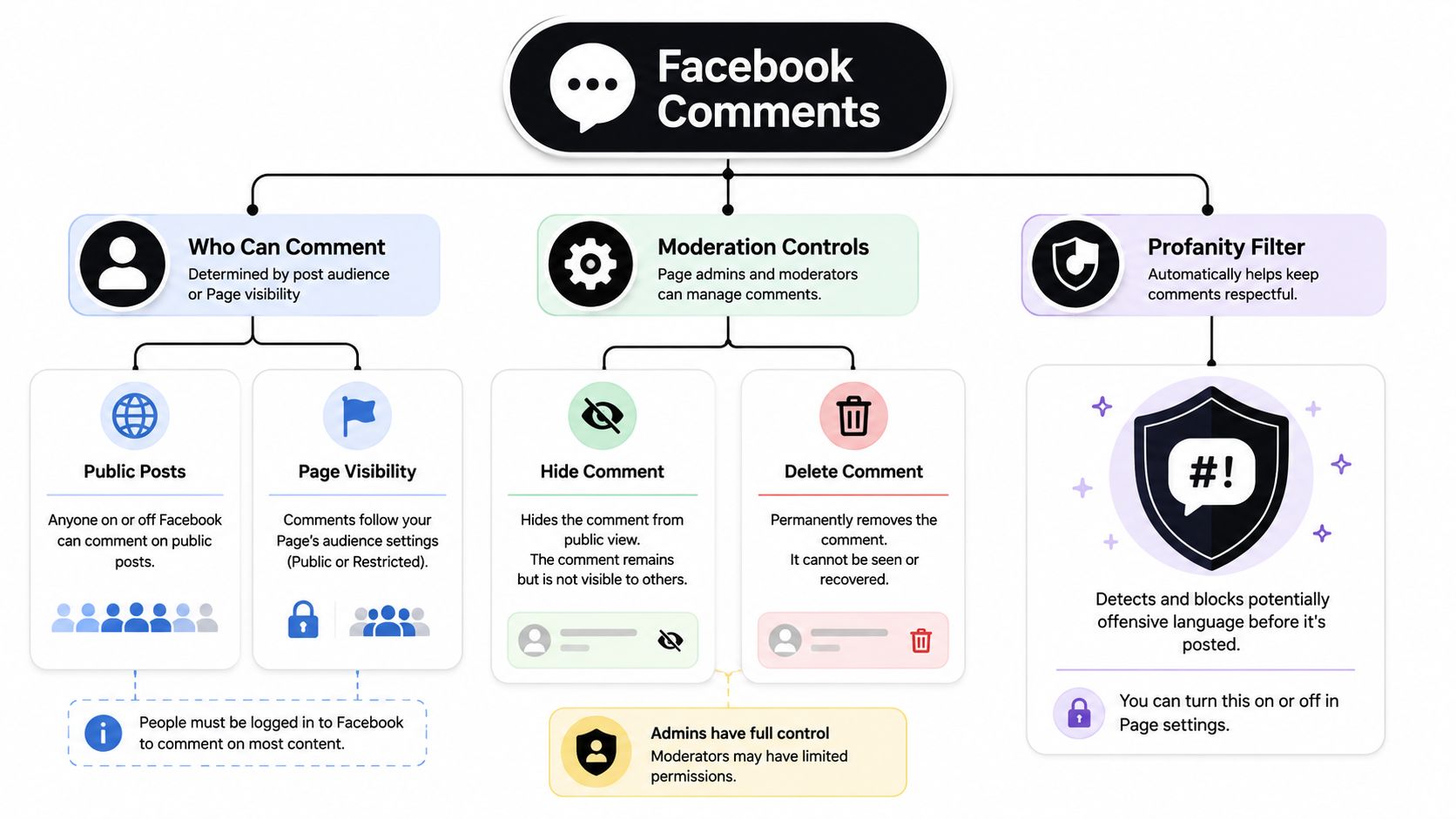
The settings that decide what people see
The platform also gives you direct comment management. Facebook says you can publish a comment by clicking Comment or the Write a comment box, typing, and pressing Enter or Return. You can add a new line with Shift + Enter, and comments can include GIFs, emojis, photos, videos, stickers, and avatar stickers Facebook Help Center. That matters because a reply is not only text. It can carry media, tone, and visual proof.
Pages can hide or delete comments, and hidden comments are no longer public while the original author can still see them, which is useful when you want to remove clutter without starting a public fight SocialRails. The same moderation layer can also use blocked words, profanity filters, and spam detection to auto-hide low-quality noise SocialRails. That gives you an operating distinction. Hide the junk. Answer the objections.
Some comment sections need less conversation, not more. They need clearer rules.
If you’re building this into a paid social workflow, use the comment rules as a control surface. Map what gets hidden, what gets answered, and what gets escalated before launch. For a practical companion, see how comment sections can act as free ad research, because the same surface that protects spend also tells you what the market is asking.
The Hidden Cost of Negative and Unanswered Comments
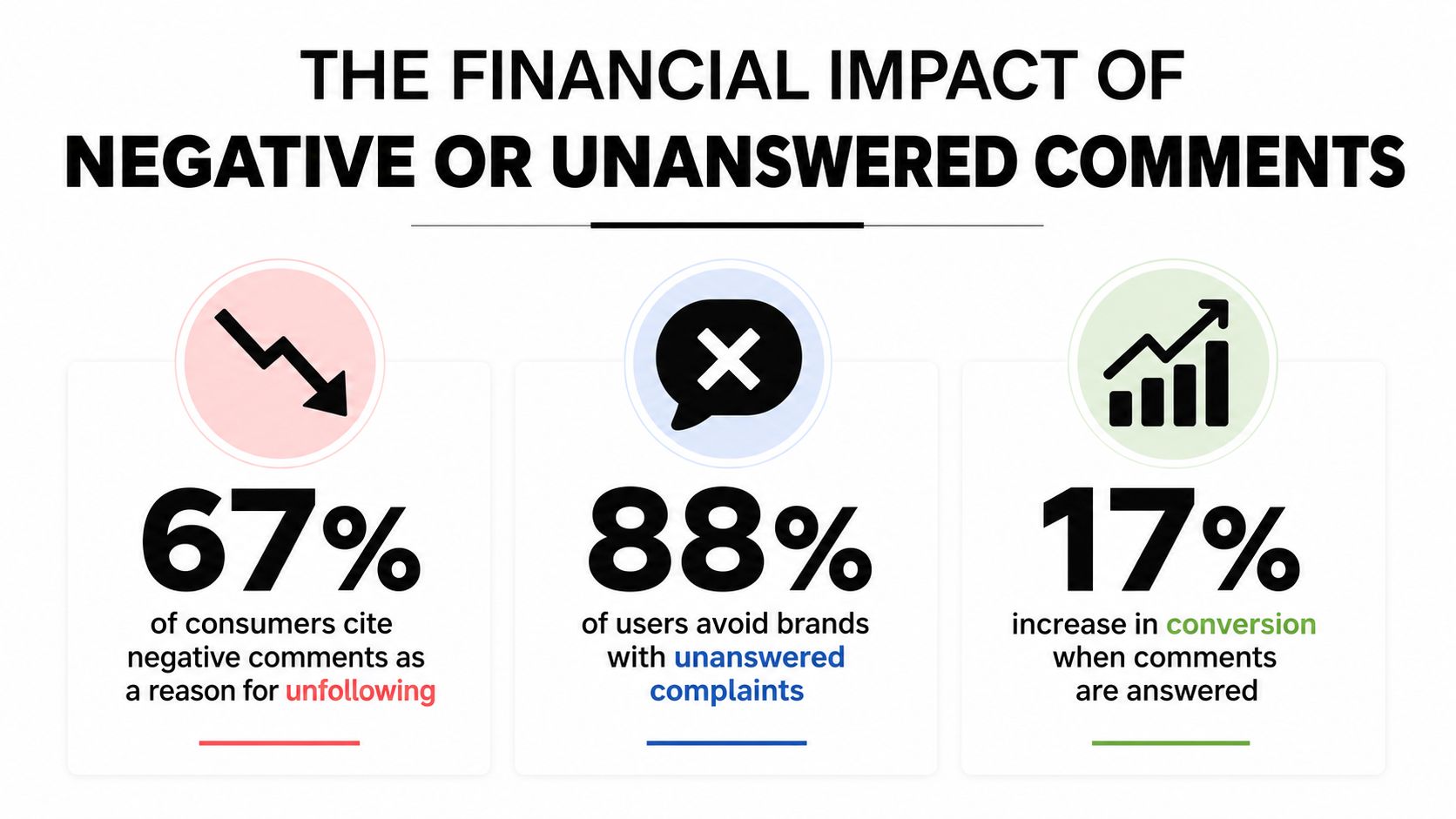
A single visible complaint can reset the whole meaning of an ad. If the first thing a shopper sees is “too expensive” or “is this a scam,” every claim in the creative starts working harder. That’s not theory. It’s how people read social proof in a feed, fast, shallow, and with very little patience.
The bigger issue is silence. When a real objection sits there unanswered, it doesn’t look neutral. It reads like the brand has no answer, or worse, doesn’t care. That’s why the wrong diagnosis is so common. Teams call it creative fatigue when the ad is really losing support in the comments.
Why silence reads like confirmation
Unanswered questions under a winning ad create a second headline. The buyer sees the ad, then sees the doubt, then sees that nobody from the brand bothered to respond. That sequence is brutal because it turns the comment thread into confirmation bias.
Practical rule: If the same objection appears twice, answer it publicly before you blame the creative.
This is especially costly outside office hours. Ads don’t pause because your team logged off. If a negative comment lands at midnight and stays visible through the morning, every click that comes in during that window inherits the damage. The ad still buys impressions, but it does so with a weaker trust signal.
That is also why low-quality responses hurt more than no response at all. A vague answer can look defensive. A rushed answer can invite more questions. Better to know in advance which comments deserve a public reply, which deserve a hidden status, and which deserve escalation to a human who can handle the actual issue.
For a deeper look at the revenue side of delayed replies, the internal article on why unanswered ad comments are costing sales goes into the mechanics. The simple version is this. Comment management is part of conversion support, not just brand care.
A Moderation Playbook for Facebook Ad Comments
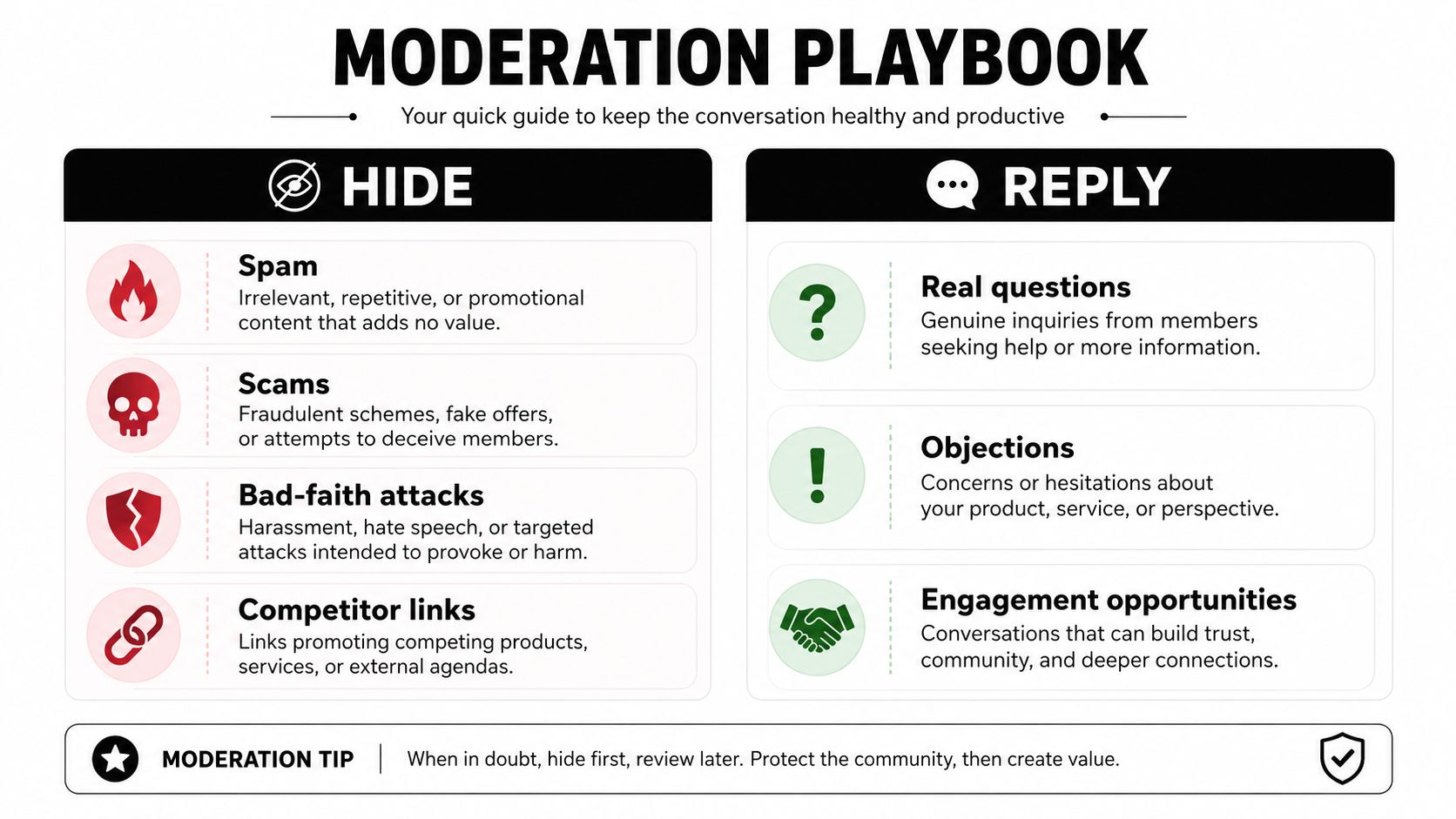
Strong moderation is a set of decisions, not a personality test. If a comment is spam, scammy, or pure bait, hide it. If it is a real question or a buying objection, reply. If it is a customer complaint, refund request, or sensitive issue, send it to a human who can handle it properly.
Hide, reply, escalate
Hide the comments that do nothing for the buying decision. That includes spam, scam attempts, bad-faith attacks, and competitor links. A hidden comment still exists for the author, but it no longer steers the public thread. Under ads, that matters because it protects the first impression without letting every thread turn into a public argument.
Reply to real friction. If someone asks whether the product runs small, ships fast, includes a warranty, or works for their use case, answer it directly. A good reply is short and specific. For example, “Yes, this fits true to size. If you want, I can send the size guide here.” That kind of response clears a blocker fast.
Escalate the comments that need judgment, not scripting. If someone says the order never arrived, asks for a refund, or raises a serious complaint, move it to a human who can solve the issue properly. Public improvisation is how brands make small problems look bigger.
“Hide fast, answer clean, escalate early.”
Use a simple rule set in your internal notes:
Spam: Hide immediately.
Scams: Hide and log.
Bad-faith attacks: Hide unless there is a real customer issue underneath.
Competitor links: Hide if the thread is about your offer, not their agenda.
Real questions: Reply with one clear answer.
Objections: Reply with proof or the next step.
Engagement opportunities: Reply if the commenter looks close to buying.
If you want a narrower walkthrough of concealment logic, the internal guide on how to hide Instagram comments applies the same moderation mindset in a different feed. The platform changes. The operating principle does not.
Turning Comment Intent Into Recovered Revenue
The best comments are not praise. They’re buying signals. Someone asking about size, compatibility, shipping, bundles, price, or guarantees is doing pre-purchase work in public. That is where revenue gets recovered, because the answer can move them from hesitation to checkout without waiting for another click.
The mistake is treating every comment like a support ticket. Some are support. Some are objections. Some are almost-ready shoppers who just need one clean nudge. The job is to tell the difference quickly and then move the conversation into the channel that can close it.
From objection to checkout
A strong workflow starts with intent reading. “Is this worth it?” is not the same as “Where’s my order?” The first can often be handled in public with a direct response and a checkout link. The second belongs in a private thread or internal queue.
Once a comment shows buying intent, move fast. If you drag it out, the shopper cools off. A short reply that offers the right next step, price clarification, or link to checkout can recover the sale while the interest is still active. Keep the language in brand voice, but don’t write like marketing copy. Write like a person who wants to help someone finish the purchase.
Practical rule: The comment is the opener. The conversion happens in the next clean step.
Attribution matters here. If a sale starts from a public question and closes after a follow-up link or code, log that path. Otherwise the comment section disappears into “organic engagement” and nobody credits it for revenue. That is how teams underinvest in the channel that is already moving shoppers.
An AI employee can sit in the flow. Exerta can reply to comments, move qualified shoppers into follow-up, and log the recovered sale back to the comment thread. It also operates across Facebook, Instagram, TikTok, and website chat, with SMS, email, and voice coming next, which gives teams one place to track what happened after the first reply Exerta. Used well, that means the comment section stops being invisible overhead and starts showing up in revenue reporting.
For more on buying signals, the internal piece on what engagement data says about intent is the right companion read.
AI Employees vs Chatbots vs Human Moderation Teams
Different jobs need different coverage. AI employees handle always-on reply, moderation, and recovery with attribution. Traditional chatbots handle fixed flows. Human moderation teams handle nuance, but they stop when shifts end and headcount runs out.
What each one does well
AI employees handle the long tail. They answer repeated questions, hide obvious junk, surface buyer intent, and hand off edge cases without making the thread feel mechanical. They fit the job when you need coverage across many posts, many hours, and many repetitive comment patterns.
Traditional chatbots work when the path is simple and the question set is narrow. Off-script comments expose the weakness fast. Someone asks about a bundle, a replacement part, a special use case, or a complaint with context, and the rigid flow breaks. People notice the seams right away.
Human teams still matter. Sensitive escalations, refunds, policy issues, and brand-defining replies need judgment. A person reads tone, context, and risk better than a rule tree. The mistake is using people for every repetitive interaction when most of the thread is predictable.
Job | Best fit | Weak spot |
|---|---|---|
Repeated comment replies | AI employees | Needs clear rules |
Scripted FAQ paths | Chatbots | Breaks off-script |
Sensitive escalation | Human teams | Limited coverage |
The right mix is not automation or humans. It is automation for volume and humans for judgment.
Exerta’s platform documentation reports adoption by 250+ brands, an average 15% more sales, and over $2M in recovered revenue attributed in-product, with Facebook, Instagram, TikTok, and website chat live today. Those figures matter because they point to a working model, not a theory. Use AI employees for the repeatable work, keep humans on the hard calls, and make sure every recovered action is logged.
An Agency Workflow for Managing Comments Across Clients
A good agency doesn’t “check comments.” It runs a system. One account has price objections, another gets spam, another attracts product questions from near-buyers, and another needs sensitivity on every public reply. If a junior team member is doing all of that manually, the workload gets messy fast.
How a small team keeps up
The clean workflow starts at intake. Every client gets the same baseline rules, but the escalation paths differ by brand. One client may want every complaint surfaced immediately. Another may only want refund issues escalated. Another may want aggressive hiding on spam but public replies on real objections.
From there, moderation rules stay shared and documented. That keeps the agency from rewriting decisions every time a new post goes live. It also makes training easier. New staff can learn the playbook once, then apply it across accounts without guessing what each brand wants.
The reporting layer is where agencies prove value. If a comment thread leads to a recovered order or a saved sale, that needs to show up in client reporting. Otherwise the work gets treated like admin instead of revenue support. The agency has to show outcomes, not just activity.
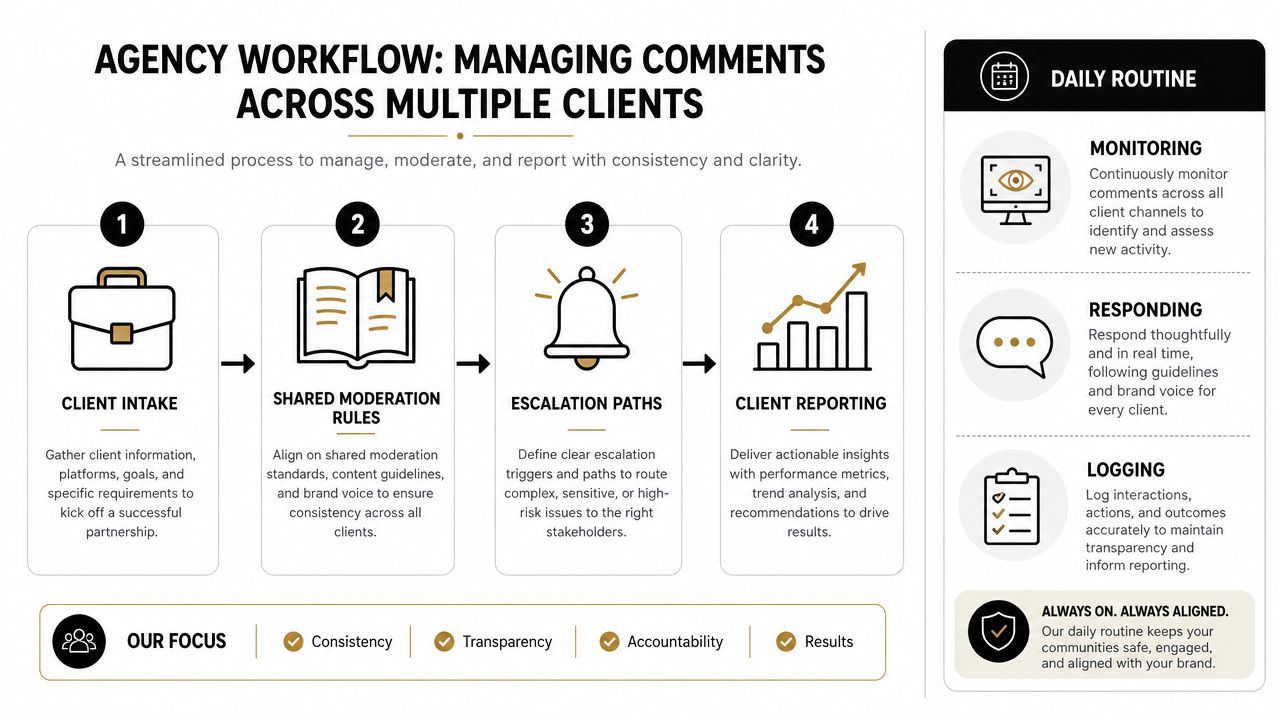
A clean daily routine looks like this:
Monitor: Scan high-spend posts first, not the quiet ones.
Respond: Answer buying questions before they go stale.
Log: Record the comment, the action, and the outcome.
Escalate: Push sensitive cases to the client with context.
That’s where AI employees help an agency most. They absorb the repetitive moderation and reply work, while the agency keeps control over brand rules and escalation. The team still owns the relationship. It just stops wasting hours on the same comments every day.
If you’ve ever watched a strong campaign get dragged by a messy thread, you already know the pattern. The agency that wins is the one that protects the thread as part of performance, not as a side task.
Your Facebook Comments Operating Checklist
Set the rules before the next campaign spends. Decide what gets hidden, what gets answered, and what gets escalated. If that is still fuzzy, the ad team will improvise, and improvisation is where comment sections go bad.
Start with the reply library. Write the five or six objections you see most often, then lock the answers in brand voice. Keep them short. Use them under every new post until the team stops seeing the same friction in public.
Next, define your moderation thresholds. Spam gets hidden. Scam behavior gets hidden and logged. Real questions get answered. Anything involving refunds, delivery failures, or sensitive complaints gets routed to a person. That way no one has to guess at midnight.
Then add the right metrics to the dashboard. Track how many comments were hidden, how many were answered, how many were escalated, and how many led to a recovery. If the team can’t tie comment work back to revenue or saved spend, it will always look optional.
If the comment thread changes the first impression, it deserves the same discipline as the ad itself.
You’ve outgrown manual moderation when the same objections keep returning, the team misses replies outside office hours, or client reporting can’t show what the thread produced. That’s the point where AI employees stop looking like a nice-to-have and start looking like the operating layer.
If your comment sections are still costing you clicks, spend, and recovered revenue, Exerta can take the repeatable work off your team’s plate. It replies in brand voice, moderates harmful comments, and ties the outcome back to the thread that started it. Visit Exerta and see how AI employees can keep your Facebook comments from dragging down paid social performance.
To turn this playbook into a daily operating queue, use How to Manage Facebook Ad Comments, then add the workflow for automatic Facebook comment replies where the answer is repetitive and low risk.

