Negative Comments on Facebook Ads How They Hurt ROAS

read

·

An article by

A Facebook ad starts to scale. Spend goes up. Click-through rate looks fine. Then CPA drifts, conversion rate softens, and nothing obvious changed. Same creative. Same audience logic. Same offer.

A lot of teams look at frequency, placement mix, or landing page speed first. Fair. But many miss the part prospects see before they click. The comment section.

People read ad comments like product reviews. They scan for proof, red flags, and signs that the brand is legit. If the first things they see are scam replies, angry customers, or lazy pile-ons, the ad has to work harder to close the same sale. That cost doesn't show up as a separate line item. It shows up as weaker efficiency.

For DTC brands and agencies running Meta and TikTok, that changes how you should think about moderation. This isn't just community management. It's part of the media buy. If you treat comments as part of the ad unit, you make better decisions about what to hide, what to answer, and what needs support involved.

The practical upside is simple. You can diagnose whether negative comments on Facebook ads are dragging performance, put rules in place today, and measure the result like any other optimization. If you want a useful starting point, this piece on comment sections as ad research is worth reading before you build workflows.

Table of Contents

Introduction Why Your Comment Section Is Part of the Ad

A familiar pattern shows up on accounts that spend hard into winners. Day one looks clean. Day two brings product questions. Day three brings copycats, fake discount offers, “scam” comments from people who never bought, and one real complaint that deserves a response but gets buried under junk.

From the buyer's side, all of that sits directly under your pitch.

That matters because the ad isn't just the image, headline, and CTA anymore. The ad is the whole visible unit. Creative gets attention. Comments either confirm the promise or break it. If your paid social team ignores that layer, you're buying impressions into a messy storefront.

Buyers use comments to validate the click

Most prospects don't trust polished brand copy by default. They trust friction. They trust how a brand handles objections in public. They trust whether anyone else asked the same question they have.

A strong comment section does three jobs:

  • Confirms legitimacy: Buyers look for normal customer behavior. Questions about sizing, shipping, ingredients, setup, or returns are healthy.

  • Reduces uncertainty: A public answer to one objection can help every future reader.

  • Adds social proof: Real discussion can make an ad feel active and credible.

A bad comment section does the opposite. It can make an honest offer look sketchy in seconds.

Practical rule: If a prospect reads comments before clicking, comments are part of conversion rate optimization.

Media buyers should own the environment, not just the spend

A lot of workflows break. The media buyer says moderation belongs to social. Social says support should handle complaints. Support says ads aren't in their queue. Meanwhile the thread stays public.

That gap creates wasted spend.

The fix isn't complicated. One team owns the rules. One queue catches escalations. One response system covers paid comments fast enough to matter. That system should tell you when to hide spam, when to reply in public, and when to pull a real issue into support before it poisons the thread for everyone else.

How Negative Comments Change Buyer Behavior and Trust

Negative comments don't hurt only because they look ugly. They change how people interpret the ad itself.

If your creative says “fast shipping” and the first visible comment says “never arrived,” the buyer now reads the whole ad through that frame. Even if the claim is unfair, the doubt is already in place. That's the problem. Comments can re-price trust in real time.

A useful visual helps here:
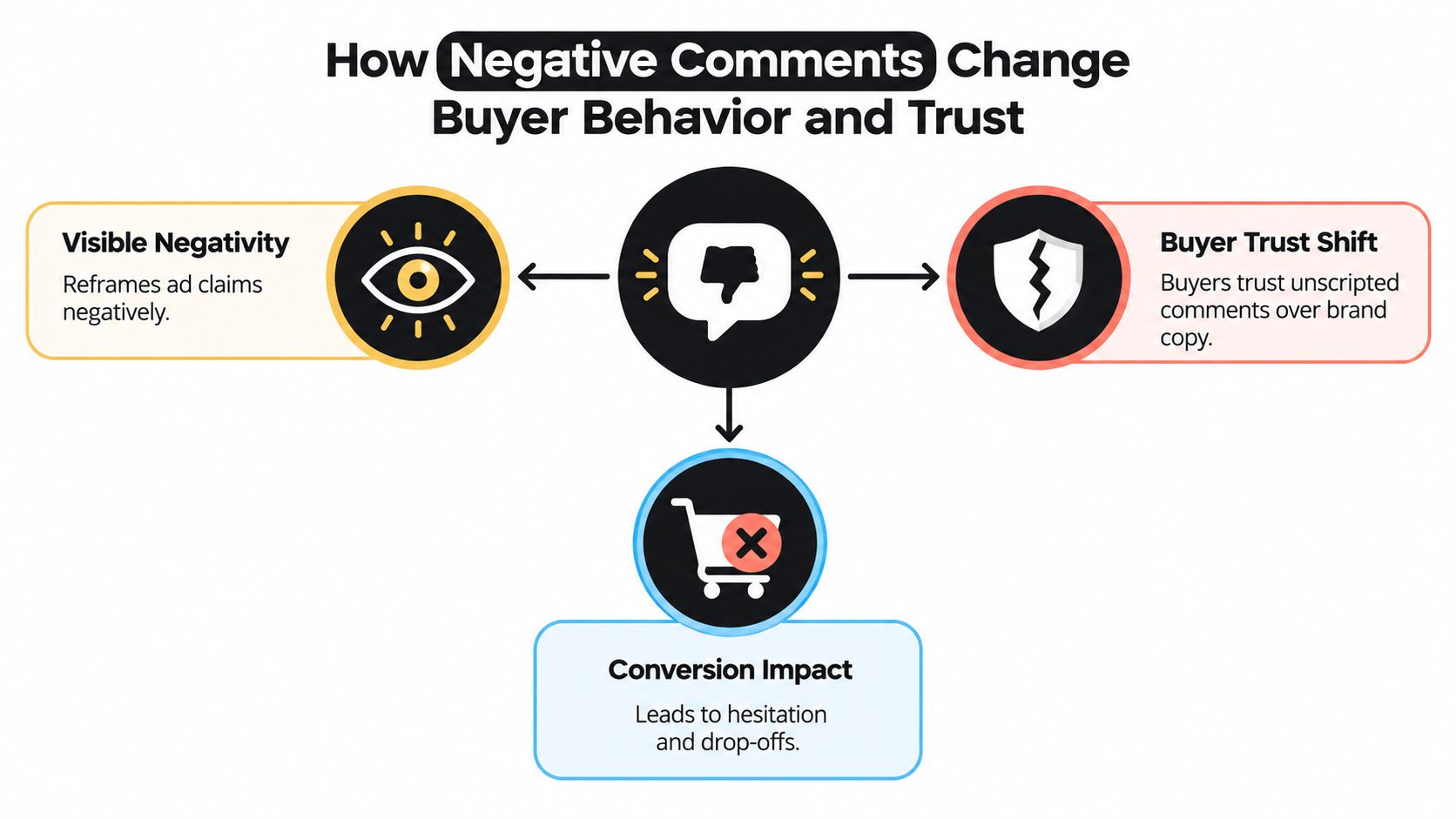
A diagram illustrating how negative comments on social media ads negatively influence buyer behavior and brand trust.

Trust drops before conversion drops

Academic and survey evidence lines this up clearly. One Facebook-based study coded 703 comments on a Lloyds Bank anniversary ad as positive, negative, or neutral, showing that comment sections can be analyzed systematically. Separate research from Pennsylvania State University found that negative user-generated Facebook posts significantly reduced trust, commitment, perceived corporate social responsibility, and reputation. The same evidence set also notes that nearly three-quarters of respondents read comments on social media ads, and more than half were less likely to purchase after seeing negative comments. You can review that evidence in the Facebook comment research summary and underlying paper.

That's the part many ad accounts miss. Comment sentiment doesn't just affect mood. It affects buying intent.

More engagement can still mean worse performance

Teams get fooled by surface metrics.

Independent research from Wharton found that showing any comments increased total engagement by 13.4% relative to control, and opposing comments generated significantly more interactions and link clicks than supportive comments. But related research summarized by Columbia notes that negative comment sections can also make consumers less likely to purchase from or donate to the organization behind the post. The paper is worth reading if you want the full mechanism behind curiosity clicks versus purchase behavior in Wharton's research on comment effects.

That means a noisy thread can inflate the numbers you feel good about while weakening the numbers that pay the bills.

Use a better performance lens

When I review paid social comments operationally, I split outcomes into two paths:

  • Attention path: More comments, more reactions, more curiosity clicks.

  • Trust path: More hesitation, more skepticism, lower purchase intent.

If you only watch CTR, a toxic thread can look healthy. If you pair comment quality with CVR and ROAS, the damage becomes obvious faster.

For teams that want a sharper lens on intent signals, this breakdown of buying intent from social engagement is useful. The main point is simple. Not every interaction deserves the same value. A comment thread full of conflict can drive motion without driving sales.

Public objections are like a product shelf tag someone else wrote. Buyers read it before they believe your copy.

The Hidden Tax on Ad Spend and Performance

Spend rarely gets wasted in one dramatic moment. It leaks. A thread picks up overnight. Spam lands first. Real objections go unanswered. By the time the team checks performance in the morning, the ad has already served into a worse environment.

That's the hidden tax.

A recent first-party analysis cited in trade coverage reviewed 118.4 million comments from 734,500 posts across more than 450 brands on Meta, TikTok, and YouTube during January through December 2024. It found that nearly 30% of Meta Ads comments were hidden because of spam or toxicity, 57.5% of all hidden comments in 2024 were spam, 23% of people said they had interacted with spam before realizing it, and AI-generated spam increased 25% year over year. The trade coverage and analysis are summarized in this review of negative comments and spam on ads.

That's not a niche moderation issue. It's an operating condition.
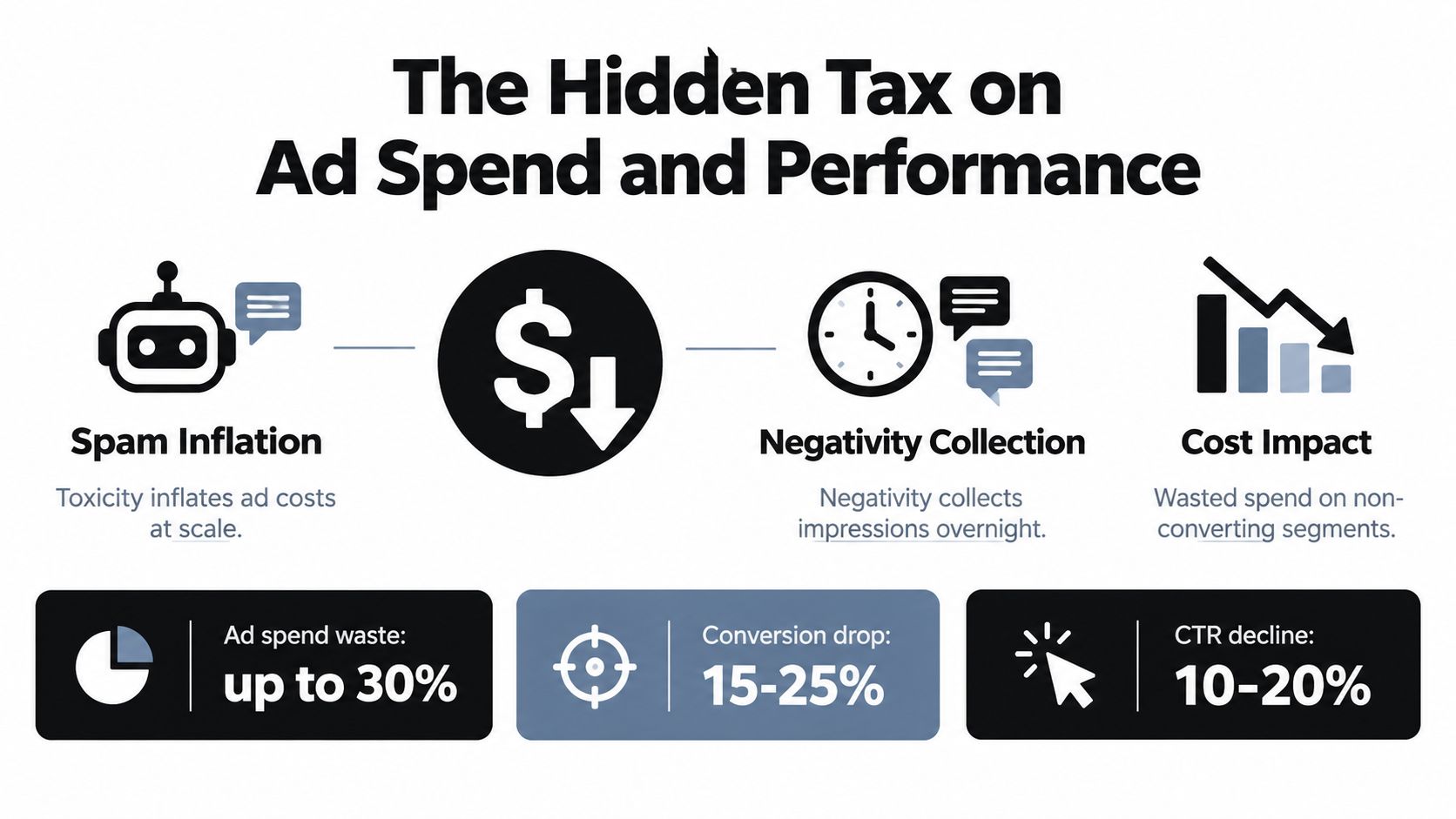
An infographic detailing the negative impact of bot spam and toxicity on ad spend and performance metrics.

Why protected spend performs differently

A lot of advertisers describe creative fatigue too early. Sometimes the ad didn't fatigue. The thread degraded.

The ad starts with clean social proof. Then the comment stack fills with:

  • Spam offers: Fake support, fake discounts, or scam links

  • Bad-faith attacks: Drive-by negativity with no intent to resolve anything

  • Unanswered objections: Real product questions that should've been handled fast

  • Competitor bait: Comments designed to pull attention away from the offer

Once that happens, each new impression has more friction attached to it.

Moderation changes media efficiency, not just optics

The strongest causal evidence matters. A Harvard field-experiment paper reported that across six studies, including two large-scale field experiments on Facebook and four online experiments, hiding harmful comments increased click-to-registration rate by 16% and return on ad spend by 48% versus otherwise identical unmoderated campaigns. The paper also found the effect was mediated by perceived brand trust, not just reduced exposure to negativity. You can read the study in the Harvard Business School field experiment on automated comment moderation.

That should change how performance teams work. If media, targeting, and creative stay constant but moderation still moves outcomes, then comments belong inside optimization.

Operator takeaway: A hostile thread can raise effective acquisition cost even when your ad settings stay the same.

For a broader paid-social process view, this Facebook ad optimization playbook is a helpful companion because it puts comment quality in the same frame as offer, creative, and account structure. The missing habit on many teams is measuring comment environment alongside auction and conversion data.

If you want one phrase to keep in mind, it's this: negativity is a tax on your ad spend. It doesn't always kill scale. But it makes scale more expensive than it should be.

Hide Reply or Escalate A Decision Framework That Protects ROAS

Blanket rules fail here. “Hide everything negative” makes brands look defensive. “Reply to every comment” burns team time and leaves obvious junk visible too long.

The better system is triage. Sort comments by whether they deserve visibility, response, or support action.

The decision matrix

Comment Type

Action

Why It Protects Performance

Spam links, fake giveaways, impersonation, scam support replies

Hide

Removes distractions and obvious risk before buyers engage with the wrong thing

Profanity, hate, abuse, repeated trolling

Hide

Keeps the ad readable and stops bad-faith comments from shaping first impression

Product questions, shipping questions, sizing, ingredients, “does this work for me?”

Reply

Turns public objections into public proof and helps future readers

“Too expensive,” “is this legit,” “why should I trust this?”

Reply

Addresses buying friction where purchase intent is still present

Actual order issues, damaged item, billing problem, missing package

Escalate

Protects the ad thread from unresolved support disputes and routes the case to the right team

Legal, compliance, safety, or sensitive medical claims

Escalate

Avoids casual public handling of comments that need review

What should be hidden fast

Hide comments when the thread gets worse by leaving them visible.

That includes spam, scams, impersonation, fake promo codes, abusive attacks, and repetitive bait. These comments don't create credibility. They create clutter and risk. On high-spend ads, I'd rather hide them immediately than workshop a “transparent” public response to nonsense.

What deserves a public reply

A skeptical buyer is still a buyer if the question is real.

Comments about price, product fit, shipping speed, ingredients, results timeline, returns, or trust can do useful work in public. The right reply helps the person asking and everyone reading. If the objection is common, a public answer is an asset.

Good replies are short. They answer the question. They don't sound defensive.

Examples:

  • Price objection: “Fair question. The price includes the full kit, not just the base item. If you want the best fit, check the size guide in the link above and we can help with specifics here.”

  • Legitimacy objection: “Yes, this is the official page. If you have a question about checkout, shipping, or returns, ask it here and we'll answer directly.”

  • Fit objection: “Tell us your use case and we'll point you to the right option.”

A team that wants better wording for difficult public replies can borrow principles from this Sift AI negative feedback response guide. The value isn't canned copy. It's the discipline of answering the issue without escalating tone.

What must be escalated

Some comments shouldn't stay in the ad thread because the ad thread isn't where they can be solved.

That includes order problems, refund disputes, account-specific complaints, and anything involving safety or compliance. Move these to support with context attached. Publicly, a short acknowledgment is enough if one is needed. Internally, the escalation needs owner, status, and SLA.

For Meta ad teams, this hide-or-reply moderation playbook is a good model to operationalize those choices. The key is consistency. Buyers notice when one comment gets a polished answer and the next gets ignored.

Building an Always On Moderation System for Meta and TikTok

A moderation policy is useless if no one executes it in the hours when comments pile up. The system has to work when the team is in meetings, asleep, or launching three campaigns at once.

The simplest version starts with platform-native habits.

Public guidance on Facebook ad comment management says advertisers can moderate comments through Ads Manager or Meta Business Suite, filter specifically for Ad comments, and should check them daily, especially in the first 48 hours after launch. The same guidance recommends hiding competitor spam immediately and pinning positive comments on high-spend ads. That workflow is outlined in this guide to Facebook comment management for advertisers.

TikTok also gives advertisers direct controls. Its ad products include comment management settings that let advertisers filter comments by advertiser-defined rules, hide unsuitable comments, turn comments off entirely, and analyze comments through a dashboard, as outlined in TikTok's ad comment management overview.
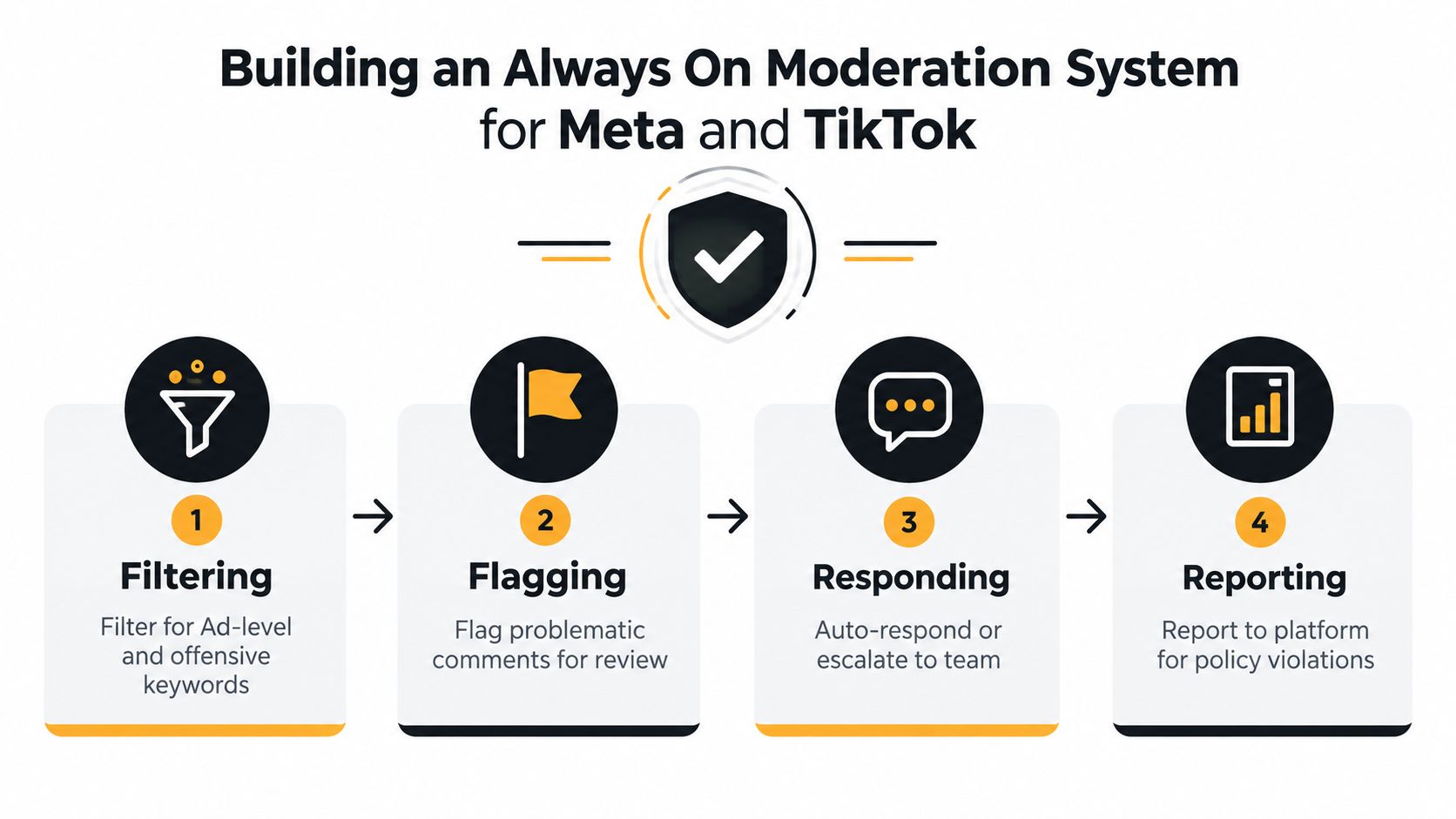
A four-step infographic showing an automated moderation system for managing comments on Meta and TikTok platforms.

A same-day workflow that actually works

Use this operating rhythm on active spend:

  1. Launch check Review comments within the first few hours of a new ad going live. Early threads shape later perception.

  2. Daily ad-comment pass Filter specifically for ad comments, not just page activity. Organic and paid don't need the same speed.

  3. Immediate hide rules Hide impersonation, fake offers, scam links, abusive content, and obvious competitor spam on sight.

  4. Public reply queue Answer recurring pre-purchase questions in public. Keep replies short and specific.

  5. Escalation lane Route order issues and sensitive cases into support with clear ownership.

  6. Pin proof when available On high-spend ads, pin strong positive comments or helpful buyer questions with useful answers.

Where automation earns its keep

Manual coverage breaks first on nights and weekends. Then it breaks on volume.

AI employees fit. They can monitor comments continuously, apply moderation rules, send approved brand-voice replies, and escalate edge cases into a human queue. One option in that category is Exerta, which supports Facebook, Instagram, TikTok, and website chat today, with SMS, email, and voice launching next. For teams that need comment moderation tied to revenue recovery, the value is simple: every action is logged, routed, and attributable instead of getting lost in a shared inbox.

If you spend enough to care about hourly media efficiency, you need hourly protection on the ad unit too.

Use the Messenger window for intent, not just support

Meta's Messenger policy gives businesses 24 hours to respond after a user's last qualifying action, and messages sent within that window may contain promotional content. The window reopens when the person interacts again, based on Meta's Messenger policy overview.

That creates a practical move for same-day operators. When a comment clearly signals buying intent, reply fast, move the person into Messenger, send the link or offer while the window is open, and hand off to checkout or a human if needed. Done well, comment moderation stops being defensive work and starts feeding revenue directly.

Turning Objections Into Sales With Brand Voice Replies

The best reply isn't the one that wins an argument. It's the one that removes friction for the next buyer reading the thread.

That's why objection handling in comments should sound like sales enablement, not customer service theater. Keep it short. Keep it calm. Answer what matters.

A woman using a laptop to respond to a customer comment on social media about discounts.

Reply patterns that help conversion

For DTC and ecommerce, three public objections show up constantly.

  • Price pressure “Do you ever run discounts?”

    Reply: “We do run offers at times. If you want the current option, send us a message and we'll point you to the best available one.”

  • Trust check “Is this site legit?”

    Reply: “Yes. This is the official page. If you want details on shipping, returns, or product fit, ask here and we'll answer directly.”

  • Fit question “Would this work for sensitive skin?” or “Will this fit a small apartment?”

    Reply: “Tell us a bit about your situation and we'll recommend the best option.”

For lead-gen teams, replace product fit with qualification. For agencies handling client pages, keep the structure but align tone to each brand.

Turn public intent into a private close

The move missed after a positive signal is speed.

If someone asks where to buy, whether there's a bundle, or if there's a first-order offer, don't leave that sitting in comments for hours. Reply publicly so the thread helps other readers, then move the buyer into a direct path to purchase. That can mean a checkout link, a booking link, or a support handoff with context already attached.

Useful systems also keep replies consistent across Facebook, Instagram, TikTok, and website chat so buyers don't get one answer publicly and a different answer privately.

Brand voice matters because the thread is permanent

Every public reply becomes sales copy for future readers. If the tone is stiff, robotic, or too promotional, people notice. If it's clear and human, it adds confidence.

A simple rule helps. Write replies the way your best salesperson would answer in a store aisle. Short. Specific. No speechmaking.

If you need examples to tighten tone without sounding canned, these brand voice examples are a useful reference point for building response templates that still sound natural.

Conclusion Measure What Moderation Earns and Scale What Works

If you treat comment moderation like cleanup, you'll measure it with vanity outcomes. Hidden comments. Response count. Inbox zero. Those are operational stats, not business answers.

Measure moderation the same way you measure any performance lever. Look at what happened to CTR, CVR, and ROAS after the thread was protected. Track which replies led to clicks, DMs, or purchases. Separate spam removal from objection handling from support escalations so you can see which work changes outcomes.

What to track each week

A practical review stack looks like this:

  • Action volume: How many comments were hidden, replied to, or escalated

  • Sentiment by ad: Which ads attract healthy product questions versus junk or hostility

  • Recovered revenue: Which public replies and follow-ups led to sales

  • Channel differences: Where Facebook, Instagram, TikTok, and website chat need different rules

  • Speed to action: Whether buyer-intent comments were answered while they still mattered

If your stack supports attribution into commerce data, even better. Then moderation stops being “soft” work and becomes measurable revenue protection and recovery.

A seven-day reset for teams with messy ad threads

If your current system is reactive, clean it up this week:

  1. Audit the highest-spend ads first.

  2. Write hide rules for spam, scams, impersonation, and abuse.

  3. Publish short reply templates for price, legitimacy, fit, shipping, and returns.

  4. Create one escalation path to support with ownership.

  5. Review attribution so replies and recovered purchases aren't invisible.

  6. Compare protected threads versus unmanaged threads before changing budget decisions.

  7. Expand coverage where the data shows comment quality is affecting performance.

The big advantage comes from consistency. A team that protects every ad thread the same way doesn't just avoid public mess. It gets cleaner performance data, stronger public proof, and fewer avoidable leaks in the funnel.

Negative comments on Facebook ads aren't only a brand problem. They're a media-efficiency problem. Teams that handle them like operators usually spend better.

Exerta deploys AI employees that moderate comments, reply in brand voice, escalate real issues, and recover revenue across Facebook, Instagram, TikTok, and website chat. If you want comment management tied to performance instead of a manual cleanup queue, visit Exerta.

Get started today

Stop losing sales you already paid for.

Connect your channels in about a minute. Your AI employees start answering, moderating and closing the same day.

No credit card required

Live in under 5 minutes

250+ brands running

Cancel anytime

Get started today

Stop losing sales you already paid for.

Connect your channels in about a minute. Your AI employees start answering, moderating and closing the same day.

No credit card required

Live in under 5 minutes

250+ brands running

Cancel anytime

Get started today

Stop losing sales you already paid for.

Connect your channels in about a minute. Your AI employees start answering, moderating and closing the same day.

No credit card required

Live in under 5 minutes

250+ brands running

Cancel anytime

AI employees that answer every buyer, protect your ad spend and close sales around the clock.

All systems operational · 99.98% uptime last 90 days

SOC 2

Type II

GDPR

Compliant

99.9% SLA

Uptime

24/7

Support

1. Pricing and billing All prices displayed on exerta.ai are in US dollars and exclude applicable taxes unless stated otherwise. Prices are subject to change. Existing subscribers will receive at least 30 days’ written notice before any price increase takes effect on their account. Annual plan savings are calculated by comparing the annual billing rate to the equivalent monthly billing rate multiplied by 12.

2. Run and usage statisticsRevenue, engagement and success figures are based on aggregated platform data and customer-reported results across 250+ brands, and are updated periodically.

3. Time-to-value claims Statements such as “live in about a minute” reflect typical setup times observed for new accounts connecting through Meta Business Manager. Actual setup time may vary with the number of channels connected and the level of agent customization.

4. AI step suggestions Exerta’s AI features are powered by a blend of leading AI models, anchored by our own fine-tuned engagement model. Suggestion quality, accuracy and availability may vary. Exerta does not guarantee that AI-generated output will be accurate, complete or suitable for any particular use case. Review AI output before acting on it.

5. Integration availability The number of native integrations referenced on this website reflects integrations available at the time of last update. Integration availability may vary by subscription plan. Third-party integrations are subject to the terms, availability and API limitations of the respective third-party providers. Exerta does not guarantee the continued availability of any specific integration and is not responsible for disruptions caused by changes to third-party APIs or services.

6. Uptime and SLA The 99.9% uptime figure refers to our published Service Level Agreement (SLA) target for paid plan customers. Actual uptime may vary. Historical uptime statistics are available upon request.

7. Security and compliance certifications Exerta’s SOC 2 Type II (coming soon) certification covers the security, availability, processing integrity, confidentiality and privacy trust service criteria. GDPR compliance reflects our internal data protection practices and contractual commitments. HIPAA compliance is available exclusively on Enterprise plans and requires execution of a Business Associate Agreement (BAA). ISO 27001 certification is currently in progress. Compliance certifications are subject to annual renewal and audit. Copies of our most recent compliance reports are available to Enterprise customers under NDA upon request.

8. Customer testimonials and case studies Testimonials, quotes and case study results featured on this website reflect the experiences of individual customers. Results vary with ad spend, engagement volume, offer and configuration. Exerta does not guarantee that any customer will achieve similar results.

9. Third-party service marks and logos All third-party brand names, logos and service marks referenced on this website — including but not limited to Meta, Facebook, Instagram, TikTok, Shopify and Trustpilot — are the property of their respective owners. References to these services do not imply endorsement, sponsorship or affiliation.

10. Free plan limitations The Free plan does not require a credit card. Free plan usage is subject to the limits described on our pricing page, including a limited number of AI actions per month and comment hiding with stock replies only. Exerta reserves the right to modify the features and limits of the Free plan at any time.

11. Trial periods Free trial periods are available on paid plans as described at the time of signup. At the end of the trial period, the selected payment method will be charged at the applicable plan rate unless the subscription is cancelled before the trial expires. Trial periods are available once per customer and may not be combined with other promotional offers.

12. Data processing and privacy Exerta processes personal data in accordance with our Privacy Policy and Data Processing Agreement. Data residency options (US and EU) are available on all paid plans. The data residency region is selected at account creation and cannot be changed without contacting our support team. Customers responsible for processing personal data of EEA or UK residents are advised to execute our standard Data Processing Agreement, available at exerta.ai/legal/dpa.

13. Activity history retention Activity history is retained for 90 days on the Starter plan and for longer periods on larger plans, as described at signup. Exported data is the responsibility of the customer once downloaded.

14. AI model providers Exerta uses a blend of leading AI models together with our own fine-tuned engagement model, specialized for customer engagement. Model composition may change as we improve the product.

15. Mobile and desktop applications Exerta is available in the browser on desktop and mobile. Certain advanced configuration features are easiest on desktop. Application updates are released on a rolling basis.

16. Template library Prebuilt agent setups provided by Exerta are starting points and are not guaranteed to be suitable for any particular purpose. Customers are responsible for reviewing and testing agent behavior before enabling it on live channels.

17. Website content accuracy The information on this website is provided for general informational purposes only and is subject to change without notice. While we make every effort to keep the content accurate and up to date, Exerta makes no warranties or representations, express or implied, about the completeness, accuracy, reliability or suitability of the information contained on this website for any particular purpose.

18. Promotional offers and discounts Promotional pricing, discounts and special offers are subject to additional terms and conditions communicated at the time of the offer. Offers cannot be applied retroactively to existing subscriptions and may not be combined with other promotions unless explicitly stated. Exerta reserves the right to modify or discontinue promotional offers at any time.

19. Startup and non-profit programs Eligibility for our startup and non-profit discount programs is assessed at Exerta’s sole discretion based on the criteria described in our support documentation. Approved discounts apply to the base subscription price only and do not apply to add-ons, Enterprise features or professional services. Discount eligibility is subject to annual review.

20. Intellectual property This website is operated by Reascend LLC (d/b/a Exerta), a limited liability company formed in the State of Delaware, United States. References to “we”, “us” and “our” throughout this website refer to Reascend LLC (d/b/a Exerta). The use of this website and our Services is governed by the laws of the State of Delaware, United States, as described in our Terms of Service.

21. Accessibility Exerta is committed to making its website and application accessible to all users, including those with disabilities. We aim to conform to the Web Content Accessibility Guidelines (WCAG) 2.1 at Level AA. If you experience any accessibility barriers, please contact us at accessibility@exerta.ai and we will make every effort to provide an accessible alternative.

22. Governing jurisdiction This website is operated by Reascend LLC (d/b/a Exerta), a limited liability company formed in the State of Delaware, United States. References to “we”, “us” and “our” throughout this website refer to Reascend LLC (d/b/a Exerta). The use of this website and our Services is governed by the laws of the State of Delaware, United States, as described in our Terms of Service.

AI employees that answer every buyer, protect your ad spend and close sales around the clock.

All systems operational · 99.98% uptime last 90 days

SOC 2

Type II

GDPR

Compliant

99.9% SLA

Uptime

24/7

Support

1. Pricing and billing All prices displayed on exerta.ai are in US dollars and exclude applicable taxes unless stated otherwise. Prices are subject to change. Existing subscribers will receive at least 30 days’ written notice before any price increase takes effect on their account. Annual plan savings are calculated by comparing the annual billing rate to the equivalent monthly billing rate multiplied by 12.

2. Run and usage statisticsRevenue, engagement and success figures are based on aggregated platform data and customer-reported results across 250+ brands, and are updated periodically.

3. Time-to-value claims Statements such as “live in about a minute” reflect typical setup times observed for new accounts connecting through Meta Business Manager. Actual setup time may vary with the number of channels connected and the level of agent customization.

4. AI step suggestions Exerta’s AI features are powered by a blend of leading AI models, anchored by our own fine-tuned engagement model. Suggestion quality, accuracy and availability may vary. Exerta does not guarantee that AI-generated output will be accurate, complete or suitable for any particular use case. Review AI output before acting on it.

5. Integration availability The number of native integrations referenced on this website reflects integrations available at the time of last update. Integration availability may vary by subscription plan. Third-party integrations are subject to the terms, availability and API limitations of the respective third-party providers. Exerta does not guarantee the continued availability of any specific integration and is not responsible for disruptions caused by changes to third-party APIs or services.

6. Uptime and SLA The 99.9% uptime figure refers to our published Service Level Agreement (SLA) target for paid plan customers. Actual uptime may vary. Historical uptime statistics are available upon request.

7. Security and compliance certifications Exerta’s SOC 2 Type II (coming soon) certification covers the security, availability, processing integrity, confidentiality and privacy trust service criteria. GDPR compliance reflects our internal data protection practices and contractual commitments. HIPAA compliance is available exclusively on Enterprise plans and requires execution of a Business Associate Agreement (BAA). ISO 27001 certification is currently in progress. Compliance certifications are subject to annual renewal and audit. Copies of our most recent compliance reports are available to Enterprise customers under NDA upon request.

8. Customer testimonials and case studies Testimonials, quotes and case study results featured on this website reflect the experiences of individual customers. Results vary with ad spend, engagement volume, offer and configuration. Exerta does not guarantee that any customer will achieve similar results.

9. Third-party service marks and logos All third-party brand names, logos and service marks referenced on this website — including but not limited to Meta, Facebook, Instagram, TikTok, Shopify and Trustpilot — are the property of their respective owners. References to these services do not imply endorsement, sponsorship or affiliation.

10. Free plan limitations The Free plan does not require a credit card. Free plan usage is subject to the limits described on our pricing page, including a limited number of AI actions per month and comment hiding with stock replies only. Exerta reserves the right to modify the features and limits of the Free plan at any time.

11. Trial periods Free trial periods are available on paid plans as described at the time of signup. At the end of the trial period, the selected payment method will be charged at the applicable plan rate unless the subscription is cancelled before the trial expires. Trial periods are available once per customer and may not be combined with other promotional offers.

12. Data processing and privacy Exerta processes personal data in accordance with our Privacy Policy and Data Processing Agreement. Data residency options (US and EU) are available on all paid plans. The data residency region is selected at account creation and cannot be changed without contacting our support team. Customers responsible for processing personal data of EEA or UK residents are advised to execute our standard Data Processing Agreement, available at exerta.ai/legal/dpa.

13. Activity history retention Activity history is retained for 90 days on the Starter plan and for longer periods on larger plans, as described at signup. Exported data is the responsibility of the customer once downloaded.

14. AI model providers Exerta uses a blend of leading AI models together with our own fine-tuned engagement model, specialized for customer engagement. Model composition may change as we improve the product.

15. Mobile and desktop applications Exerta is available in the browser on desktop and mobile. Certain advanced configuration features are easiest on desktop. Application updates are released on a rolling basis.

16. Template library Prebuilt agent setups provided by Exerta are starting points and are not guaranteed to be suitable for any particular purpose. Customers are responsible for reviewing and testing agent behavior before enabling it on live channels.

17. Website content accuracy The information on this website is provided for general informational purposes only and is subject to change without notice. While we make every effort to keep the content accurate and up to date, Exerta makes no warranties or representations, express or implied, about the completeness, accuracy, reliability or suitability of the information contained on this website for any particular purpose.

18. Promotional offers and discounts Promotional pricing, discounts and special offers are subject to additional terms and conditions communicated at the time of the offer. Offers cannot be applied retroactively to existing subscriptions and may not be combined with other promotions unless explicitly stated. Exerta reserves the right to modify or discontinue promotional offers at any time.

19. Startup and non-profit programs Eligibility for our startup and non-profit discount programs is assessed at Exerta’s sole discretion based on the criteria described in our support documentation. Approved discounts apply to the base subscription price only and do not apply to add-ons, Enterprise features or professional services. Discount eligibility is subject to annual review.

20. Intellectual property This website is operated by Reascend LLC (d/b/a Exerta), a limited liability company formed in the State of Delaware, United States. References to “we”, “us” and “our” throughout this website refer to Reascend LLC (d/b/a Exerta). The use of this website and our Services is governed by the laws of the State of Delaware, United States, as described in our Terms of Service.

21. Accessibility Exerta is committed to making its website and application accessible to all users, including those with disabilities. We aim to conform to the Web Content Accessibility Guidelines (WCAG) 2.1 at Level AA. If you experience any accessibility barriers, please contact us at accessibility@exerta.ai and we will make every effort to provide an accessible alternative.

22. Governing jurisdiction This website is operated by Reascend LLC (d/b/a Exerta), a limited liability company formed in the State of Delaware, United States. References to “we”, “us” and “our” throughout this website refer to Reascend LLC (d/b/a Exerta). The use of this website and our Services is governed by the laws of the State of Delaware, United States, as described in our Terms of Service.

AI employees that answer every buyer, protect your ad spend and close sales around the clock.

All systems operational · 99.98% uptime last 90 days

SOC 2

Type II

GDPR

Compliant

99.9% SLA

Uptime

24/7

Support

1. Pricing and billing All prices displayed on exerta.ai are in US dollars and exclude applicable taxes unless stated otherwise. Prices are subject to change. Existing subscribers will receive at least 30 days’ written notice before any price increase takes effect on their account. Annual plan savings are calculated by comparing the annual billing rate to the equivalent monthly billing rate multiplied by 12.

2. Run and usage statisticsRevenue, engagement and success figures are based on aggregated platform data and customer-reported results across 250+ brands, and are updated periodically.

3. Time-to-value claims Statements such as “live in about a minute” reflect typical setup times observed for new accounts connecting through Meta Business Manager. Actual setup time may vary with the number of channels connected and the level of agent customization.

4. AI step suggestions Exerta’s AI features are powered by a blend of leading AI models, anchored by our own fine-tuned engagement model. Suggestion quality, accuracy and availability may vary. Exerta does not guarantee that AI-generated output will be accurate, complete or suitable for any particular use case. Review AI output before acting on it.

5. Integration availability The number of native integrations referenced on this website reflects integrations available at the time of last update. Integration availability may vary by subscription plan. Third-party integrations are subject to the terms, availability and API limitations of the respective third-party providers. Exerta does not guarantee the continued availability of any specific integration and is not responsible for disruptions caused by changes to third-party APIs or services.

6. Uptime and SLA The 99.9% uptime figure refers to our published Service Level Agreement (SLA) target for paid plan customers. Actual uptime may vary. Historical uptime statistics are available upon request.

7. Security and compliance certifications Exerta’s SOC 2 Type II (coming soon) certification covers the security, availability, processing integrity, confidentiality and privacy trust service criteria. GDPR compliance reflects our internal data protection practices and contractual commitments. HIPAA compliance is available exclusively on Enterprise plans and requires execution of a Business Associate Agreement (BAA). ISO 27001 certification is currently in progress. Compliance certifications are subject to annual renewal and audit. Copies of our most recent compliance reports are available to Enterprise customers under NDA upon request.

8. Customer testimonials and case studies Testimonials, quotes and case study results featured on this website reflect the experiences of individual customers. Results vary with ad spend, engagement volume, offer and configuration. Exerta does not guarantee that any customer will achieve similar results.

9. Third-party service marks and logos All third-party brand names, logos and service marks referenced on this website — including but not limited to Meta, Facebook, Instagram, TikTok, Shopify and Trustpilot — are the property of their respective owners. References to these services do not imply endorsement, sponsorship or affiliation.

10. Free plan limitations The Free plan does not require a credit card. Free plan usage is subject to the limits described on our pricing page, including a limited number of AI actions per month and comment hiding with stock replies only. Exerta reserves the right to modify the features and limits of the Free plan at any time.

11. Trial periods Free trial periods are available on paid plans as described at the time of signup. At the end of the trial period, the selected payment method will be charged at the applicable plan rate unless the subscription is cancelled before the trial expires. Trial periods are available once per customer and may not be combined with other promotional offers.

12. Data processing and privacy Exerta processes personal data in accordance with our Privacy Policy and Data Processing Agreement. Data residency options (US and EU) are available on all paid plans. The data residency region is selected at account creation and cannot be changed without contacting our support team. Customers responsible for processing personal data of EEA or UK residents are advised to execute our standard Data Processing Agreement, available at exerta.ai/legal/dpa.

13. Activity history retention Activity history is retained for 90 days on the Starter plan and for longer periods on larger plans, as described at signup. Exported data is the responsibility of the customer once downloaded.

14. AI model providers Exerta uses a blend of leading AI models together with our own fine-tuned engagement model, specialized for customer engagement. Model composition may change as we improve the product.

15. Mobile and desktop applications Exerta is available in the browser on desktop and mobile. Certain advanced configuration features are easiest on desktop. Application updates are released on a rolling basis.

16. Template library Prebuilt agent setups provided by Exerta are starting points and are not guaranteed to be suitable for any particular purpose. Customers are responsible for reviewing and testing agent behavior before enabling it on live channels.

17. Website content accuracy The information on this website is provided for general informational purposes only and is subject to change without notice. While we make every effort to keep the content accurate and up to date, Exerta makes no warranties or representations, express or implied, about the completeness, accuracy, reliability or suitability of the information contained on this website for any particular purpose.

18. Promotional offers and discounts Promotional pricing, discounts and special offers are subject to additional terms and conditions communicated at the time of the offer. Offers cannot be applied retroactively to existing subscriptions and may not be combined with other promotions unless explicitly stated. Exerta reserves the right to modify or discontinue promotional offers at any time.

19. Startup and non-profit programs Eligibility for our startup and non-profit discount programs is assessed at Exerta’s sole discretion based on the criteria described in our support documentation. Approved discounts apply to the base subscription price only and do not apply to add-ons, Enterprise features or professional services. Discount eligibility is subject to annual review.

20. Intellectual property All content on this website, including text, graphics, logos, icons, images, audio clips, digital downloads and software, is the property of Reascend LLC (d/b/a Exerta) or its content suppliers and is protected by applicable intellectual property laws. Exerta® is a registered trademark of Reascend LLC. Unauthorised reproduction, distribution or modification of any content from this website is prohibited without prior written consent.

21. Accessibility Exerta is committed to making its website and application accessible to all users, including those with disabilities. We aim to conform to the Web Content Accessibility Guidelines (WCAG) 2.1 at Level AA. If you experience any accessibility barriers, please contact us at accessibility@exerta.ai and we will make every effort to provide an accessible alternative.

22. Governing jurisdiction This website is operated by Reascend LLC (d/b/a Exerta), a limited liability company formed in the State of Delaware, United States. References to “we”, “us” and “our” throughout this website refer to Reascend LLC (d/b/a Exerta). The use of this website and our Services is governed by the laws of the State of Delaware, United States, as described in our Terms of Service.