Conversational Marketing Platforms That Recover Revenue
read
·

Someone's under your Meta ad after midnight asking whether there's a discount and whether the order will arrive before the weekend. Your campaign is running, the buyer is interested, and nobody's watching the inbox. By morning, your team can answer the question, but they can't assume the buyer is still ready to purchase.
A conversational marketing platform should help close that gap. Evaluate it as a revenue-recovery system, not a chat tool: can it answer accurately, protect the public conversation, help the shopper act, and show whether the intervention changed the outcome?
Table of Contents
Why Paid Social Conversations Cost You Sales
The unanswered discount request isn't just a support backlog. You've paid to attract someone who's now asking for a reason to proceed. Sending that person into an unattended queue leaves the commercial work unfinished.
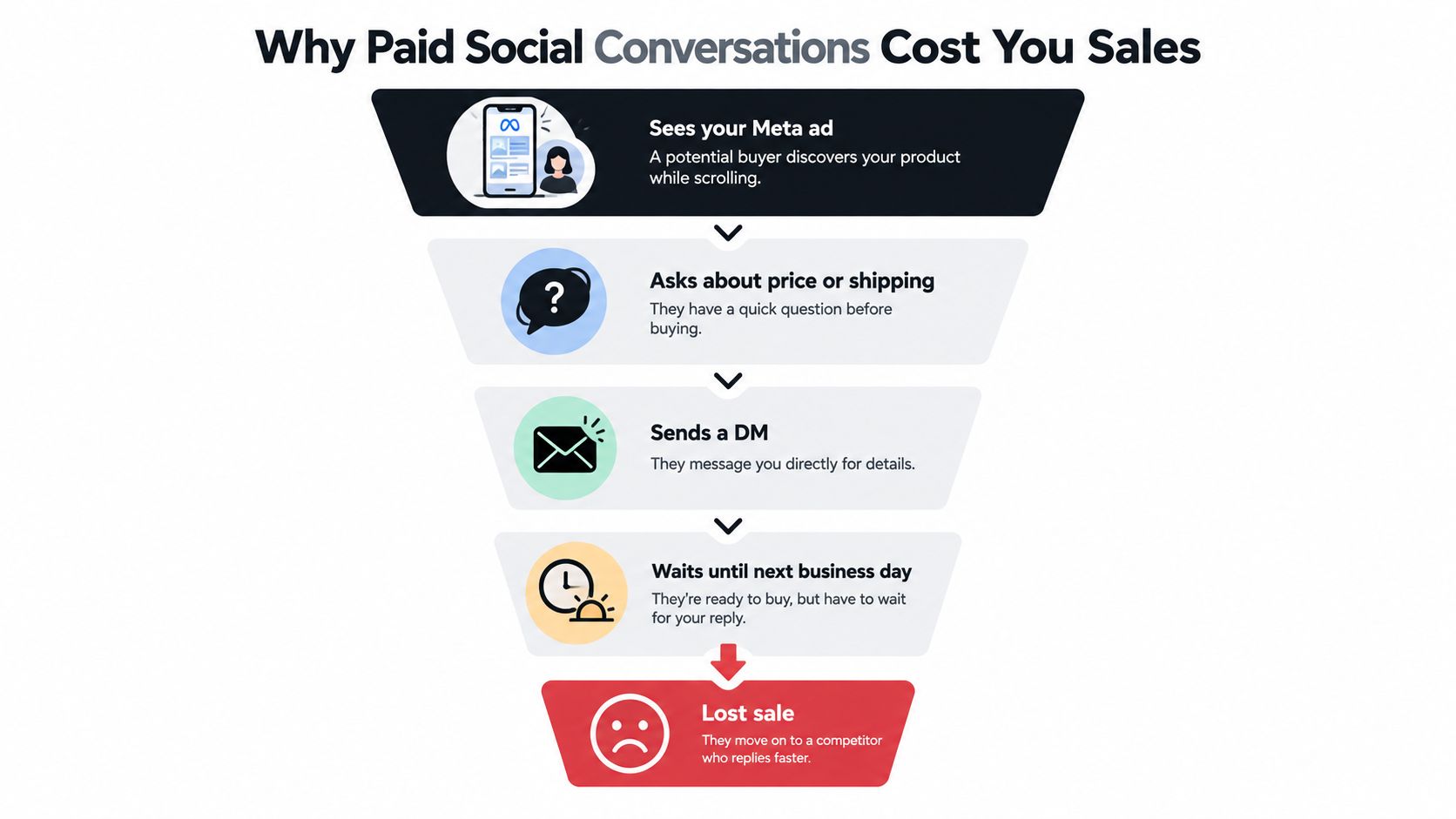
Consider a typical journey. A shopper asks about shipping under an Instagram ad, sends a DM with their location, then waits until the next business day. The eventual reply might be correct, but the shopper may have bought elsewhere or abandoned the idea entirely.
Treat Questions as Commercial Signals
A price question, delivery objection, and complaint shouldn't enter the same undifferentiated queue. Each needs a different response and a different owner.
Purchase questions: Answer from current product and policy information, then offer the relevant next step.
Service problems: Identify the order securely and route the issue to someone authorized to resolve it.
Harmful content: Apply moderation rules without confusing ordinary criticism with abuse.
For broader campaign planning, Wojo Media's 2026 social ads overview is a useful companion resource. Conversation handling belongs alongside creative, targeting, and landing-page decisions, rather than being assigned only after launch.
The operational challenge is coverage. Separate Facebook, Instagram, TikTok, and website queues can leave teams repeating work while missing urgent buying questions. A useful starting point is to distinguish buying intent from engagement, then assign actions to those signals.
Buying test: Does the platform help a shopper take a measurable next step, or does it merely produce another answered message?
What a Conversational Marketing Platform Does
Think of a capable store employee standing between the display and the till. They explain the product, clarify the offer, notice hesitation, and help the shopper finish. When a question exceeds their authority, they bring in the right colleague.
A conversational marketing platform should coordinate that same journey across digital channels. The conversation can begin under an advertisement, continue privately, reach checkout, and resume later without forcing the customer to explain everything again.

The Platform Is More Than the Reply
A standalone live-chat widget provides a place to talk. A basic autoresponder acknowledges the message. An underlying AI model generates language, but it doesn't independently establish the business rules, permissions, integrations, and accountability needed to operate a sales conversation.
The platform earns its place by coordinating those pieces:
Business knowledge: Approved prices, product details, promotions, delivery terms, and return policies.
Conversation context: What the shopper asked, what they've already been told, and what remains unresolved.
Permitted actions: Which links to send, which workflows to trigger, and which decisions require approval.
Outcome records: Whether the exchange produced a checkout visit, an order, a qualified lead, or a handoff.
The distinction matters during follow-up. A shopper who asked about sizing shouldn't receive the same message as someone disputing a charge. For a complementary view of planned onboarding communication, the Class A Media welcome flow provides a resource to consider alongside conversation-led journeys.
Test the Complete Journey
Ask a vendor to demonstrate a question becoming an action, not just a polished response. Have the shopper change their mind, introduce an exception, and request a person.
The platform should preserve context through those changes. If staff must copy messages between tools, reconstruct the offer, and manually identify the resulting order, the business still owns much of the coordination work.
The practical definition is coordination with accountability. Good language is necessary, but it isn't enough to make a collection of disconnected features a revenue-recovery system.
AI Employees Compared With Manual Teams and Bots
AI employees, support teams, scripted bots, and moderators perform different jobs. Comparing them only on response speed hides the trade-offs that matter during a live campaign.
A scripted bot can execute a narrow, predictable path. A trained employee can interpret an unusual complaint. An AI employee can handle varied routine questions, provided its knowledge and authority are constrained. Manual moderation gives people direct editorial control over public discussions.
Conversation Operations Compared
Approach | Best at | Core limitation | Revenue role |
|---|---|---|---|
AI employees | Handling repetitive purchase questions across supported channels | Can produce unsupported answers without grounding and controls | Resolve routine objections and initiate approved purchase actions |
Live chat or support teams | Judgment, exceptions, emotional situations, and disputes | Coverage depends on staffing and queue capacity | Save complex purchases and preserve customer relationships |
Simple scripted bots | Fixed questions, menus, and deterministic routing | Struggle when the request falls outside the designed path | Complete narrow qualification or navigation tasks |
Manual moderation | Interpreting context and reviewing sensitive public comments | Requires ongoing attention as activity changes | Keep legitimate discussion usable while addressing harmful content |
The right operating model is usually a division of responsibility, not a replacement exercise. Let AI employees absorb repetitive work while people retain authority over sensitive decisions.
Assign Authority Before Assigning Volume
Availability matters only if the answers are trustworthy. An immediate but incorrect delivery promise can create more work than a slower, accurate answer.
Automate routine explanations: Product specifications, published prices, and approved policy summaries are reasonable starting points.
Constrain commercial discretion: Discounts, refunds, and exceptions need explicit authorization.
Reserve judgment for people: Regulated advice, unusual complaints, threats, and ambiguous disputes should reach an accountable employee.
Preserve brand control: Review examples of actual replies, not just a tone-of-voice settings screen.
A useful comparison of chatbots and AI should inform the operating decision: how much variation must the system handle, and what happens when it can't?
Don't make automation rate the staffing plan. A system that escalates a difficult conversation correctly has done its job, even when it hasn't resolved the issue alone. Humans should spend less time repeating shipping policies and more time handling cases where judgment changes the outcome.
Core Capabilities That Drive Revenue
A paid-social reply earns its budget when it moves a shopper from public doubt to a private, trackable action. The commercial job is revenue recovery inside a conversation: capture the question, ground the answer, protect the thread, trigger the permitted next step, and record what happened.
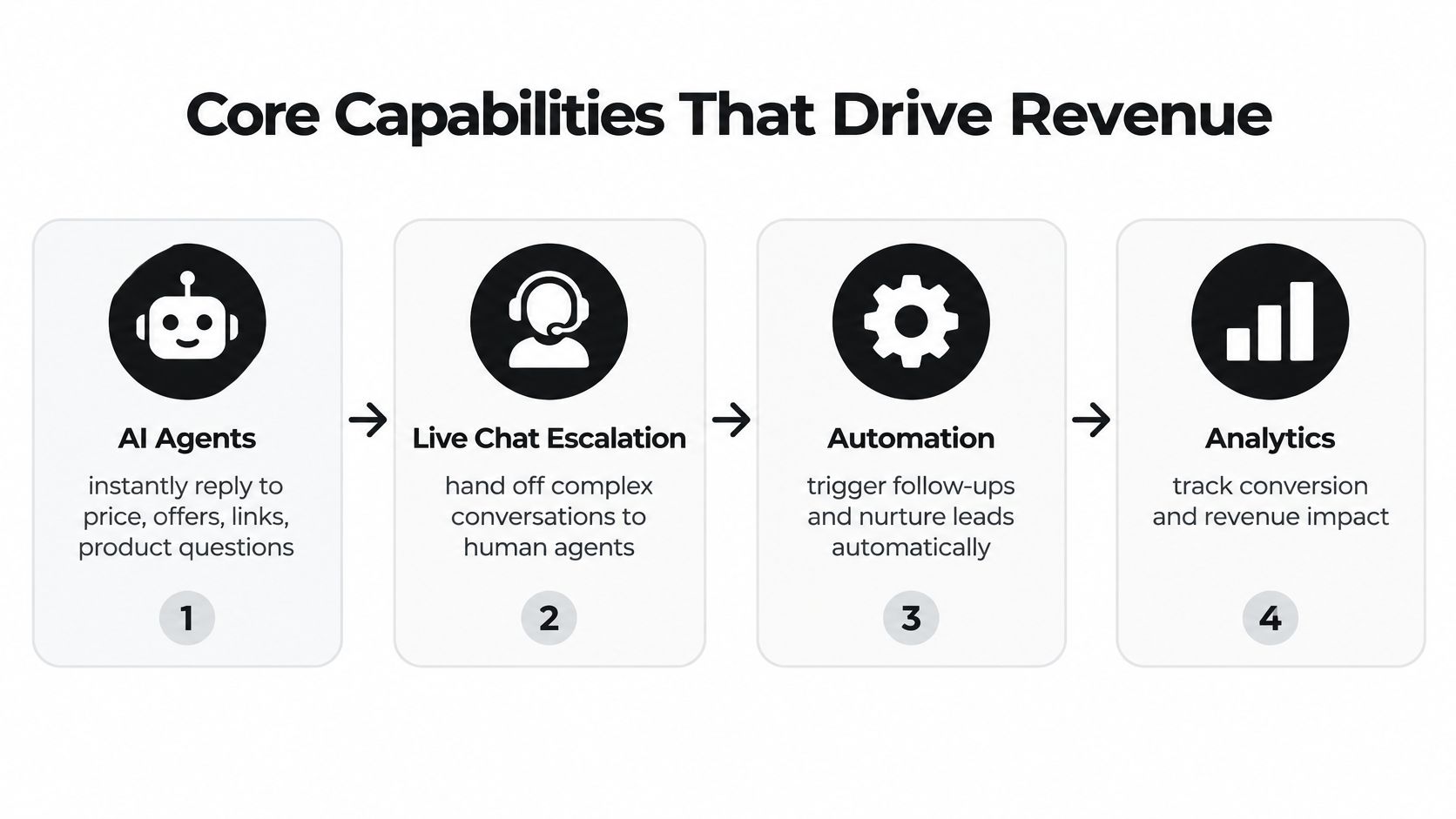
Weak setups stop at the first step and leave the order to manual follow-up.
Grounded answering comes first because speed only helps when the answer is allowed. For a discount request, the system should check the active offer, eligibility rules and approved purchase link, then explain what applies. It should refuse to improvise a promotion because the shopper sounds hesitant. Human access sits inside that same trust boundary: in research reported by Emplifi, 83% of surveyed consumers wanted disclosure when AI was being used, 60% worried about inaccurate AI answers, and 71% reported satisfaction with AI-supported customer care (Emplifi's AI customer-care findings).
A clean handoff preserves the work already done. The receiving employee should see the original comment, the evidence checked, the reply sent and the unresolved question, so the customer does not have to restart the story after the platform already collected the context.
Action logic has to match the obstacle. A delivery question needs shipping information. Payment uncertainty needs approved payment guidance. A price objection needs offer clarity, while a suspicious purchase link needs moderation. TikTok describes advertiser controls for filtering, hiding, disabling and analyzing comments, which supports a more deliberate response than blanket removal (TikTok's advertiser brand-safety guidance). Scams, threats and impersonation can be hidden under policy; ordinary criticism should reach someone who can answer it usefully.
Attribution closes the loop. The record should show trigger, response, approval status, checkout action, order event and handoff owner, because a media buyer has to separate a hidden scam from an answered objection and a true recovery attempt. In day-to-day operation, social media inbox management should make that ownership visible when a conversation stalls: automation, support, compliance or the shopper always has the next move.
Use Cases You Can Launch Today
Start with workflows your team can explain and audit. The following are implementation examples, not claims about completed customer results.
A Skincare Question Under a Meta Ad
A shopper asks what a Vitamin C serum costs and whether an advertised offer still applies. Configure the AI employee to answer from the approved product page and promotion rules, then offer a private continuation when appropriate.

Buying signal: A price or offer question.
Permitted response: Current price, valid offer conditions, and approved product information.
Next action: Send the relevant product or checkout link through an allowed channel.
Escalation condition: A reported reaction, medical question, or request for an unauthorized exception.
Recorded outcome: Link visit, checkout event, order, or human handoff.
A TikTok Campaign With Mixed Comments
Separate product objections from harmful content. A shopper saying the product seems expensive needs an explanation of the offer, not the same treatment as an impersonator posting a suspicious purchase link.
Use distinct moderation categories. TikTok identifies spam, harassment, hate speech, impersonation, and disclosure of another person's identifying information among prohibited or restricted behaviors (TikTok's Community Guidelines overview).
The next action might be a public answer, a hidden comment, or human review. Record the category and decision so the agency can inspect errors instead of relying on a single hidden-comment total.
A Shopper Hesitating at Checkout
Configure website chat around shipping costs, return terms, delivery estimates, and payment options. Answer the stated concern before offering any incentive.
Baymard places average global cart abandonment at approximately 70.19%, which makes checkout a substantial place to investigate friction, not proof that conversation alone will recover it (Baymard's checkout-usability research).
Use approved checkout links and record the resulting order when available. If you're planning follow-up, DM automation for abandoned-cart recovery belongs behind consent, channel permissions, and suppression rules.
Telehealth and Agency Boundaries
For telehealth, allow appointment logistics and approved contact information. Escalate diagnosis, treatment outcomes, and individual eligibility decisions rather than generating persuasive guesses. The FTC requires health advertising to be truthful and supported, including claims conveyed through testimonials (FTC health-products compliance guidance).
For insurance, Medicare, or solar lead generation, capture only approved qualification information and route consequential decisions to authorized staff. Record a qualified lead or booked consultation, not merely a completed chat.
Agencies should separate client knowledge, permissions, approvals, and reporting. A policy change for one account must never become an answer for another.
Prove Incremental Revenue and Guardrails
A shopper asks whether a jacket runs small, gets an answer, and buys twenty minutes later. The dashboard records a recovered sale. The shopper may have planned to buy anyway, which means the report describes timing rather than causation.
Set the measurement rules before launch. Teams that define attribution after seeing early results tend to keep whichever number looks best.
Four terms belong in every performance report:
Assisted revenue: revenue associated with an eligible conversation. Association alone doesn't establish causation.
Recovery-associated revenue: revenue following a documented interruption and intervention. The shopper might have returned without help.
Incremental revenue: additional revenue measured against a comparable control group.
Incremental profit: contribution remaining after discounts, software costs, and human review time.
Define eligibility per workflow. A shipping question during checkout qualifies; an unrelated reaction to an ad does not.
Attach each intervention record to the campaign, traffic source, product category, checkout activity, and the resulting order or lead ID. For implementation context, the SourceLoop guide to set up Intercom chat conversions walks through the instrumentation. Sending a conversion event is plumbing, not proof of lift.
Use a Credible Baseline
Randomized routing or a holdout group estimates what would have happened without the intervention. Keep treatment and comparison groups commercially comparable, and document differences in offers, staffing, and traffic.
Separate event matching from causal measurement when you build conversion attribution reporting. Reconcile orders with cancellations, refunds, and delayed conversions before drawing budget conclusions.
Guardrails belong in the same dashboard as sales. Track unsupported claims and incorrect links under answer quality; complaints, refunds, and unresolved escalations under customer outcomes; contribution after discounts and review time under economics; and missing events, duplicate orders, and contaminated groups under test integrity.
A smaller attributed number with defensible measurement beats a larger one nobody can explain.
Choose the system that improves campaign economics under those controls. Conversation volume measures workload, not profit.
Evaluate and Select a Platform
In one evaluation I sat through, the platform recovered an abandoned checkout in under a minute. When we fed the same system a real complaint thread, it offered a refund policy that did not exist. Demos follow the vendor's strongest path, so bring your hardest conversations instead.
Pull anonymized transcripts from your own inbox: a price question, a discount push, a harmful comment on a paid ad, an angry customer, a policy edge case, and a checkout that stalled halfway. Ask the vendor to run each one live and show the response, the source it pulled from, the action it took, and the record it wrote.
Make them show the log. A polished reply with no audit trail behind it is a liability.
Score the mandatory gates before any convenience features. If the system cannot ground answers in approved sources or keep data access under your control, a nicer dashboard does not compensate.
Priority | Evaluation area | Evidence to request |
|---|---|---|
Mandatory | Accuracy and permissions | Answers grounded in approved sources, with action limits |
Mandatory | Escalation and privacy | Handoff behavior, access controls, retention settings |
Highest weight | Commercial workflow fit | Demonstration using your purchase obstacles |
High weight | Attribution and auditability | Exportable intervention records and order matching |
High weight | Channel coverage and reliability | Supported actions, failure handling, outage procedures |
Supporting weight | Setup, support, and total cost | Configuration effort, service scope, usage charges |
Set the weights before the sales calls, because every platform looks good on its own script. An agency running separate client workspaces will weight isolation heavily. A DTC team puts catalog accuracy and checkout context first.
Failure handling tells you more than happy-path performance. Ask what happens when a promotion expires, the catalog contradicts the knowledge base, or a product sells out mid-thread. The right answer is pause, clarify, or escalate. Confident improvisation is a disqualifier.
Then test the system directly in a bounded pilot:
Does it acknowledge a frustrated customer without inventing promises?
Can it tell a prospective buyer from someone chasing a refund on an existing order?
Where do failed actions, missing integrations, and unresolved handoffs land, and who owns them?
Can your operator change policies and workflows without a developer?
Does the quoted price cover review time, configuration, integration work, and support?
Judge response quality and staff workload before reading anything into revenue.
Agree on stop conditions before go-live. Unsupported health claims, repeated wrong offers, or broken checkout links trigger intervention even when the aggregate dashboard looks healthy. Expand coverage only after the system clears both the commercial and the operational bar.
Make the Final Decision With Confidence
A DTC team losing purchase questions after hours has a different requirement from an agency managing sensitive complaints across client accounts. Weight your shortlist toward the job costing you revenue today, then inspect how each system behaves under your rules. Channel counts and reply volume prove nothing about whether it can operate inside your approval boundaries.
Match the Platform to the Operating Model
Exerta is one option for teams evaluating AI employees across Facebook, Instagram, TikTok, and website chat. Its stated scope covers automated replies, moderation, sales-recovery workflows, and logged actions. SMS, email, and voice are planned channels rather than current coverage, so an operation that depends on texting needs a different answer right now.
The company reports adoption by more than 250 brands, a 15% average sales lift, more than $2 million in recovered revenue attributed in-product, and 99.9% uptime (company-reported figures, not independently verified). Treat those numbers as context for what the vendor claims the system can recover. Your own controlled evaluation decides what your account will achieve.
The honest comparison set includes manual coverage, a narrow scripted workflow, and automation paired with a specialist support team. Each arrangement carries a different cost and risk profile. The question is which one performs your priority jobs at a price your margins accept.
Approve the Launch on Paper
Before a broader rollout, get five commitments in writing:
Priority conversations: the purchase obstacles that go live first, named explicitly.
Approval boundaries: what automation may answer, send, change, and escalate.
Attribution wiring: conversation records reaching the order or lead outcome they influenced.
Baseline agreement: the comparison your team accepts as evidence of lift.
Expansion threshold: the error rate, customer outcome, and workload level that justify wider coverage.
A signed checklist forces the vendor relationship into specifics.
A demo can feel human and still be the wrong system. Confidence at this stage means your team can explain every action the platform took, defend the response to a customer or an executive, and show recovered revenue on a report your finance lead trusts.
Exerta offers AI employees for social and website conversations, with replies, moderation, and sales-recovery workflows tied to logged actions. Evaluate a pilot around your highest-intent conversations, approved response rules, and revenue measurement requirements.