Chatbot vs AI: Which System Actually Recovers Revenue

read

·

An article by

Most advice on chatbot vs AI starts with the wrong test: which system gives the more intelligent answer? For an advertiser, that's a weak buying criterion. The system that recovers a product question from a Meta comment, hides a scam reply before it damages trust, and follows a high-intent DM while the conversation is still open can create more value than one that writes a better paragraph.

Chatbots have existed for decades. ELIZA was created in 1966, and the category moved from rule-based programs through ALICE in the 1990s to large-language-model assistants. Facebook's decision to open Messenger to developers in 2016 helped trigger a wave of branded deployments, while the 2023 AI boom pushed the technology from a customer-service add-on into a major software category. The historical chatbot timeline makes that progression clear.

For DTC brands and agencies buying Meta and TikTok traffic, the current decision is more practical. Should you keep a scripted chatbot, add an AI employee, or run both? The answer depends on revenue recovery, moderation coverage, attribution, compliance, and how much manual work your team can absorb.

Table of Contents

Why Chatbot vs AI Is the Wrong Question for Advertisers

Chatbots and AI employees aren't interchangeable versions of the same product. A traditional chatbot follows a known path. An AI employee can interpret what a person means, consult approved information, decide which workflow applies, and take a permitted action.

That distinction matters under paid ads. A customer may ask, “Does this run small?” instead of using a trigger such as “sizing.” Another may write, “Still waiting, paid last week,” which requires order context rather than a shipping FAQ. A third may post a scam link under a campaign after the team has gone offline. A keyword bot can handle the exact phrases it was built for. It struggles when intent appears in unfamiliar language or when one thread combines sales, support, and moderation.

Performance rule: Don't judge the system by its best answer. Judge it by what happens to the comment, DM, or visitor it encounters at the worst time.

The revenue problem is easy to miss because ad dashboards usually show spend and conversion, not every unanswered conversation. If a buyer asks for price, shipping, fit, or a discount in a public thread and receives no useful reply, the brand loses a chance to move that person toward checkout. If a toxic reply remains visible beneath an ad, the comment section can change how later viewers assess the offer.

That's why unanswered ad comments can cost sales. The right system should connect the conversation to the campaign, record what it did, and show whether the interaction produced a sale, lead, escalation, or moderation action.

The same principle applies to agency WhatsApp automation strategies. Agencies shouldn't evaluate automation as a chat widget alone. They need repeatable rules for brand voice, approvals, escalation, account separation, and reporting across client workflows.

The market is also moving toward systems that complete workflows rather than answer questions. A 2026 forecast projects generative AI for customer-support automation and conversational agents to grow from USD 7.82 billion in 2025 to USD 34.12 billion by 2031. The market coverage behind that projection reflects a shift from static answers toward systems that can retrieve information, make decisions, and execute approved actions.

For advertisers, the comparison is therefore operational:

  • Revenue recovery: Can the system turn intent into a product, checkout, booking, or lead action?

  • Ad-spend protection: Can it detect spam, scams, harmful language, and repeated negativity?

  • Attribution: Can the team tie actions back to a campaign, creative, thread, and outcome?

  • Control: Can a human review high-risk cases before the system responds or acts?

How Rule-Based Chatbots and AI Employees Actually Work

A rule-based chatbot starts with a map created by a human. The map contains triggers, branches, canned replies, and fallback behavior. A marketer might create one path for “price,” another for “shipping,” and a button menu for “returns.” When a customer's wording matches the rule, the bot sends the assigned response.

That setup has a real advantage: predictability. A brand can approve every message in advance, limit the available actions, and make compliance review straightforward. It works well for narrow FAQs where customers use familiar language and the answer rarely changes.

The weakness appears in the edges. “Can I get this before Friday?” may mean shipping speed, delivery availability, or urgency around an event. “You charged me twice” isn't a general billing question if the system needs to inspect an order. “Is this safe for me?” may require an escalation rather than a confident answer, especially in healthcare or insurance-related workflows.
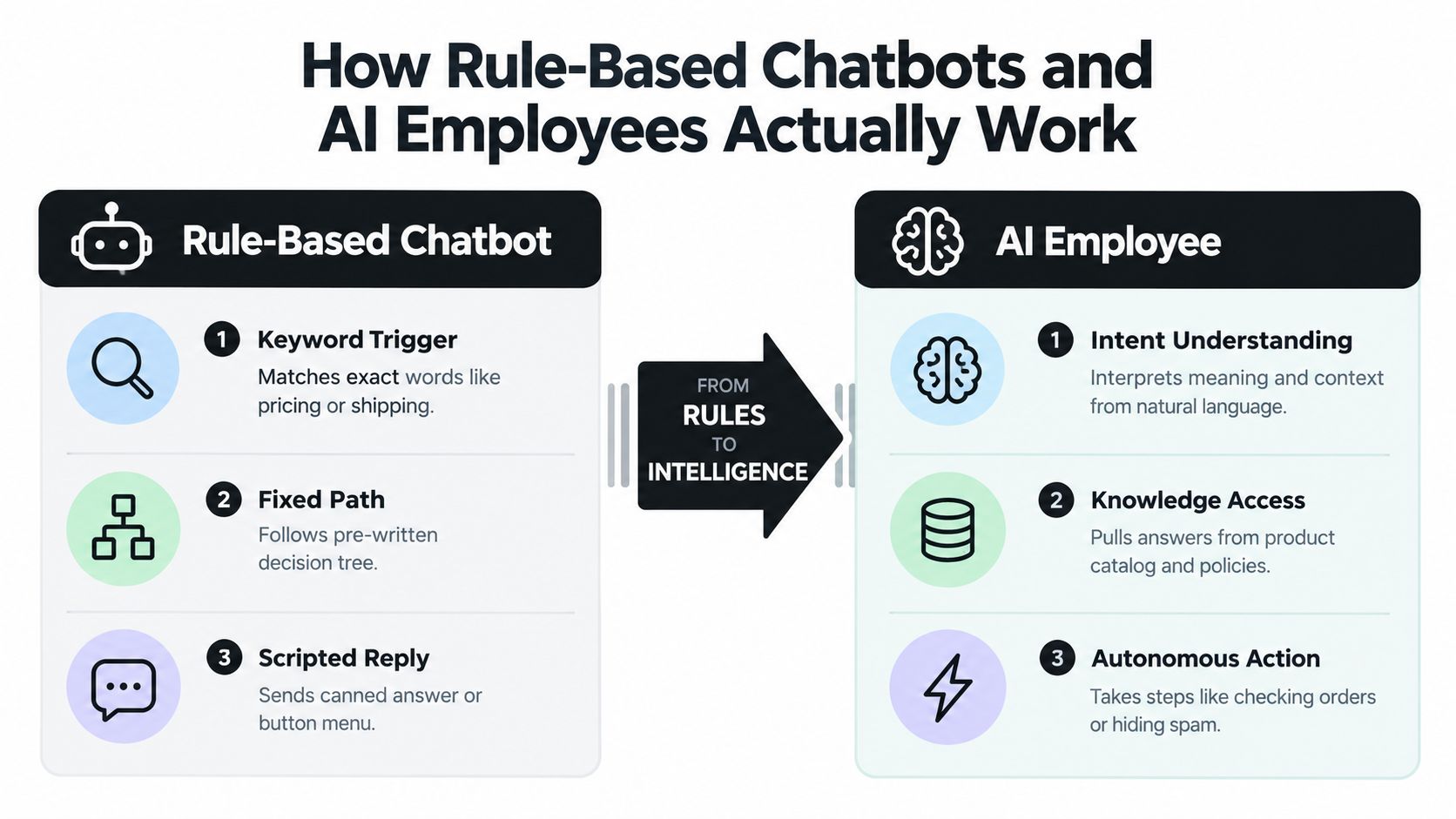
A comparison chart showing how rule-based chatbots differ from intelligent AI employees in functional operation.

The operational difference

An AI employee begins with intent and context rather than an exact keyword. It can identify that “runs small” is a fit question, retrieve the approved sizing guidance, answer in the brand's voice, and offer the relevant product link. If the customer asks a follow-up, the system can use the conversation history instead of restarting at the first menu.

A production AI employee still needs boundaries. It should retrieve from a controlled knowledge base, follow pricing and promotion rules, avoid unsupported claims, and escalate requests that fall outside its authority. The system isn't valuable because it can generate unlimited language. It's valuable because it can connect language to a constrained workflow.

That's where orchestration matters more than raw model size. A 2026 benchmark examined 703 conversations across three domains and found that a policy layer called DPA improved adherence enough for a smaller model, GPT-4o-mini, to outperform a larger model, GPT-4o, on policy and business adherence. The benchmark supports a practical lesson: guardrails, retrieval, routing, and action permissions can matter more than choosing the largest available foundation model.

Independent customer-support evaluations now score systems on more than answer quality. They include instruction following, response speed, hallucination control, compliance, moderation, and cost per conversation. This customer-support evaluation framework reflects how production teams should assess an AI employee.

A useful system can:

  • Interpret intent: Recognize objections, urgency, purchase signals, and support requests.

  • Retrieve knowledge: Pull from product details, policies, order data, and approved offers.

  • Apply rules: Respect escalation, moderation, compliance, and brand-voice constraints.

  • Take action: Send a checkout link, route a lead, check an order, or hide a harmful comment.

  • Log outcomes: Preserve the reason, response, action, and resulting conversion path.

For a broader operational view, the social media chatbot guide is useful when mapping comment and DM workflows across channels.

Comparing Chatbots and AI Across the Metrics That Matter

A chatbot can be the right choice when the workflow is narrow, the answers are stable, and the team values strict predictability. An AI employee becomes more useful when conversations contain unexpected phrasing, multiple steps, product context, or a revenue action.

Criterion

Rule-Based Chatbot

AI Employee

Response speed

Fast when a trigger matches

Fast when routing and integrations are configured

Accuracy under pressure

Reliable for approved scripts, weak outside them

Handles varied intent, but needs grounded knowledge and testing

Moderation

Matches defined words or patterns

Interprets context and applies moderation policy

Brand voice

Highly consistent in fixed replies

Consistent when trained with voice rules and approvals

Attribution

Requires deliberate event tracking

Can connect replies and actions to workflows and outcomes

Scalability

More branches create maintenance work

Handles language variation, but requires governance

Cost control

Predictable for simple flows

Depends on conversation volume, actions, and safeguards

Compliance

Easy to review when scope is narrow

Strong when policies, logs, and escalation are enforced

Response speed and recovery windows

Speed isn't just a customer-experience metric. It can determine whether a sales conversation remains actionable. Meta's Messenger policy allows free-form replies only within 24 hours of the user's last message, and each new inbound message resets that window. After it closes, standard replies are blocked until the user messages again. The Messenger policy explanation makes the workflow implication clear.

A script can reply quickly when the customer uses the expected phrase. An AI employee can classify “Do you still have the black one in medium?” as purchase intent, retrieve availability if connected to the right data, and send the next action without forcing the user through a menu. The winning setup isn't automatically the more advanced one. It's the one that responds accurately before the conversation loses momentum.

Accuracy, moderation, and voice

Rule-based logic gives compliance teams a smaller surface area to review. It doesn't invent a product claim when the response is fixed. But it may send an irrelevant answer, miss a disguised scam, or fail to distinguish a genuine complaint from abusive content.

AI employees handle variation better, but they require stronger controls. Use approved knowledge, confidence thresholds, escalation paths, moderation categories, and logs. Don't let the system improvise medical, financial, legal, or promotional claims because a customer asks with confidence.

Moderation has a direct advertising implication. A Harvard Business School paper found that hiding harmful comments can improve consumer reactions to social posts and ads, which positions moderation as a performance lever rather than only a community-management task. The paper on automated comment moderation supports testing cleaner comment environments against campaign outcomes.

Attribution and scale

Attribution separates a useful AI employee from an impressive chat demo. Track the source ad, thread, intent classification, response, link or offer sent, escalation, and final conversion. Without those events, a team may see more activity but can't decide whether to shift budget or keep the workflow.

Use the same discipline described in conversion attribution for engagement workflows. A reply should become a measurable event, not a disconnected support record.

Traditional bots scale branches. AI employees scale interpretation and action, provided the brand maintains knowledge quality and policy control. The trade-off is clear: simple automation offers a predictable ceiling, while AI offers wider coverage with a larger governance responsibility.

Real Use Cases on Meta, TikTok and Website Chat

A Meta ad comment arrives at 2 a.m. Someone posts a fake customer-service link beneath a product creative. A rule-based chatbot may do nothing unless the text matches a known scam phrase. An AI employee can classify the comment as suspicious, apply the moderation policy, hide or report it when authorized, and preserve the event for review.

The same campaign may contain a legitimate sizing question. A fixed bot can send a general product link. An AI employee can identify the product being discussed, retrieve fit guidance, answer the actual objection, and move the buyer toward the correct variant.

Meta comments and DMs

High-intent comments deserve a different route from general engagement. Build rules that identify buying signals such as requests for price, availability, shipping, fit, discount, or a purchase link. Send the public answer when it helps other shoppers, then move the detailed exchange into a DM when appropriate.

The 24-hour Messenger window makes timing operational. Route the comment into the inbox, reply within the open window, and use each new inbound message to keep the conversation active. A same-day test should compare:

  • Intent coverage: How many purchase questions received a useful response?

  • Action completion: How many received a product, checkout, or offer link?

  • Recovery: Which threads produced attributed revenue or qualified leads?

  • Risk handling: How many scam or harmful comments were hidden or escalated?

TikTok comment pressure

TikTok campaigns can create dense comment activity quickly. A generic bot may repeat the same answer, queue conversations, or fail when customers combine product questions with objections. An AI employee can classify comments by intent, answer routine questions, route support issues, and apply moderation rules across changing language.

Independent reporting tied cleaner comment threads to a 17.6% ROAS increase on TikTok and a 7.35% ROAS increase on Meta when moderation was applied. The moderation and paid-social reporting gives advertisers a testable direction, not a promise. Apply moderation to spend-heavy creatives and compare ROAS, CPC, and cost per conversion against a comparable campaign set.

Website chat for paid traffic

Website chat catches objections after the click. A visitor may ask about shipping, fit, returns, ingredients, or pricing while sitting on a product or landing page. A button-only chatbot can point to an FAQ. An AI employee can respond like a sales associate, use approved product knowledge, and route the visitor to checkout or a lead form.

A widely cited benchmark says adding live chat typically increases conversion by about 20%, while another says shoppers who use chat are about 2.8 times more likely to convert. The website chat benchmarks support placing chat on high-intent landing pages and measuring the result against paid-traffic conversion data.

Use omnichannel customer engagement workflows to keep the answer logic consistent across comments, DMs, and web sessions instead of forcing each channel into a separate knowledge silo.

How to Choose and Migrate Without Breaking What Works

Don't replace a working FAQ flow because AI sounds more capable. First identify where the current system loses money or creates manual work. A narrow, approved script may remain the safest option for a simple shipping question. An AI employee is more appropriate when the workflow depends on context, order data, multilingual phrasing, moderation, or a sales action.

Start with an audit

Export or review the most common comment and DM patterns. List the top triggers, fallback replies, unanswered questions, moderation failures, escalation cases, and links sent. Mark each workflow as safe to automate, needs human approval, or must remain human-led.

Pay special attention to high-intent moments. Pricing questions, stock checks, sizing objections, delivery concerns, abandoned conversations, and scam replies usually reveal more than a generic FAQ count.

A five-step guide on how to choose and migrate a chatbot system without breaking existing workflows.

Pick the operating model

Use a rule-based chatbot when the answer is stable, the wording is predictable, and compliance requires pre-approved copy. Use an AI employee when the system must interpret intent, retrieve changing information, or complete a multi-step action. A hybrid setup often works best at the start, with scripted handling for sensitive topics and AI handling for qualified, bounded workflows.

Check integrations before you judge response quality. The system should connect to the commerce platform, Meta, TikTok, website chat, and helpdesk processes your team uses. If it can't pass the right context into the conversation, a strong language layer won't recover the missing revenue.

Migrate in phases

Run the new workflow beside the existing one. Start with one campaign, one product category, or one client page. Keep approval required for sensitive replies, and review the logs for unsupported claims, missed intent, incorrect links, and unnecessary escalations.

Measure response time, resolution rate, spam blocked, qualified leads, checkout actions, attributed revenue, and human review volume. Compare the same campaign types before and after the change rather than relying on total conversation volume.

Agencies also need separate knowledge bases, voice rules, permissions, and reporting for every client. A practical workflow automation software evaluation should include those controls, not just the number of channels supported.

The Operational Case for AI Employees Over Manual Teams

The alternative to a chatbot isn't always another piece of software. Often, it's a person checking comments, opening DMs, copying product links, hiding spam, updating a spreadsheet, and escalating support issues between campaigns. That work fragments attention and leaves coverage dependent on shifts, inbox discipline, and who knows the product.

Manual teams still matter for judgment, sensitive complaints, exceptions, and relationship management. AI employees should take the repeatable first pass, preserve context, and hand difficult cases to people with the full conversation attached. That arrangement gives the team more time for creative testing, offer strategy, landing-page work, and account analysis.

The operational case depends on control, not on removing humans. Public-facing AI needs logging, attribution, escalation, moderation rules, and approval thresholds. Those safeguards matter even more in telehealth, insurance, Medicare, solar lead generation, and other areas where an inaccurate answer can create regulatory or reputational exposure.

Governance standard: Every automated action should have an owner, a reason, a permitted scope, and a record that a human can review.

A static bot creates channel silos when each platform holds separate scripts and exceptions. An AI employee can use a shared knowledge and policy layer across Facebook, Instagram, TikTok, and website chat, while keeping channel-specific permissions. SMS, email, and voice can be added later, but the operating model should start with consistent data and escalation logic.

Exerta is one example of the AI employee category. Its current channels include Facebook, Instagram, TikTok, and website chat, with automated comment and DM replies, moderation, sales recovery workflows, logged actions, and attribution. Exerta reports adoption by 250+ brands, a 15% average sales lift, $2M+ in recovered revenue, and 99.9% uptime. Treat those figures as product-reported outcomes, and validate fit with your own campaign-level measurement before expanding coverage.

What to Do Next With Your Ad Comment and DM Strategy

Start today with three workflows: high-intent ad comments, follow-up inside the open DM window, and moderation for scam, spam, profanity, and repeated harmful replies. Keep the first test narrow enough that you can inspect every action and tie it to a campaign.

Record the baseline before changing anything. Compare response speed, useful-reply rate, links sent, escalations, spam blocked, checkout actions, qualified leads, ROAS, CPC, cost per conversion, and attributed revenue. Review the conversation logs weekly, then expand only when the system handles edge cases without creating new support work.

The chatbot vs AI decision isn't about choosing the cleverest conversational interface. Choose the operating model that protects paid traffic, recovers buyer intent, and gives your team evidence for the next budget decision.

Exerta deploys AI employees for Facebook, Instagram, TikTok, and website chat to reply to comments and DMs, moderate harmful content, and attribute recovered revenue. Visit Exerta to map your first ad comment and DM workflow, then test it against the campaign metrics you already use.

Other useful guides

Get started today

Stop losing sales you already paid for.

Connect your channels in about a minute. Your AI employees start answering, moderating and closing the same day.

No credit card required

Live in under 5 minutes

250+ brands running

Cancel anytime

Get started today

Stop losing sales you already paid for.

Connect your channels in about a minute. Your AI employees start answering, moderating and closing the same day.

No credit card required

Live in under 5 minutes

250+ brands running

Cancel anytime

Get started today

Stop losing sales you already paid for.

Connect your channels in about a minute. Your AI employees start answering, moderating and closing the same day.

No credit card required

Live in under 5 minutes

250+ brands running

Cancel anytime

AI employees that answer every buyer, protect your ad spend and close sales around the clock.

STAY IN THE LOOP

No spam, unsubscribe anytime.

FIND US ON

All systems operational · 99.98% uptime last 90 days

SOC 2

Type II

GDPR

Compliant

99.9% SLA

Uptime

24/7

Support

1. Pricing and billing All prices displayed on exerta.ai are in US dollars and exclude applicable taxes unless stated otherwise. Prices are subject to change. Existing subscribers will receive at least 30 days’ written notice before any price increase takes effect on their account. Annual plan savings are calculated by comparing the annual billing rate to the equivalent monthly billing rate multiplied by 12.

2. Run and usage statisticsRevenue, engagement and success figures are based on aggregated platform data and customer-reported results across 250+ brands, and are updated periodically.

3. Time-to-value claims Statements such as “live in about a minute” reflect typical setup times observed for new accounts connecting through Meta Business Manager. Actual setup time may vary with the number of channels connected and the level of agent customization.

4. AI step suggestions Exerta’s AI features are powered by a blend of leading AI models, anchored by our own fine-tuned engagement model. Suggestion quality, accuracy and availability may vary. Exerta does not guarantee that AI-generated output will be accurate, complete or suitable for any particular use case. Review AI output before acting on it.

5. Integration availability The number of native integrations referenced on this website reflects integrations available at the time of last update. Integration availability may vary by subscription plan. Third-party integrations are subject to the terms, availability and API limitations of the respective third-party providers. Exerta does not guarantee the continued availability of any specific integration and is not responsible for disruptions caused by changes to third-party APIs or services.

6. Uptime and SLA The 99.9% uptime figure refers to our published Service Level Agreement (SLA) target for paid plan customers. Actual uptime may vary. Historical uptime statistics are available upon request.

7. Security and compliance certifications Exerta’s SOC 2 Type II (coming soon) certification covers the security, availability, processing integrity, confidentiality and privacy trust service criteria. GDPR compliance reflects our internal data protection practices and contractual commitments. HIPAA compliance is available exclusively on Enterprise plans and requires execution of a Business Associate Agreement (BAA). ISO 27001 certification is currently in progress. Compliance certifications are subject to annual renewal and audit. Copies of our most recent compliance reports are available to Enterprise customers under NDA upon request.

8. Customer testimonials and case studies Testimonials, quotes and case study results featured on this website reflect the experiences of individual customers. Results vary with ad spend, engagement volume, offer and configuration. Exerta does not guarantee that any customer will achieve similar results.

9. Third-party service marks and logos All third-party brand names, logos and service marks referenced on this website — including but not limited to Meta, Facebook, Instagram, TikTok, Shopify and Trustpilot — are the property of their respective owners. References to these services do not imply endorsement, sponsorship or affiliation.

10. Free plan limitations The Free plan does not require a credit card. Free plan usage is subject to the limits described on our pricing page, including a limited number of AI actions per month and comment hiding with stock replies only. Exerta reserves the right to modify the features and limits of the Free plan at any time.

11. Trial periods Free trial periods are available on paid plans as described at the time of signup. At the end of the trial period, the selected payment method will be charged at the applicable plan rate unless the subscription is cancelled before the trial expires. Trial periods are available once per customer and may not be combined with other promotional offers.

12. Data processing and privacy Exerta processes personal data in accordance with our Privacy Policy and Data Processing Agreement. Data residency options (US and EU) are available on all paid plans. The data residency region is selected at account creation and cannot be changed without contacting our support team. Customers responsible for processing personal data of EEA or UK residents are advised to execute our standard Data Processing Agreement, available at exerta.ai/legal/dpa.

13. Activity history retention Activity history is retained for 90 days on the Starter plan and for longer periods on larger plans, as described at signup. Exported data is the responsibility of the customer once downloaded.

14. AI model providers Exerta uses a blend of leading AI models together with our own fine-tuned engagement model, specialized for customer engagement. Model composition may change as we improve the product.

15. Mobile and desktop applications Exerta is available in the browser on desktop and mobile. Certain advanced configuration features are easiest on desktop. Application updates are released on a rolling basis.

16. Template library Prebuilt agent setups provided by Exerta are starting points and are not guaranteed to be suitable for any particular purpose. Customers are responsible for reviewing and testing agent behavior before enabling it on live channels.

17. Website content accuracy The information on this website is provided for general informational purposes only and is subject to change without notice. While we make every effort to keep the content accurate and up to date, Exerta makes no warranties or representations, express or implied, about the completeness, accuracy, reliability or suitability of the information contained on this website for any particular purpose.

18. Promotional offers and discounts Promotional pricing, discounts and special offers are subject to additional terms and conditions communicated at the time of the offer. Offers cannot be applied retroactively to existing subscriptions and may not be combined with other promotions unless explicitly stated. Exerta reserves the right to modify or discontinue promotional offers at any time.

19. Startup and non-profit programs Eligibility for our startup and non-profit discount programs is assessed at Exerta’s sole discretion based on the criteria described in our support documentation. Approved discounts apply to the base subscription price only and do not apply to add-ons, Enterprise features or professional services. Discount eligibility is subject to annual review.

20. Intellectual property This website is operated by Reascend LLC (d/b/a Exerta), a limited liability company formed in the State of Delaware, United States. References to “we”, “us” and “our” throughout this website refer to Reascend LLC (d/b/a Exerta). The use of this website and our Services is governed by the laws of the State of Delaware, United States, as described in our Terms of Service.

21. Accessibility Exerta is committed to making its website and application accessible to all users, including those with disabilities. We aim to conform to the Web Content Accessibility Guidelines (WCAG) 2.1 at Level AA. If you experience any accessibility barriers, please contact us at accessibility@exerta.ai and we will make every effort to provide an accessible alternative.

22. Governing jurisdiction This website is operated by Reascend LLC (d/b/a Exerta), a limited liability company formed in the State of Delaware, United States. References to “we”, “us” and “our” throughout this website refer to Reascend LLC (d/b/a Exerta). The use of this website and our Services is governed by the laws of the State of Delaware, United States, as described in our Terms of Service.

AI employees that answer every buyer, protect your ad spend and close sales around the clock.

STAY IN THE LOOP

No spam, unsubscribe anytime.

FIND US ON

All systems operational · 99.98% uptime last 90 days

SOC 2

Type II

GDPR

Compliant

99.9% SLA

Uptime

24/7

Support

1. Pricing and billing All prices displayed on exerta.ai are in US dollars and exclude applicable taxes unless stated otherwise. Prices are subject to change. Existing subscribers will receive at least 30 days’ written notice before any price increase takes effect on their account. Annual plan savings are calculated by comparing the annual billing rate to the equivalent monthly billing rate multiplied by 12.

2. Run and usage statisticsRevenue, engagement and success figures are based on aggregated platform data and customer-reported results across 250+ brands, and are updated periodically.

3. Time-to-value claims Statements such as “live in about a minute” reflect typical setup times observed for new accounts connecting through Meta Business Manager. Actual setup time may vary with the number of channels connected and the level of agent customization.

4. AI step suggestions Exerta’s AI features are powered by a blend of leading AI models, anchored by our own fine-tuned engagement model. Suggestion quality, accuracy and availability may vary. Exerta does not guarantee that AI-generated output will be accurate, complete or suitable for any particular use case. Review AI output before acting on it.

5. Integration availability The number of native integrations referenced on this website reflects integrations available at the time of last update. Integration availability may vary by subscription plan. Third-party integrations are subject to the terms, availability and API limitations of the respective third-party providers. Exerta does not guarantee the continued availability of any specific integration and is not responsible for disruptions caused by changes to third-party APIs or services.

6. Uptime and SLA The 99.9% uptime figure refers to our published Service Level Agreement (SLA) target for paid plan customers. Actual uptime may vary. Historical uptime statistics are available upon request.

7. Security and compliance certifications Exerta’s SOC 2 Type II (coming soon) certification covers the security, availability, processing integrity, confidentiality and privacy trust service criteria. GDPR compliance reflects our internal data protection practices and contractual commitments. HIPAA compliance is available exclusively on Enterprise plans and requires execution of a Business Associate Agreement (BAA). ISO 27001 certification is currently in progress. Compliance certifications are subject to annual renewal and audit. Copies of our most recent compliance reports are available to Enterprise customers under NDA upon request.

8. Customer testimonials and case studies Testimonials, quotes and case study results featured on this website reflect the experiences of individual customers. Results vary with ad spend, engagement volume, offer and configuration. Exerta does not guarantee that any customer will achieve similar results.

9. Third-party service marks and logos All third-party brand names, logos and service marks referenced on this website — including but not limited to Meta, Facebook, Instagram, TikTok, Shopify and Trustpilot — are the property of their respective owners. References to these services do not imply endorsement, sponsorship or affiliation.

10. Free plan limitations The Free plan does not require a credit card. Free plan usage is subject to the limits described on our pricing page, including a limited number of AI actions per month and comment hiding with stock replies only. Exerta reserves the right to modify the features and limits of the Free plan at any time.

11. Trial periods Free trial periods are available on paid plans as described at the time of signup. At the end of the trial period, the selected payment method will be charged at the applicable plan rate unless the subscription is cancelled before the trial expires. Trial periods are available once per customer and may not be combined with other promotional offers.

12. Data processing and privacy Exerta processes personal data in accordance with our Privacy Policy and Data Processing Agreement. Data residency options (US and EU) are available on all paid plans. The data residency region is selected at account creation and cannot be changed without contacting our support team. Customers responsible for processing personal data of EEA or UK residents are advised to execute our standard Data Processing Agreement, available at exerta.ai/legal/dpa.

13. Activity history retention Activity history is retained for 90 days on the Starter plan and for longer periods on larger plans, as described at signup. Exported data is the responsibility of the customer once downloaded.

14. AI model providers Exerta uses a blend of leading AI models together with our own fine-tuned engagement model, specialized for customer engagement. Model composition may change as we improve the product.

15. Mobile and desktop applications Exerta is available in the browser on desktop and mobile. Certain advanced configuration features are easiest on desktop. Application updates are released on a rolling basis.

16. Template library Prebuilt agent setups provided by Exerta are starting points and are not guaranteed to be suitable for any particular purpose. Customers are responsible for reviewing and testing agent behavior before enabling it on live channels.

17. Website content accuracy The information on this website is provided for general informational purposes only and is subject to change without notice. While we make every effort to keep the content accurate and up to date, Exerta makes no warranties or representations, express or implied, about the completeness, accuracy, reliability or suitability of the information contained on this website for any particular purpose.

18. Promotional offers and discounts Promotional pricing, discounts and special offers are subject to additional terms and conditions communicated at the time of the offer. Offers cannot be applied retroactively to existing subscriptions and may not be combined with other promotions unless explicitly stated. Exerta reserves the right to modify or discontinue promotional offers at any time.

19. Startup and non-profit programs Eligibility for our startup and non-profit discount programs is assessed at Exerta’s sole discretion based on the criteria described in our support documentation. Approved discounts apply to the base subscription price only and do not apply to add-ons, Enterprise features or professional services. Discount eligibility is subject to annual review.

20. Intellectual property All content on this website, including text, graphics, logos, icons, images, audio clips, digital downloads and software, is the property of Reascend LLC (d/b/a Exerta) or its content suppliers and is protected by applicable intellectual property laws. Exerta® is a registered trademark of Reascend LLC. Unauthorised reproduction, distribution or modification of any content from this website is prohibited without prior written consent.

21. Accessibility Exerta is committed to making its website and application accessible to all users, including those with disabilities. We aim to conform to the Web Content Accessibility Guidelines (WCAG) 2.1 at Level AA. If you experience any accessibility barriers, please contact us at accessibility@exerta.ai and we will make every effort to provide an accessible alternative.

22. Governing jurisdiction This website is operated by Reascend LLC (d/b/a Exerta), a limited liability company formed in the State of Delaware, United States. References to “we”, “us” and “our” throughout this website refer to Reascend LLC (d/b/a Exerta). The use of this website and our Services is governed by the laws of the State of Delaware, United States, as described in our Terms of Service.