Guide

Conversion Attribution for Paid Social and Chat Recovery

Master conversion attribution for Meta, TikTok, and chat-driven revenue. Learn models, fix blind spots, and track recovered sales accurately.

14 min read

read

·

gray steel mesh hole screen

An article by

Myko M.

Founder

Most advice on conversion attribution starts in the wrong place. It tells brands to pick a model, then act like the model is truth. That's backwards for paid social, where a buyer can see an ad, read comments, ask a question in DMs, check the site later, and convert after the visible click trail has already gone cold.

For DTC and ecommerce teams running Meta and TikTok, the problem is not just measurement. It's revenue recovery. If the conversation that removed friction never gets credited, the budget goes to the easiest clicks, the comment section gets treated like noise, and the team cuts the exact work that closes sales.

Table of Contents

Why Last-Click Attribution Fails Paid Social

Last-click attribution is popular because it feels clean. One conversion, one winner. In paid social, that simplicity breaks the minute a buyer interacts with more than one touchpoint before buying, which is the norm, not the exception. A widely cited industry statistic says the average customer now interacts with 6.5 touchpoints before converting, and 75.5% of marketers prefer a multi-touch attribution model because a single-touch view misses most of the journey (marketing attribution statistics).

That matters in real account work. A person sees a TikTok ad, reads the comments, asks about sizing in a DM, comes back through a branded search later, and purchases. Last-click gives all the credit to the final visit, even though the conversation likely removed the last bit of hesitation. If you're judging creative from that report alone, you'll cut the ad that started the journey and keep the one that merely finished it.

Practical rule: if the buying path has a comment, a DM, and a later site visit, don't use last-click as your only decision layer.

The budget damage is predictable. Teams using stronger attribution report 15–30% higher marketing ROI, 19% better budget accuracy, and 27% less wasted ad spend than teams relying on weaker measurement (marketing attribution statistics). Those gains don't come from prettier dashboards. They come from moving spend away from channels that only capture demand and toward the messages, offers, and conversations that create it.

If you want a plain-English refresher on the mechanics, the last click attribution insight for marketers is useful as a starting point. For paid social teams, the bigger lesson is simpler. Attribution is a decision system, not a reporting layer. It decides which creative gets scaled, which audience gets more budget, and which “losing” campaign was doing the hard work.

The operational mistake is assuming the last visible action is the most important one. It usually isn't. In comment-heavy funnels, the last click often belongs to the channel with the lowest effort, not the highest influence. That's why teams using a narrow last-click view end up overfunding retargeting and underfunding the content that creates the first spark.

For teams that want a deeper look at the operational cost of ignored conversations, this internal guide on why unanswered ad comments are costing you sales connects the measurement problem to the revenue problem directly.

Attribution Models Explained for Ecommerce Funnels

Different attribution models answer different questions. The mistake is treating them as interchangeable. In a paid social funnel, the right model depends on whether you're trying to measure awareness, close-rate support, or final conversion trigger.

Where each model helps and where it lies

First-click gives the first touch all the credit. That's useful when you want to know which creative, hook, or audience introduced the brand. It's weak for ecommerce because it ignores the later comment reply, DM, or retargeting step that got the order across the line.

Last-click credits the final interaction. It's good for identifying what sealed the deal, but it tends to over-credit bottom-funnel retargeting and branded search. That makes it dangerous as a sole scaling rule.

Linear splits credit across all touches. It's fairer, but it can blur the difference between a throwaway impression and a conversation that answered a buying objection.

Time-decay gives more weight to recent touches. That can work when purchases happen quickly, but it still favors the final steps over the interaction that opened the door.

Position-based gives extra weight to the first and last touches. It's helpful when you care about both discovery and conversion, but it can still miss the role of the middle, where comments, DMs, and chat usually live.

Data-driven uses your own conversion-path data to calculate contribution. Google says this model is the default for most conversion actions, and it's built to distribute credit based on actual paths rather than a fixed rule set (Google Ads attribution models). For ecommerce teams with enough clean data, that's the model that usually gets closest to reality.

If you're comparing model logic inside a Shopify-heavy funnel, the Shopify multi touch attribution model is a useful reference point for how path-based thinking translates into store-level decisions. The key is not the label. It's whether the model reflects how people buy.

Model

Best For

Key Limitation

First-click

Awareness measurement

Ignores later conversion support

Last-click

Final conversion trigger

Over-credits retargeting and branded search

Linear

Broad fairness across touches

Treats weak and strong touches the same

Time-decay

Faster purchase cycles

Still leans toward the end of the journey

Position-based

Discovery plus close

Can under-credit mid-journey conversations

Data-driven

Mature accounts with clean path data

Needs enough reliable conversion history

For teams managing the full journey, the practical split is simple. Use first-click to judge discovery creative, use last-click only as a sanity check, and use data-driven models when you need a more realistic view of contribution.

Good attribution doesn't make every touch equal. It makes the expensive touches visible.

If your team is also working on full-funnel engagement, this internal resource on omnichannel customer engagement pairs well with model selection because the same buyer often crosses multiple channels before converting.

The Technical Foundation of Accurate Attribution

Attribution breaks when the system can't identify the same person, can't record the touchpoint, or can't keep the lookback window open long enough to catch the sale. Adobe Analytics separates three variables for a reason, the model, the scope container, and the lookback window. Change one, and credit assignment changes with it (Adobe Analytics attribution models).

Identity, event capture, and time window

The first failure point is identity resolution. Multi-touch attribution works best when the system can connect ad clicks, web visits, email interactions, and purchase events to the same user. Industry guidance on multi-touch attribution stresses that the identity graph has to stay intact, because credit becomes unstable when cookies break, platforms lose linkage, or conversion events are incomplete (multi-touch attribution guidance). That's the main reason social-to-web attribution is so messy. The user doesn't disappear. The tracking does.

The second failure point is event capture. If a comment reply, DM follow-up, or chat exchange never gets logged as a real event, the attribution system has nothing to credit. That's why server-side conversion tracking matters. It creates a cleaner handoff from the conversation to the recorded purchase event, instead of relying on fragile browser-side signals.

The third failure point is the lookback window. Recast notes that Meta ads are constrained by a 7-day click conversion window (Meta conversion window explanation). If a buyer asks a question today and purchases after that window closes, the platform may undercount the sale in its own logic. That's not a minor issue for comment-led or DM-led funnels. It's the difference between “unprofitable” and “profitable but delayed.”
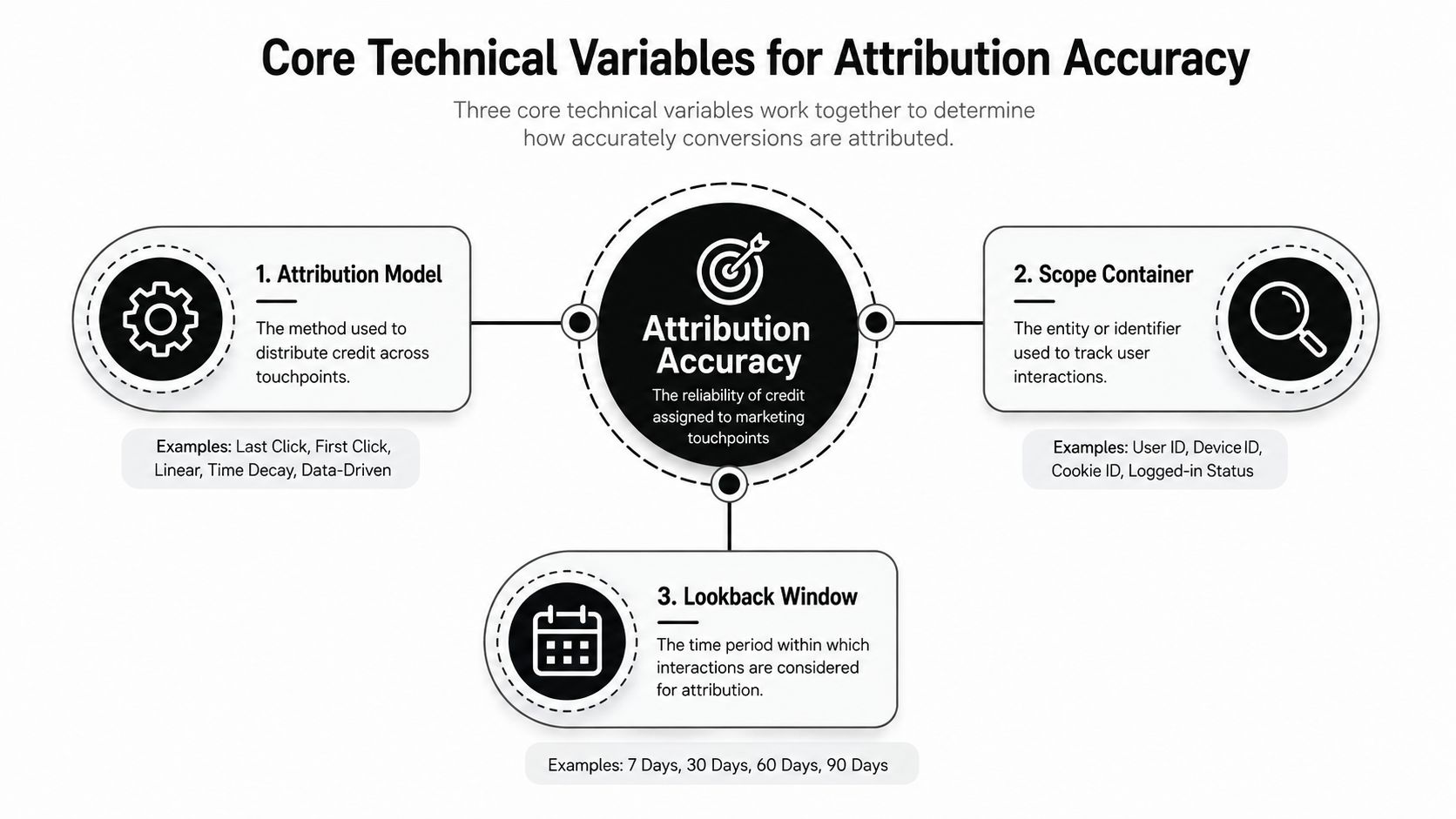
A diagram illustrating three core technical variables, including attribution model, scope container, and lookback window, determining attribution accuracy.

If a setup can't stitch identity across devices and channels, it's not measuring attribution. It's measuring fragments.

The practical fix is straightforward, even if the implementation takes discipline. Use server-side event capture where possible, keep conversion definitions tight, and audit whether your reporting window is long enough to catch assisted sales. For teams adding site-level conversational tracking, this internal guide on website chat integrations is relevant because chat events only matter when they're tied to a purchase path.

The technical rule is blunt. A model can only distribute credit for events it can see. If the system misses the conversation, the model will overvalue whatever it did see last.

Attributing Revenue from Comments, DMs, and Chat

Comments, DMs, and website chat are where a lot of paid social revenue gets rescued. They also disappear fastest in standard reporting. A buyer asks about shipping, size, ingredients, or eligibility, gets a useful reply, then buys later. If that exchange isn't captured cleanly, the sale looks like it came from nowhere or from the last generic click.

Capture the conversation before you lose the credit

Start by treating every real buying question as a trackable event. A comment that asks for price is not just engagement. A DM that asks for a checkout link is not just support. A chat thread that resolves hesitation is part of the conversion path. The goal is to move those events into the same measurement layer as the ad click and the purchase.

The hard part is identity stitching. A buyer might comment publicly, move into a DM, then convert on site hours later. If the conversation record isn't tied to the same person, the platform sees three disconnected moments. Industry guidance increasingly recommends capturing offline and anonymous touchpoints and checking attribution against incrementality data, because standard models often miss pre-conversion conversations that don't end in a clean click (conversation-to-revenue attribution guidance).

That's where AI employees fit. Exerta deploys AI employees across Facebook, Instagram, TikTok, and website chat today, with the workflow built to reply, escalate, and log the interaction. Exerta says it has supported 250+ brands, recovered $2M+ in attributed revenue in-product, and reports a 15% average sales lift with 99.9% uptime. For teams trying to recover conversational demand, the point isn't the automation alone. It's that every reply, handoff, and recovered sale can be tied back to the interaction that created it.
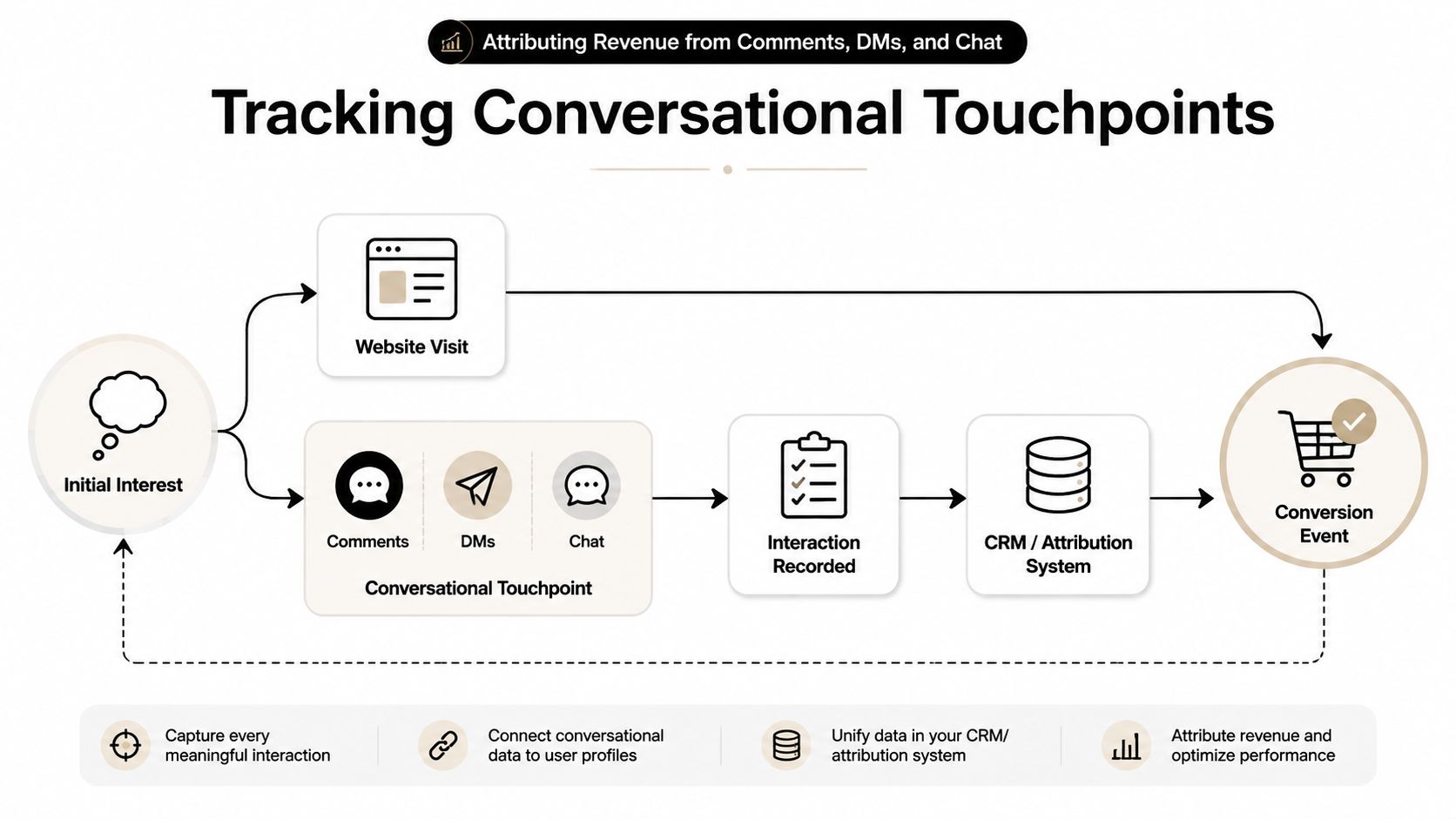
A flowchart illustrating how conversational touchpoints like comments, DMs, and chats lead to revenue tracking and conversions.

A clean operational pattern looks like this.

  • Record the first question: log the comment, DM, or chat message as soon as it signals intent.

  • Preserve the path: tie the conversation to a user or session ID so the same buyer isn't counted as a new person later.

  • Attach the outcome: connect the recovered sale, checkout link click, or assisted purchase to the original touch.

  • Separate support from demand: a product question that removes friction belongs in attribution, not just in a support inbox.

Practical rule: if a reply helps close the order, it belongs in revenue reporting even when the final purchase happens later.

For high-volume ad accounts, this changes how the team reads performance. A campaign with average click-through may still drive strong revenue if it creates the conversations that close the sale. A campaign with shiny retargeting numbers may only be harvesting interest already created elsewhere.

If you're specifically managing comment flows, this internal guide on Facebook comments is the right companion piece because comment handling is often where the attribution gap starts.

Combining Attribution Methods for Better Decisions

No single attribution method is reliable enough to govern every budget decision. That's more obvious now because signal loss, privacy changes, and fragmented journeys keep weakening platform reports. The practical answer is to use multiple imperfect methods for different jobs.

Use each method for the decision it handles best

Data-driven attribution works best for day-to-day optimization. It helps a media buyer move budget between audiences, creatives, and placements based on real conversion paths. Google's own setup reflects that logic, since its data-driven model uses account-specific path data rather than a fixed rule (Google Ads attribution models).

Marketing mix modeling fits higher-level budget allocation. It looks at broader patterns over time, which makes it useful when platform-level credit is noisy or incomplete. That matters when paid social, search, and email all influence the same sale.

Incrementality testing answers the blunt question, did this channel cause the outcome. That's the cleanest check on whether reported conversions are real or just well-labeled. It's especially important when comment-led sales, dark social, or delayed purchases fall outside the platform's cleanest windows.

The useful move is not to force these methods into one blended report. It's to assign each one a job. Use platform attribution for tactical day-to-day changes. Use incrementality tests to validate major claims. Use broader modeling when you're making durable budget decisions. A 2026 industry synthesis reports that cross-channel short-term marketing ROI averages £1.87 per £1 spent, but rises to £4.11 when long-term effects are included, a 120% increase when fuller attribution is applied (marketing attribution synthesis). That gap is exactly why short-window reports can mislead teams into cutting the wrong channel.

Decision type

Best method

Why it fits

Daily bid and creative tweaks

Data-driven attribution

Fast feedback on tracked paths

Quarterly budget allocation

Marketing mix modeling

Better for bigger, slower effects

Channel validation

Incrementality testing

Tests real causal impact

Conversation recovery review

Logged conversation events plus purchase data

Captures assisted sales

When models disagree, don't average them blindly. Ask which decision you're making, then trust the method built for that decision.

This is also where a newer attribution angle matters. AI-mediated discovery can send traffic into direct or unlabelled paths, which hides the assistive role of content. Recent guidance on attribution governance notes that users arriving through AI assistant contexts can bypass traditional search paths, making older report logic less reliable (attribution governance challenges). That doesn't mean the journey is unmeasurable. It means no single report gets the full picture.

Building a Reporting Dashboard That Drives Action

A useful dashboard does one thing well. It changes what the team does next. If it just summarizes numbers, nobody will check it twice. The setup should blend platform attribution, server-side conversion events, and conversational touchpoint data into one decision layer.

Build for each stakeholder, not for the data warehouse

Media buyers need clarity on what to scale, pause, or test. Founders need to know whether spend is creating real revenue or just expensive activity. Agencies need to show assisted revenue and recovery revenue without burying the client in jargon. Those are different audiences, so the dashboard should show different slices of the same truth.

Start with four core views. First, platform-reported conversions, so the buyer sees what Meta and TikTok are claiming. Second, server-side purchases, so the team has a cleaner event record. Third, recovered revenue from comments, DMs, and chat, so the hidden sales work is visible. Fourth, a divergence view that flags when platform credit and server-side outcomes drift too far apart. That's usually where tracking breaks, windows are too short, or conversational events aren't being logged.

The practical value comes from alerts, not charts. If a campaign's reported conversions drop but conversation volume stays high, something in the path changed. If chat recovery spikes while last-click remains flat, the team may be under-crediting the work that is closing sales. If the same creative keeps generating questions and later purchases, it deserves different treatment than a piece that only produces cheap clicks.

Practical rule: when platform data and observed buyer behavior disagree, investigate the journey before you cut spend.

For teams building the operational side of that view, this internal piece on the best social media monitoring tool is useful because comment and DM monitoring is part of the measurement stack, not just the support stack.

Keep the dashboard tight. Too many charts slow action. The main objective is to show how much demand was created, how much was recovered, and where the system is undercounting either one. If the reporting layer can't answer that, it isn't helping the business.

Attribution Governance as Competitive Advantage

The brands winning in paid social aren't the ones with the prettiest attribution model. They're the ones with rules for what to trust when the numbers disagree. That discipline, attribution governance, is the true advantage because it turns messy reporting into usable decisions.

The first rule is to decide which source owns which decision. Platform reports can guide fast creative and bid changes. Server-side data should carry more weight when you're checking whether conversions were recorded correctly. Incrementality tests should overrule both when you're validating major budget shifts. Without that hierarchy, every meeting turns into a debate about whose dashboard is prettier.

The second rule is to treat attribution as a process, not a setup task. Customer paths change. Privacy settings change. AI search changes discovery. Comment volume changes how many sales get rescued outside the standard click path. That means the team needs recurring review, not a one-time implementation. Google's attribution reports are designed to show the actual paths customers take to complete conversions, which is useful only if someone on the team is comparing those paths against the recovery work happening in comments and chat (Google attribution reports).

The third rule is security and access. If attribution data touches customer paths, purchase events, or internal budget decisions, control who can change definitions and who can export raw data. For a practical framework on that side of the stack, data security best practices 2026 is worth reading alongside your reporting rules because governance fails fast when the data layer is loose.

The best teams write down three things.

  • Which report drives spend: so nobody guesses in a meeting.

  • Which report validates truth: so bad data gets caught early.

  • Which report explains recovery: so conversational revenue doesn't disappear into support.

If your team can't say which source wins when reports conflict, it doesn't have an attribution strategy. It has a spreadsheet.

Exerta fits that workflow because it connects conversation recovery to logged actions, so the revenue story doesn't end at the ad click. If you're trying to see which comments, DMs, and chats recover sales, visit Exerta and look at how the platform tracks engagement across paid social and website chat.

Get started today

Stop losing sales you already paid for.

Connect your channels in about a minute. Your AI employees start answering, moderating and closing the same day.

No credit card required

Live in under 5 minutes

250+ brands running

Cancel anytime

Get started today

Stop losing sales you already paid for.

Connect your channels in about a minute. Your AI employees start answering, moderating and closing the same day.

No credit card required

Live in under 5 minutes

250+ brands running

Cancel anytime

Get started today

Stop losing sales you already paid for.

Connect your channels in about a minute. Your AI employees start answering, moderating and closing the same day.

No credit card required

Live in under 5 minutes

250+ brands running

Cancel anytime

AI employees that answer every buyer, protect your ad spend and close sales around the clock.

All systems operational · 99.98% uptime last 90 days

SOC 2

Type II

GDPR

Compliant

99.9% SLA

Uptime

24/7

Support

1. Pricing and billing All prices displayed on exerta.ai are in US dollars and exclude applicable taxes unless stated otherwise. Prices are subject to change. Existing subscribers will receive at least 30 days’ written notice before any price increase takes effect on their account. Annual plan savings are calculated by comparing the annual billing rate to the equivalent monthly billing rate multiplied by 12.

2. Run and usage statisticsRevenue, engagement and success figures are based on aggregated platform data and customer-reported results across 250+ brands, and are updated periodically.

3. Time-to-value claims Statements such as “live in about a minute” reflect typical setup times observed for new accounts connecting through Meta Business Manager. Actual setup time may vary with the number of channels connected and the level of agent customization.

4. AI step suggestions Exerta’s AI features are powered by a blend of leading AI models, anchored by our own fine-tuned engagement model. Suggestion quality, accuracy and availability may vary. Exerta does not guarantee that AI-generated output will be accurate, complete or suitable for any particular use case. Review AI output before acting on it.

5. Integration availability The number of native integrations referenced on this website reflects integrations available at the time of last update. Integration availability may vary by subscription plan. Third-party integrations are subject to the terms, availability and API limitations of the respective third-party providers. Exerta does not guarantee the continued availability of any specific integration and is not responsible for disruptions caused by changes to third-party APIs or services.

6. Uptime and SLA The 99.9% uptime figure refers to our published Service Level Agreement (SLA) target for paid plan customers. Actual uptime may vary. Historical uptime statistics are available upon request.

7. Security and compliance certifications Exerta’s SOC 2 Type II (coming soon) certification covers the security, availability, processing integrity, confidentiality and privacy trust service criteria. GDPR compliance reflects our internal data protection practices and contractual commitments. HIPAA compliance is available exclusively on Enterprise plans and requires execution of a Business Associate Agreement (BAA). ISO 27001 certification is currently in progress. Compliance certifications are subject to annual renewal and audit. Copies of our most recent compliance reports are available to Enterprise customers under NDA upon request.

8. Customer testimonials and case studies Testimonials, quotes and case study results featured on this website reflect the experiences of individual customers. Results vary with ad spend, engagement volume, offer and configuration. Exerta does not guarantee that any customer will achieve similar results.

9. Third-party service marks and logos All third-party brand names, logos and service marks referenced on this website — including but not limited to Meta, Facebook, Instagram, TikTok, Shopify and Trustpilot — are the property of their respective owners. References to these services do not imply endorsement, sponsorship or affiliation.

10. Free plan limitations The Free plan does not require a credit card. Free plan usage is subject to the limits described on our pricing page, including a limited number of AI actions per month and comment hiding with stock replies only. Exerta reserves the right to modify the features and limits of the Free plan at any time.

11. Trial periods Free trial periods are available on paid plans as described at the time of signup. At the end of the trial period, the selected payment method will be charged at the applicable plan rate unless the subscription is cancelled before the trial expires. Trial periods are available once per customer and may not be combined with other promotional offers.

12. Data processing and privacy Exerta processes personal data in accordance with our Privacy Policy and Data Processing Agreement. Data residency options (US and EU) are available on all paid plans. The data residency region is selected at account creation and cannot be changed without contacting our support team. Customers responsible for processing personal data of EEA or UK residents are advised to execute our standard Data Processing Agreement, available at exerta.ai/legal/dpa.

13. Activity history retention Activity history is retained for 90 days on the Starter plan and for longer periods on larger plans, as described at signup. Exported data is the responsibility of the customer once downloaded.

14. AI model providers Exerta uses a blend of leading AI models together with our own fine-tuned engagement model, specialized for customer engagement. Model composition may change as we improve the product.

15. Mobile and desktop applications Exerta is available in the browser on desktop and mobile. Certain advanced configuration features are easiest on desktop. Application updates are released on a rolling basis.

16. Template library Prebuilt agent setups provided by Exerta are starting points and are not guaranteed to be suitable for any particular purpose. Customers are responsible for reviewing and testing agent behavior before enabling it on live channels.

17. Website content accuracy The information on this website is provided for general informational purposes only and is subject to change without notice. While we make every effort to keep the content accurate and up to date, Exerta makes no warranties or representations, express or implied, about the completeness, accuracy, reliability or suitability of the information contained on this website for any particular purpose.

18. Promotional offers and discounts Promotional pricing, discounts and special offers are subject to additional terms and conditions communicated at the time of the offer. Offers cannot be applied retroactively to existing subscriptions and may not be combined with other promotions unless explicitly stated. Exerta reserves the right to modify or discontinue promotional offers at any time.

19. Startup and non-profit programs Eligibility for our startup and non-profit discount programs is assessed at Exerta’s sole discretion based on the criteria described in our support documentation. Approved discounts apply to the base subscription price only and do not apply to add-ons, Enterprise features or professional services. Discount eligibility is subject to annual review.

20. Intellectual property All content on this website, including text, graphics, logos, icons, images, audio clips, digital downloads and software, is the property of Exerta, Inc. or its content suppliers and is protected by applicable intellectual property laws. Exerta® is a registered trademark of Exerta, Inc. Unauthorised reproduction, distribution or modification of any content from this website is prohibited without prior written consent.

21. Accessibility Exerta is committed to making its website and application accessible to all users, including those with disabilities. We aim to conform to the Web Content Accessibility Guidelines (WCAG) 2.1 at Level AA. If you experience any accessibility barriers, please contact us at accessibility@exerta.ai and we will make every effort to provide an accessible alternative.

22. Governing jurisdiction This website is operated by Exerta, Inc., a corporation incorporated in the State of Delaware, United States. References to “we”, “us” and “our” throughout this website refer to Exerta, Inc. The use of this website and our Services is governed by the laws of the State of Delaware, United States, as described in our Terms of Service.

AI employees that answer every buyer, protect your ad spend and close sales around the clock.

All systems operational · 99.98% uptime last 90 days

SOC 2

Type II

GDPR

Compliant

99.9% SLA

Uptime

24/7

Support

1. Pricing and billing All prices displayed on exerta.ai are in US dollars and exclude applicable taxes unless stated otherwise. Prices are subject to change. Existing subscribers will receive at least 30 days’ written notice before any price increase takes effect on their account. Annual plan savings are calculated by comparing the annual billing rate to the equivalent monthly billing rate multiplied by 12.

2. Run and usage statisticsRevenue, engagement and success figures are based on aggregated platform data and customer-reported results across 250+ brands, and are updated periodically.

3. Time-to-value claims Statements such as “live in about a minute” reflect typical setup times observed for new accounts connecting through Meta Business Manager. Actual setup time may vary with the number of channels connected and the level of agent customization.

4. AI step suggestions Exerta’s AI features are powered by a blend of leading AI models, anchored by our own fine-tuned engagement model. Suggestion quality, accuracy and availability may vary. Exerta does not guarantee that AI-generated output will be accurate, complete or suitable for any particular use case. Review AI output before acting on it.

5. Integration availability The number of native integrations referenced on this website reflects integrations available at the time of last update. Integration availability may vary by subscription plan. Third-party integrations are subject to the terms, availability and API limitations of the respective third-party providers. Exerta does not guarantee the continued availability of any specific integration and is not responsible for disruptions caused by changes to third-party APIs or services.

6. Uptime and SLA The 99.9% uptime figure refers to our published Service Level Agreement (SLA) target for paid plan customers. Actual uptime may vary. Historical uptime statistics are available upon request.

7. Security and compliance certifications Exerta’s SOC 2 Type II (coming soon) certification covers the security, availability, processing integrity, confidentiality and privacy trust service criteria. GDPR compliance reflects our internal data protection practices and contractual commitments. HIPAA compliance is available exclusively on Enterprise plans and requires execution of a Business Associate Agreement (BAA). ISO 27001 certification is currently in progress. Compliance certifications are subject to annual renewal and audit. Copies of our most recent compliance reports are available to Enterprise customers under NDA upon request.

8. Customer testimonials and case studies Testimonials, quotes and case study results featured on this website reflect the experiences of individual customers. Results vary with ad spend, engagement volume, offer and configuration. Exerta does not guarantee that any customer will achieve similar results.

9. Third-party service marks and logos All third-party brand names, logos and service marks referenced on this website — including but not limited to Meta, Facebook, Instagram, TikTok, Shopify and Trustpilot — are the property of their respective owners. References to these services do not imply endorsement, sponsorship or affiliation.

10. Free plan limitations The Free plan does not require a credit card. Free plan usage is subject to the limits described on our pricing page, including a limited number of AI actions per month and comment hiding with stock replies only. Exerta reserves the right to modify the features and limits of the Free plan at any time.

11. Trial periods Free trial periods are available on paid plans as described at the time of signup. At the end of the trial period, the selected payment method will be charged at the applicable plan rate unless the subscription is cancelled before the trial expires. Trial periods are available once per customer and may not be combined with other promotional offers.

12. Data processing and privacy Exerta processes personal data in accordance with our Privacy Policy and Data Processing Agreement. Data residency options (US and EU) are available on all paid plans. The data residency region is selected at account creation and cannot be changed without contacting our support team. Customers responsible for processing personal data of EEA or UK residents are advised to execute our standard Data Processing Agreement, available at exerta.ai/legal/dpa.

13. Activity history retention Activity history is retained for 90 days on the Starter plan and for longer periods on larger plans, as described at signup. Exported data is the responsibility of the customer once downloaded.

14. AI model providers Exerta uses a blend of leading AI models together with our own fine-tuned engagement model, specialized for customer engagement. Model composition may change as we improve the product.

15. Mobile and desktop applications Exerta is available in the browser on desktop and mobile. Certain advanced configuration features are easiest on desktop. Application updates are released on a rolling basis.

16. Template library Prebuilt agent setups provided by Exerta are starting points and are not guaranteed to be suitable for any particular purpose. Customers are responsible for reviewing and testing agent behavior before enabling it on live channels.

17. Website content accuracy The information on this website is provided for general informational purposes only and is subject to change without notice. While we make every effort to keep the content accurate and up to date, Exerta makes no warranties or representations, express or implied, about the completeness, accuracy, reliability or suitability of the information contained on this website for any particular purpose.

18. Promotional offers and discounts Promotional pricing, discounts and special offers are subject to additional terms and conditions communicated at the time of the offer. Offers cannot be applied retroactively to existing subscriptions and may not be combined with other promotions unless explicitly stated. Exerta reserves the right to modify or discontinue promotional offers at any time.

19. Startup and non-profit programs Eligibility for our startup and non-profit discount programs is assessed at Exerta’s sole discretion based on the criteria described in our support documentation. Approved discounts apply to the base subscription price only and do not apply to add-ons, Enterprise features or professional services. Discount eligibility is subject to annual review.

20. Intellectual property All content on this website, including text, graphics, logos, icons, images, audio clips, digital downloads and software, is the property of Exerta, Inc. or its content suppliers and is protected by applicable intellectual property laws. Exerta® is a registered trademark of Exerta, Inc. Unauthorised reproduction, distribution or modification of any content from this website is prohibited without prior written consent.

21. Accessibility Exerta is committed to making its website and application accessible to all users, including those with disabilities. We aim to conform to the Web Content Accessibility Guidelines (WCAG) 2.1 at Level AA. If you experience any accessibility barriers, please contact us at accessibility@exerta.ai and we will make every effort to provide an accessible alternative.

22. Governing jurisdiction This website is operated by Exerta, Inc., a corporation incorporated in the State of Delaware, United States. References to “we”, “us” and “our” throughout this website refer to Exerta, Inc. The use of this website and our Services is governed by the laws of the State of Delaware, United States, as described in our Terms of Service.

AI employees that answer every buyer, protect your ad spend and close sales around the clock.

All systems operational · 99.98% uptime last 90 days

SOC 2

Type II

GDPR

Compliant

99.9% SLA

Uptime

24/7

Support

1. Pricing and billing All prices displayed on exerta.ai are in US dollars and exclude applicable taxes unless stated otherwise. Prices are subject to change. Existing subscribers will receive at least 30 days’ written notice before any price increase takes effect on their account. Annual plan savings are calculated by comparing the annual billing rate to the equivalent monthly billing rate multiplied by 12.

2. Run and usage statisticsRevenue, engagement and success figures are based on aggregated platform data and customer-reported results across 250+ brands, and are updated periodically.

3. Time-to-value claims Statements such as “live in about a minute” reflect typical setup times observed for new accounts connecting through Meta Business Manager. Actual setup time may vary with the number of channels connected and the level of agent customization.

4. AI step suggestions Exerta’s AI features are powered by a blend of leading AI models, anchored by our own fine-tuned engagement model. Suggestion quality, accuracy and availability may vary. Exerta does not guarantee that AI-generated output will be accurate, complete or suitable for any particular use case. Review AI output before acting on it.

5. Integration availability The number of native integrations referenced on this website reflects integrations available at the time of last update. Integration availability may vary by subscription plan. Third-party integrations are subject to the terms, availability and API limitations of the respective third-party providers. Exerta does not guarantee the continued availability of any specific integration and is not responsible for disruptions caused by changes to third-party APIs or services.

6. Uptime and SLA The 99.9% uptime figure refers to our published Service Level Agreement (SLA) target for paid plan customers. Actual uptime may vary. Historical uptime statistics are available upon request.

7. Security and compliance certifications Exerta’s SOC 2 Type II (coming soon) certification covers the security, availability, processing integrity, confidentiality and privacy trust service criteria. GDPR compliance reflects our internal data protection practices and contractual commitments. HIPAA compliance is available exclusively on Enterprise plans and requires execution of a Business Associate Agreement (BAA). ISO 27001 certification is currently in progress. Compliance certifications are subject to annual renewal and audit. Copies of our most recent compliance reports are available to Enterprise customers under NDA upon request.

8. Customer testimonials and case studies Testimonials, quotes and case study results featured on this website reflect the experiences of individual customers. Results vary with ad spend, engagement volume, offer and configuration. Exerta does not guarantee that any customer will achieve similar results.

9. Third-party service marks and logos All third-party brand names, logos and service marks referenced on this website — including but not limited to Meta, Facebook, Instagram, TikTok, Shopify and Trustpilot — are the property of their respective owners. References to these services do not imply endorsement, sponsorship or affiliation.

10. Free plan limitations The Free plan does not require a credit card. Free plan usage is subject to the limits described on our pricing page, including a limited number of AI actions per month and comment hiding with stock replies only. Exerta reserves the right to modify the features and limits of the Free plan at any time.

11. Trial periods Free trial periods are available on paid plans as described at the time of signup. At the end of the trial period, the selected payment method will be charged at the applicable plan rate unless the subscription is cancelled before the trial expires. Trial periods are available once per customer and may not be combined with other promotional offers.

12. Data processing and privacy Exerta processes personal data in accordance with our Privacy Policy and Data Processing Agreement. Data residency options (US and EU) are available on all paid plans. The data residency region is selected at account creation and cannot be changed without contacting our support team. Customers responsible for processing personal data of EEA or UK residents are advised to execute our standard Data Processing Agreement, available at exerta.ai/legal/dpa.

13. Activity history retention Activity history is retained for 90 days on the Starter plan and for longer periods on larger plans, as described at signup. Exported data is the responsibility of the customer once downloaded.

14. AI model providers Exerta uses a blend of leading AI models together with our own fine-tuned engagement model, specialized for customer engagement. Model composition may change as we improve the product.

15. Mobile and desktop applications Exerta is available in the browser on desktop and mobile. Certain advanced configuration features are easiest on desktop. Application updates are released on a rolling basis.

16. Template library Prebuilt agent setups provided by Exerta are starting points and are not guaranteed to be suitable for any particular purpose. Customers are responsible for reviewing and testing agent behavior before enabling it on live channels.

17. Website content accuracy The information on this website is provided for general informational purposes only and is subject to change without notice. While we make every effort to keep the content accurate and up to date, Exerta makes no warranties or representations, express or implied, about the completeness, accuracy, reliability or suitability of the information contained on this website for any particular purpose.

18. Promotional offers and discounts Promotional pricing, discounts and special offers are subject to additional terms and conditions communicated at the time of the offer. Offers cannot be applied retroactively to existing subscriptions and may not be combined with other promotions unless explicitly stated. Exerta reserves the right to modify or discontinue promotional offers at any time.

19. Startup and non-profit programs Eligibility for our startup and non-profit discount programs is assessed at Exerta’s sole discretion based on the criteria described in our support documentation. Approved discounts apply to the base subscription price only and do not apply to add-ons, Enterprise features or professional services. Discount eligibility is subject to annual review.

20. Intellectual property All content on this website, including text, graphics, logos, icons, images, audio clips, digital downloads and software, is the property of Exerta, Inc. or its content suppliers and is protected by applicable intellectual property laws. Exerta® is a registered trademark of Exerta, Inc. Unauthorised reproduction, distribution or modification of any content from this website is prohibited without prior written consent.

21. Accessibility Exerta is committed to making its website and application accessible to all users, including those with disabilities. We aim to conform to the Web Content Accessibility Guidelines (WCAG) 2.1 at Level AA. If you experience any accessibility barriers, please contact us at accessibility@exerta.ai and we will make every effort to provide an accessible alternative.

22. Governing jurisdiction This website is operated by Exerta, Inc., a corporation incorporated in the State of Delaware, United States. References to “we”, “us” and “our” throughout this website refer to Exerta, Inc. The use of this website and our Services is governed by the laws of the State of Delaware, United States, as described in our Terms of Service.