Social Media Management for Agencies to Scale Profitably
read
·

An ad campaign is live, comments are accumulating, and DMs are arriving across several client pages. One buyer wants a checkout link. Another is asking whether a product works for a specific need. A third is posting spam beneath an active ad. Meanwhile, the account manager is checking multiple inboxes and the media buyer can't tell whether anyone is handling the conversations.
That isn't a content calendar problem. It's an operating problem tied to revenue, brand safety, and client retention. Social media management for agencies now requires clear queues, response targets, moderation rules, approval paths, and attribution across Facebook, Instagram, TikTok, and website chat.
Table of Contents
Why Social Media Management Is Now an Operating Function for Agencies
Building Scalable Workflows for Multi Client and Multi Page Management
Moderation Escalation and Approval Flows That Protect Ad Spend
Tooling for Paid Social Engagement at Scale From Inbox to Revenue
Why Social Media Management Is Now an Operating Function for Agencies
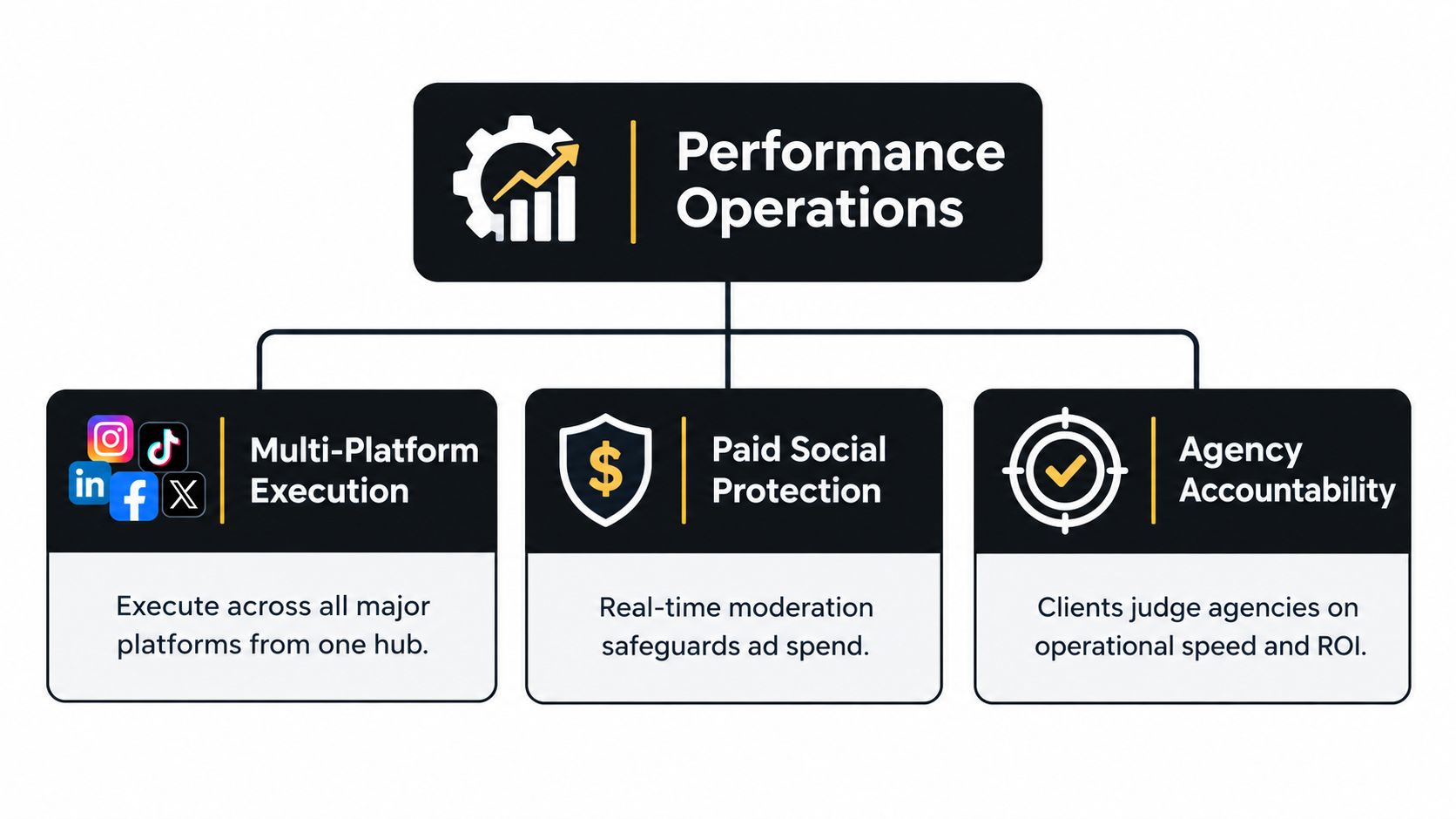
Agency clients still expect strong creative, but creative output no longer defines the entire social service. Agencies plan, produce, publish, moderate, manage communities, run paid social, support influencer activity, and report on performance across major channels. The current agency market overview from Clutch describes this broad service scope and shows leading firms with monthly web traffic ranging from about 133,901 to 448,595 visits, alongside operating histories of 14 to 29 years. Those figures indicate an established commercial category, not a side service added to a media retainer.
Pricing reinforces the same point. Industry pages list common retainers from $1,000 to $10,000+ per month, with some mid-market and enterprise engagements ranging from $15,000 to $250,000+ per month, depending on scope and complexity. At that level, clients don't pay only for scheduled posts. They pay for dependable execution, fast customer handling, risk control, and evidence that social activity supports business outcomes.
The comment section is part of the paid funnel
A public comment can answer an objection, expose a product weakness, or influence the next buyer. A DM can contain high purchase intent, especially after someone clicks an ad and asks for a price, offer, shipping detail, or product link. If the agency treats those interactions as optional community work, the client's paid traffic keeps arriving while the conversion layer remains unattended.
Global audience and spending scale make this operational gap harder to ignore. One industry source estimates 4.9 billion social media users worldwide and reports global social ad spend above $296 billion. The same agency market analysis places social media management alongside audits, strategy, production, paid advertising, influencer work, and analytics. Agencies therefore need one mental model: management means coverage, speed, and attribution, not just publishing.
Practical rule: If a conversation can influence a purchase, treat it like a revenue event until the team proves otherwise.
A useful agency system connects each page, campaign, inbox, moderation action, reply, escalation, and sale. The best creative agencies still need this operational layer because strong creative attracts attention, while disciplined engagement converts and protects that attention. Agencies scaling engagement without scaling headcount can also use a centralized engagement model to separate routine conversations from cases that need human judgment.
Building Scalable Workflows for Multi Client and Multi Page Management
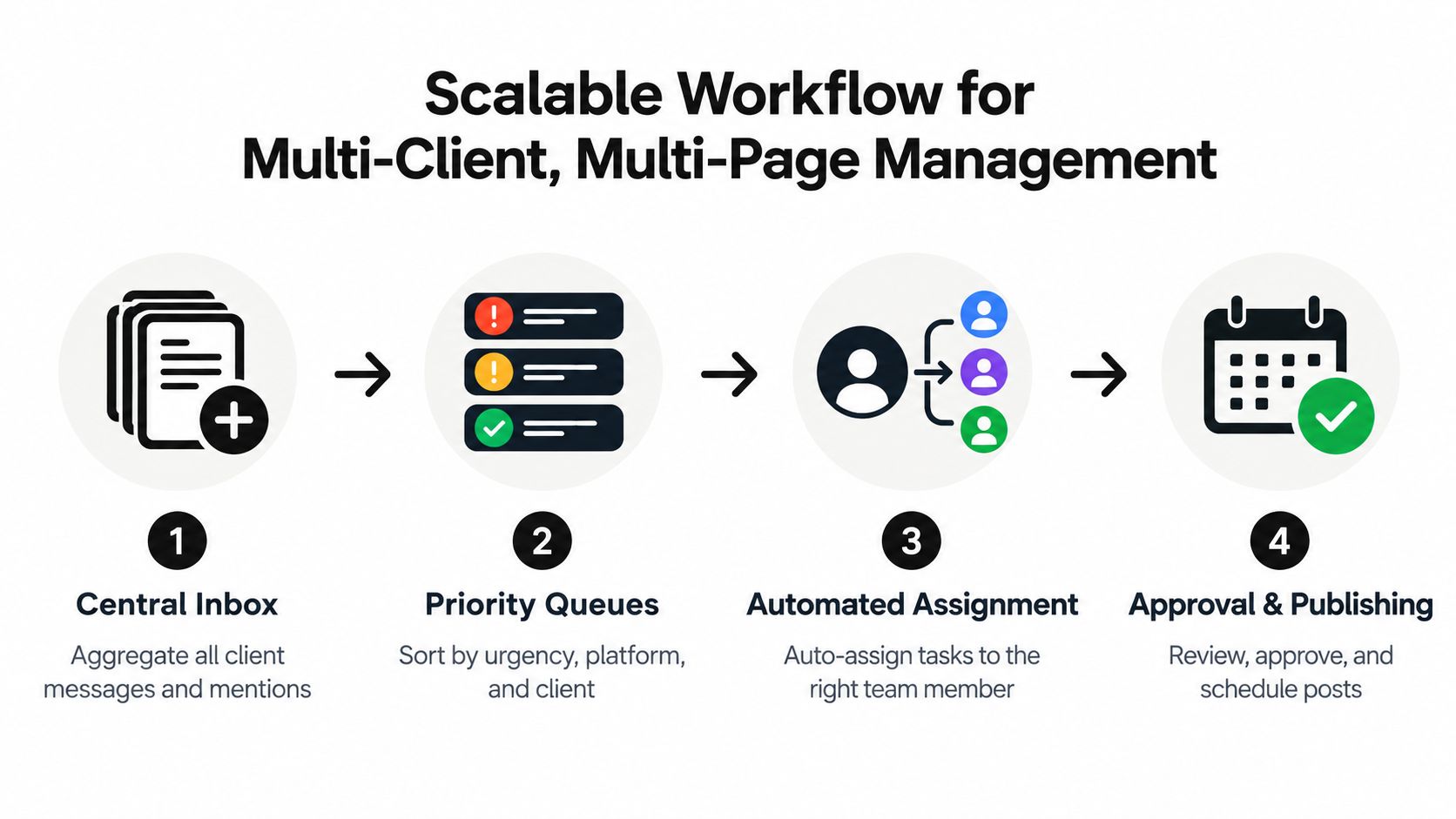
A scalable workflow starts with one inbox and ends with an accountable action. Don't let each client page create its own process. Use a shared structure, then apply client-specific rules inside it.
Start with three priority queues
Every incoming comment, mention, or DM should enter one of three queues:
Sales intent. The person asks about price, availability, shipping, a discount, a product match, or a checkout link. Route these conversations to a trained responder quickly. The operating target should be 30 to 60 minutes for sales-intent messages, because delay can turn active interest into comparison shopping.
Support issue. The person has an order question, delivery concern, product problem, refund request, or account issue. Acknowledge the public comment when appropriate, then move private details into a secure channel. Assign the case to the client's support owner rather than leaving it with a general social queue.
Moderation risk. The content includes spam, scams, abuse, unsafe claims, personal information, or a complaint that could create legal or reputational exposure. Apply automated filtering first, then escalate uncertain cases for human review.
Benchmark data places customer expectations for social replies within 24 hours for about 76% of customers, while average brand response time remains around 4 to 5 hours. On X, complaint-specific expectations are tighter, with roughly 72% to 78% of complainants expecting a response within 1 hour. These figures are documented in the 2026 first-response benchmark research. Even when an agency doesn't manage X, the lesson applies to high-intent Meta and TikTok traffic: “same day” is often too vague to manage performance.
Assign ownership before volume arrives
Use a simple RACI structure:
Responder: handles routine sales and support replies.
Approver: reviews sensitive offers, regulated language, refunds, and unusual claims.
Escalation owner: takes responsibility for complaints, safety concerns, and public issues.
Account lead: reports performance, reviews misses, and confirms client decisions.
Build coverage around actual traffic, not office hours alone. Paid campaigns can generate conversations in the evening and on weekends, so agencies need either scheduled coverage or an automated first-response layer that captures intent, answers approved questions, and routes exceptions.
The workflow builder should reflect these branches. A buyer asking for a link shouldn't enter the same path as a customer alleging a defective product. Routing by client, platform, campaign, intent, and risk keeps the system fast without making it careless.
Client Onboarding That Locks In Brand Voice and Approvals
Most off-brand replies start before launch. The agency lacks a current offer sheet, the brand uses different language for the same product, or nobody knows who can approve a sensitive answer. Onboarding should create a working source of truth, not another document that sits untouched.
Capture the information responders actually need
Ask the client for five inputs:
Voice rules: preferred tone, vocabulary, sentence length, greetings, and banned phrases.
Offer details: current prices, promotions, discount conditions, expiry rules, and eligibility.
Product facts: features, limitations, shipping information, returns, warranties, and approved claims.
Links: product pages, checkout URLs, support forms, booking pages, and tracking links.
Escalation rules: topics that require a human, topics that must stay private, and topics the agency must never answer independently.
Use examples from the client's existing customer conversations. A generic adjective list won't teach a system how the brand responds to an angry buyer or a short question such as “Does this ship today?” The brand voice examples guide can help the agency turn vague preferences into usable response rules.
Separate routine answers from approval-required answers
A responder can usually handle approved product links, public pricing, standard shipping information, and documented offer terms. Route medical, financial, legal, safety, refund exceptions, influencer disputes, and allegations of harm to a human reviewer.
Connect the client's Meta assets through the approved business-access process, then verify every page, ad account, inbox, and permission before going live. Don't rely on a single test. Publish or simulate a routine comment, a buyer question, a support complaint, and a moderation-risk example. Confirm that each one reaches the correct queue.
Keep approvals explicit. The client should know who approves posts, who approves replies, and who can pause an automation. Store the answer library centrally, record changes, and give the account lead a clear audit trail. This prevents the most expensive onboarding failure, where the agency spends the first weeks asking the client to approve the same basic answers repeatedly.
Moderation Escalation and Approval Flows That Protect Ad Spend
Moderation should run as a rule stack, not as a person scrolling through comments whenever someone remembers. Active ads can collect repetitive spam, fraudulent offers, abusive replies, and negative claims faster than a manual team can inspect them.
Apply the rule stack in order
Use three decisions:
Hide immediately. Remove obvious spam, scams, bot-like promotion, abusive slurs, exposed personal information, and malicious links from public view. Log the action and preserve the original content for review.
Reply in public. Answer genuine product questions, purchase objections, and straightforward requests for a link. Keep the response short, accurate, and consistent with the approved brand voice.
Escalate to a human. Route safety complaints, regulated topics, threats, refund disputes, legal allegations, and unclear cases to a reviewer. A public acknowledgment can show that the brand saw the issue, while private follow-up protects sensitive details.
A 2026 empirical study reported that automated moderation of harmful comments causally improved ad performance, including conversion rate and return on ad spend, across six studies, including two large-scale field experiments. The study on automated comment moderation and advertising performance supports a practical conclusion: moderation can affect campaign efficiency, not just appearance.
Measure protection and judgment separately
Set a target for the percentage of harmful comments hidden within minutes. Then review false positives, approved replies, escalations, and the downstream change in conversion rate or ROAS after moderation is enabled. Don't measure only how many comments the team processed. A high action count can hide poor routing.
Manual review still matters for edge cases. It shouldn't handle every obvious spam comment while a buyer waits for a link. Automated pre-screening handles repeatable patterns. Human reviewers handle context, policy, and risk.
Every action should record the client, page, campaign, comment or DM, rule applied, responder, approval status, timestamp, and outcome. This log gives the account lead something more useful than “community management completed.” It shows which objections recur, which rules need tuning, and where paid traffic is creating avoidable support load. Agencies can formalize those paths with a documented issue escalation workflow.
Tooling for Paid Social Engagement at Scale From Inbox to Revenue
Tool selection should follow the failure you need to remove. A scheduler solves publishing. It doesn't necessarily answer a buyer, hide a scam, route an escalation, or connect a conversation to an order.
Compare the operating models
Model | Response coverage | Best use | Main trade-off |
|---|---|---|---|
Manual team | Strong judgment during staffed hours | Sensitive support and exceptions | Coverage and cost rise with volume |
Simple bot | Fast answers to narrow prompts | Repetitive FAQs and basic routing | Breaks when context or tone changes |
AI employees | Continuous handling across approved workflows | Comments, DMs, moderation, and sales recovery | Requires careful training, rules, and review paths |
Manual teams remain essential for regulated, emotional, and ambiguous cases. The problem appears when they also handle every routine question. That creates queue backlogs, inconsistent replies, and missed opportunities.
Simple bots can answer a fixed question such as “Where can I find the size guide?” They often struggle when the same buyer asks a follow-up, changes intent, or combines a product question with a complaint. Agencies need to test the full conversation, not only the first response.
AI employees can handle approved comment and DM replies, moderation, routing, follow-up, and web chat while escalating exceptions. Exerta provides AI employees for Facebook, Instagram, TikTok, and website chat, with SMS, email, and voice launching next. Its workflow builder supports multi-branch logic, and its dashboards log engagement actions and connect recovered sales through Shopify attribution. Exerta reports 250+ brands, a 15% average sales lift, $2M+ recovered, and 99.9% uptime as product figures provided by the publisher.
A practical same-day rollout starts narrowly. Automate product links, approved prices, standard offer questions, and obvious spam. Keep refunds, regulated claims, safety concerns, and angry customer escalations with humans. Agencies comparing broader categories can use this guide to scaling with social tools to evaluate inbox, approval, and reporting requirements without treating a long feature list as an operating plan.
The Meta messaging policy adds urgency. After a customer messages on Instagram or Messenger, the company has 24 hours to send free-form replies. Each new customer message resets the window, and after it closes, only Meta-approved message types can be sent, as explained in this overview of the 24-hour messaging window. Your system should therefore prioritize first response, approved links, order details, and follow-up questions before the window expires.
SLAs Reporting and Revenue Attribution That Retain Clients
Clients stay when the agency can explain what happened and what changed. Build the report around operational outcomes, not activity totals.
Track three service-level measures for every client:
First-response time: how long a buyer waits for the first answer.
Hide time: how long harmful or fraudulent content remains visible.
Escalation time: how long it takes to route a sensitive case to the right human.
Report these alongside sales-intent volume, support volume, moderation actions, approval requests, unresolved conversations, and recovered orders. Separate public replies from private DMs. A large number of replies may reflect confusion or product friction, while a smaller set of sales conversations may produce meaningful revenue.
Attribution requires a consistent event trail. Connect the conversation ID, campaign, product, link, reply, follow-up, and completed order. Shopify attribution can then show which conversations closed sales, rather than forcing the client to infer value from engagement metrics. The revenue attribution model provides a framework for defining those events and assigning credit without hiding the underlying assumptions.
Use weekly reviews to tune the system. Identify unanswered buyer questions, repeated objections, false moderation flags, delayed approvals, and escalations that lacked enough context. Update the answer library and workflow rules, then check whether response quality and conversion outcomes improve.
For broader agency reporting, a resource on how to centralize client data for agencies can help organize shared dashboards and client-facing views. The agency growth loop is simple: set the SLA, capture every action, connect conversations to revenue, review misses, and deploy more capacity where demand is highest. That's how social media management for agencies becomes a repeatable operating service instead of labor hidden behind a content retainer.
Exerta provides AI employees that reply to comments and DMs, moderate harmful content, route escalations, and recover sales across Facebook, Instagram, TikTok, and website chat. Visit Exerta to connect your client workflows, set approval rules, and start measuring engagement against recovered revenue.