Guide
Brand Reputation Protection: Safeguard Trust & Ad Spend
Protect ad spend & brand trust with proven brand reputation protection for Meta & TikTok. Learn moderation, escalation, and AI response strategies.
12 min read
read
·


Your winning ad doesn't always die because the creative got worse. Sometimes it starts losing the moment a nasty comment sits at the top, buyers see it before your team does, and your CPMs keep burning while trust leaks out of the thread. That's the part most brands miss. Brand reputation protection isn't a cleanup task after the fact, it's revenue protection in real time.
That matters more now because reputation is a commercial input, not a soft metric. A 2025 market analysis valued the ORM software market at $6.88 billion in 2025 and projected $12.57 billion by 2030 at a 12.8% CAGR (market analysis summary). The same roundup says a single negative review on page one can cost a business 22% of potential customers, and four or more negative reviews can reduce total sales by 70% (same data source). On paid social, that risk shows up faster. It shows up in the comment section, in the DM inbox, and in the first buyer objections your media buy attracts.
Table of Contents
Why Brand Reputation Protection Is a Revenue Problem
A team can launch a strong Meta ad, watch it print for a few days, then see performance sag with no obvious change in targeting, offer, or creative. The usual explanation is fatigue. The more expensive answer is visibility. A negative comment stays public, more people see it under paid reach, and the next prospect decides someone else looks safer.
That's why moderation isn't censorship. It's merchandising. The public thread under an ad is part of the sales page, and every visible reply shapes what the next buyer thinks they're walking into. When a shopper sees unresolved abuse, scam links, or an angry customer comment with no response, they don't separate that from the offer. They absorb it as risk.
What changes when comments become part of the funnel
A brand that treats comment sections like a side channel usually pays for the mistake twice. First in wasted attention, then in slower conversion. The problem is bigger on paid social because the ad is buying fresh impressions every minute, which means the bad thread keeps getting reintroduced to new prospects.
Practical rule: if the comment section would make you hesitate to buy, it's already costing you money.
That doesn't mean every critical comment should disappear. It means the thread needs a decision rule. Spam and scams should not remain visible. Real objections should get a useful public reply. Actual customer complaints should move fast into support. That mix keeps the ad environment clean without turning the brand into a silence machine.
The internal logic is simple. You're not trying to eliminate disagreement. You're trying to stop low-quality noise from becoming the first thing buyers read. If the top of the thread is filled with junk, your ad is now selling under a cloud.
Negativity is a tax on your ad spend is the cleanest way to think about it.
The High-Velocity Reality of Paid Social Comments
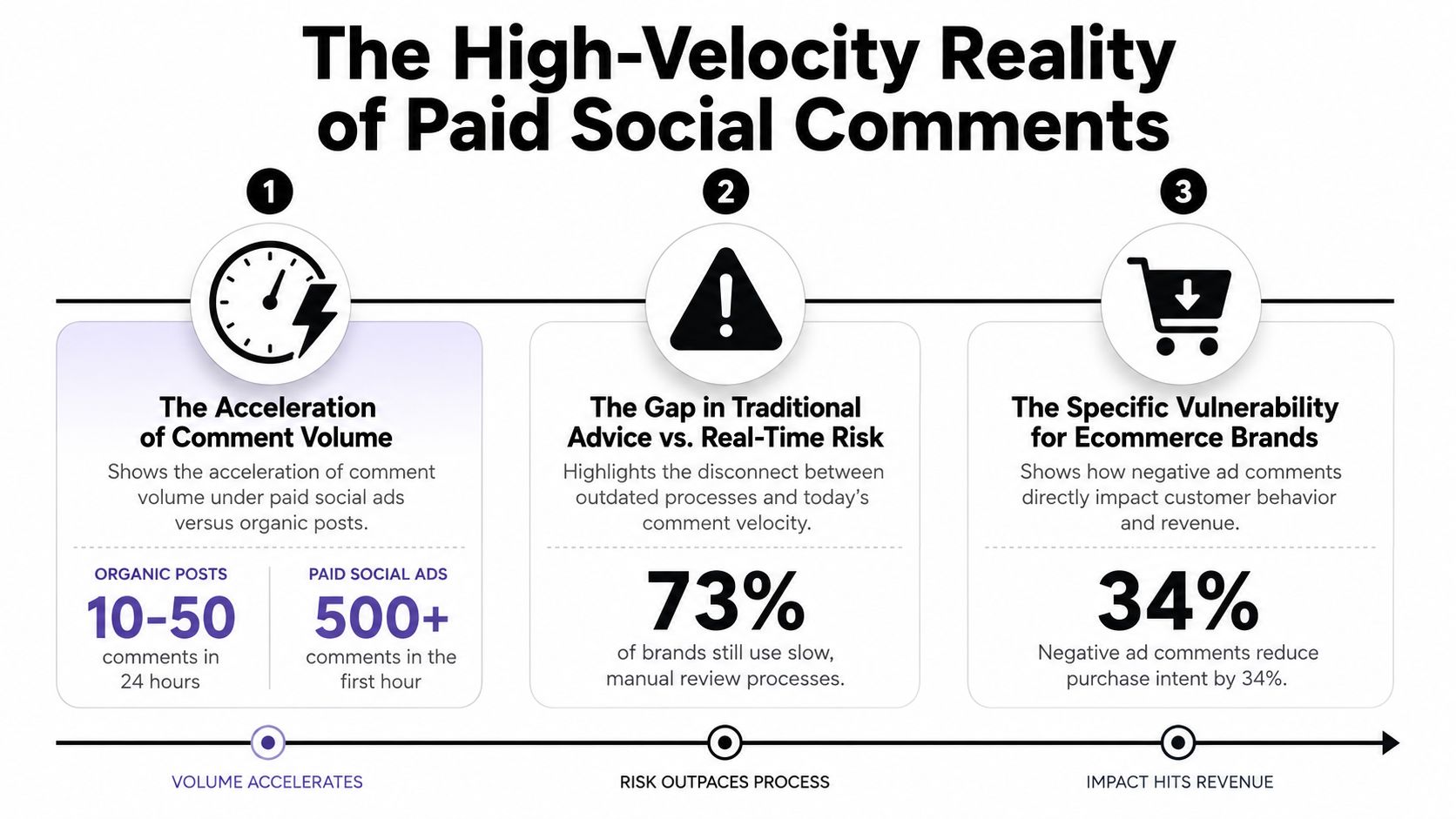
A paid post can start collecting objections before the ad spend has even settled. That is the reality with Meta and TikTok. Buyers do not wait around for a weekly review cycle. They ask a question, hesitate, or leave in the same session, and the comment thread or DM often decides what happens next.
Why weekly checks miss the real damage
The highest-risk window is the first minutes and hours after an ad goes live. Curiosity spikes, objections surface, and trolls pile in once they see attention. A team that only reviews comments in weekly meetings is already late. By then, the thread has shaped how new prospects read the creative, and the ad has been selling under that pressure the whole time.
Analysts at Shno report that a single negative review on page one can cost a business 22% of potential customers, and four or more negative reviews can cut total sales by 70%. That is a revenue problem with public visibility, not just a social media annoyance.
Attention also decays fast. Comment sections cool down quickly, but the harm often lands before the post loses momentum. DMs move the same way. Prospects expect a fast answer, and if they do not get one, they move on. The operational goal is not just watching volume. It is deciding who responds first, how quickly they respond, and whether the first voice sounds like the brand or like a gap in the process.
Why public replies matter more than silent cleanup
A public reply can save a sale before a private conversation starts. A clear answer to a price question, shipping concern, or product objection can do more than a testimonial because it shows up at the exact decision point. Buyers do not need polished corporate language. They need certainty.
The first reply under a paid post often does the work the landing page never gets to finish.
That is why ad comments need attribution-aware handling. When a comment appears under a high-intent creative, the team should treat it like a live sales assist, not a moderation task. The ad is buying reach, but the reply protects that spend and keeps the conversation moving toward purchase. What 3 million engagements taught us about buying intent makes the point clearly. The thread itself often reveals purchase intent before the form fill does.
The Hide Reply Escalate Framework for Ad Comments
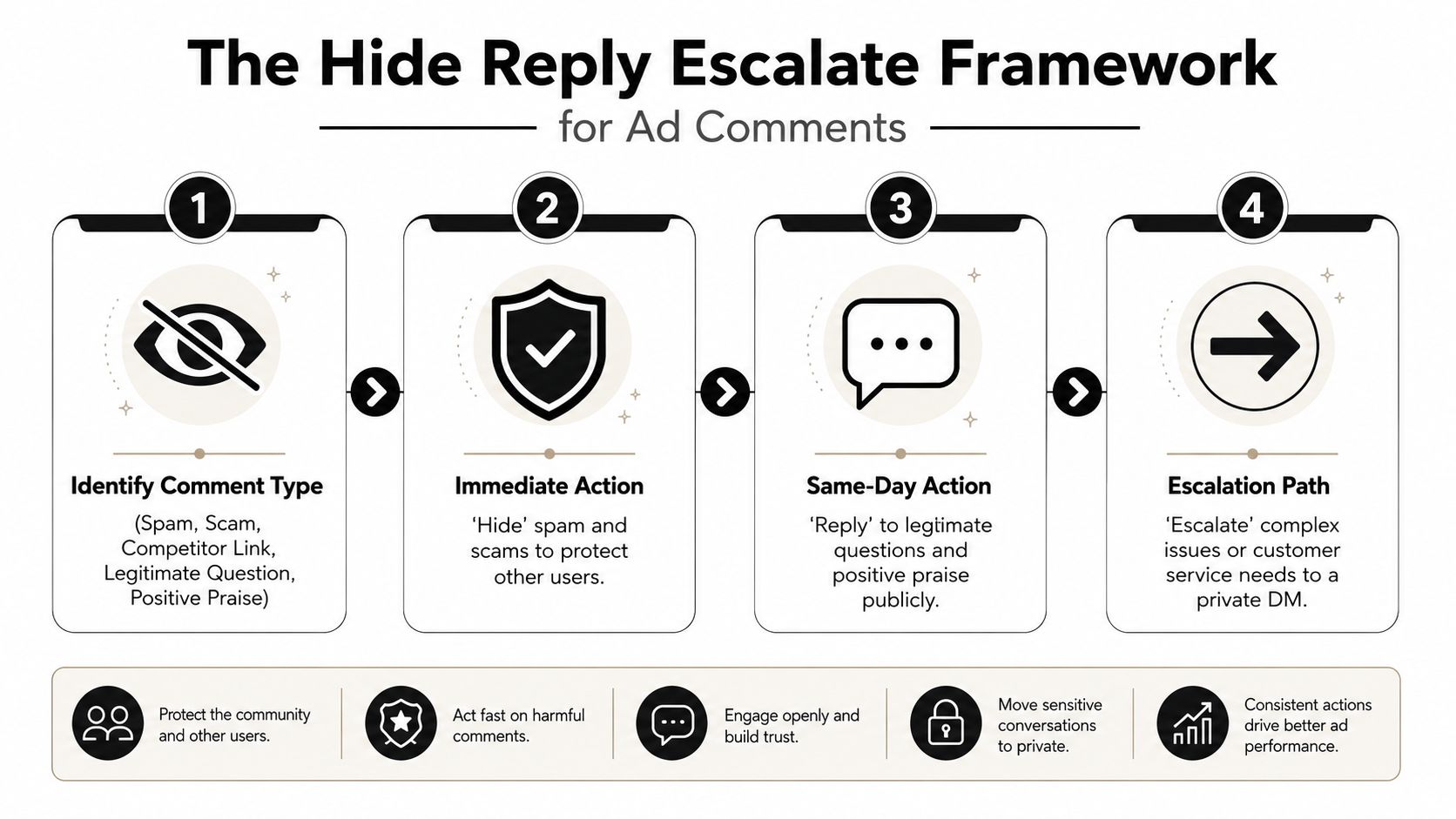
The fastest teams use a simple rule set. Not every comment deserves the same move. If you try to answer everything publicly, you waste time and amplify abuse. If you hide everything, you bury legitimate buyer questions and lose trust. The middle path is a hide, reply, escalate workflow.
Hide the stuff that only drags the thread down
Spam, scams, competitor links, and pure abuse should be hidden fast. On Meta, hiding is invisible to the commenter, which matters because it lets you clean up the thread without feeding the person who posted it. That makes it the right move for junk that has no legitimate business value.
Examples are easy to spot once you define them. A comment pushing a random discount link, a fake support number, or a repeated insult aimed at the brand doesn't need a debate. It needs removal. The same goes for obvious bait designed to drag buyers away from the offer.
Reply to questions that signal real buying intent
Real questions should get a public answer. Price, shipping, sizing, ingredients, setup time, and compatibility are all buying signals. Those comments should be answered in plain language, with enough detail that another prospect reading the thread can also benefit.
A single solid reply can outperform a testimonial because it reduces friction in the exact place the hesitation appears. If someone asks whether the product works with a certain routine or how long delivery takes, answer directly. That reply is serving the whole audience, not just the person who asked.
Escalate customer problems before they harden
An angry customer comment is usually a support ticket wearing a comment costume. Don't treat it like a debate. Move it to private DM or email, preserve the record, and keep the public tone calm. That's how you reduce escalation without looking evasive.
Practical rule: if the person has purchase history, move fast and move private.
A moderation playbook for Meta ads works best when the team decides in advance which thread types stay public and which ones don't.
Manual Teams Versus Simple Bots Versus AI Employees
Human moderation, rule-based bots, and AI employees all solve different parts of the problem. The issue is that they fail in different ways too. Manual teams miss coverage. Simple bots sound robotic. AI employees can handle the volume while keeping replies natural and attributable.
Moderation Approach Comparison | Manual Teams | Simple Bots | AI Employees |
|---|---|---|---|
Speed | Fast only when staffed and awake | Fast, but limited by rules | Fast in seconds, all day |
Tone | Can be good, but varies by person | Rigid and easy to spot | Natural language in brand voice |
Coverage | Breaks at nights, weekends, spikes | Available, but shallow | Built for always-on coverage |
Attribution | Usually messy or manual | Often weak | Every action can be logged |
Operational cost | Grows with headcount | Cheap, but limited value | Scales without adding full-time load |
Where manual teams break first
Manual teams can work when volume is low. They break when your campaigns scale, when launches stack up, or when your audience gets loud on weekends. That's when threads sit unanswered and the brand looks absent.
The workload also gets expensive in a quiet way. One person can only watch so many conversations before response quality slips. When the team gets busy, the early signs of buyer intent get missed, and the comment section turns from lead capture into a backlog.
Why simple bots frustrate buyers
Rule-based bots usually answer fast and sound wrong. They can't handle nuance, and the more the buyer deviates from the script, the more the reply feels off-brand. That hurts trust in the exact moment where the prospect was ready to engage.
Why AI employees fit paid social
AI employees sit in the middle. They respond in brand voice, handle comments, DMs, and web chat, and keep a log of what happened. That gives the team speed without losing attribution. It also lets the brand keep one consistent voice across Facebook, Instagram, TikTok, and website chat, with SMS, email, and voice on the roadmap.
Exerta is documented with 250+ brands, 15% average sales lift, and $2M+ recovered revenue attributed in-product. It also offers 99.9% uptime and no-code setup via Meta Business Manager, which matters when the team needs coverage without waiting on developers. Scaling engagement without scaling headcount is the right lens here, because paid social problems rarely arrive in neat business-hours packages.
Building Moderation Rules That Protect Without Over-Censoring
Good moderation rules remove abuse without burying legitimate feedback. That balance matters more in regulated or trust-sensitive categories, where the line between protection and suppression gets thin. If the team deletes everything sharp or uncomfortable, it may solve the short-term thread problem and create a trust problem later.

Start with clear filters, not vague sentiment
Keyword lists are useful when they're specific. Profanity, slurs, scam language, and suspicious outbound links belong in auto-hide rules. Comments asking about price, shipping, product details, or support should stay visible and get priority handling.
A broader sentiment flag helps, but it shouldn't act alone. Some negative comments are abusive. Some are legitimate complaints. Some are false alarms. The rule set should let the team review edge cases instead of flattening them into one bucket.
Build a branch for edge cases
A good workflow has more than one path. If a comment includes both a complaint and evidence of a real customer issue, send it to a reviewer. If it looks like fraud, hide it. If it sounds like a real service problem, move it to a private queue and preserve the public record.
Practical rule: hide the threat, answer the question, archive the complaint.
Approval gates help when a reply could create compliance exposure or trigger a broader issue. That's especially useful where a public answer could be too specific, too broad, or just wrong. The point isn't to slow the team down. It's to stop one bad public reply from becoming a second problem.
Use logs as a tuning tool
Every moderation action should leave a trail. If the team hides a comment, escalates a thread, or approves a reply, that history helps tune the rules later. Logs also create transparency, which matters when someone asks why a post disappeared or why a response was sent privately.
A lot of teams over-censor because they don't have a clean way to tell abuse from criticism. The fix isn't more fear. It's better branching logic and a clear record of what happened. That's what lets the brand protect itself without looking brittle.
Turning Comment Sections Into Revenue Recovery Channels
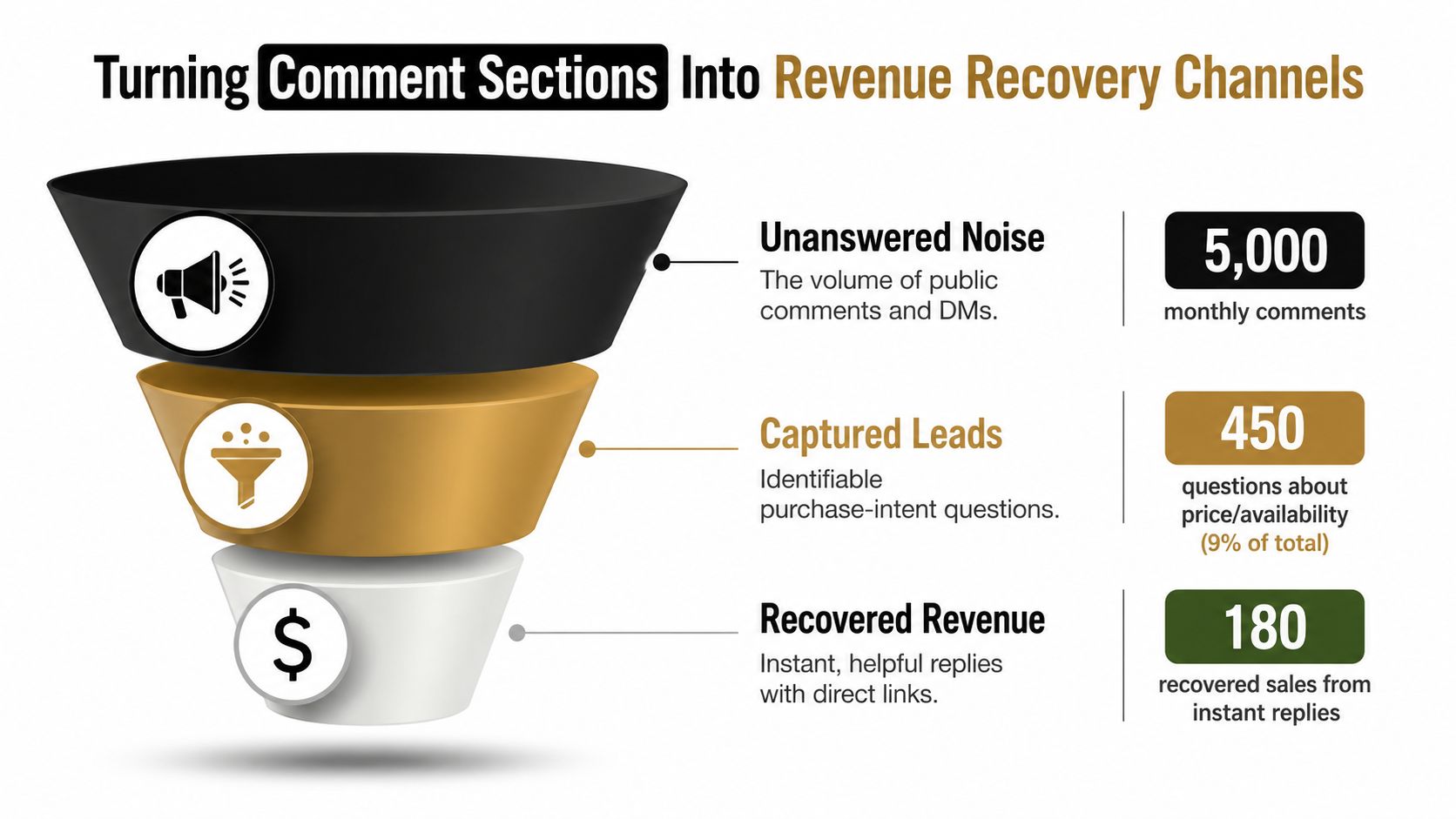
The fastest way to see the value of brand reputation protection is to connect comments to recovered sales. A question that sits unanswered is lost revenue pressure, because it leaves friction in place for every shopper who sees the thread. A quick reply with price, shipping, or a checkout link can turn a public comment into a sales assist.
Treat intent like a recoverable asset
In a high-volume account, the thread fills up fast. Some comments are just chatter. Some show real buying intent. The job is to separate the two and respond quickly when a comment signals purchase energy.
A simple funnel makes that logic clear. Public noise gets filtered. Purchase-intent questions get captured. Helpful replies move the next click. Moderation stops acting like a defensive chore and starts working as part of the conversion path.
Make the reply do a real job
A useful reply should remove one specific barrier. If the obstacle is price, answer it. If the obstacle is availability, answer it. If the obstacle is trust, answer with details a shopper can verify. Vague reassurance wastes the moment.
Exerta provides Shopify attribution that links recovered sales to the exact conversations that closed them, with real-time dashboards for recovered revenue and interaction volume. That matters because the team can see which replies saved revenue instead of guessing from engagement alone.
The system works best when it can also handle discounts, objections, and follow-up automatically. That lets the brand keep moving the buyer forward without waiting for a human to notice the thread. Why unanswered ad comments are costing you sales is the reality check here, because silence in a high-intent thread is rarely free.
Your Always-On Brand Reputation Protection System
Treat brand reputation protection like an operating system, not a campaign task. Review windows are too slow for paid social. You need coverage that runs all day, keeps a clean record, and answers buyer questions before the thread turns into a reason not to buy. That's the only way to protect both trust and ad spend at the same time.
The practical setup is straightforward. Use no-code setup through Meta Business Manager, configure brand training controls, and define escalation rules before volume spikes. Keep the system live across Facebook, Instagram, TikTok, and website chat, then extend into SMS, email, and voice as those channels come online. Exerta offers 99.9% uptime SLA, SOC 2 Type II in progress, and a 90-day revenue guarantee, which makes it a fit for teams that need reliability without dragging engineers into every workflow.
Start by auditing your current ad comments and DMs. Identify the posts that attract the most objections, the most spam, and the most purchase questions. Then put a protection layer on the threads that already influence revenue. That's where the money is leaking now, and that's where the fix should start.
If your comment sections are already shaping ad performance, Exerta gives you AI employees that reply, moderate, and recover revenue across the channels where buyers ask questions. It's built for Meta and TikTok teams that need speed, attribution, and a clean public thread without adding headcount. Visit Exerta to see how it fits your ad stack and what it can recover from the conversations you're already paying to start.

