Guide
Instagram DM Automation Guide for Ecommerce Brands in 2026
Learn how Instagram DM automation works, the 24-hour window rule, and how to build AI employees that recover sales, capture leads, and scale support in 2026.
13 min read
read
·


You're running paid traffic, comments are piling up, and the inbox is full of buyers who already raised their hand. One asked about price at 9:12 p.m. Friday. By Monday morning, that intent is cold, the click is buried, and the sale is gone. Instagram DM automation exists to stop that leak, but only if you treat DMs like a 24-hour revenue window, not a support queue.
The mistake most brands make is simple. They automate replies without measuring what came back in dollars. That creates busy inboxes, not recovered revenue. The better model is tighter, faster, and more selective. It respects the window, tracks the handoff, and only automates what can be captured safely and profitably.
Table of Contents
The 24-Hour Revenue Window Most Brands Are Bleeding
A buyer comments on a product post at 9:07 p.m. Friday, then replies to the auto-DM with a question about sizing. The brand sees it, but nobody answers until Monday. By then, the person has bought somewhere else, or at minimum stopped thinking about the offer. That's not a missed support ticket, it's a closed revenue conversation.
The practical reality is harsher than most admit. A comment or DM is not just engagement, it's a short-lived buying signal. The moment a buyer stops interacting, the clock starts decaying on your chance to move them toward checkout, booking, or a handoff. That's why the inbox should be run like a live sales desk, not a backlog.
Practical rule: if the reply can't land while the buyer still cares, it probably won't recover the sale later.
That's also why speed beats sophistication in the early moment. A clean, immediate acknowledgement keeps the conversation alive long enough for qualification, link delivery, or escalation. Slow inbox handling turns even strong offers into dead ends. For a useful breakdown of the timing itself, see the 24-hour DM window explained.
Why the window matters more than the message
The window is the constraint that shapes everything else. In the first few minutes, the job is to keep intent from evaporating. After that, every extra step, every manual delay, and every unnecessary back-and-forth raises the odds that the buyer disappears.
That's why AI employees matter as a category. They don't just answer, they keep the channel open while the buyer is active. The difference isn't cosmetic. It's whether the conversation is still alive when the prospect is ready to act.
Comments age on the same curve. A strong comment thread can drive private interest, but only while the thread is still fresh and the post is still circulating. Once attention moves on, the same message becomes much harder to recover. DMs are where the value is captured, but only if the handoff happens before the window shuts.
What Instagram DM Automation Actually Does
Instagram DM automation is a triggered private response system. A user takes an action, the system recognizes that action, and a message goes out inside the allowed window. That's very different from a generic chatbot, a public comment reply, or a bulk broadcast campaign. The mechanics matter because each one creates a different compliance and revenue outcome.
The four things people confuse it with
A scripted chatbot follows a fixed tree and breaks when the user goes off script. A comment auto-reply stays public, which can help with visibility but doesn't move the conversation into a private conversion path. A CRM broadcast is outbound by design, which makes it the wrong mental model for permission-based Instagram messaging. And AI employees are broader than any single bot, because they operate across messages, remember context, and can escalate when the conversation changes shape.
The clean way to explain it to a skeptical CMO is this. The user starts the interaction, the brand responds privately, and every handoff gets logged. If that sequence doesn't exist, it isn't real DM automation, it's just a canned response layer.
Good automation moves one user from public intent to private action without making them repeat themselves.
That's why the trigger matters as much as the copy. A keyword comment can route a shopper to a checkout link. A Story reply can open a qualification flow. An inbound DM can become support triage. The value comes from the motion, not from the fact that a message was sent.
What a working flow looks like
A usable flow has three parts. First, a user-initiated trigger, like a comment, Story reply, or inbound DM. Second, a private reply inside the active window. Third, a logged handoff so the team can see what happened and why.
If you want a tactical resource on how this connects to content, Instagram captions and repurposing tips can help shape the trigger language that gets people to comment in the first place. For the internal operating model behind the role itself, what an AI employee actually does all day is the better lens.
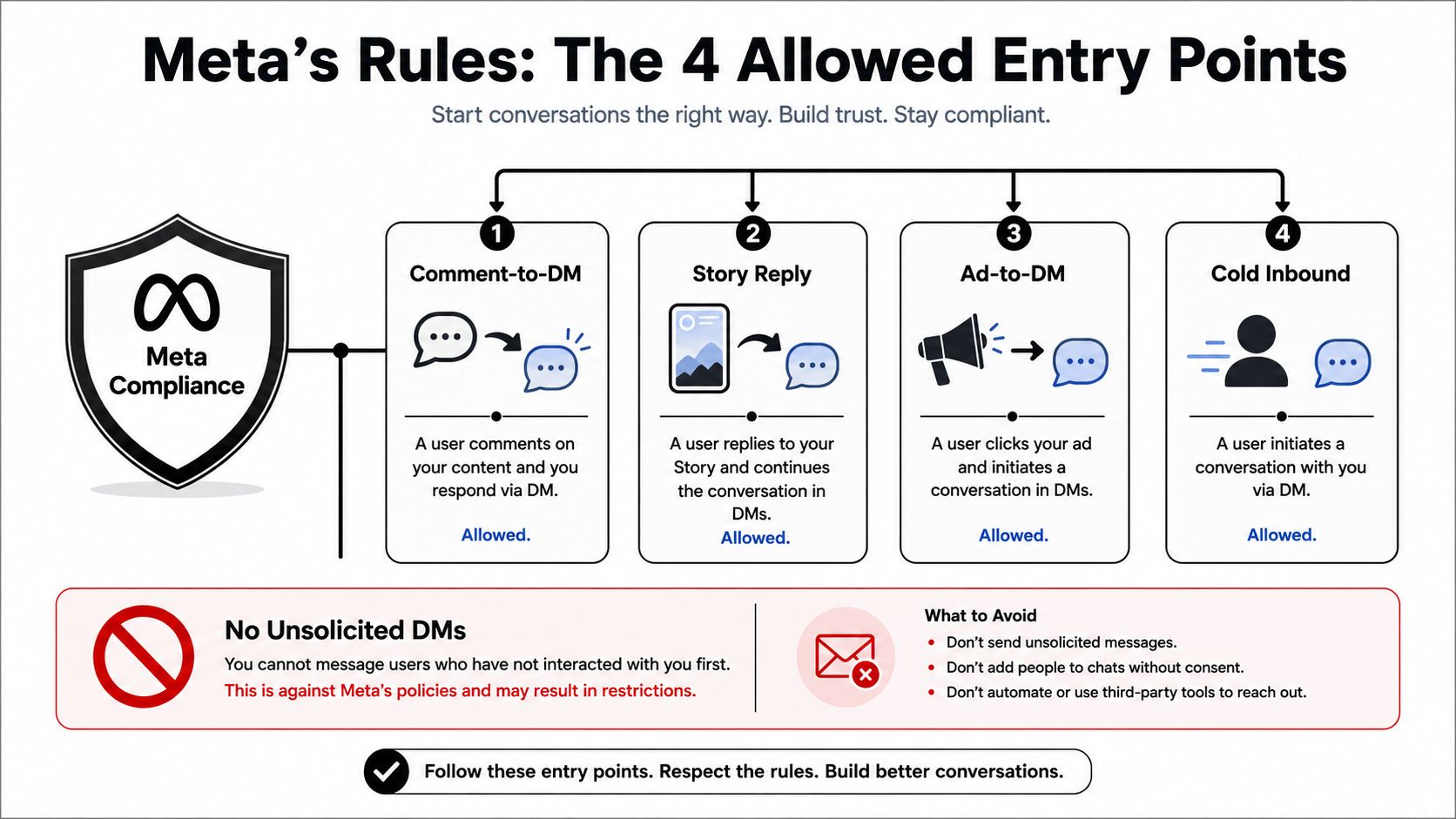
The deliverables are concrete. Send a checkout link after a keyword comment. Ask two qualifying questions before booking a call. Escalate a complaint to a human with the transcript attached. Those are revenue mechanics, not feature lists. For a broader workflow view, comment automation patterns show how public intent turns into private action.
The Meta Rules Every DM Automation Has to Respect
The safest way to think about Instagram messaging is operational, not theoretical. Meta permits automation when the conversation starts from a real user action, not from cold outreach. That means the starting point matters: comment-to-DM, Story reply, ad-to-DM, or inbound DM. Each one has a different purpose, but they all share the same rule, the user has to move first.
The boundary is the clock, not your intent
The most important constraint is the 24-hour user-interaction window. Once the user engages, you can reply inside that window. If they interact again, the window resets. If they don't, the window closes. A Friday night message that sits until Monday is outside the live service window, which is why slow handling kills recovery.
Meta also rate-limits automated private replies to about 200 messages per hour per account on the official Instagram Graph API, and the practical effect is queueing. During a viral ad spike, your system has to pace delivery rather than blast all at once. That's not a bug, it's the operating model. For official API and account eligibility details, the clean reference is Meta-compliant DM automation rules.
The right question isn't, “Can we send more?” It's, “Can we stay compliant while the queue is hot?”
What's safe, risky, and forbidden
Safe automation starts from user behavior and stays relevant to the trigger. Risk starts when teams try to stretch the window, reuse identical text at high volume, or automate outside the official API. Forbidden behavior is clearer, cold DMs to people who never engaged, scraping usernames, browser bots, and promotional messaging after the window has closed.
A separate operational detail matters for brands with volume. Each new user interaction can reopen the window, which is why recovery flows, FAQs, and handoffs work best when they're tied to real replies. That gives the team time to resolve the issue without needing a heavy developer stack. For a practical framing of compliant sales recovery, Instagram DM automation rules lays out the core boundaries.
Simple Bots vs Rule Flows vs AI Employees
Teams get pitched three architectures. The wrong choice usually comes from confusing speed of setup with value recovered. A simple bot is easy to describe, a rule flow is easy to control, and an AI employee is easiest to scale when the inbox gets messy. The best option depends on how much variation your conversations carry.
The trade-offs that matter
Simple bots are rigid. They can answer a narrow set of prompts, but they fall apart when the user asks something outside the script. Rule-based flows are better because they branch on triggers like keywords, Story replies, and order intent. That's where most first-time automation should start if the use case is narrow and the revenue path is obvious.
AI employees are different because they can work in natural language while staying inside the brand's boundaries. They're built for longer conversations, mixed intent, and recovery across channels, which is why they're better when the inbox is not predictable. If you want a useful way to think about this style of system, what is agentic automation is a relevant framework.
DM Automation Approaches Compared | Simple Bots | Rule-Based Flows | AI Employees |
|---|---|---|---|
Speed to launch | Fast | Moderate | Moderate |
Voice quality | Robotic | Controlled | Brand-consistent |
Handling exceptions | Weak | Limited | Strong |
Attribution | Basic | Better | Strongest |
Escalation logic | Manual | Conditional | Context-aware |
Maintenance load | Low at first, then brittle | Moderate | Lower over time when volume grows |
Exerta fits in the AI employee column, and its public operating claims matter because they show what a mature system should look like, 99.9% uptime, 250+ brands, and 15% average sales lift. That doesn't make simple rules wrong. It means rules are right for narrow flows, while AI employees become the better asset when recovery, moderation, and support all live in the same inbox.
Where simple still wins
A rule flow is still the right tool when the path is fixed. If the only job is to send a checkout link after one keyword, don't over-engineer it. If the only job is to collect one qualifying answer and route to a human, a simple branch works fine. The mistake is using a brittle bot where the conversation requires judgment.
The maintenance cost is what usually tips the decision. Simple bots need constant patching when product offers, objections, or policy language changes. Rule flows need more careful design but are easier to audit. AI employees reduce the rewrite burden because they adapt to context while staying measurable.
For a more detailed view of branching logic, multi-branch logic is the concept to study if your team is deciding how far to push automation before the handoff to a human.
Three Same-Day Plays for Sales Recovery, Leads and Support
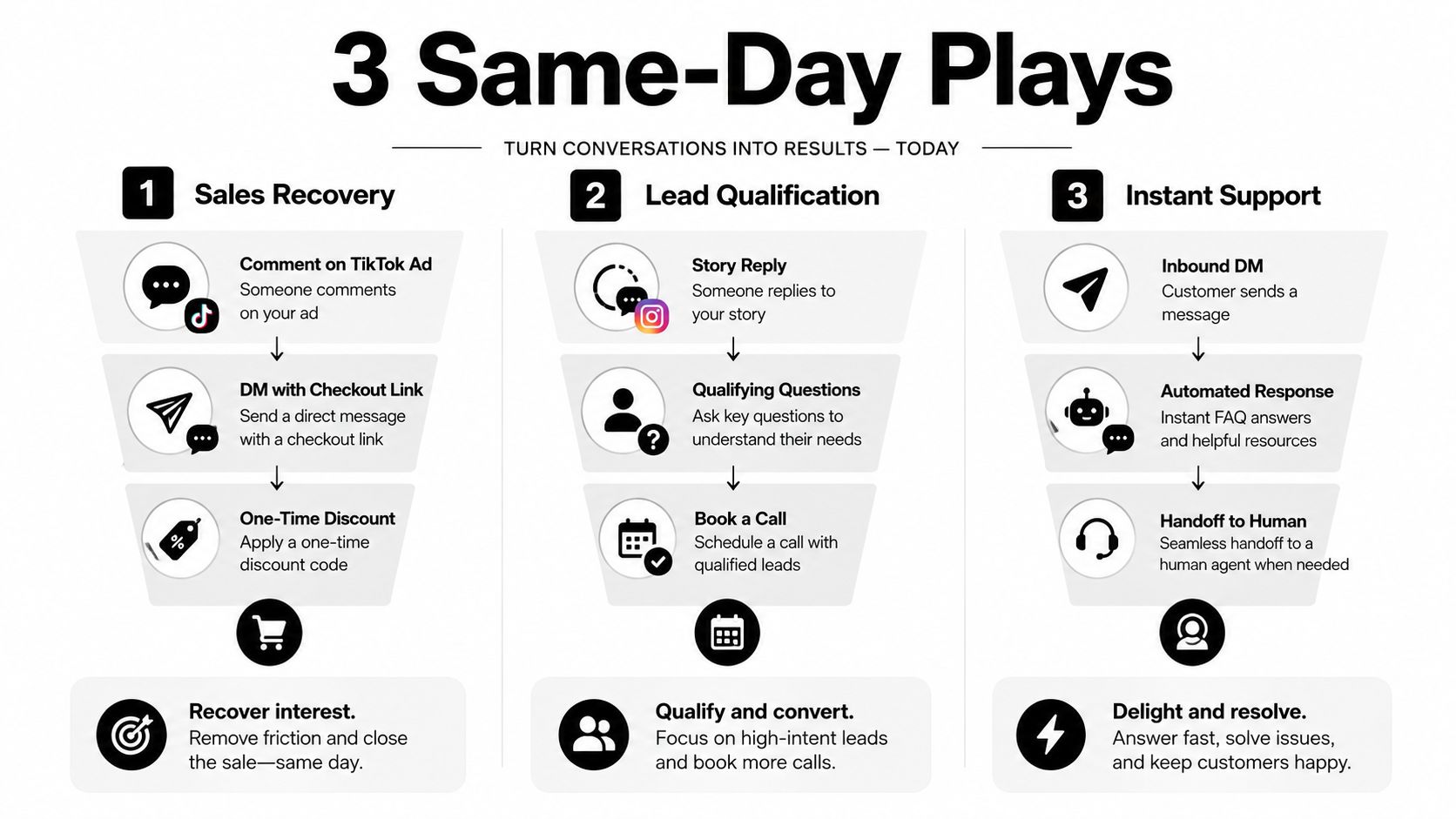
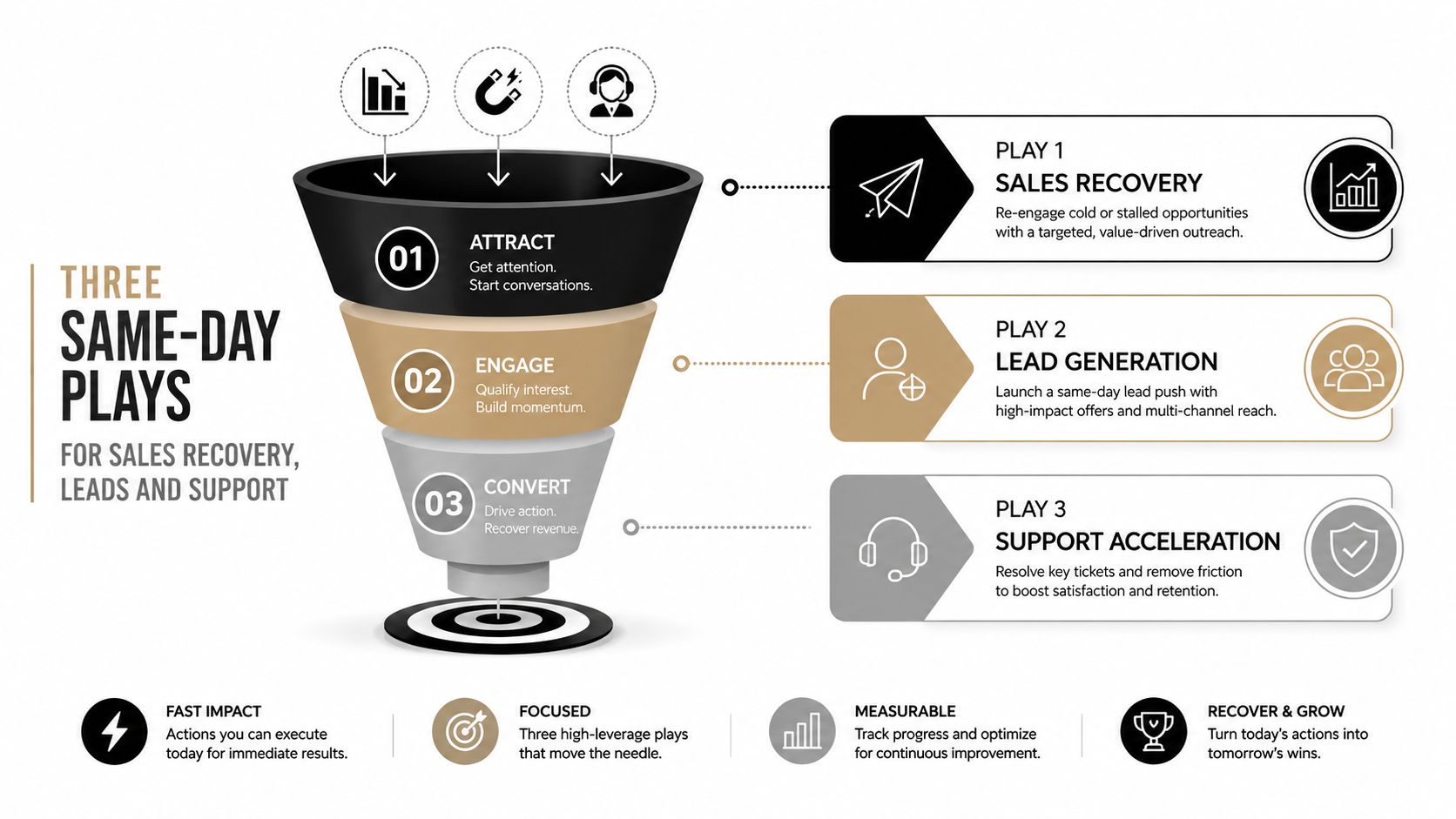
The fastest way to use Instagram DM automation is to deploy it against one of three jobs. Sales recovery, lead qualification, and support triage each have a different trigger, a different reply, and a different handoff. If your team can't name those three pieces in one sentence, the flow is probably too loose.
Sales recovery from comment intent
A shopper comments on a TikTok or Instagram ad with a keyword like “price” or “link.” The system sends a private message with the checkout link, then follows up once more inside the window if there's no click. The metric to watch is recovered orders from that thread, not the number of messages sent. The important move is to keep the offer attached to the original intent instead of restarting the pitch from scratch.
Lead qualification from Story replies
A telehealth, insurance, or education brand can use a Story reply to open a short qualification path. The first DM asks one orienting question, the second captures the key filter, and the last step books a slot or hands the transcript to a human. That keeps the conversation tight and avoids wasting a live lead with a long form. The metric to watch is qualified handoffs, not raw reply volume.
Support triage with escalation
A complaint comment should get a public acknowledgment first, then a private DM with the fastest useful answer, like order status or a return path. If the tone stays negative, the system escalates to a human with context attached. The metric to watch is escalation rate, because that tells you whether the automation is defusing pressure or pushing it deeper.
A clean way to ship this is to keep each play separate. Don't merge sales, lead-gen, and support into one branching tree on day one. That creates messy attribution and makes the handoff harder to control. Facebook Messenger automation is a useful reference if your team wants to think in channel-specific workflows rather than one generic inbox script.
Measuring What DM Automation Actually Recovers
The hard part is not sending the reply. The hard part is knowing which reply created incremental revenue. Many teams count conversations, then assume those conversations were all new sales. That's how you overstate lift and keep automations that look busy but don't change the P&L.
Reply volume is not recovered revenue
A high reply count can hide weak economics. If your system answered a hundred people, but most of them would have purchased anyway, the automation didn't recover much. The only number that matters is the one tied back to an order, booking, or qualified next step. That's why the dashboard has to separate conversation activity from outcome.
The cleaner approach is to log intent and outcome on every thread. Intent tells you why the conversation started. Outcome tells you whether the thread produced a click, a booking, or a sale. Shopify attribution linking makes that much easier because the recovered sale can be tied back to the thread that closed it, not just the campaign that started it.
Measure the sale recovered, not the message sent.
There's also a real attribution gap in most setups. A customer may have come in hot and would have bought with or without automation. That means the right question is incremental lift, not raw reply count. The more precise your tagging, the easier it is to separate true recovery from likely conversion.
Exerta's reported $2M+ in recovered revenue is a useful benchmark because it shows why attribution matters more than vanity metrics. If every conversation is logged and linked to the original comment or DM, the team can see which flows create value and which ones only create noise. A more detailed view of this problem appears in DM automation revenue attribution, which surfaces the same gap from a measurement angle.
The weekly numbers to pull
Response time: How fast the first meaningful reply lands.
Conversion rate: How many threads move to the next action.
Recovered revenue: What the conversation brought back.
Escalation rate: How often the automation had to hand off.
Those four numbers are enough to decide whether the flow belongs in production, needs a rewrite, or should be cut. Anything more complicated usually just delays the decision.
Best Practices Before You Turn It On
Before launch, keep the checklist short and ruthless. Stay inside the 24-hour window on every flow. Queue messages instead of blasting them when volume spikes. Split the four entry points into separate strategies. Escalate real complaints to a human fast. Tag every reply with intent and outcome so you can see what the automation recovered.
What to ship first
Start with the flow that has the clearest money path. If comments routinely ask for price or checkout links, ship that first. If Story replies mostly qualify leads, start there instead. If support is drowning in the same order questions, triage that before anything else.
AI employees help because they keep coverage on while your team sleeps, hold brand voice steady, and leave an audit trail behind every action. That combination is what makes the channel manageable at scale. It's also what separates a real operating system from a pile of canned replies.
Keep the first version boring. Boring is easier to measure, easier to fix, and harder to break.
Never automate what should be a judgment call. Complaints with real emotion, sensitive topics, and edge-case refund issues still deserve a person. The strongest programs automate the repetitive part and reserve humans for the moments that change the customer relationship.
Frequently Asked Questions on Instagram DM Automation
The cost depends on volume, complexity, and how much the system has to do beyond basic replies. A small brand often only needs a narrow rule flow, while a high-volume advertiser needs better attribution, queueing, and escalation logic. Cost question is whether the automation recovers more than it consumes in missed labor and lost replies.
Meta-compliant automation is safe for new accounts if it starts from user action and stays inside the allowed window. The risk isn't the age of the account, it's cold outreach, scraping, or unsafe message patterns. New accounts should keep the first workflows simple and highly relevant.
Agencies should separate each client page into its own logic, tags, and reporting. Shared processes are fine, shared context is not. If a thread from one brand bleeds into another, attribution breaks and support gets slower.
When SMS, email, and voice launch, the playbook gets wider, not looser. Instagram stays the fastest intent-capture channel, then the rest of the stack handles follow-up and persistence. That's the right sequencing for brands that want recovery without living inside one inbox.
If you want a system that treats DMs like revenue, not noise, Exerta is built for that job. It deploys AI employees across Instagram, Facebook, TikTok, and website chat today, with SMS, email, and voice next, so your team can recover more from the conversations you're already paying to start.

