Unified Customer View: How DTC Brands Build It
15 min read
read
·

The most popular advice about a unified customer view is also the least useful for a DTC advertiser. Teams are told to centralize data, build a customer profile, and create a clean source of truth. That sounds sensible, but a static profile won't recover a sale from a Meta comment, answer a TikTok objection, or protect a landing page while paid traffic is arriving.
A unified customer view only earns its keep when it acts on current intent. For brands and agencies running Meta and TikTok ads, that means recognizing the person, conversation, purchase context, consent status, and channel, then responding before the opportunity expires. The back office still matters, but revenue is won in the activation layer.
Only 36% of companies currently have capabilities that maintain a unified view of customer insights, according to Aberdeen research summarized in a unified customer data report. Nearly two-thirds are still working with fragmented visibility. The gap doesn't come from a lack of dashboards. It comes from slow, stale, disconnected operations.
Table of Contents
Why Most Unified Customer View Projects Fail
A unified customer view isn't a data warehouse project with a marketing label attached. It's a live operating system for customer conversations, and most implementations fail because the profile decays after launch.
A shopper might click an ad on one device, ask a question from another, use a different email at checkout, and return through website chat. If the system doesn't reconcile those signals, the brand sees several partial records instead of one active buying journey. The profile may look complete on the day it launches, but new identifiers and new behavior keep arriving.
Static profiles lose the moment
The 2025 customer management research identifies data fragmentation as a major barrier for 52% of customer management leaders, while 52% cite insufficient integration between systems and 42% cite legacy technology. Only 15% mention privacy or compliance and 15% cite lack of expertise, according to the 2025 State of Customer Management report.
Those findings point to a production problem. Teams often spend their energy defining fields, mapping systems, and approving a schema. They spend less time deciding who owns stale records, how quickly new events must flow, which match rules can merge identities, and what happens when two sources disagree.
For a paid social operator, the failure is immediate:
A missed intent signal: A comment asks about price, but the reply system can't connect it to a previous site visit or abandoned cart.
A broken suppression rule: A recent buyer continues seeing the same acquisition ad because the purchase record hasn't reached activation.
An unmanaged escalation: A genuine complaint is treated like spam, or a high-intent question waits behind a general support queue.
A dead conversation: The brand has context somewhere, but not inside the channel where the shopper is ready to act.
Practical rule: If a unified profile can't trigger a useful action while intent is fresh, it's reporting infrastructure, not a revenue engine.
Build for freshness, not just completeness
A reliable implementation needs a refresh policy for every important signal. Define how quickly purchases, product views, comment intent, DM history, refunds, and support issues should become available to the activation layer. Then test the path under real campaign conditions instead of assuming that a successful data sync equals a usable customer experience.
The same principle applies to behavioral personalization. If you want to understand how message framing influences a shopper's next action, this guide to applying psychological triggers in Shopify offers useful context. The trigger only matters, though, when the system can recognize the shopper and deliver the next response in the right channel.
Privacy creates another operating requirement. Research reports that 64% of senior executives cite privacy, security, or governance concerns as barriers to connecting customer data, while 48% cite poor-quality or disorganized data. The same research notes that unstructured data is estimated to grow at 7x the rate of structured data through 2026, increasing the pressure on controls and data integrity. Those figures appear in Adobe's 2025 data and insights report.
A useful customer view therefore needs consent-aware activation, clear escalation rules, audit logs, and a process for correcting bad matches. Without that maintenance loop, the project doesn't fail loudly. It sends the wrong message to the wrong person until the team stops trusting it.
How Identity Resolution Actually Works
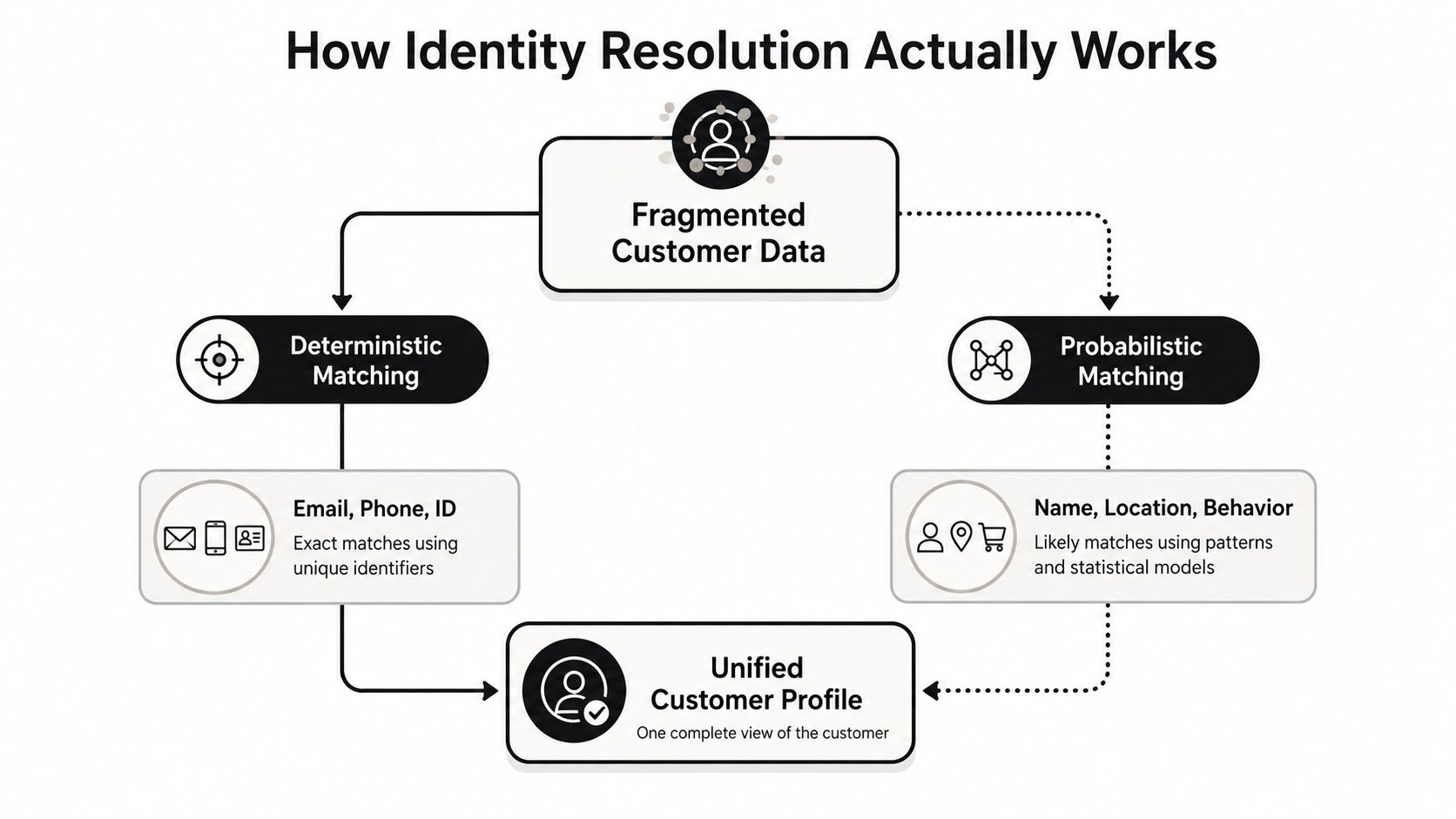
Identity resolution is the mechanism that turns scattered identifiers into an actionable customer profile. It doesn't mean every record gets merged automatically. It means the system evaluates evidence, applies matching rules, and decides which signals belong together.
A single shopper may generate six or more records across CRM, web, app, email, point of sale, support, and advertising systems, as described in Salesforce's identity resolution documentation. Those records can include an email address, phone number, device ID, loyalty ID, cookie, transaction reference, or offline purchase.
Deterministic matching favors strong evidence
Deterministic matching connects records through a known shared identifier. A verified email, loyalty ID, or phone number can provide a strong link. If a shopper uses the same email at checkout that they used to request a product link in a DM, the system can associate those events with higher confidence.
That doesn't mean the profile should discard the source values. A strong profile preserves unique contact-point values and records where each value came from. This helps downstream systems choose the right channel and prevents a new source from overwriting useful information.
Advertisers should define match thresholds before activation. For example, a purchase record might require an exact customer ID or verified email, while a broader behavioral association could require several consistent signals. The threshold determines whether the system merges, keeps records separate, or sends the case for review.
Probabilistic matching handles incomplete signals
Probabilistic matching estimates whether records describe the same person when no single identifier is conclusive. Name, location, device behavior, and interaction patterns can contribute to the decision, but each signal carries uncertainty.
Bad implementations create risk. If the system merges two household members because they share an address and device, a promotion or suppression rule can reach the wrong person. Probabilistic matching should support a confidence score, an audit trail, and a clear way to reverse an incorrect association.
A unified profile is also not automatically a golden record. Salesforce distinguishes identity resolution from master data management. Identity resolution creates a complete, actionable view for activation and analytics, while it doesn't establish a universal master record for every business process.
For a DTC team, start with the use case that needs speed. Connect the sources that influence ad comments, DMs, purchases, and web chat first. You can review Exerta's integrations when planning the channel layer, but keep the architecture explicit. Document the identifiers, thresholds, reconciliation rules, consent conditions, and source ownership before you let automation act on the profile.
Revenue Recovery in the 24-Hour Window
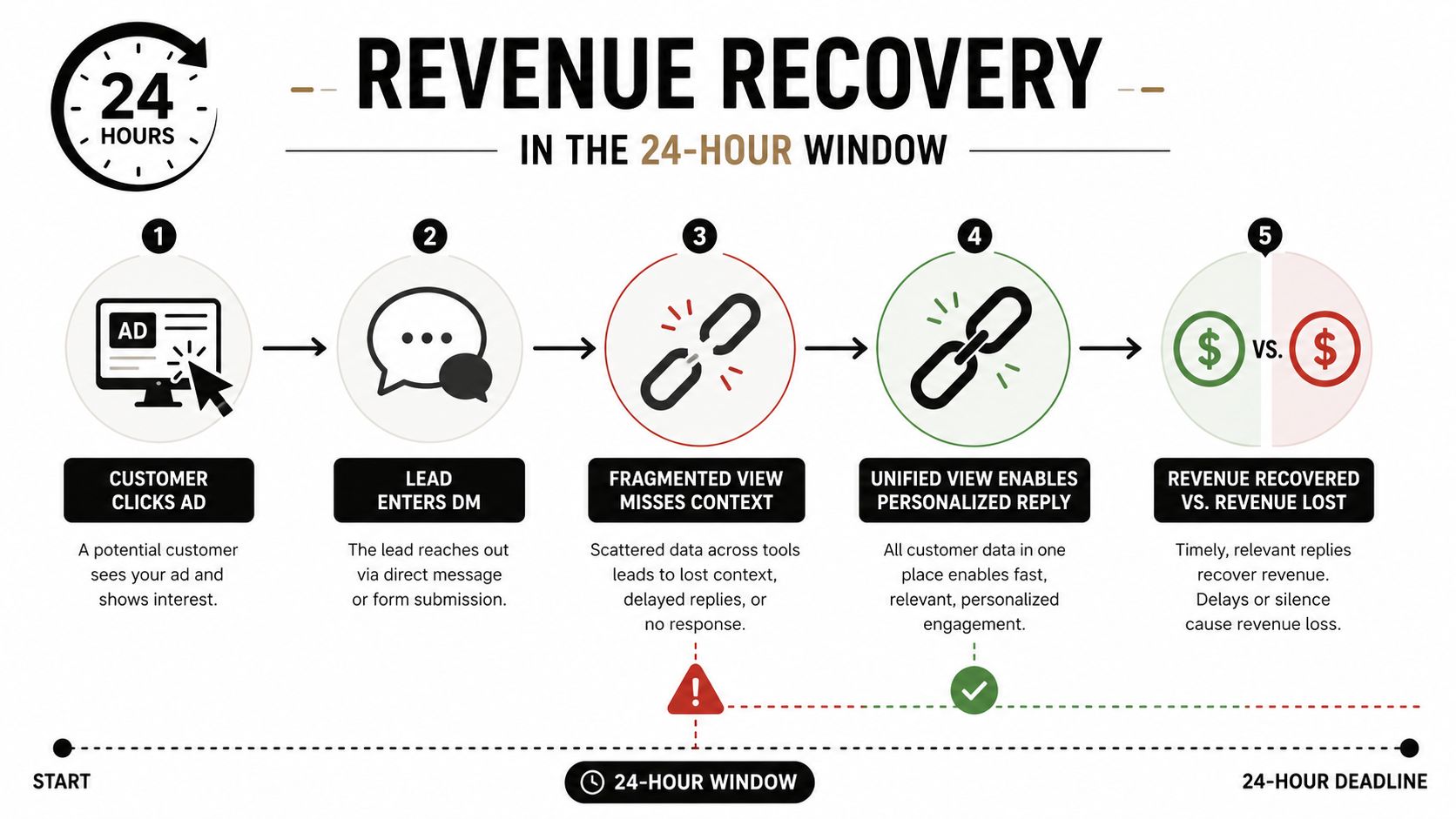
A shopper comments, “Does this fit size M?” under an Instagram ad. The public reply can resolve the basic question, yet the purchase often depends on the next interaction. Move the shopper into a private conversation, provide sizing guidance, and send a checkout path while intent is still active.
Meta's messaging policy gives brands a 24-hour standard messaging window after a user messages a Page. Outside that window, the account is limited to approved message tags for specific non-promotional purposes, as explained in this guide to the Facebook Messenger marketing window. A public comment can start recovery, but the private thread must begin quickly. Delay turns paid intent into an uncontactable lead.
Turn public intent into a private path
A unified customer view gives the responder more than comment text. It can show whether the person visited the product page, interacted with an earlier message, used a discount, or bought another item. That context helps the response address the actual blocker instead of forcing a generic script.
Use this same-day workflow:
Detect purchase intent: Route comments about price, stock, sizing, delivery, returns, or discounts into a priority queue.
Reply publicly with clarity: Answer the immediate question briefly so future viewers see a useful response.
Open the private thread: Send sizing help, an offer, a product link, or a checkout path inside the available messaging window. Follow this explanation of the 24-hour DM window when configuring the handoff.
Record the action: Log the comment, reply, link, and resulting purchase event against the customer profile.
Escalate the exceptions: Send medical, legal, payment, fraud, or serious complaint issues to a human with the full context attached.
The system should flag spam, profanity, scams, and misinformation within minutes of an ad going live. Moderation protects the thread, while legitimate objections should remain visible because they can help the next shopper decide.
Use chat where paid traffic hesitates
Website chat adds another recovery point on high-spend product pages. A visitor may pause over shipping costs and start to leave. A trained chat employee can answer shipping, returns, bundle pricing, and coupon questions without making the visitor search through the site.
One industry summary reports that sites with live chat see an average 12% conversion lift, while another conversational-commerce source reports that AI-powered chat shoppers convert at 12.3% compared with 3.1% for shoppers who don't engage with chat. Those figures are summarized in this live chat conversion guide.
Connect the conversation to the customer context used by social channels, then measure whether chat-assisted sessions produce orders rather than conversations alone. The unified view should help the agent answer faster and show the media buyer which campaigns generate intent that can still be recovered. That turns customer data into a revenue control loop, provided the team records the handoff and acts before the messaging window closes.
Protecting Ad Spend from Comment Toxicity
Negative comments under an ad become part of the ad experience. Future viewers read them before they decide whether the offer looks credible, and a hostile thread can change the economics of otherwise solid creative.
A Harvard Business School paper reports six empirical studies, including two large-scale field experiments on social platforms, and finds that automated moderation and engagement increased real advertising outcomes such as conversion rates and return on ad spend. The research is described in the paper on automated moderation and advertising outcomes.
A separate CXL case study reported a Facebook campaign without negative comments delivered a cost per install roughly four times cheaper than an otherwise similar campaign with negative comments, as detailed in this analysis of ad performance. The result doesn't mean every negative comment has the same effect. It does show why comment management belongs inside the paid media operating model.
Moderate by revenue risk
Start with rules that separate harmful content from useful friction. Hide obvious scams, crypto spam, competitor links, profanity, and misinformation. Keep legitimate questions visible, then answer them with short, factual replies that reduce uncertainty.
A workable launch queue looks like this:
First response: Review the first visible comments as soon as a paid post starts delivering.
High-risk removal: Hide scams, spam, and hostile content that can mislead or poison the thread.
Objection handling: Reply to questions about price, quality, delivery, sizing, or returns with approved facts.
Purchase routing: Move clear buying intent into DM or website chat and provide the next action.
Escalation: Send unresolved complaints to a human instead of letting an automated reply argue publicly.
Ad operations rule: Treat the comment section as creative placement. If the media team monitors spend but nobody monitors the thread, the campaign isn't fully managed.
Use the same logic across TikTok and website chat. TikTok comments need fast classification because the conversation can move quickly. Website chat needs intent routing, fallback answers, and a clear handoff when the visitor asks something outside the approved knowledge base.
For teams that want to connect moderation outcomes to commercial reporting, a practical reference on analytics for e-commerce and creators can help frame the measurement layer. Exerta's brand reputation protection workflow is another internal reference for building rules around visible risk, escalation, and campaign coverage.
AI Employees vs Traditional CDPs and Manual Teams
Traditional customer data platforms and manual moderation teams solve different problems. A CDP can provide durable identity, governance, segmentation, and historical analysis. A human team can handle nuance, empathy, exceptions, and sensitive complaints. Neither option alone guarantees fast revenue recovery in a live ad thread.
AI employees operate in the activation layer. They classify comments, respond in a brand voice, moderate harmful content, continue conversations in DMs, and answer website chat questions. The useful architecture often combines both approaches instead of forcing one system to replace the other.
Compare the operating choices
Approach | Setup Time | Response Speed | Attribution |
|---|---|---|---|
Traditional customer data platform | Integration-led and dependent on data engineering | Depends on event flow and activation configuration | Strong for journeys, segments, and cross-channel analysis |
Manual moderation team | Requires hiring, training, scheduling, and supervision | Limited by queue size and staff availability | Often depends on manual tagging and reporting |
AI employees | Can be configured around channels, rules, brand voice, and escalation paths | Designed for rapid replies across live conversations | Each action can be logged against the conversation and outcome |
A CDP is the right foundation when the business needs enterprise reporting, governed customer data, complex segmentation, or broad back-office analytics. It can answer questions such as which audiences purchased, how customers move across channels, and which events should influence future campaigns.
Manual teams remain necessary for cases that require judgment. A customer describing a serious service failure shouldn't receive a canned response, and a sensitive complaint shouldn't be treated as a conversion script.
Put automation where latency costs revenue
AI employees make the most sense where volume and response time create a measurable operational burden. Comment moderation, purchase-intent replies, product questions, and first-line website chat are repeatable workflows. The team can reserve human attention for exceptions instead of spending every launch hour clearing the queue.
Exerta is one example of this activation approach. Its AI employees work across Facebook, Instagram, TikTok, and website chat today, with SMS, email, and voice planned next. The platform logs engagement and recovery actions for attribution, while configurable escalation rules keep human review in the loop. For a deeper operational view, see what an AI employee actually does all day.
The trade-off is control versus speed. Automation needs approved answers, moderation boundaries, consent rules, and review paths. A CDP can supply durable context, while AI employees turn that context into a response where the shopper is already active.
Your Same-Day Implementation Roadmap
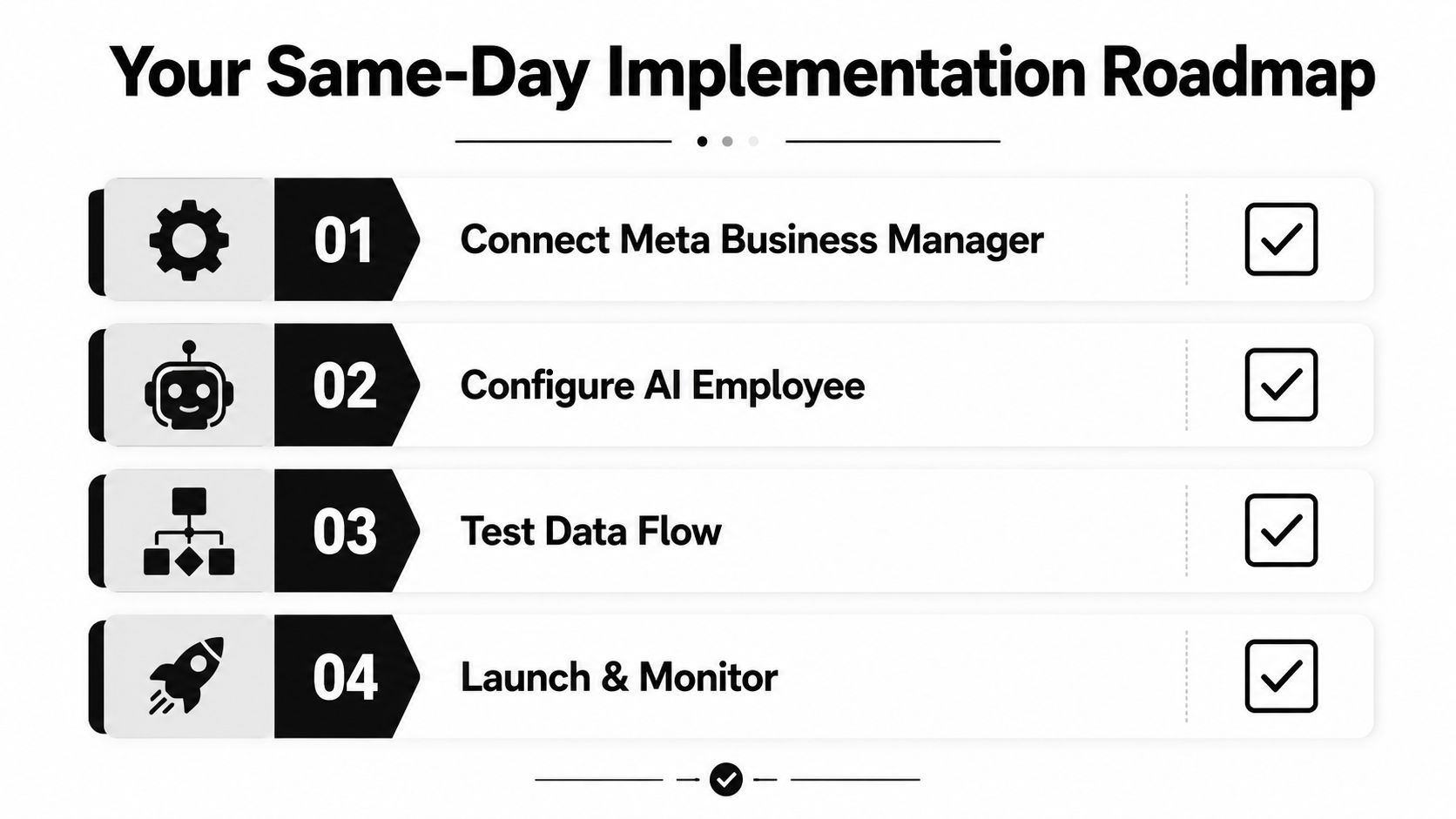
Don't start by trying to unify every customer system. Start with the paid traffic path where a delayed answer costs the most. Connect the ad account, conversation channels, product information, purchase events, and escalation rules that support one measurable recovery workflow.
Connect the live channels
First, connect Meta Business Manager and the relevant Facebook and Instagram assets. Add TikTok and website chat where those channels receive paid traffic. Then define the source of truth for product names, pricing, shipping, returns, discounts, and inventory language.
Next, configure the AI employee around the brand's actual operating rules:
Moderation rules: Hide crypto spam, scams, competitor links, profanity, and misinformation.
Sales responses: Answer price, stock, sizing, shipping, and offer questions with approved language.
DM routing: Move purchase-intent shoppers into private threads before the available messaging window closes.
Escalation paths: Send genuine complaints, sensitive subjects, refund disputes, and uncertain answers to a human.
Logging requirements: Record the source comment, response, link, handoff, and resulting revenue event.
A workflow builder such as Exerta's workflow builder can help teams express these paths with branches rather than burying every case inside one oversized prompt.
Test the data flow before launch
Run test comments for a product question, a discount request, a scam, a complaint, and an ambiguous message. Confirm that the system identifies the right intent, selects the right response, preserves the conversation context, and escalates when required.
Add website chat to high-spend landing pages first. Program it to answer the blockers that appear repeatedly in support tickets and sales conversations. Don't measure success by chat volume. Track response time, assisted sessions, conversion lift, recovered revenue, and the campaign or ad group that produced the interaction.
For agencies, create one repeatable template, then customize brand voice, product data, moderation rules, and escalation contacts for each client. Review the live dashboard during launches, especially when spend increases, and use failed responses to tune the workflow rather than hiding the errors in a manual report.
A unified customer view is complete when a buyer's signal becomes a timely, compliant action, and the business can prove what happened afterward. That is the standard to use when deciding whether to expand coverage or increase media budget.
Exerta deploys AI employees across Facebook, Instagram, TikTok, and website chat to moderate comments, answer buyer questions, move intent into DMs, and attribute recovered revenue. Visit Exerta to connect your paid social and web engagement workflows, then start with one high-spend campaign you can measure today.