Multi Channel Engagement Strategy: A Practical Guide
read
·

97% of consumers say it's important to switch channels without repeating information, yet only 16% of CX leaders report fully integrated channel technology and data, according to Genesys' customer experience overview. That's the gap a multi channel engagement strategy needs to close. Switching on another inbox is easy. Keeping the buyer's question, promised offer and next action intact is harder.
For paid-social teams, the useful unit of measurement isn't channels connected. It's recovered revenue per transition, such as an Instagram comment becoming a private conversation, then a checkout. Build around those transitions, and you can judge whether more coverage helps buyers purchase.
Table of Contents
What a Multi Channel Engagement Strategy Covers
Having channels means buyers can reach you in several places. Coordinating them means your team applies one set of operating rules wherever a conversation starts: Facebook, Instagram and TikTok ad comments, DMs, website chat, and eventually SMS and email.
Think of a store with one floor manager who knows every open conversation. If a shopper moves from a display to the checkout counter, the next employee knows what they discussed. Disconnected inboxes work like separate counters whose staff never share notes.
The difference matters commercially. In 2025, customer satisfaction was reported at 67% for integrated omnichannel support versus 28% for disconnected multichannel support, according to Plivo's compilation of omnichannel service research. That comparison supports coordination, not the assumption that adding another channel automatically improves sales.

Build the operating system around the buyer
A practical strategy has five parts:
Coverage and response targets: Decide where buyers need help and how quickly someone must act.
Intent routing: Separate spam, questions, objections, complaints and purchase signals.
Continuity: Carry relevant context into the next conversation.
Governance: Set claim boundaries, moderation rules and human approvals.
Measurement: Connect the interaction to checkout and order outcomes.
Say a buyer asks about price under an Instagram ad, requests details privately, then visits the product page. The public reply should explain the price. The private response should address their remaining concern. Website chat shouldn't restart the sales conversation from scratch.
That doesn't mean copying every message into every tool. Share the information the next owner needs to act, with appropriate access controls. A public question about fit doesn't justify exposing someone's order history.
Self-check: For every channel, name an owner, a response target and a rule for hiding content. A channel missing any of these is present, but it isn't yet managed as part of the strategy.
For agencies, ownership must include the client boundary. Specify who can answer product questions, who can authorize exceptions and who takes over when the agency can't resolve an issue.
Channel Coverage Map for Meta, TikTok and Web Chat
Channel roles, response targets and platform limits
Channel | Role in the strategy | Response target | Platform limit |
|---|---|---|---|
Facebook comments | Public questions, objections and social proof | Within minutes while intent is hot | Hide spam immediately; no fixed reply window specified here |
Instagram comments | Public questions and buying signals | Within minutes while intent is hot | Hide spam immediately; no fixed reply window specified here |
TikTok ad comments | Comments under paid placements | Same day | Filter, review, hide and switch off comments per ad in Ads Manager |
Facebook and Instagram DMs | Private product questions, links and checkout help | Within one hour | User-initiated messaging window applies |
Website chat | Buyers arriving on paid landing pages | Within minutes while the buyer is on the page | Coverage limited to your own chat hours |
SMS, roadmap | Recovery follow-up after a buyer opts in | Planned, set before launch | Require opt-in consent before sending |
Email, roadmap | Post-purchase and recovery messages | Planned, set before launch | Build consent and unsubscribe checks |
Voice, roadmap | Callbacks for high-value or complex questions | Planned, set before launch | Check consent and permitted calling hours |
Read the map in buying order. Public comments are the sales floor. Answer useful questions where later visitors can see the answer, and remove obvious spam promptly. TikTok ad comments need assigned coverage too, not whatever time remains after Meta moderation.
Private messages handle details that don't belong in public. In a 2025 survey of frequent social-media users, 32% expected a DM response within one hour, reported by Chain Store Age. Treat that as a service expectation, not permission to message someone.
Website chat catches buyers after the click. Configure it around the landing page's product, promotion and likely objections. When planning website chat coverage, assign an escalation owner as well as an automated answer path.
Track relevance, not just speed
In an Emplifi survey of more than 1,000 social-media users aged 16 to 55, 52% expected a digital-channel message response within one hour, including 10% within five minutes, according to MarketingCharts. Use those expectations to set staffing and alerting priorities.
Track both time to first response and time to first relevant response. An acknowledgment doesn't resolve a shipping objection. The relevant-response clock stops only when the buyer gets the delivery information they asked for.
For example, set a 15-minute comment target during a launch window. Route any shipping question still unanswered after that hypothetical target to the owner on shift. Don't promise that speed outside the hours your team or automation can sustain.
SMS, email and voice are planned channels, not live coverage. Define their consent checks and ownership before launch rather than inheriting social-inbox rules.
Route Every Comment and DM by Intent
Route by what the buyer needs, not which inbox received the message. A shipping question under an ad and the same question in chat should use the same approved delivery facts. Their public and private handling can still differ.

Hide spam, scams, competitor links and abuse under a written policy. Remove prohibited material from the public thread so buyers can assess the offer without scam links or harassment. For example, hide a fake support account directing shoppers to an unrelated payment page, but don't hide a legitimate product comparison just because it names a competitor.
Answer the actual product question. Give the size, price, material or feature detail requested instead of sending everyone to support. If someone asks whether a jacket has an inside pocket, answer that question directly using the product specification.
Resolve objections with specific proof. A price objection needs an explanation of what's included, while a legitimacy concern needs verifiable delivery, review or refund information. Use the brand's published policy, not an invented guarantee, because later readers will judge the same reply.
Acknowledge genuine complaints publicly, then transfer ownership privately. A short acknowledgment shows that support is available without exposing personal details. For a missing parcel, ask the customer to contact private support and attach the complaint summary to the handoff.
Route purchase intent to the permitted sales action. Send a requested product or checkout link when the channel supports that action and messaging permission is active. A buyer asking for the correct size's purchase page needs that page, not another qualification script.
Stop automated follow-ups when permission or engagement ends. Suppress further sales prompts when the buyer opts out, stops replying under your configured stop rule, or the applicable messaging window closes. If they've already purchased, close the recovery flow instead of continuing to pitch.
Apply the route without inventing channel permissions
Say a TikTok comment asks whether a product comes in black. List the available colors and direct the buyer to the product page through the supported reply path. If they then request a private link, use a permitted messaging route, not an assumed Meta-style window on TikTok.
Use buying-intent analysis to distinguish curiosity from a request to purchase. For support handoffs, teams can also explore the Gorgias integration from Securify when assessing how engagement should connect with their helpdesk.
If a comment takes value from the audience, moderate it under policy. If it adds information to the buying decision, answer it.
Carry Context Across Channels Inside Platform Limits
A buyer gives their preferred size in a public comment. They move into a DM and get asked for the size again. The team hasn't completed a handoff. It has opened another conversation and made the buyer repair the missing context.
Create a minimum shared interaction record, not an unrestricted copy of everything you know about the customer. Include these fields:
Campaign or ad source: Preserve the originating campaign, ad set and creative identifiers.
Product and intent: Record the item, variant and unresolved question.
Promises already made: Save quoted offers, delivery commitments and approved exceptions.
Last qualifying interaction: Store the timestamp and event that established messaging eligibility.
Consent and ownership: Record permitted follow-up channels, opt-outs and the person responsible for the next action.
A unified customer view should help the next owner act without guessing. Don't merge identities solely because public usernames look similar. Use a confirmed connection or keep the records separate until the buyer supplies one.
Enforce the messaging boundary
Meta's Messenger Platform FAQ generally permits messaging within 24 hours after a qualifying user interaction; the window opens after the user interacts with the opt-in message, and standard messages outside it can fail. Supported message tags can extend messaging for specific use cases, but they can't be used for unrelated promotion.
Build that rule into the workflow. Answer product questions, send requested links, confirm availability and address checkout objections while eligibility is active. Stop ordinary follow-ups when it expires, and don't treat an old comment as indefinite permission to sell.
The record should retain failed-send status too. Otherwise, an operator may assume the buyer ignored an answer that never arrived.
For retention planning, Up North Media's guide to boost loyalty through omnichannel marketing offers a useful broader perspective. Operationally, loyalty starts with honoring the details and promises already exchanged.
A buyer moving from comment to DM shouldn't have to supply a fact again because your systems failed to pass it on.
Security checks are different. Explain why verification is needed rather than presenting it as another sales question.
Governance for Brand Voice and Moderation Rules
Risk tiers for automated engagement actions
Risk tier | Examples | Handling | Approval needed |
|---|---|---|---|
Hide | Spam, scam links, competitor attacks, abuse | Hide immediately and log it | None under the written hide policy |
Automate | Order status, shipping timing, product facts | AI employee answers in brand voice | None after the voice sheet is approved |
Approve | Discounts, eligibility, offer exceptions | Answer only from the approved offer list | Named owner signs off before the offer goes live |
Escalate | Health or financial claims, sensitive data, unclear intent or emotion | Hand to a human at once | Human agent responds |
Assign separate accountability for brand voice, moderation policy and approvals. One person can hold several roles, but each decision needs a named owner. Otherwise, an operator may approve a reply's tone without anyone checking its commercial promise.
Write a voice sheet containing approved claims, banned phrases, current offers and escalation language. Use brand voice examples to make the difference between acceptable and unacceptable replies concrete. Include an example where the right answer is to decline a request politely.

Match controls to campaign risk
TikTok's brand safety guidance describes per-ad controls to filter, review, hide and switch off comments in Ads Manager. Use that granularity: a regulated-product campaign needs stricter unsupported-claim filters than a straightforward product launch.
Don't turn a keyword list into a blanket ban on criticism. A competitor attack containing abuse can qualify for hiding. A buyer asking why another brand costs less deserves a factual response.
Before enabling an AI employee, test difficult cases:
Discount request: Does it quote only an authorized offer?
Health question: Does it avoid unsupported advice and transfer appropriately?
Angry customer: Does it acknowledge the issue without inventing a refund?
Mixed intent: Does it recognize a complaint inside an otherwise positive message?
Customers are responsible for reviewing and testing agent behavior before enabling it on live channels. Approval isn't complete until someone checks both the wording and the action the workflow takes.
Log evidence, not just output
In global research published by Twilio, 85% of consumers had interacted with an AI agent in the prior three months, but only 15% experienced a smooth AI-to-human handoff, while 66% were uneasy about an agent accessing their full customer history. Faster automation doesn't remove those trust concerns.
Log each automated reply, hidden item, approval and transfer. Include the rule applied and the information used to produce the answer. Limit customer-history access to what the task requires, and make human support available.
Automate order status, shipping facts and approved product details only when the underlying record supports them. A confident tone can't compensate for missing evidence.
Measure Recovered Revenue Without Counting Comments Alone
KPIs for multi channel engagement
KPI | What it shows | How to calculate |
|---|---|---|
Time to first relevant response | Speed of an answer that resolves the question | Median minutes from the buyer's question to the first reply that answers it |
Channel handoff rate | How often a buyer moves between channels | Conversations with a second channel divided by all conversations |
Repeated-question rate | Lost context across channels | Buyers asked for the same fact twice divided by all handoffs |
Intent-to-checkout rate | Buying signals routed toward checkout | Checkout links sent divided by purchase-intent conversations |
Recovered-revenue rate | Sales attributed to engagement | Attributed orders divided by all conversations that reached a buying signal |
Median time from first signal to purchase | Speed of the buying path | Median hours from first buying signal to order |
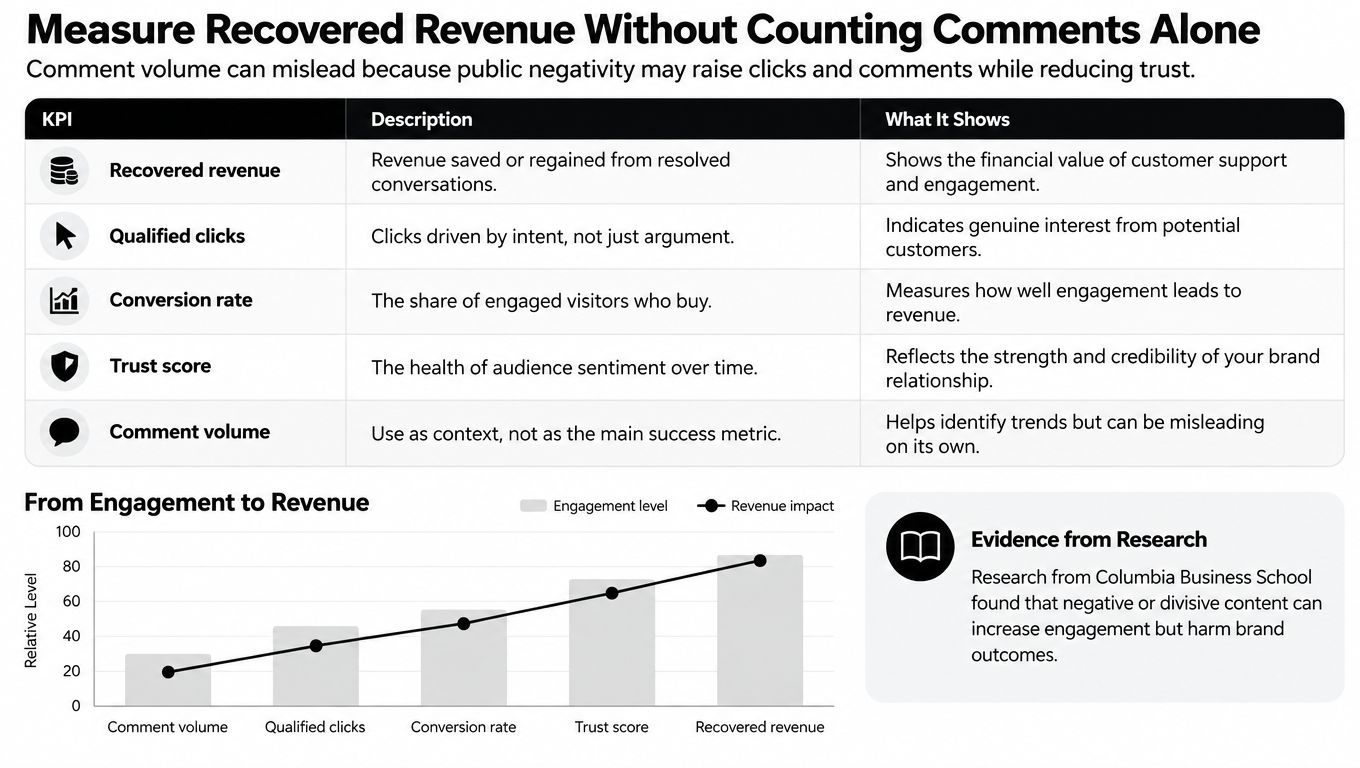
Comment volume can reward the wrong behavior. In a field experiment involving about one million viewers, negative or opposing comments produced more clicks, comments and reactions; a separate survey experiment with 5,000 participants found that people exposed mainly to negative comments were less supportive and less likely to donate afterward, according to Columbia Business School.
That isn't a retail sales experiment. It is a clear reason not to equate visible activity with a better business outcome. An argument under an ad can attract attention without resolving anyone's purchase concern.
Run a comparison that answers a business question
Use comparable ad sets or matched time periods. Apply the documented hide policy to spam, abuse, scams and misleading claims in the test condition, while maintaining required safety controls everywhere. Don't deliberately leave dangerous content visible just to create a control.
Keep the creative, offer, audience and landing page as comparable as possible. Compare click-through rate, landing-page conversion rate and purchase or lead rate. Record changes in spend and traffic quality so you don't credit moderation for a different audience mix.
Start the test today, but don't declare a winner from an early fluctuation. The operational decision is whether the policy improves qualified traffic and purchasing, not whether the thread looks quieter.
Attribute orders without claiming causation
Tag each reply, DM and checkout link with its source and shared record identifier. Define the qualifying interaction before reviewing results, then use consistent conversion attribution rules.
For example, a DM sends a checkout link on Tuesday and an order closes Wednesday. Count it as attributed recovered revenue only when the link and order connect to the same record and meet your recovery definition. A timestamp near a purchase isn't enough.
The table's intent-to-checkout metric measures links sent, not verified checkout visits. Track actual checkout starts separately. Likewise, the recovered-revenue rate shown is an order-based rate, so retain attributed revenue as a currency total alongside it.
Finally, calculate recovered revenue per transition by dividing qualifying attributed revenue by completed handoffs for each path. Compare comment-to-DM against DM-to-chat, while checking complaints, opt-outs and repeat questions. Attribution assigns credit; a controlled comparison helps assess whether the engagement created additional sales.
Confirm Your Setup Before You Scale It
Channel presence is the easy part. Before adding coverage, check that ownership, handoffs and escalation rules work across the channels already connected. Measure the revenue recovered through each transition, not just the number of channels switched on.
Map live channels. Assign Facebook, Instagram, TikTok and website chat to an owner and response target. Agencies should name both the operator and the client contact for unresolved product or policy questions.
Approve operating rules. Set the moderation policy, brand voice and risk tiers before enabling automation. Define a fallback for uncertain intent rather than forcing every message into a sales flow.
Connect, review and test. Connecting channels takes about a minute, and AI employees can start answering, moderating and closing sales the same day. Actual setup time varies with channel count and customization. Review and test agent behavior before enabling it on live channels.
Compare outcomes. Use comparable ad sets and assess conversions, not comment counts alone. Keep a change log so the team can separate the effect of a moderation change from changes to an offer, creative or landing page.
Review before expanding. Use the KPI table as a checkpoint after two weeks. Expand only when current response targets hold. Investigate repeated questions, failed transfers and unresolved complaints before adding more coverage.
Expand only when ownership is ready
Treat SMS, email and voice as a later phase, with their own consent, suppression and escalation rules. Social coverage does not automatically give the same operator the capacity or authority to manage callbacks. Check the owner and handoff for each path first.
Exerta serves 250+ brands, with a 15% average sales lift and $2M+ recovered. Revenue and success figures draw on aggregated platform data and customer-reported results, and are updated periodically. Results vary with ad spend, engagement volume, offer and configuration, and Exerta does not guarantee similar results for any customer. Teams considering a Bigger plan can book a call to map their channels to the right fit in under 15 minutes.
Exerta's AI employees answer comments and DMs, moderate content and help interested buyers reach checkout across connected social and website channels. Visit Exerta to build coverage around handoffs, approval rules and revenue measurement, rather than adding another inbox.


