Order Management for Ecommerce That Scales Paid Social
read
·

Your Meta campaign is working. Clicks are coming in, comments are active, and checkout volume is rising. Then the cracks appear. A product sells through in one channel, but the others still show stock. Orders sit in a spreadsheet. A high-intent buyer asks for a link in an Instagram comment, but nobody replies before interest fades.
Order management for ecommerce affects paid social performance. The ad only creates demand. Your order flow decides whether that demand becomes a delivered order, a refund, or a support ticket. Inventory accuracy, routing, processing speed, customer messaging, and returns all influence the revenue your media spend can produce.
Table of Contents
Introduction Why Order Management Decides Growth
A DTC team often treats fulfillment as an operations problem and paid social as a marketing problem. Customers don't experience those departments separately. They see one brand. If an ad promises a product that isn't available, or a payment clears but the order doesn't move, the customer blames the brand, not the handoff between systems.
Order management connects the promise made in the ad to the work required after checkout. It captures orders from each channel, checks the data, reserves inventory, chooses a fulfillment location, sends the order to the warehouse, and keeps the customer informed. It also gives your team a place to investigate exceptions instead of searching across storefronts, spreadsheets, inboxes, and carrier portals.
The category has grown because the operating model has changed. A market report projects worldwide order management software spend to rise from $2.2 billion in 2024 to $4.3 billion by 2029, while ecommerce sales increased 8.7% from 2023, according to Infios market data. The underlying issue is practical. Brands now sell through websites, marketplaces, stores, social channels, and mobile experiences, so one channel can no longer hold the full operational picture.
The paid-social failure pattern
Suppose a paid video sends buyers to a product page. The campaign drives demand, but the OMS still uses yesterday's inventory. Orders continue to enter after the last unit has been allocated elsewhere. Your team then cancels orders, offers substitutions, or explains delays. The campaign may still show attractive front-end metrics, yet its downstream cost-to-serve rises.
The same gap appears in comment and DM recovery. A shopper asks about sizing or shipping. If the response arrives late, the buyer may leave before receiving the checkout link. If a hostile or spam comment stays under the ad, it can change the context new prospects see while evaluating the offer.
What you'll be able to do
You can fix these issues without starting with a full platform replacement. Start by mapping the order path, locating the handoffs that create delay, and assigning automation to repeatable work. Then connect paid-social conversations to order attribution, inventory status, and fulfillment outcomes.
The rest of this guide moves from the basic OMS job to workflow design, capability selection, integrations, KPIs, and rollout decisions. Each part includes actions a DTC operator or agency can apply the same day.
What Order Management for Ecommerce Really Means
Think of an ecommerce OMS as air traffic control for orders. The storefront creates the flight request. Payment and fraud systems check whether the request can proceed. Inventory tells the control tower which destinations can handle it. Routing logic chooses the best path, and fulfillment takes responsibility for the final handoff.
The analogy helps because an OMS isn't just a dashboard of purchases. It coordinates decisions that happen after the customer clicks buy. A useful order path has five connected jobs:
Capture orders from the website, marketplaces, stores, and social commerce channels.
Validate payment status, addresses, fraud signals, product details, and customer rules.
Sync inventory so each channel consumes the same available stock state.
Orchestrate the order to the warehouse, store, or fulfillment partner that can meet the promise.
Hand off fulfillment with the correct pick, pack, ship, tracking, and return instructions.

The systems are related, but they aren't interchangeable
A storefront displays products and accepts checkout. It doesn't necessarily know which warehouse should fulfill an order or whether another channel has already reserved the item.
An ERP manages broader business functions such as finance, procurement, and accounting. A WMS manages warehouse activity, including locations, picking, packing, and stock movements. The OMS sits between customer demand and operational execution. It uses data from those systems to manage the order lifecycle.
That distinction matters for multichannel brands. A buyer may discover a product through a social ad, purchase on a website, receive the package from a third-party warehouse, and request a return through chat. The OMS needs a connected view of the transaction even though separate systems perform each task.
For a deeper view of how this connects to customer conversations, see Exerta's omnichannel customer engagement guide. The operating principle is simple:
Routing is only as good as the inventory state it consumes.
If the stock record is wrong, the OMS can make a fast decision and still create a bad customer outcome. That's why order management for ecommerce starts with synchronized inventory, not with order capture alone.
How the Order Workflow Works From Click to Delivery
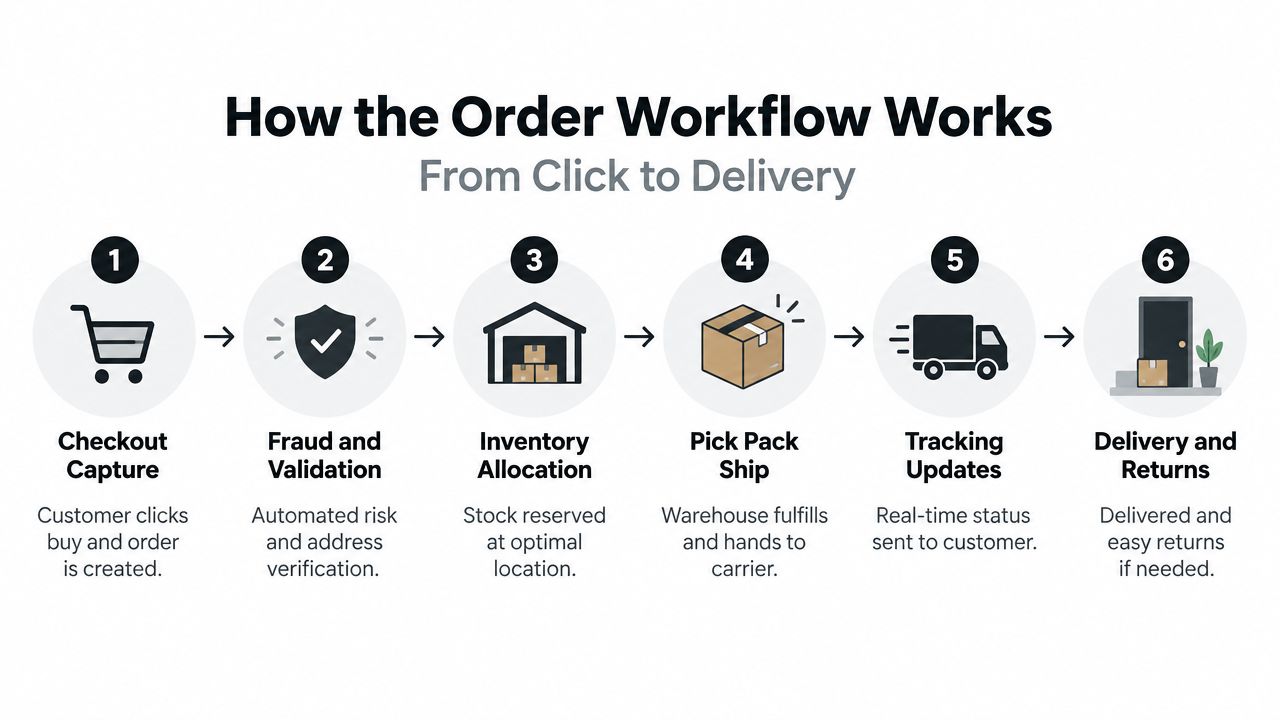
A customer journey becomes an operational workflow the moment someone clicks buy. Each stage creates an event. The next system should receive that event quickly, apply a rule, and either continue the straight-through path or create an exception for review.
Capture and validate before reserving stock
Checkout creates the order record. The OMS should capture the channel, customer details, line items, payment state, shipping method, and any campaign or conversation attribution available. It should then validate the order before sending it into fulfillment.
Validation can include address checks, duplicate-order rules, payment confirmation, fraud thresholds, restricted products, and promotion conditions. Most orders should pass automatically. Orders that fail a rule should pause with a reason, not disappear into a general queue.
Manual processing creates measurable drag. Benchmark sources report manual processing at about 11 minutes per order, compared with 3 minutes for AI-assisted processing and under 1 minute for top performers. The same benchmark reports a manual order-entry error rate near 9%, falling below 1% with automation in the cited benchmark set, as described by Esker's order management benchmarks.
Allocate inventory and choose a route
After validation, the system reserves stock. It should consider available-to-sell inventory, warehouse capacity, shipping promises, split-shipment rules, location priorities, and customer commitments. A nearby store may fulfill one order faster than a distant warehouse. A warehouse with the complete basket may be better than splitting the order across locations.
That decision should happen through event-driven updates rather than a batch process that waits for a later synchronization cycle. Enterprise OMS benchmarks cited in the same benchmark source demonstrate handling of over 200,000 order lines per hour and more than 1 million inventory adjustments per hour, which illustrates the throughput required when a system processes frequent stock and order events.
Fulfill, notify, deliver, and handle exceptions
The selected location receives the fulfillment request. Scan verification confirms that the picker selected the right item. Packing rules determine the shipment, the carrier receives the handoff, and tracking updates return to the OMS. Customers then receive status messages instead of asking support to investigate every movement. Teams can apply real-time order notifications to keep those updates visible across the customer journey.
Returns create another event path. The OMS should connect the returned item, refund or exchange decision, inventory disposition, and customer communication. Human review belongs where the rules can't safely decide, such as address conflicts, high-risk payment signals, damaged goods, or inventory discrepancies. This exception-led model lets automation handle normal orders while people focus on cases that need judgment.
Key Features and Capabilities That Matter Most
Good OMS software should help you make accurate decisions, not collect more records. Prioritize the capabilities that protect the customer promise and lower manual work. Treat secondary features as optional until the basics operate reliably.
Capability | What It Does | When It Matters Most |
|---|---|---|
Inventory synchronization | Updates available stock across connected channels and locations | When the same SKU sells through the website, marketplaces, stores, or social channels |
Order orchestration | Applies routing rules based on location, stock, service level, and order attributes | When one order can be fulfilled from multiple locations |
Exception management | Holds failed or unusual orders with a visible reason and assigned action | When teams lose time searching for payment, address, fraud, or stock problems |
Fulfillment visibility | Shows order status from capture through delivery and return | When support and operations need one current record |
Auditability | Logs changes, decisions, and handoffs | When you need to explain why an order was routed, delayed, canceled, or refunded |
Inventory accuracy comes first
A routing engine can't compensate for unreliable stock. In a 10,000-unit environment, 92% to 94% inventory accuracy can leave 600 to 800 units miscounted, increasing overselling, substitutions, and exception handling, according to SkuLabs warehouse KPI guidance. The same source describes scan verification and cycle counting as practical ways to move accuracy into the 98% to 99% range.
Ask vendors how they represent available-to-sell inventory, reservations, damaged units, inbound stock, and channel buffers. If those states are unclear, the promise date shown to a paid-social buyer may be unreliable.
Orchestration should reflect your actual rules
Don't accept a routing demo built around one warehouse if your business ships from several locations. Test real scenarios:
A bundle has stock in separate locations.
One channel needs a protected inventory buffer.
A high-value order requires review.
A customer chooses expedited delivery.
A return should go to a designated location.
Your team should be able to inspect the rule that fired and change it without rebuilding the entire stack. For operations that require fast, coordinated handling, logistique à haute vélocité offers useful context on automated order entry and high-velocity logistics.
Choose promise reliability over feature volume
Ship-from-store, pickup, split orders, backorders, and returns matter when your network supports them. They aren't valuable because they appear on a feature page. They matter when the workflow can show accurate stock, assign ownership, update the customer, and preserve a clear audit trail.
Use a workflow builder such as Exerta's workflow builder when you need configurable branches around customer conversations and recovery. The evaluation question is always the same: can the system reduce cost-to-serve without damaging the experience?
Integrations That Keep Orders Moving Including Chat and AI Recovery
An OMS works only when the surrounding systems exchange useful events. Build the integration map around four flows: fulfillment, money, delivery, and customer intent.
Start with fulfillment. Connect the OMS to your warehouse or fulfillment partner so order acceptance, pick status, shipment confirmation, stock changes, and exceptions move in both directions. A one-way connection creates a false sense of control. Your OMS may show an order as released while the warehouse has rejected it.
Next, connect payments and fraud controls. The OMS needs a clear payment state, not just a checkout success message. Define what happens when payment is pending, captured, reversed, or flagged for review. The system should stop fulfillment when the rule says stop, and it should release the order when the condition clears.
Then connect carriers and tracking. Delivery status should return to the customer record and trigger the right message. A late shipment should create an exception or service workflow, not wait for a customer complaint.
Add conversation signals to the order path
Paid social creates more than clicks. Comments and DMs reveal buying intent, objections, product questions, and dissatisfaction. Connect those conversations to checkout attribution so the team can see which interactions led to orders and which questions repeatedly block purchase.
TikTok provides advertiser-controlled comment tools for filtering by defined rules, hiding unsuitable comments, turning comments off, and analyzing comments in a dashboard, as explained in TikTok's advertiser comment controls. Use that control the same day. Create rules for spam phrases, scams, profanity, competitor mentions, and refund bait. Review the moderation dashboard daily and escalate ambiguous cases to a person.
A Harvard Business School study found that automated comment moderation improved advertising outcomes across six studies, including field experiments on social platforms, with stronger monetary return per dollar spent when harmful comments were actively managed, according to the published study. Treat moderation as an ad-efficiency control, not only a support task.
Use the messaging window deliberately
Meta's Messenger policy provides a 24-hour standard messaging window after a qualifying action. The window can reopen after another qualifying interaction, including a comment or reaction, as described in the Messenger messaging policy guidance.
Route a high-intent comment into a DM immediately. Send the product answer, checkout link, or offer while the conversation remains eligible. An AI employee can handle the first response, apply the brand rules, record the interaction, and escalate an unusual request.
Exerta works across Facebook, Instagram, TikTok, and website chat today. SMS, email, and voice are launching next. For Shopify-specific connection planning, review Exerta's Shopify integration. Teams also looking to reduce Shopify backlog with automation should map which repetitive requests can be resolved before they reach a human queue.
KPIs and Best Practices to Measure and Improve Performance
Operations improve when the team measures the point where customer value is at risk. Don't rely on shipped-order volume alone. Track the time, accuracy, intervention, and recovery signals that explain whether paid demand becomes profitable fulfillment.
The core operating scorecard
Cycle time measures the elapsed time from order creation to the relevant fulfillment or delivery milestone. Break it into stages, such as payment approval, allocation, release, pick, pack, carrier handoff, and delivery. A total number can hide the constraint.
Touchless rate shows how many orders move through the workflow without manual intervention. A low rate usually points to poor data quality, overly strict rules, missing integrations, or unclear exception ownership.
Inventory accuracy compares system stock with physical stock. Cycle counting and scan verification address the cause. In the cited warehouse benchmark, accuracy can move from 92% to 94% into the 98% to 99% range with stronger controls, while the same source connects inaccurate records with overselling and routing problems. Review Arlo Inc.'s KPI guide for Shopify for a broader ecommerce measurement framework.
Perfect order rate combines the customer outcome: correct item, correct quantity, correct address, on-time delivery, and no avoidable exception. Inventory adjustment throughput shows whether the system can process stock changes quickly enough to maintain a trustworthy available-to-sell state.
Run the scorecard as a diagnosis tool
Use a daily exception review. Group failures by cause, then fix the rule or integration creating the repeated work. If cycle time rises while touchless rate falls, inspect validation and routing. If cancellations rise while processing speed looks healthy, inspect inventory accuracy.
Measure the handoff, not just the outcome. A delivered order can still hide slow allocation, repeated manual touches, or an avoidable support contact.
For paid social, connect the operational scorecard to campaign and conversation attribution. Conversion attribution for ecommerce helps teams connect engagement activity with downstream purchases rather than judging comments, DMs, and ad clicks in isolation.
Keep a moderation review in the same operating rhythm. The Wharton Marketing paper reported that displaying comments increased total engagement by 0.065 percentage points, a 13.4% increase relative to a 0.485% control mean, according to the paper on comment visibility. Test curated positive comments against hidden or unmoderated comments during comparable campaign conditions, while tracking downstream clicks and orders.
Choosing Your System and Putting It Into Practice
Choose an OMS against the workflow you need to run, not the feature list you want to own. Confirm channel coverage, inventory-state handling, routing flexibility, API access, exception queues, attribution, uptime, audit logs, and support ownership. Ask the vendor to demonstrate an oversell, a split shipment, a failed address check, a delayed carrier event, and a return.
Roll out in a controlled sequence:
Map inventory states across every location and channel.
Connect order capture and fulfillment so status moves in both directions.
Add validation and routing rules for normal orders and exceptions.
Instrument cycle time, touchless rate, accuracy, and perfect order rate.
Connect comment and DM recovery to checkout attribution.
Review exceptions daily and change the rule causing repeated work.
Avoid a rip-and-replace decision when a targeted integration or workflow change can remove the bottleneck. For paid-social teams, the right stack turns attention into a traceable path from comment or click to checkout, fulfillment, delivery, and recovery.
Exerta provides AI employees for comment replies, DMs, moderation, and website chat across Facebook, Instagram, TikTok, and website chat. The platform reports use by 250+ brands, a 15% average sales lift, $2M+ recovered, and 99.9% uptime, with those figures presented as Exerta product proof points. SMS, email, and voice are launching next.
Use Exerta to connect paid-social conversations with faster replies, moderation, and revenue recovery while your OMS manages inventory and fulfillment decisions. Visit Exerta to see how AI employees can help your team recover more orders without adding manual coverage.