10 Social Commerce Tools for Brands in 2026
read
·

A comment section can change the economics of a paid campaign. In two real-budget field experiments, automated moderation increased click-to-registration rate by 16% and return on ad spend by 48%, with ROAS reaching 0.678 versus 0.459 in the control group and purchases reaching 22 versus 15. The findings are summarized by BrandBastion's account of the Harvard working paper, and they point to a practical issue many teams still underfund: public conversations affect revenue.
Meta and TikTok advertisers deal with the same problem every day. Buyer questions, objections, spam, shipping concerns, and purchase intent accumulate in comments and DMs while teams work limited hours. A tool that only publishes posts won't solve that bottleneck.
This roundup evaluates social commerce tools by the revenue workflow they support, not by the length of their feature list. The comparison focuses on channel coverage, automation depth, checkout paths, attribution, moderation, implementation effort, and cost model. Exerta calls its configurable agents AI employees, and supports Facebook, Instagram, TikTok, and website chat today. SMS, email, and voice are launching next.
Table of Contents
1. Exerta
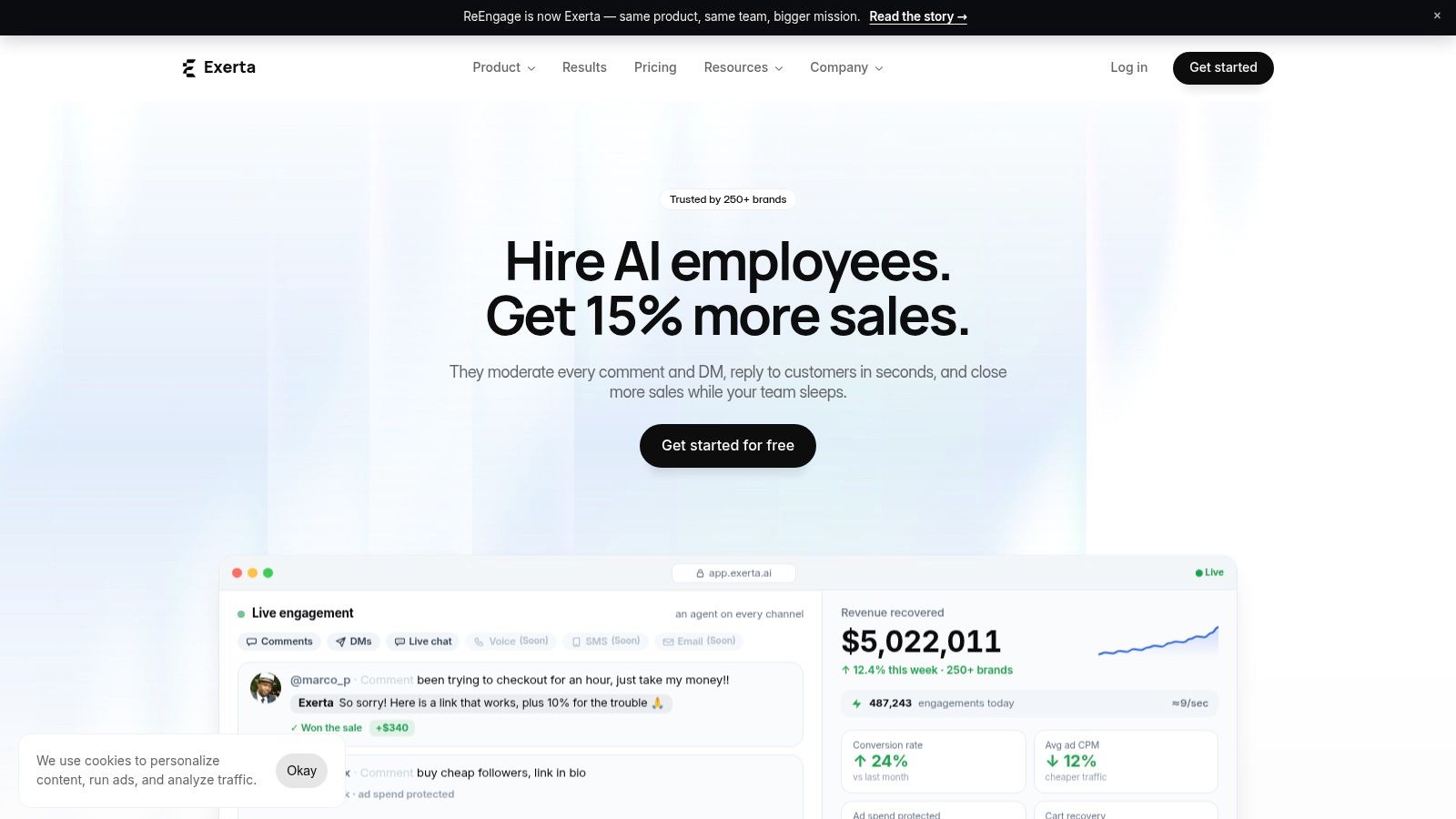
Exerta is the strongest fit when comments, DMs, moderation, website chat, and sales recovery need to operate as one workflow. Its AI employees answer in a trained brand voice, share links, prices, offers, and discounts, and detect buying intent before sending a checkout path. The platform also logs actions and connects recovered conversations to Shopify orders, so the team can inspect what happened instead of treating engagement as an unmeasured support queue.
The important distinction is operational. A simple bot handles a keyword. Exerta can branch based on the buyer's question, product interest, objection, or escalation need. That matters for DTC brands running Meta and TikTok ads, where one public question can become a sales opportunity or a visible objection for other shoppers.
Where Exerta earns its place
Exerta is built for brands and agencies that need coverage beyond business hours without adding moderators to every account. Its moderation rules can hide spam, scams, and harmful content, while the workflow builder supports approval and escalation paths. Connect it through Exerta's workflow builder to create branches for product questions, discount requests, order issues, and high-intent checkout conversations.
Exerta reports adoption by 250+ brands, an average 15% sales lift, $2M+ in recovered revenue, and 99.9% uptime. These are product claims, so I'd validate them against your own baseline during a controlled pilot rather than treating them as a forecast.
Practical rule: Start with one campaign and one offer. Measure qualified conversations, moderation actions, checkout links sent, recovered orders, and attributed revenue before expanding across the account.
The trade-off is plan depth. Free and Starter tiers limit AI actions, agents, and history, while higher-volume teams may need custom plans for dedicated support, HIPAA options, and extended requirements. SOC 2 Type II is listed as coming soon. SMS, email, and voice aren't live yet, so teams needing those channels now will need another layer.
Best for: DTC brands, agencies, and high-spend Meta and TikTok teams that want one revenue workflow.
Visit Exerta for current plan details. Pricing and product availability may change.
2. Manychat
Manychat can turn an Instagram comment into a trackable sales conversation before a community manager opens the inbox. A brand publishes a post, watches for a keyword, and sends a DM with a product link, coupon code, quiz, or follow-up question. That workflow suits launches, lead magnets, creator collaborations, and ads built around a direct response.
Its visual flow builder helps agencies repeat the same campaign logic across several Instagram accounts. Templates shorten setup, while Messenger, WhatsApp, TikTok, and Instagram support allow teams to reuse a funnel across channels. The trade-off is implementation depth: the more channels and branches a team adds, the more carefully it must test permissions, handoffs, opt-ins, and fallback responses.

Where it works and where it stops
Manychat performs best when the desired action is clear. A beauty brand can ask people to comment “shade” and return a product quiz or collection link. A creator can invite Story replies and send an early-access URL. These flows are quick to test and easy to hand to a media buyer.
The boundaries appear once the workflow needs judgment. Complex product advice, public comment moderation, order-specific support, and Shopify-level revenue attribution may require another system or a human agent. WhatsApp also needs separate cost modeling. Meta's WhatsApp Business API policy, described in Meta's WhatsApp Business messaging pricing policy, charges businesses for messages after 1,000 free service messages per month. That policy applies to the business API, not the regular consumer app.
Manychat's 2026 pricing change meters by active contacts, so audience growth and retained campaign history can affect the bill. Test the contact model during a busy launch, not only in a quiet month. A large retargeting audience may cost more even when relatively few conversations become orders.
Teams comparing support handoff, attribution, and cross-channel coverage can use this guide to Manychat alternatives.
Best for: Fast Instagram comment-to-DM campaigns and agencies managing repeatable social funnels.
Visit Manychat to review current channel and pricing options.
3. Heyday by Hootsuite
Heyday makes the most sense when Hootsuite already sits at the center of the social team's publishing, listening, and inbox operations. It adds retail-focused conversational automation across Instagram DMs, Facebook Messenger, and WhatsApp, with use cases such as product questions, order lookups, promotions, appointments, and store finders.
That existing ecosystem reduces operational handoffs. A social manager can publish a campaign, monitor reactions, and manage customer conversations without moving between unrelated tools. Retail playbooks also give teams a starting point for common questions instead of forcing them to design every response from an empty canvas.
The Hootsuite trade-off
Heyday is less compelling for a small DTC team that only needs comment triggers and checkout links. Pricing is typically quote-based and sold as an add-on, so the buying process requires a sales conversation. The team should ask for an implementation estimate, channel limits, escalation controls, and the cost of adding additional brands or regions.
Its conversational strength is customer assistance, not necessarily the deepest in-chat commerce path. If the primary workflow is “show a product, create a cart, take payment, and attribute the order,” a commerce-specialist platform may require fewer workarounds. If the primary workflow is “answer retail questions while the team manages publishing and listening,” Heyday is easier to justify.
A practical pilot should use real questions from an active campaign. Load product details, shipping policies, returns information, and promotion rules. Then review how often the AI resolves the request, how clearly it hands off exceptions, and whether agents can see enough customer context to finish the sale.
Teams assessing automated social support can also compare AI social media agent workflows before choosing an ecosystem.
Best for: Retail teams already invested in Hootsuite.
Explore Heyday by Hootsuite for current packaging and availability.
4. Emplifi Social Commerce
Emplifi Social Commerce, including ShopStream and Live Advisor, is designed for brands that treat live video and UGC merchandising as core commerce channels. It combines shoppable galleries, creator content, live broadcasts, product cards, replay experiences, and analytics across UGC, influencers, ratings, reviews, and commerce.
That makes it different from a comment automation platform. Emplifi helps a brand turn social proof into a product-page experience and run structured live-selling programs. A fashion or beauty team can curate creator content, place it near relevant products, run a broadcast, and analyze how those assets contribute to discovery and product engagement.
Built for commerce programs, not quick experiments
Emplifi suits multi-market and multi-brand organizations with a content operation behind the storefront. The benefit comes from centralizing rights, merchandising, live content, and reporting. The cost is implementation. Smaller brands may spend more time configuring catalogs, governance, analytics, and content workflows than they can recover from an occasional live event.
Live commerce also creates staffing requirements that software can't remove. Someone must host, answer questions, manage products, handle inventory changes, and follow up with buyers. A team should test replay merchandising as well as the live broadcast, because the content can continue working after the event.
For teams comparing live support with conversational selling, this ecommerce live chat software guide offers a useful adjacent perspective.
Best for: Enterprise brands investing in live commerce, UGC merchandising, and unified social analytics.
Explore Emplifi Social Commerce for current enterprise options.
5. CommentSold
CommentSold is built around live selling rather than general-purpose messaging. It supports broadcasts across TikTok, Instagram, Facebook, websites, and branded apps, with comment selling, product overlays, shoppable replays, inventory workflows, fulfillment, shipping, and returns.
That focus matters for fashion, beauty, and lifestyle retailers where the host drives demand in real time. A viewer can ask about sizing or availability in the comments, see the product connected to the broadcast, and purchase through an eligible checkout path. Videeo for Shopify extends the model into shoppable video and UGC on the storefront.

Calculate the cost per live sale
The platform's advantage is operator depth. Teams don't need to assemble separate tools for streaming, product presentation, replay merchandising, and fulfillment management. That can justify a larger software commitment when live shows already generate meaningful volume.
The risk is the commercial model. Plans can include revenue share or a percentage of sales, which changes the economics as volume grows. Model the fee against gross margin, refunds, fulfillment costs, and the staff time required to run each event. A flat subscription may look more expensive at launch, while a percentage fee may become more expensive once the channel scales.
Platform policies and eligibility also affect what works. The team should confirm where native checkout, TikTok Shop features, and multicasting are available for its business and region. Run a pilot with a limited product set, a trained host, and a replay plan. Don't judge the tool only by concurrent viewers. Track product clicks, completed checkouts, cancellations, and post-event support demand.
Use comment-to-DM automation guidance when deciding whether your live comments need a separate follow-up layer.
Best for: Retailers that run live commerce as a repeatable sales channel.
Visit CommentSold for current plans and platform eligibility.
6. Vonage Conversational Commerce
Vonage Conversational Commerce, branded around Jumper.ai, targets brands that need assisted selling across messaging channels. The workflow goes beyond answering questions. Agents can share products, create carts, send payment links, and hand a conversation to a human sales representative.
That human handoff is the central strength. A customer can begin with automation, ask a complex question, and continue in the same thread with an agent who has the context. For higher-consideration products, this can be more useful than forcing every buyer through a fixed flow.
Enterprise capability carries enterprise overhead
The platform supports Instagram, WhatsApp, Messenger, and broader integrations, including Shopify Plus. Enterprise APIs make sense when the brand needs custom connections, regional operations, or integration with an existing customer stack.
The trade-off is implementation cost. Published commercial information includes setup from approximately $5,000, plus monthly fees or a percentage of sales, so small teams should model the full commitment before scheduling a technical rollout. That figure comes from the product plan notes and should be confirmed directly with Vonage because commercial terms can change.
A useful test starts with one high-value product or one lead-generation campaign. Define the points where the AI must stop, the data a human agent needs, and the payment handoff. Then compare assisted conversations with ordinary support conversations using response time, qualified intent, completed payment links, and agent handling time.
Vonage is not the right choice just because it supports many channels. It earns its place when human selling, custom integrations, and governance justify the setup.
Best for: Enterprise brands that need automated and human-assisted commerce in one thread.
Explore Vonage Conversational Commerce for current commercial terms.
7. respond.io
respond.io treats the social commerce problem as an inbox and routing problem. It brings together WhatsApp, Instagram, TikTok, Messenger, email, and web chat, then uses AI agents, lifecycle tracking, contact merging, campaign triggers, and human handoff to manage conversations across markets and brands.
This is useful for a team that has outgrown separate inboxes. A lead can arrive from a TikTok messaging ad, receive qualification questions, get a product or payment link, and move to an agent when the request exceeds the automation rules. The platform also focuses on attributing conversations back to Meta and TikTok ads.
Strong routing, lighter storefront depth
respond.io is not a storefront. It relies on links or Shop APIs for checkout, so the brand needs to test the complete path rather than assuming that a payment link equals a completed order. Connect the product catalog, pass the right campaign parameters, and confirm that the final order appears in the system you use for revenue reporting.
Its WhatsApp support also requires operational discipline. Template approvals, proactive messaging rules, customer consent, and message charges can affect both deliverability and cost. Teams should create separate flows for service, sales, reminders, and reactivation instead of sending the same message to every contact.
Use the platform when routing and cross-market coordination are the bottleneck. Choose something else when the main requirement is live shopping production or deep UGC merchandising.
Best for: Multi-market DTC and retail teams centralizing messaging and ad attribution.
Visit respond.io to review current channel integrations and plan limits.
8. SleekFlow
SleekFlow fits WhatsApp-led commerce funnels that also need Instagram, Messenger, TikTok Business Messaging, and regional channels. It can share products, create payment links, place Shopify orders, and connect gross merchandise value to messaging interactions.
The workflow supports assisted checkout inside a conversation. An agent can answer a WhatsApp question, recommend a product, send a payment link, and leave an order record in Shopify. Automation flows, broadcasts, and AI agents extend that process, but teams should verify where automation ends and human support begins.
Model channel fees before launch
SleekFlow supports WhatsApp, Instagram, Messenger, Telegram, LINE, WeChat, SMS, live chat, and TikTok Business Messaging. This reach helps regional teams coordinate campaigns, but each channel adds consent rules, message formats, escalation ownership, and reporting checks. It is an operations decision, not just a feature comparison.
WhatsApp charges are billed separately, so the subscription does not represent the full funnel cost. Forecast contact volume, service conversations, promotional messages, templates, human follow-ups, and expected order value before launch. Meta's WhatsApp Business messaging policy separates service, utility, and marketing conversations, with different treatment for each type. Message timing and message type therefore affect the commercial model.
Run three tests before committing: product recommendation to payment link, an order question to human handoff, and an abandoned conversation to compliant follow-up. Confirm that Shopify records each order and that attributed GMV matches internal revenue reporting. Also test comment and DM routing, channel-specific moderation, and whether support ownership remains clear across markets.
Best for: WhatsApp-first commerce teams that need broader regional messaging coverage.
Explore SleekFlow for current channel fees and plan details.
9. Gorgias
Gorgias is the practical choice when customer support and social selling share the same Shopify context. It brings Instagram DMs, public comments, mentions, Facebook ad comments, and Story replies into an ecommerce helpdesk. Agents can see customer and order data, answer questions, use macros, and send checkout links from the conversation.
That context changes the workflow. A customer asking about an order doesn't need to repeat the order number. A shopper asking about a product can receive an answer based on catalog information, then move toward purchase without leaving the support queue.
Support teams need moderation, not only replies
Gorgias can convert public comments into private DMs and supports an AI Agent for common Instagram and Messenger requests, listed as beta in the product notes. It also provides revenue attribution through Shopify data inside the conversation. That makes it useful for measuring support-assisted sales rather than treating every ticket as a cost center.
The limitation is public comment moderation. The social AI Agent doesn't moderate public comments, so a brand running aggressive Meta or TikTok spend may need a separate moderation layer. That matters because harmful replies can remain visible even when the support team answers private messages quickly.
Pricing is ticket-metered. High social volume can increase the bill, especially when one campaign generates many repetitive comments. Before adopting it, sample a busy week and estimate how comments, DMs, order questions, and automation events map to billable volume. Then test whether macros and AI resolution reduce human workload without hiding useful sales signals.
Best for: Shopify-led DTC teams that need one inbox for support, sales assistance, and revenue context.
Visit Gorgias to review its current ecommerce helpdesk options.
10. Bazaarvoice Social Commerce
Bazaarvoice Social Commerce, formerly Curalate, focuses on the visual side of social commerce. It turns creator and customer content into shoppable UGC galleries, product-page displays, link-in-bio experiences, and retailer-ready content. Rights management, APIs, widgets, and syndication support a merchandising operation that extends beyond a brand's own social profile.
The workflow is straightforward. Find relevant customer content, secure permission, connect the content to products, and place it where shoppers are deciding. A shopper who sees a product used in a real context can move from inspiration to the product detail page without searching for the matching SKU.
Choose it for merchandising, not inbox automation
Bazaarvoice is a strong fit for brands selling through retailers or managing a large content and reviews program. Enterprise services, analytics, and connections to ratings and reviews stacks help teams govern content across markets. Retail syndication can also matter when the brand's revenue depends on product pages it doesn't fully control.
The limitation is scope. Bazaarvoice doesn't replace a DM automation platform, comment moderator, or assisted-selling inbox. It helps shoppers discover and evaluate products, but it doesn't manage the conversation after a buyer asks about delivery or needs a checkout link.
Pricing is quote-based, and implementation is heavier than an SMB link-in-bio tool. Test the content-rights process, product matching, page performance, analytics handoff, and retailer syndication requirements before signing. The pilot should use a real product category with enough approved UGC to judge whether the merchandising workflow saves time and improves product discovery.
Best for: Enterprise brands and retailers that need shoppable UGC and visual merchandising.
Explore Bazaarvoice for current Social Commerce capabilities.
Top 10 Social Commerce Tools: Feature Comparison
Solution | Core capabilities | Target audience | Key differentiator / Value prop | Pricing & notable limits |
|---|---|---|---|---|
Exerta | AI agents for comments, DMs & web chat; moderation; automated sales‑recovery; Shopify attribution; no‑code workflows; dashboards | DTC/ecommerce, agencies, high‑spend Meta/TikTok teams, telehealth & lead‑gen | Unified cross‑channel intelligence + measurable recovered‑revenue attribution; fast setup; elastic agent scale | Free (100 AI actions/mo); Starter $79.99/mo ($769/yr); custom enterprise (HIPAA, higher volume); SOC2 coming; SMS/email/voice on roadmap |
Manychat | Comment→DM, visual flow builder, templates, AI reply assistant, multi‑channel (TikTok/WhatsApp/Messenger) | Creators, agencies, brands using IG/Messenger ad funnels | Fastest IG DM automation with large template library for quick time‑to‑value | Template/tier pricing; 2026 change meters by active contacts (costs can rise); WhatsApp depth may need BSPs |
Heyday (Hootsuite) | Retail‑focused AI replies, unified inbox in Hootsuite, Shopify integrations, retail playbooks | Retail teams already on Hootsuite; merchants needing simple chat automation | Combines publishing/listening + retail chat playbooks inside Hootsuite stack | Quote‑based add‑on pricing; less granular in‑DM commerce vs specialized suites |
Emplifi Social Commerce | Shoppable UGC galleries, live shopping broadcasts, unified analytics across creators/reviews | Enterprise brands investing in large‑scale live commerce and UGC merchandising | End‑to‑end live commerce + deep UGC merchandising and reporting | Enterprise, sales‑led pricing; heavier implementation, not SMB plug‑and‑play |
CommentSold | Multicast live broadcasts, comment selling workflows, shoppable replays, inventory & fulfillment | Fashion, beauty, lifestyle retailers running live commerce as a core channel | Purpose‑built live selling stack with operator tooling and shoppable replays | Plans may include revenue share; some features depend on platform eligibility/policies |
Vonage Conversational Commerce (Jumper.ai) | Omnichannel chat commerce, product sharing, cart creation, payment links, agent handoff, enterprise APIs | Brands needing assisted selling + enterprise integrations at scale | Blends automation with human sales in the same thread; robust enterprise integrations | High setup fees/minimums (eg. ~$5k+) and ongoing costs; heavier ops lift |
respond.io | Omnichannel AI inbox, routing, agent handoff, WhatsApp template mgmt, ad attribution | Multi‑market DTC & retail teams centralizing messaging and attribution | Messaging‑centric platform with strong compliance and ad attribution | Not a storefront (relies on links/APIs); WhatsApp API & template costs apply |
SleekFlow | Unified inbox (WhatsApp, IG, Messenger, LINE, WeChat, SMS), in‑chat payment links, Shopify order logging | Teams running WhatsApp‑heavy funnels and IG DMs wanting Shopify attribution | In‑chat payments + automatic Shopify order creation and GMV attribution | Channel fees (WhatsApp) billed separately; more operational work than IG‑only bots |
Gorgias | Ecommerce helpdesk, Instagram DMs & comments, Shopify data in conversations, AI agent | Shopify‑led DTC teams bridging support and sales | Native ecommerce context inside tickets; revenue attribution from conversations | Ticket‑metered pricing can rise with high social volume; AI doesn't moderate public comments |
Bazaarvoice Social Commerce | Shoppable UGC galleries, visual content sourcing, rights mgmt, retailer syndication, APIs | Enterprise brands/retailers merchandising visual social content on PDPs | Enterprise UGC merchandising & syndication to retailer networks | Quote‑based enterprise pricing; focuses on UGC/display rather than DM automation |
Choose the Workflow Before the Tool
Start with the revenue leak, not the brand name on the software page. If paid-social comments and DMs contain buyer intent, unanswered questions, spam, and objections, prioritize response coverage, moderation, checkout recovery, and attribution. If the main issue is a weak product-page experience, prioritize UGC merchandising. If the business runs scheduled live shows, choose live-commerce infrastructure instead of forcing a general inbox to act like a broadcast system.
The market is already large enough that these decisions affect core revenue operations. One industry summary reported global social commerce revenue of about $700 billion in 2024, rising from $571 billion in 2023 and $449 billion in 2022, while another projection estimated $1.485 trillion in 2025 and $12.951 trillion by 2032. Those figures are summarized in Hootsuite's social commerce overview. The estimates differ by methodology, but the operational conclusion is consistent. Social commerce tools now sit close to the checkout path.
Use this decision guide:
Choose Exerta when you need unified comment, DM, moderation, website chat, sales recovery, and attribution workflows across Facebook, Instagram, and TikTok.
Choose Manychat when you need fast Instagram comment-to-DM campaigns with templates and simple routing.
Choose Gorgias when Shopify support and sales operations belong in the same inbox.
Choose respond.io or SleekFlow when your messaging stack spans multiple channels, markets, and handoff rules.
Choose CommentSold or Emplifi when live commerce is a primary sales motion.
Choose Bazaarvoice when shoppable UGC and product-page merchandising are the priority.
Choose Vonage when enterprise assisted selling and custom integrations justify heavier implementation.
Run the evaluation as a revenue test
Connect the channels that drive paid spend first. Don't start with every available integration. Give the tool access to one campaign, one product or offer, and the minimum customer data needed to answer accurately.
Then define escalation rules before launch. Product questions may receive an automated answer. Refund requests, medical concerns, delivery failures, and legal or compliance issues may need a human. TikTok says advertisers can filter comments using defined rules, hide unsuitable comments, turn comments off, and review comment activity through a dashboard in its advertiser guidance. The platform also says moderation operates 24 hours a day, 365 days a year in separate moderation guidance, so your escalation policy can't assume that comments only arrive during office hours.
Verify the checkout path with a real test order. Check links, discounts, inventory, UTM parameters, Shopify order records, and attribution. Model contact fees, message fees, ticket charges, revenue share, setup fees, and the cost of human handoff. A tool that looks inexpensive at low volume can become expensive when a campaign generates thousands of contacts or requires WhatsApp follow-up.
Finally, compare results with a measured baseline. Track response time, qualified conversations, recovered orders, moderation actions, checkout links sent, human escalations, and attributed revenue. A same-day pilot won't answer every enterprise question, but it will show whether the tool improves the workflow that currently costs you money.
Teams building a broader channel operation can also use this omni channel retail guide to pressure-test ownership, consistency, and handoff decisions.
Exerta gives DTC brands and agencies AI employees for Facebook, Instagram, TikTok, and website chat, with comment replies, DM automation, harmful-content moderation, sales recovery, and attribution in one operating layer. Start with one paid campaign and one offer, measure the revenue workflow, and visit Exerta to see whether it fits your social commerce operation.