AI Agents vs LLM: What DTC Brands Need to Know
read
·

An LLM generates text from a prompt. An AI agent adds planning, tool use, and execution, and benchmark results include a 78% success rate for GPT-4 in an interactive household-task environment. The difference is simple: an LLM writes a reply, while an agent can use that reply to help close a sale.
A buyer comments under your ad after business hours. They ask for the price, a product link, or a discount code. The answer is easy to generate. The hard part is identifying intent, checking the right information, sending the correct link, recording the interaction, and knowing when a person needs to take over.
That's the practical question behind AI agents vs LLM. Not which system sounds smarter. Which system completes the commercial workflow without creating more risk than it removes?
Capability | LLM workflow | AI agent workflow |
|---|---|---|
Generate a reply | Yes | Yes |
Classify intent | With a prompt or surrounding workflow | As part of a multi-step process |
Use product, policy, or customer data | Only when connected by another system | Selects and calls approved tools |
Send a message or link | Usually requires external automation | Can execute through configured channels |
Track outcomes | Requires separate instrumentation | Can log actions and workflow state |
Handle exceptions | Produces another response | Applies rules, requests approval, or escalates |
Best fit | Stable, narrow, low-risk tasks | Coordinated workflows tied to measurable outcomes |
Table of Contents
The Operational Gap Between Language and Action
A buyer sends a direct message at 9pm on Friday. Meta's 24-hour Standard Messaging Window starts when the person messages a Facebook Page or Instagram Professional account, or begins a conversation through a web plug-in. Promotional content is allowed during that window, but ordinary automated promotional messaging cannot continue after it closes. Meta's Messenger Platform documentation explains the boundary and the separate mechanisms for eligible outreach afterward.
An LLM can draft a useful response in seconds. On its own, it can't send that message, retrieve the right checkout URL, record the event, or decide whether a follow-up remains permitted. It produces language. It doesn't own the operational state.
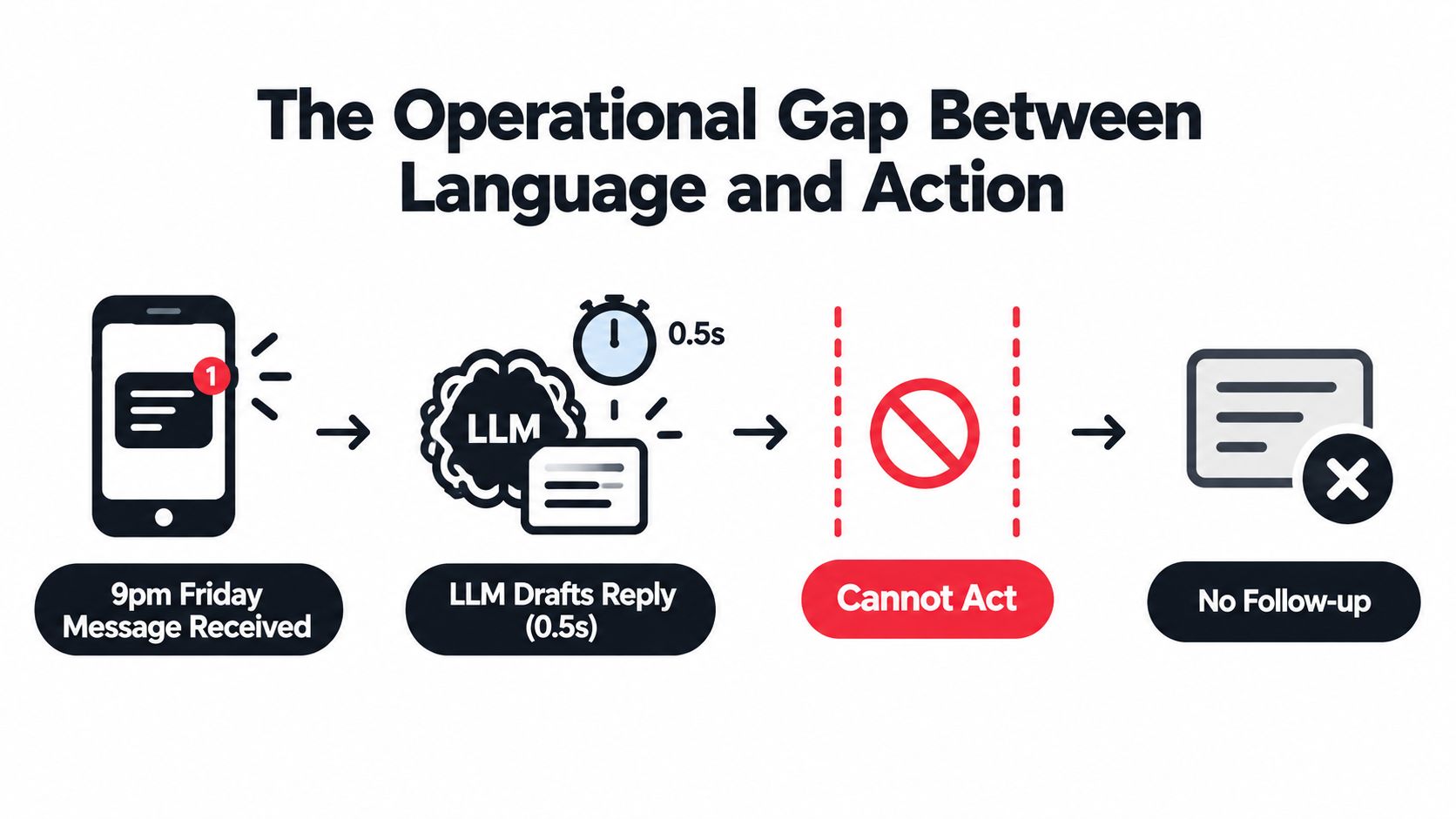
An AI agent adds an operational loop around the language model. It interprets a goal, breaks the goal into steps, selects approved tools, observes their results, maintains state, and continues until it reaches an outcome or needs escalation. In the example above, the loop might classify the message as purchase intent, check product data, retrieve a checkout link, send it, log the interaction, and apply a follow-up rule.
The distinction is measurable. AgentBench evaluated language models across eight interactive environments, rather than limiting evaluation to static question answering. GPT-4 achieved the best result on six of the eight datasets and recorded a 78% success rate in the household-task environment. Earlier MLAgentBench results reported a 37.5% average success rate for Claude 3 Opus on machine-learning tasks, while GPT-4 produced a 41.3% average improvement when it succeeded.
Practical rule: A fluent reply is an input to revenue recovery, not proof that the recovery workflow completed.
This is also why technical teams need to think about making websites agent-ready. Pages, product information, policies, and actions need clear structure if an agent is expected to use them safely. For a practical view of how this execution layer fits into marketing operations, see using AI for automation.
Comparing Capabilities and Failure Modes
An agent isn't automatically a better choice. It adds coordination, and coordination creates more places for a workflow to fail. A simple FAQ response may be faster and cheaper when a conventional LLM workflow receives the question, retrieves a short policy passage, and drafts an answer for immediate delivery.
The comparison changes when the task has a business outcome that requires several actions. A buyer asking whether a product is available may need an answer, a product link, a variant check, and attribution after purchase. A comment containing a scam link may need classification, hiding, logging, and escalation if the wording also makes a serious product claim.
Area | Conventional LLM workflow | Agent workflow | Main failure mode |
|---|---|---|---|
Narrow FAQ | Generates a response from supplied context | May add unnecessary planning | Added latency or irrelevant tool use |
Comment moderation | Classifies or suggests an action | Classifies, applies a rule, and logs the action | Incorrect hiding or missed harmful content |
Product question | Drafts an answer | Checks approved product data and delivers a link | Wrong inventory, price, or destination |
Sales recovery | Suggests copy | Tracks intent, sends permitted messages, and attributes an outcome | Compounding errors across steps |
Sensitive conversation | Produces a cautious reply | Routes according to policy and approval rules | Unauthorized advice or an unsafe action |
Recent benchmark evidence supports a restrained view. A comparative evaluation of LLM-based agent systems reported agent accuracy of 60.3% on AgentClinic MedQA, 28.0% on MIMIC, 30.3% on MedAgentsBench, and 8.6% on the HLE text benchmark. The reported advantage over the strongest baseline LLM ranged from 0.5 to 8.9 percentage points, and those differences weren't statistically significant. The comparative study shows that tools can expand what a system does without guaranteeing better decisions.
The added risk comes from the chain itself. An agent can plan the wrong sequence, choose the wrong tool, provide invalid arguments, violate a policy, or compound a small mistake over several steps. A customer engagement system should therefore limit permissions, make important actions idempotent, preserve audit logs, and provide a clear fallback.
Teams comparing a simple bot with an agent should start with the workflow, not the label. Chatbot vs AI is a useful distinction to make before deciding whether a multi-step system is justified.
When Autonomy Actually Works for Revenue
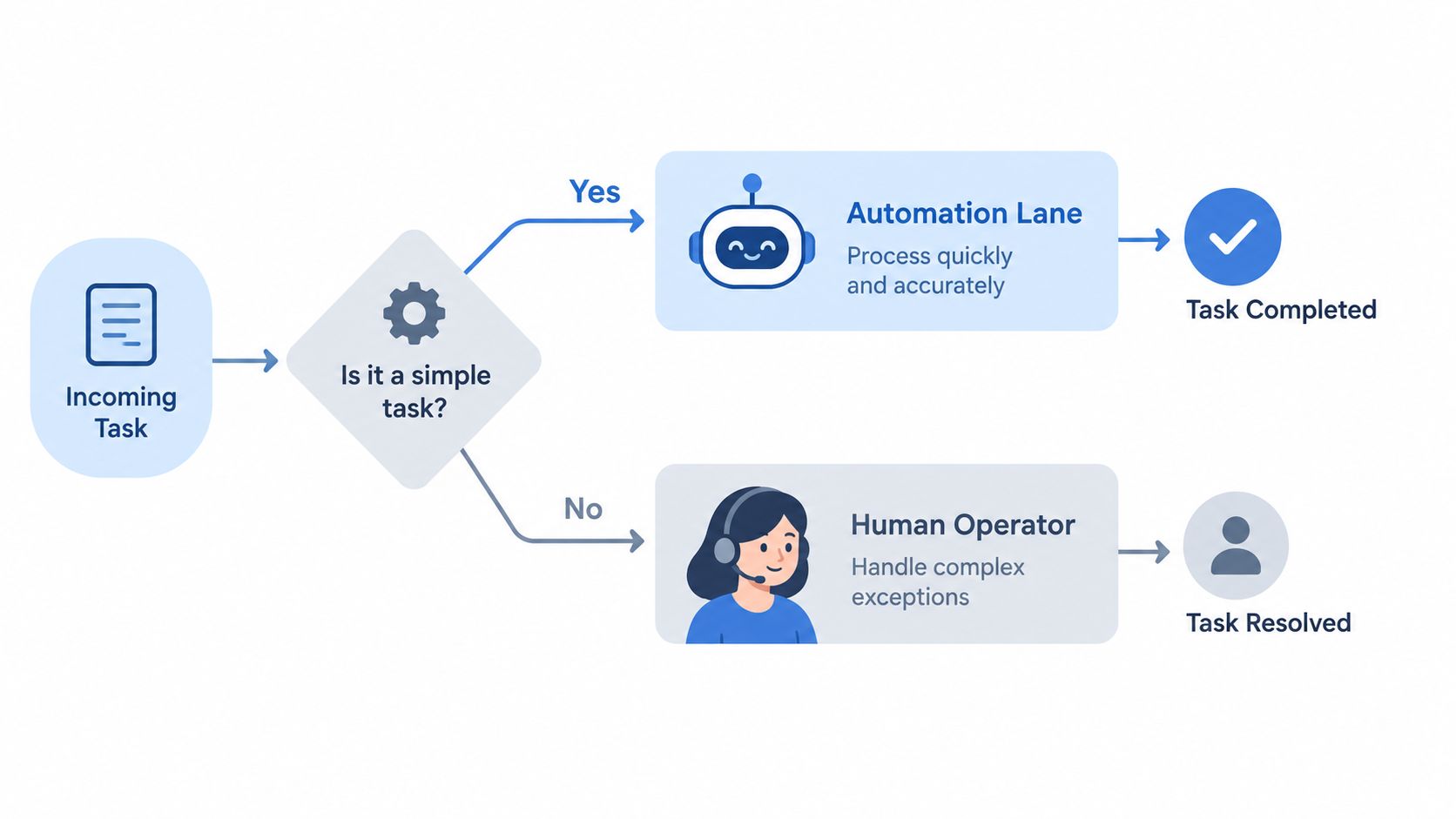
The strongest revenue agent isn't the one that acts without interruption. It's the one that knows which actions it can complete, which actions need approval, and which situations require a person.
A practical autonomy ladder has five levels:
Generate: Write a suggested response for a person or another workflow.
Suggest: Recommend an action, such as hiding a comment or sending a product link.
Execute under rules: Complete reversible actions that match documented criteria.
Execute with approval: Prepare a discount, refund response, or sensitive claim for review.
Escalate: Stop and route the conversation when intent, policy, or emotion falls outside the rules.
Replying to a comment may look like one action. In practice, the system may need to identify whether the comment is a question, complaint, joke, spam, or purchase signal. It then needs to select a response, verify the offer, choose the channel action, and record what happened. A wrong public reply can affect more than one customer, so the cost of failure matters.
A workplace-agent benchmark tested 175 realistic professional tasks. The strongest tested system completed only 30% autonomously, with a broader score of 39% when partial completion counted. The benchmark dataset and results make the operational point clear. Autonomy should be assigned by task risk, reversibility, and judgment requirements.

Match autonomy to the action
FAQ replies, spam hiding, and delivery of a known product link are usually easier to bound. Refunds, medical claims, regulated advice, angry customers, ambiguous purchase intent, and unusual discounts deserve a human checkpoint.
The right design doesn't ask whether the agent can act. It asks whether the business can detect and recover from a wrong action. That approach is more useful than treating autonomy as a binary feature. Teams planning AI sales automation should define the escalation boundary before they add more tools.
Deploying AI Employees in Paid Social Workflows
Paid social creates two connected workloads. Ads generate public comments that affect the visible conversation around the campaign, and DMs create private buying opportunities that can disappear if nobody responds promptly.
Start with moderation. Define rules for spam, scams, abusive terms, misleading claims, and comments that require a person. TikTok provides advertiser controls for filtering comments according to defined rules, hiding unsuitable comments, turning comments off, and reviewing activity through a dashboard. Its comment and brand-safety guidance gives advertisers a practical foundation for same-day moderation.
Use three actions rather than one broad “moderate” instruction:
Answer: Respond to legitimate product and service questions in the approved brand voice.
Hide: Remove comments that match documented spam or abuse criteria.
Escalate: Route claims, threats, sensitive complaints, and uncertain cases to a person.
TikTok says its commercial content and paid ads undergo review before going live, using manual review and automated tools in its policy process. That review doesn't replace post-publication moderation. A campaign can pass ad review and still attract misleading replies, scams, or customer complaints that need attention.
Meta requires a separate timing check. When a person starts a qualifying conversation, the business can send messages for up to 24 hours, and promotional content is allowed inside that window. Afterward, ordinary automated promotional messaging isn't permitted. The agent should therefore record the conversation start, send the useful response while the window is active, and avoid treating silence as permission for unlimited follow-up.
A same-day recovery flow
Detect intent: Separate product questions, objections, support requests, and casual comments.
Verify the offer: Pull the approved product, price, availability, and destination data.
Send the next action: Deliver the relevant product or checkout link without inventing terms.
Record attribution: Store the conversation, action, link, and eventual purchase relationship.
Escalate exceptions: Require approval for discounts, sensitive claims, refunds, or unclear requests.
Teams building broader marketing automation can also review guidance on setting up an AI SEO agent, especially where structured information and controlled actions matter. For customer engagement, the same principle applies: the agent should have clear inputs, narrow permissions, and an observable result. A human-in-the-loop AI workflow supplies the approval boundary when a rule can't safely resolve the situation.
Measuring Success Beyond Response Quality
Fluency is easy to notice. Revenue impact is harder, and it's the metric that matters. A polished response can still fail if it goes to the wrong person, contains the wrong offer, misses the permitted messaging window, or never produces a traceable business outcome.
Agent evaluation therefore needs to measure the full path from request to result. Guidance on evaluating AI agents recommends looking at task completion, tool selection, argument validity, step success, cost, latency, and failure recovery. For a paid social team, those technical measures should sit beside commercial and governance measures.
Scorecard area | Metric to track | What it reveals |
|---|---|---|
Conversation quality | Qualified conversations per 1,000 interactions | Whether replies create useful buying or support opportunities |
Commercial impact | Incremental recovered revenue | Whether the workflow contributes revenue beyond existing demand |
Speed | Median time to response | Whether the system acts while intent is active |
Offer control | Wrong-offer rate | Whether the system sends inaccurate prices, links, or terms |
Safety | Escalation rate and harmful-content misses | Whether the rules catch difficult cases |
Permissions | Unauthorized-action rate | Whether the agent acts outside its approved scope |
Efficiency | Cost per resolved conversation | Whether the workflow earns its operational cost |
Traceability | Attribution completeness | Whether the business can connect actions to outcomes |
A conventional LLM can outperform an agent on a narrow, stable task. Extra planning and tool calls add latency, cost, and failure opportunities. An agent earns its place when coordination across channels or systems creates measurable incremental value.
The GAIA benchmark illustrates the difference between static answers and tool-assisted work. Humans achieved 92%, while GPT-4 with plugins achieved 15%. Another comparison reported a result below 7% for GPT-4 without an agentic setup and 67.36% for an agentic deep-research system. Meta's GAIA research page provides the benchmark context.
Higher completion can also require more calls and longer execution. On TPS-Bench, GLM-4.5 reached 64.72% task completion with long execution times, while GPT-4o used more parallel calls and reached 45.08%. The useful business objective isn't maximum intelligence. It's successful outcomes per dollar and second, with recovery when a step fails.
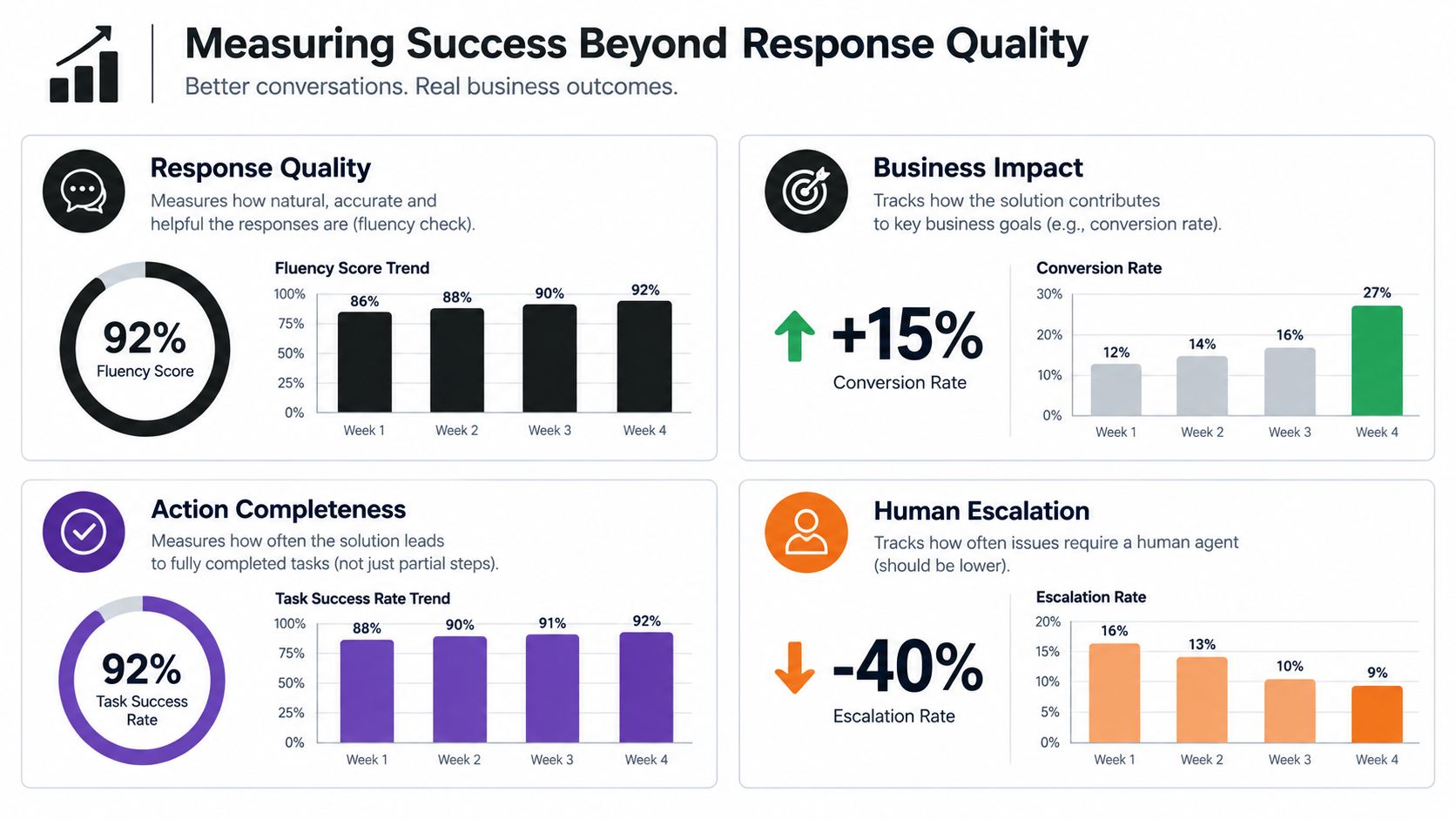
For a DTC team, attribution deserves special attention. A response may help a buyer without directly closing the order, so the system should preserve the message, intent classification, link delivery, and purchase relationship. A documented revenue attribution model helps separate assisted conversion from unsupported claims.
Choosing Bounded Autonomy for Your Brand
Start with the actions your team repeats often and can reverse safely. Don't begin by giving an agent authority over every customer conversation. Begin with a narrow workflow, log the decisions, inspect errors, and expand only when the results justify the added complexity.
A sensible rollout looks like this:
First, automate low-risk coverage. Answer approved FAQs and hide comments that match precise spam rules.
Next, add controlled link delivery. Let the system retrieve approved destinations and require approval for unusual offers.
Then, add recovery logic. Detect buying intent, send permitted follow-ups, and connect actions to purchase outcomes.
Finally, widen the scope selectively. Add more channels or policies only after the current workflow has stable monitoring and escalation.
The same agent should not have identical permissions across every brand. A skincare store, a Medicare lead-generation business, and a coach selling an information product face different claims, policies, and customer risks. Brand voice matters, but the approval policy matters more.
The commercial evidence available from Exerta's documented adoption is 250+ brands, an average of 15% more sales, and over $2M in recovered revenue attributed in-product. Those figures describe a product-reported outcome, not a guarantee for every account. The important lesson is the measurement approach. A brand should judge an AI employee by recovered revenue, response latency, safe completion, and attribution quality.
A simple LLM workflow may remain the right choice when the task is narrow and the response is the whole outcome. Choose an agent when the workflow needs several systems, several decisions, and a measurable result. Keep people responsible for exceptions.
Key Takeaways and Next Steps
The practical answer to AI agents vs LLM is not that one replaces the other.
An LLM is the language layer. It drafts, classifies, summarizes, and answers. An AI agent adds workflow logic, approved tools, memory, state, and action. That extra layer can recover opportunities, but it also creates planning, permission, and monitoring requirements.
Use this checklist before deployment:
Define the outcome: Is the goal a reply, a qualified conversation, a delivered link, a resolved issue, or a purchase?
Map every step: Identify the data lookup, tool call, message, log entry, and follow-up involved.
Assign autonomy: Decide what the system can generate, suggest, execute, execute with approval, or escalate.
Set hard boundaries: Limit discounts, refunds, sensitive claims, regulated advice, and public responses.
Measure the workflow: Track response quality alongside completion, latency, revenue, cost, escalation, safety, and attribution.
Review failures: Inspect wrong links, missed intent, unnecessary escalations, and actions taken outside policy.
Expand carefully: Add channels and permissions only when the current workflow is predictable and auditable.
For DTC brands and agencies, the best first use case is usually a high-volume interaction with clear rules and a reversible action. That might be answering a product question, hiding a scam comment, or delivering a verified link. More complex recovery flows should earn autonomy through evidence.
The final verdict is straightforward. An LLM helps you write. An agent helps you operate. Revenue-facing autonomy works when the system has a narrow job, controlled permissions, human escalation, and a scorecard tied to business outcomes.
Exerta provides AI employees for comments, DMs, moderation, and website chat across Facebook, Instagram, TikTok, and web conversations, with every action logged for review and attribution. If you want to test bounded autonomy on your paid social workflows, visit Exerta and start with one measurable recovery or moderation use case.