Using AI for Automation in Ecommerce Engagement

read

·

An article by

A buyer sends a product question at 9 p.m. on Friday. Your team sees it Monday. The buyer's intent has cooled, the messaging window may have closed, and the ad paid to create that conversation has done its job without closing the sale.

This is the actual case for using AI for automation in ecommerce engagement. It isn't about replacing every support task with a bot. It's about putting an AI employee in the comment section, inbox, and chat window while the opportunity still exists.

Table of Contents

Why Using AI for Automation Stopped Being Optional

A DTC brand can staff a customer service queue during business hours. It can't staff every comment and DM at the exact moment a buyer asks, “Does this fit true to size?” or “Can I get this by Friday?” Paid social creates demand continuously. Manual teams process it in batches.

Meta's messaging rules make that delay expensive. Businesses can send promotional or non-essential messages within 24 hours of a user's last interaction, and the window resets when the person interacts again. A comment response that moves a buyer into DM can therefore create a short opportunity to send a checkout link, discount, or product answer before the conversation expires. The operational details are covered in Meta's 24-hour messaging workflow.

AI adoption has moved well beyond isolated experiments. The Federal Reserve reported that about 18% of U.S. firms had adopted AI by year-end 2025, while about 41% of workers were using generative AI for work in November 2025. Roughly 54% of the U.S. labor force worked at firms using large language models, and the same report noted that only about 9% of firms expected to use AI within six months at the beginning of 2025. The Federal Reserve's analysis shows how quickly AI moved from consideration to routine operations.

That shift changes the staffing question. A team can use people for judgment, complaints, sensitive offers, and merchandising decisions. An AI employee can handle the repetitive first response, classify intent, moderate visible content, and route the exceptions at any hour.

The job isn't to remove people from the conversation. It's to make sure people only handle the conversations that need them.

For operators building this system, Stimulead's AI automation guide provides useful background on connecting AI decisions to repeatable business processes. For paid social teams, the practical application is narrower and more valuable: respond to comments, protect the ad unit, open the DM path, and attribute the resulting sale.

The architecture matters. So do the guardrails, measurement model, and escalation rules. The rest of this article applies those decisions to Meta and TikTok campaigns, with examples teams can deploy without waiting for a large engineering project. The core thesis is simple: automation should merchandise conversations, not replace human judgment.

Teams also need a way to scale engagement without scaling headcount while keeping response quality consistent. That means treating comments and DMs as revenue surfaces, not as an afterthought owned by whoever happens to clear the inbox.

What AI-Driven Automation Actually Means

The comment section under an ad is part of the ad. Every visible question, objection, compliment, or spam message changes what the next customer sees. A product comment can answer a concern for dozens of silent shoppers. A hostile or misleading comment can distract them from the offer.

AI-driven automation puts an AI employee inside that merchandising layer. The employee reads the message, considers the conversation context, follows brand rules, chooses an action, and records the result. That action might be a public reply, a DM, a hidden comment, an escalation, or a request for human approval.

This differs from a scripted chatbot. A script usually waits for a keyword and returns a fixed response. That works for a narrow question with a predictable answer. It struggles when a buyer combines intent, emotion, product details, and a request for an offer in one message.

A human moderation team brings judgment and nuance, but capacity follows schedules, staffing, and queue volume. An AI employee brings speed and consistency, while still needing boundaries for sensitive cases. The useful comparison looks like this:

  • Human moderators: Strong judgment and empathy, but limited by working hours and queue capacity.

  • Simple bots: Fast and inexpensive to run, but brittle when wording, tone, or context changes.

  • AI employees: Fast, context-aware, and trainable in brand voice, with escalation paths for conversations that require a person.
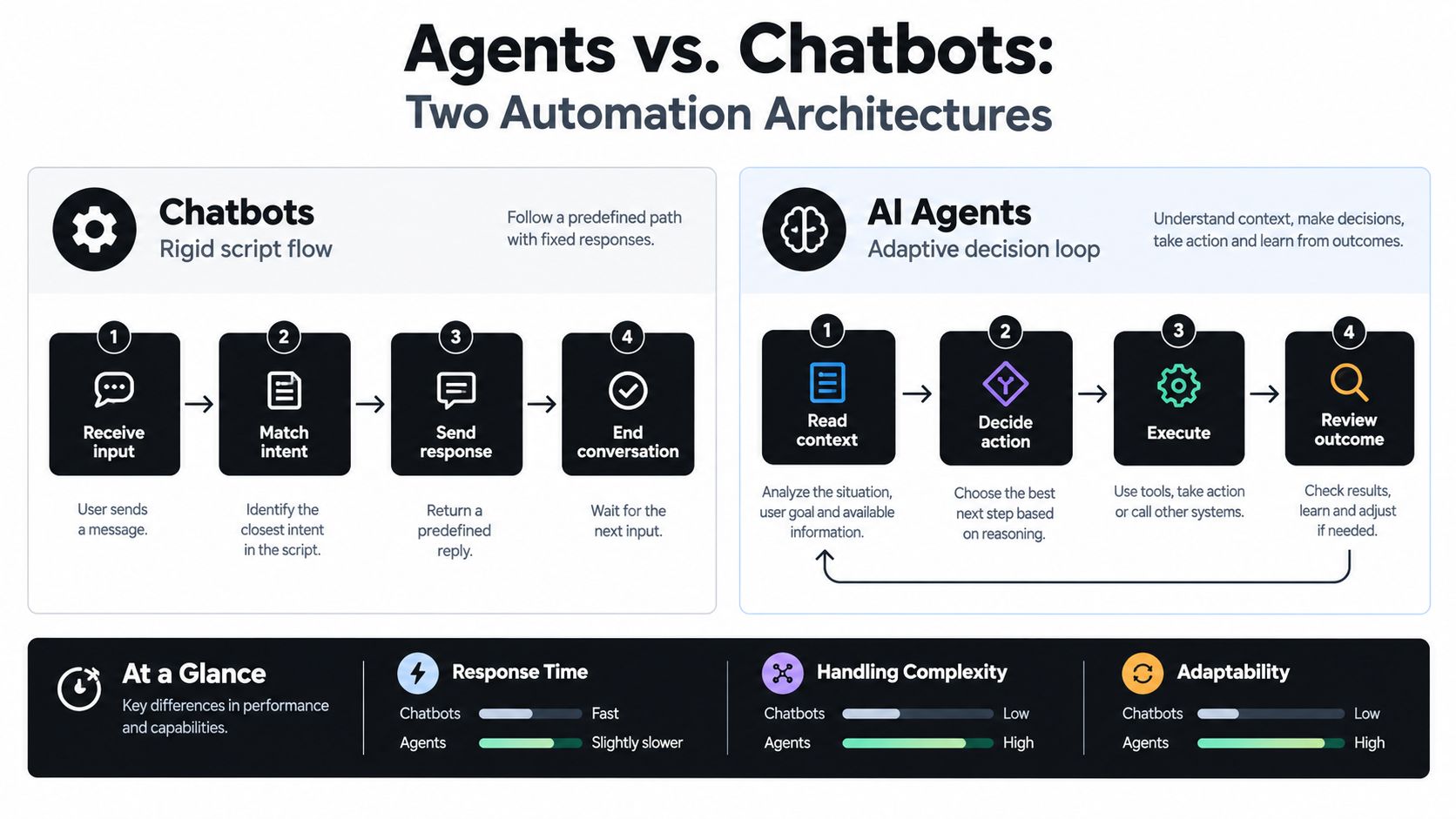
A comparison infographic showing the workflow and performance differences between traditional chatbots and advanced AI agents.

The operating model

A useful deployment starts with four inputs:

  1. The message: A comment, DM, or website chat request.

  2. The context: The ad, product, prior conversation, customer intent, and brand policy.

  3. The permitted action: Reply, hide, send a link, ask a question, or escalate.

  4. The outcome: Whether the buyer continued, purchased, complained, or needed human help.

Unified intelligence connects those actions across Facebook, Instagram, TikTok, and website chat. A question about shipping should receive the same approved answer wherever it appears. A recurring objection should inform the next response, the campaign brief, and the moderation rules.

The system shouldn't improvise commercial terms. Give it approved prices, offers, product facts, delivery language, prohibited claims, and examples of the brand voice. Then let it work inside those boundaries. The conversational AI for ecommerce approach is most useful when it connects natural language handling to real actions, not when it only produces plausible text.

Agents and Workflows Compared

An agent and a workflow solve different parts of the problem.

An AI agent reads context, decides what matters, and acts toward an outcome. In an ad engagement flow, it might recognize a buying question, answer publicly, send a checkout link, and escalate a complaint. It has room to interpret language instead of waiting for one exact phrase.

A workflow defines the permitted route. If the message signals purchase intent, send the approved offer. If it contains a complaint from an existing customer, route it to support. If it matches spam criteria, hide it. The workflow makes the operating boundaries visible and repeatable.

Most production systems combine both. The workflow controls the branches. The agent handles the language inside each branch.
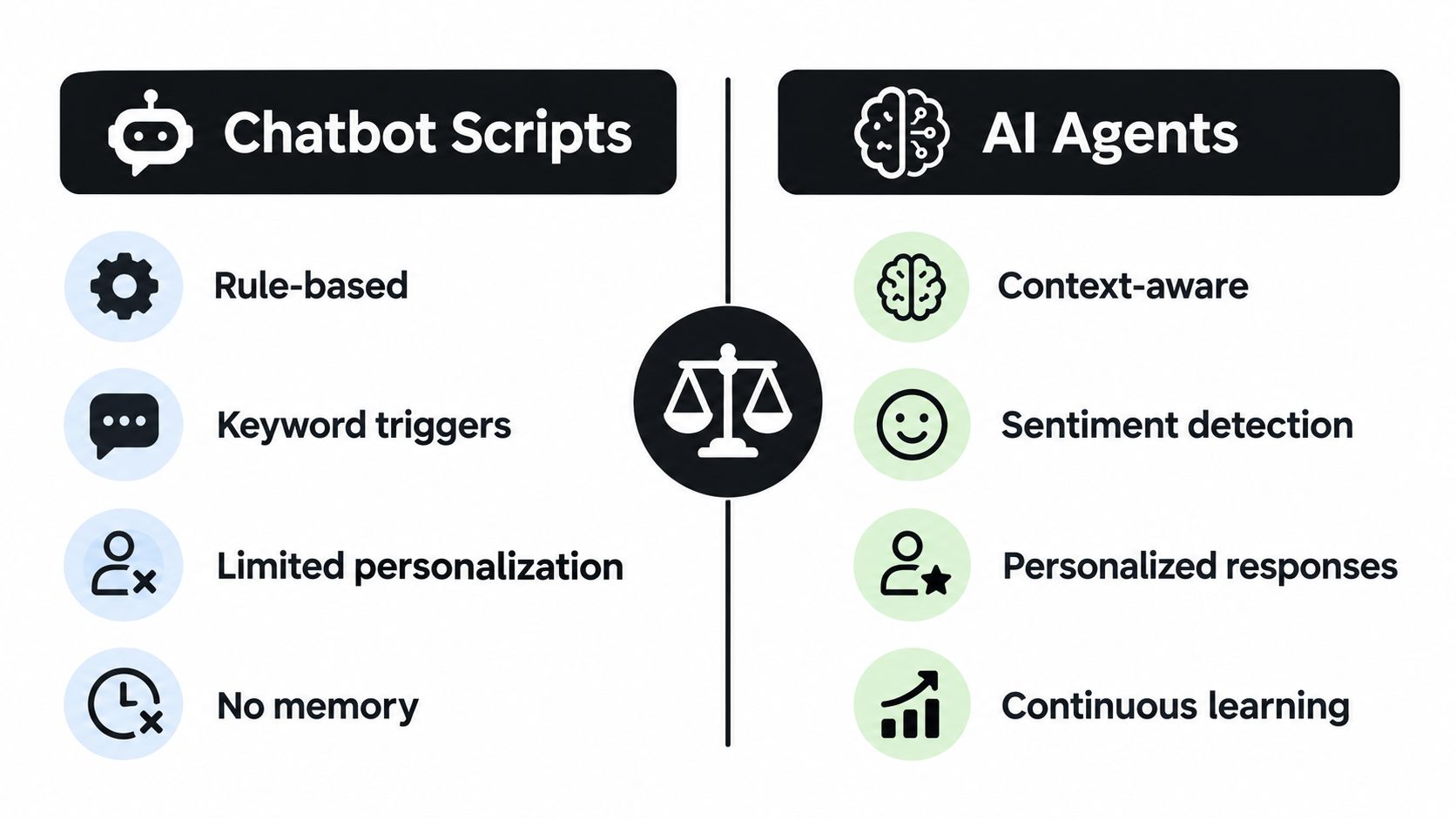
A comparison chart highlighting the key differences between traditional chatbot scripts and advanced AI agents.

Choosing the right architecture

Architecture

Strength

Control

Best Fit

Agents

Interpret context and handle varied language

Requires clear permissions and review rules

Buyer questions, product discovery, conversational selling

Workflows

Make branches, approvals, and escalation explicit

High control and predictable routing

Moderation, compliance checks, offer eligibility

Hybrid architectures

Combines judgment with defined guardrails

Strong control with flexible responses

Paid social engagement across comments, DMs, and chat

A pure workflow often fails when customers phrase the same intent in many ways. A pure agent can create risk if it has unclear permissions or no escalation boundary. The hybrid model gives the agent room to answer naturally while the workflow decides what it may do.

For example, the workflow can classify a comment into buyer intent, product question, complaint, or spam. The agent then writes the response using approved product information. If the customer asks about a regulated claim or disputes a charge, the workflow pauses the action and routes the thread to a person.

The quality test isn't whether one reply sounds convincing. It is whether the full process completes correctly. Did the system identify intent, send the right response, preserve the messaging window, deliver the correct link, record the action, and attribute the sale? Automation benchmark research describes this end-to-end standard across real tools and business functions, with scoring based on final-state success rather than isolated model output.

A response that sounds excellent but sends the wrong offer is a failed workflow. A short response that moves the right buyer to checkout, records the event, and escalates the edge case is operationally better.

For teams weighing traditional scripts against agents, chatbots versus AI employees is the more useful comparison than a generic feature list. The decision should follow the work, the risk, and the action the system must complete.

Use Cases You Can Apply Today

Paid social teams don't need to automate every customer interaction on day one. Start with the points where delay costs revenue or where visible comments affect the next buyer.

Meta comment-to-DM sales recovery

A buyer comments, “Do you have this in black?” under a product ad.

  1. Reply publicly with the approved product answer.

  2. Invite the buyer into DM.

  3. Confirm the product or variant.

  4. Send the checkout link or approved offer while the 24-hour window remains open.

  5. Record the conversation and connect the purchase to the reply.

The window can start when someone messages a Page, clicks a call-to-action, uses a Click-to-Messenger ad, or engages through an m.me link. A new interaction resets it. That makes the comment-to-DM route practical for same-day sales recovery, provided the brand follows the platform's messaging rules.

Meta rule: Move a genuine buyer from public comment to DM, then complete the commercial follow-up inside the active messaging window.

Don't send the same sales pitch to every commenter. A product question deserves an answer. A complaint deserves ownership. A request for a discount may require an eligibility check. The AI employee should identify the difference before taking action. The operational design is similar to AI sales automation for ecommerce, where intent detection must lead to a measurable commercial step.

TikTok comment moderation

TikTok Ads Manager lets advertisers view and manage ad comments. Its controls include replying, liking, blocking, exporting, hiding, and filtering comments. TikTok also documents advertiser-defined filters, the ability to hide unsuitable comments, the option to turn comments off, and dashboard analysis through its comment-management controls.

A same-day setup looks like this:

  • Filter obvious spam: Add rules for repetitive promotional phrases, scam language, and irrelevant links.

  • Hide harmful content: Remove comments that damage the ad environment or mislead shoppers.

  • Prioritize buying questions: Keep human attention on sizing, ingredients, delivery, stock, and product fit.

  • Review the exceptions: Check what the system hid and what it answered before expanding the rules.

TikTok rule: Automate obvious moderation decisions, but reserve judgment for comments that contain product questions, real complaints, or purchase intent.

TikTok's own brand-safety guidance treats comment management as an ad-control mechanism, not a cosmetic setting. Its advertiser guidance gives teams a practical basis for filtering, hiding, or disabling comments when moderation cost outweighs the benefit.

Agency management across client pages

Agencies need separation, not one generic AI personality. Train each AI employee on the client's approved voice, products, offers, escalation contacts, prohibited claims, and moderation preferences. Keep the account, campaign, and attribution data separated by brand.

A useful onboarding checklist includes product feeds, frequently asked questions, offer rules, comment categories, and examples of acceptable replies. Teams looking to improve onboarding workflow efficiency can apply the same principle here: collect structured information once, validate it with the client, and reuse it across the engagement workflow.

Give account managers a dashboard that shows response volume, hidden comments, escalations, buyer-intent conversations, and recovered revenue by client. Without that separation, agencies may save moderation time but lose the ability to defend performance or tune the right brand policy.

Implementing AI Agents Safely

Adoption doesn't equal governance. One 2026 benchmark found that 63% of firms had operationalized or implemented AI in parts of the business, while only about 20% reported mature frameworks for managing AI agents. The AI adoption and risk benchmark captures the gap that matters to operators: many teams have deployed AI, but fewer have defined when it may act alone.

The fix is practical. Start by specifying the action boundary, not by asking whether the AI is “smart enough.”

Train the brand before training the agent

Give the system approved answers, product facts, pricing rules, offer eligibility, delivery policies, and examples of the desired voice. Add explicit exclusions. An agent shouldn't invent stock information, make unsupported health claims, or promise an outcome the brand hasn't approved.

Review the first replies against those rules. Correct the source material when the system repeatedly makes the same mistake. Prompt changes alone won't repair missing or contradictory policy.

Separate hide, answer, and escalate

Moderation needs three distinct outcomes:

  • Hide: Obvious spam, scams, abusive content, or comments that meet a defined brand-safety rule.

  • Answer: Routine product questions and clear buying intent with approved information.

  • Escalate: Complaints, refunds, threats, sensitive personal data, and regulated topics.

Telehealth and insurance require tighter approval workflows than a low-risk product-sizing question. The system can collect context and draft a response, but a qualified person should approve sensitive claims and recommendations.

Every automated action needs an audit trail. Log the original message, context used, action taken, response, escalation reason, and final outcome. Shopify attribution should connect a recovered sale to the reply that closed it, while dashboards should let operators inspect the path rather than trust an aggregate number.

No-code setup through Meta Business Manager reduces the need for custom development, but it doesn't remove the need for permissions and review. Start with narrow access. Expand actions after the logs show consistent behavior.

Governance principle: Use augmentation for high-stakes replies. Let the AI employee prepare, classify, and route. Let a person approve the decision when the cost of being wrong is high.

The human-in-the-loop AI model works best when the escalation trigger is explicit. “Feels risky” isn't a rule. “Refund request,” “medical question,” and “unsupported claim” are rules a team can test.

KPIs and ROI You Can Measure

The first metric is first response time. A delayed answer loses context and forces the buyer to repeat the question. Benchmark data reports AI-powered support reducing average first response from over six hours to under four minutes, while high-performing live chat targets five to ten seconds and social expectations range from roughly 15 minutes to 60 minutes. Customer service response benchmarks put the paid-social problem in clear terms: manual queues often respond after the highest-intent moment has passed.

Track response time by channel, campaign, and intent. A single blended average hides the difference between a product question answered quickly and a complaint sitting unresolved.

The revenue metrics

Use four operating measures:

  • DM window coverage: The share of eligible conversations answered while the platform messaging window remains active.

  • Buyer-intent recovery rate: The share of purchase-intent conversations that reach a defined recovery action, such as a product answer, offer, or checkout link.

  • Attributed revenue per reply: Revenue connected to a specific automated response, rather than revenue assigned to the campaign in general.

  • Escalation quality: The percentage of escalated threads that reach the right human team without unnecessary routing.

Exerta reports that its AI employees are used by 250+ brands, average a 15% sales lift, have recovered more than $2 million in attributed revenue in-product, and operate at 99.9% uptime. Shopify attribution links each recovered sale to the reply associated with the conversion. These are platform-reported figures, so teams should still validate them against their own holdouts, campaign records, and order data.

Read value before the long-term forecast

Businesses may expect meaningful ROI from AI automation to take two to three years, while adoption continues to accelerate. Gallup's workplace research also found that only 16% of AI users cited automation as a use case, and frequent users were nearly three times as likely as infrequent users to use AI for automation or process automation, 21% versus 8%.

That maturity gap creates room for disciplined measurement. Set a baseline before launch. Compare response time, eligible-window coverage, recovered conversations, and attributed revenue over the first 90 to 180 days. Don't call every sale an AI sale. Require a traceable reply, a defined action, and an order connection.

Best Practices for Deploying AI Automation

Start with one AI employee on the highest-spend Meta campaign. Choose a campaign with steady comment volume, a clear product offer, and a support team that can review escalations. Don't begin with every channel, every product, and every exception.

A practical launch checklist

  1. Train the voice: Add approved answers, product data, offer rules, prohibited claims, and escalation contacts before activation.

  2. Define moderation: Specify what gets hidden, what receives an answer, and what goes to a person.

  3. Limit permissions: Allow only the actions the employee needs for the first deployment.

  4. Review the logs: Inspect automated replies, hidden comments, escalations, and failed actions during the first week.

  5. Measure from day one: Record response time, DM-window coverage, buyer-intent recovery, and attributed revenue.

  6. Tune the branches: Change rules when the same error appears repeatedly. Don't patch isolated replies forever.

  7. Review at 90 days: Decide whether the campaign earned broader coverage based on revenue, quality, and escalation load.

Add agents as volume grows instead of adding headcount for every new page or campaign. Extend coverage to SMS, email, and voice as those channels launch, but keep complaints and regulated categories in a human approval path.

The market is moving toward larger automation systems. One industry report projects the AI automation market from $129.9 billion in 2025 to $1,144.8 billion by 2033, with a projected 31.4% compound annual growth rate from 2026 to 2033. The market projection matters less than the operating lesson: teams that start with a narrow, measurable process will have better evidence when they expand.

Pick your best-performing ad, connect the channel, and let the first AI employee work one weekend. Read the dashboard Monday morning. Look for the conversations answered, the comments moderated, the escalations created, and the sales tied to specific replies.

Exerta deploys AI employees for comments, DMs, moderation, and website chat across Facebook, Instagram, TikTok, and web channels, with every action logged for review and attribution. Visit Exerta to connect a paid social channel and start testing automated engagement on one campaign.

Get started today

Stop losing sales you already paid for.

Connect your channels in about a minute. Your AI employees start answering, moderating and closing the same day.

No credit card required

Live in under 5 minutes

250+ brands running

Cancel anytime

Get started today

Stop losing sales you already paid for.

Connect your channels in about a minute. Your AI employees start answering, moderating and closing the same day.

No credit card required

Live in under 5 minutes

250+ brands running

Cancel anytime

Get started today

Stop losing sales you already paid for.

Connect your channels in about a minute. Your AI employees start answering, moderating and closing the same day.

No credit card required

Live in under 5 minutes

250+ brands running

Cancel anytime

AI employees that answer every buyer, protect your ad spend and close sales around the clock.

All systems operational · 99.98% uptime last 90 days

SOC 2

Type II

GDPR

Compliant

99.9% SLA

Uptime

24/7

Support

1. Pricing and billing All prices displayed on exerta.ai are in US dollars and exclude applicable taxes unless stated otherwise. Prices are subject to change. Existing subscribers will receive at least 30 days’ written notice before any price increase takes effect on their account. Annual plan savings are calculated by comparing the annual billing rate to the equivalent monthly billing rate multiplied by 12.

2. Run and usage statisticsRevenue, engagement and success figures are based on aggregated platform data and customer-reported results across 250+ brands, and are updated periodically.

3. Time-to-value claims Statements such as “live in about a minute” reflect typical setup times observed for new accounts connecting through Meta Business Manager. Actual setup time may vary with the number of channels connected and the level of agent customization.

4. AI step suggestions Exerta’s AI features are powered by a blend of leading AI models, anchored by our own fine-tuned engagement model. Suggestion quality, accuracy and availability may vary. Exerta does not guarantee that AI-generated output will be accurate, complete or suitable for any particular use case. Review AI output before acting on it.

5. Integration availability The number of native integrations referenced on this website reflects integrations available at the time of last update. Integration availability may vary by subscription plan. Third-party integrations are subject to the terms, availability and API limitations of the respective third-party providers. Exerta does not guarantee the continued availability of any specific integration and is not responsible for disruptions caused by changes to third-party APIs or services.

6. Uptime and SLA The 99.9% uptime figure refers to our published Service Level Agreement (SLA) target for paid plan customers. Actual uptime may vary. Historical uptime statistics are available upon request.

7. Security and compliance certifications Exerta’s SOC 2 Type II (coming soon) certification covers the security, availability, processing integrity, confidentiality and privacy trust service criteria. GDPR compliance reflects our internal data protection practices and contractual commitments. HIPAA compliance is available exclusively on Enterprise plans and requires execution of a Business Associate Agreement (BAA). ISO 27001 certification is currently in progress. Compliance certifications are subject to annual renewal and audit. Copies of our most recent compliance reports are available to Enterprise customers under NDA upon request.

8. Customer testimonials and case studies Testimonials, quotes and case study results featured on this website reflect the experiences of individual customers. Results vary with ad spend, engagement volume, offer and configuration. Exerta does not guarantee that any customer will achieve similar results.

9. Third-party service marks and logos All third-party brand names, logos and service marks referenced on this website — including but not limited to Meta, Facebook, Instagram, TikTok, Shopify and Trustpilot — are the property of their respective owners. References to these services do not imply endorsement, sponsorship or affiliation.

10. Free plan limitations The Free plan does not require a credit card. Free plan usage is subject to the limits described on our pricing page, including a limited number of AI actions per month and comment hiding with stock replies only. Exerta reserves the right to modify the features and limits of the Free plan at any time.

11. Trial periods Free trial periods are available on paid plans as described at the time of signup. At the end of the trial period, the selected payment method will be charged at the applicable plan rate unless the subscription is cancelled before the trial expires. Trial periods are available once per customer and may not be combined with other promotional offers.

12. Data processing and privacy Exerta processes personal data in accordance with our Privacy Policy and Data Processing Agreement. Data residency options (US and EU) are available on all paid plans. The data residency region is selected at account creation and cannot be changed without contacting our support team. Customers responsible for processing personal data of EEA or UK residents are advised to execute our standard Data Processing Agreement, available at exerta.ai/legal/dpa.

13. Activity history retention Activity history is retained for 90 days on the Starter plan and for longer periods on larger plans, as described at signup. Exported data is the responsibility of the customer once downloaded.

14. AI model providers Exerta uses a blend of leading AI models together with our own fine-tuned engagement model, specialized for customer engagement. Model composition may change as we improve the product.

15. Mobile and desktop applications Exerta is available in the browser on desktop and mobile. Certain advanced configuration features are easiest on desktop. Application updates are released on a rolling basis.

16. Template library Prebuilt agent setups provided by Exerta are starting points and are not guaranteed to be suitable for any particular purpose. Customers are responsible for reviewing and testing agent behavior before enabling it on live channels.

17. Website content accuracy The information on this website is provided for general informational purposes only and is subject to change without notice. While we make every effort to keep the content accurate and up to date, Exerta makes no warranties or representations, express or implied, about the completeness, accuracy, reliability or suitability of the information contained on this website for any particular purpose.

18. Promotional offers and discounts Promotional pricing, discounts and special offers are subject to additional terms and conditions communicated at the time of the offer. Offers cannot be applied retroactively to existing subscriptions and may not be combined with other promotions unless explicitly stated. Exerta reserves the right to modify or discontinue promotional offers at any time.

19. Startup and non-profit programs Eligibility for our startup and non-profit discount programs is assessed at Exerta’s sole discretion based on the criteria described in our support documentation. Approved discounts apply to the base subscription price only and do not apply to add-ons, Enterprise features or professional services. Discount eligibility is subject to annual review.

20. Intellectual property This website is operated by Reascend LLC (d/b/a Exerta), a limited liability company formed in the State of Delaware, United States. References to “we”, “us” and “our” throughout this website refer to Reascend LLC (d/b/a Exerta). The use of this website and our Services is governed by the laws of the State of Delaware, United States, as described in our Terms of Service.

21. Accessibility Exerta is committed to making its website and application accessible to all users, including those with disabilities. We aim to conform to the Web Content Accessibility Guidelines (WCAG) 2.1 at Level AA. If you experience any accessibility barriers, please contact us at accessibility@exerta.ai and we will make every effort to provide an accessible alternative.

22. Governing jurisdiction This website is operated by Reascend LLC (d/b/a Exerta), a limited liability company formed in the State of Delaware, United States. References to “we”, “us” and “our” throughout this website refer to Reascend LLC (d/b/a Exerta). The use of this website and our Services is governed by the laws of the State of Delaware, United States, as described in our Terms of Service.

AI employees that answer every buyer, protect your ad spend and close sales around the clock.

All systems operational · 99.98% uptime last 90 days

SOC 2

Type II

GDPR

Compliant

99.9% SLA

Uptime

24/7

Support

1. Pricing and billing All prices displayed on exerta.ai are in US dollars and exclude applicable taxes unless stated otherwise. Prices are subject to change. Existing subscribers will receive at least 30 days’ written notice before any price increase takes effect on their account. Annual plan savings are calculated by comparing the annual billing rate to the equivalent monthly billing rate multiplied by 12.

2. Run and usage statisticsRevenue, engagement and success figures are based on aggregated platform data and customer-reported results across 250+ brands, and are updated periodically.

3. Time-to-value claims Statements such as “live in about a minute” reflect typical setup times observed for new accounts connecting through Meta Business Manager. Actual setup time may vary with the number of channels connected and the level of agent customization.

4. AI step suggestions Exerta’s AI features are powered by a blend of leading AI models, anchored by our own fine-tuned engagement model. Suggestion quality, accuracy and availability may vary. Exerta does not guarantee that AI-generated output will be accurate, complete or suitable for any particular use case. Review AI output before acting on it.

5. Integration availability The number of native integrations referenced on this website reflects integrations available at the time of last update. Integration availability may vary by subscription plan. Third-party integrations are subject to the terms, availability and API limitations of the respective third-party providers. Exerta does not guarantee the continued availability of any specific integration and is not responsible for disruptions caused by changes to third-party APIs or services.

6. Uptime and SLA The 99.9% uptime figure refers to our published Service Level Agreement (SLA) target for paid plan customers. Actual uptime may vary. Historical uptime statistics are available upon request.

7. Security and compliance certifications Exerta’s SOC 2 Type II (coming soon) certification covers the security, availability, processing integrity, confidentiality and privacy trust service criteria. GDPR compliance reflects our internal data protection practices and contractual commitments. HIPAA compliance is available exclusively on Enterprise plans and requires execution of a Business Associate Agreement (BAA). ISO 27001 certification is currently in progress. Compliance certifications are subject to annual renewal and audit. Copies of our most recent compliance reports are available to Enterprise customers under NDA upon request.

8. Customer testimonials and case studies Testimonials, quotes and case study results featured on this website reflect the experiences of individual customers. Results vary with ad spend, engagement volume, offer and configuration. Exerta does not guarantee that any customer will achieve similar results.

9. Third-party service marks and logos All third-party brand names, logos and service marks referenced on this website — including but not limited to Meta, Facebook, Instagram, TikTok, Shopify and Trustpilot — are the property of their respective owners. References to these services do not imply endorsement, sponsorship or affiliation.

10. Free plan limitations The Free plan does not require a credit card. Free plan usage is subject to the limits described on our pricing page, including a limited number of AI actions per month and comment hiding with stock replies only. Exerta reserves the right to modify the features and limits of the Free plan at any time.

11. Trial periods Free trial periods are available on paid plans as described at the time of signup. At the end of the trial period, the selected payment method will be charged at the applicable plan rate unless the subscription is cancelled before the trial expires. Trial periods are available once per customer and may not be combined with other promotional offers.

12. Data processing and privacy Exerta processes personal data in accordance with our Privacy Policy and Data Processing Agreement. Data residency options (US and EU) are available on all paid plans. The data residency region is selected at account creation and cannot be changed without contacting our support team. Customers responsible for processing personal data of EEA or UK residents are advised to execute our standard Data Processing Agreement, available at exerta.ai/legal/dpa.

13. Activity history retention Activity history is retained for 90 days on the Starter plan and for longer periods on larger plans, as described at signup. Exported data is the responsibility of the customer once downloaded.

14. AI model providers Exerta uses a blend of leading AI models together with our own fine-tuned engagement model, specialized for customer engagement. Model composition may change as we improve the product.

15. Mobile and desktop applications Exerta is available in the browser on desktop and mobile. Certain advanced configuration features are easiest on desktop. Application updates are released on a rolling basis.

16. Template library Prebuilt agent setups provided by Exerta are starting points and are not guaranteed to be suitable for any particular purpose. Customers are responsible for reviewing and testing agent behavior before enabling it on live channels.

17. Website content accuracy The information on this website is provided for general informational purposes only and is subject to change without notice. While we make every effort to keep the content accurate and up to date, Exerta makes no warranties or representations, express or implied, about the completeness, accuracy, reliability or suitability of the information contained on this website for any particular purpose.

18. Promotional offers and discounts Promotional pricing, discounts and special offers are subject to additional terms and conditions communicated at the time of the offer. Offers cannot be applied retroactively to existing subscriptions and may not be combined with other promotions unless explicitly stated. Exerta reserves the right to modify or discontinue promotional offers at any time.

19. Startup and non-profit programs Eligibility for our startup and non-profit discount programs is assessed at Exerta’s sole discretion based on the criteria described in our support documentation. Approved discounts apply to the base subscription price only and do not apply to add-ons, Enterprise features or professional services. Discount eligibility is subject to annual review.

20. Intellectual property This website is operated by Reascend LLC (d/b/a Exerta), a limited liability company formed in the State of Delaware, United States. References to “we”, “us” and “our” throughout this website refer to Reascend LLC (d/b/a Exerta). The use of this website and our Services is governed by the laws of the State of Delaware, United States, as described in our Terms of Service.

21. Accessibility Exerta is committed to making its website and application accessible to all users, including those with disabilities. We aim to conform to the Web Content Accessibility Guidelines (WCAG) 2.1 at Level AA. If you experience any accessibility barriers, please contact us at accessibility@exerta.ai and we will make every effort to provide an accessible alternative.

22. Governing jurisdiction This website is operated by Reascend LLC (d/b/a Exerta), a limited liability company formed in the State of Delaware, United States. References to “we”, “us” and “our” throughout this website refer to Reascend LLC (d/b/a Exerta). The use of this website and our Services is governed by the laws of the State of Delaware, United States, as described in our Terms of Service.

AI employees that answer every buyer, protect your ad spend and close sales around the clock.

All systems operational · 99.98% uptime last 90 days

SOC 2

Type II

GDPR

Compliant

99.9% SLA

Uptime

24/7

Support

1. Pricing and billing All prices displayed on exerta.ai are in US dollars and exclude applicable taxes unless stated otherwise. Prices are subject to change. Existing subscribers will receive at least 30 days’ written notice before any price increase takes effect on their account. Annual plan savings are calculated by comparing the annual billing rate to the equivalent monthly billing rate multiplied by 12.

2. Run and usage statisticsRevenue, engagement and success figures are based on aggregated platform data and customer-reported results across 250+ brands, and are updated periodically.

3. Time-to-value claims Statements such as “live in about a minute” reflect typical setup times observed for new accounts connecting through Meta Business Manager. Actual setup time may vary with the number of channels connected and the level of agent customization.

4. AI step suggestions Exerta’s AI features are powered by a blend of leading AI models, anchored by our own fine-tuned engagement model. Suggestion quality, accuracy and availability may vary. Exerta does not guarantee that AI-generated output will be accurate, complete or suitable for any particular use case. Review AI output before acting on it.

5. Integration availability The number of native integrations referenced on this website reflects integrations available at the time of last update. Integration availability may vary by subscription plan. Third-party integrations are subject to the terms, availability and API limitations of the respective third-party providers. Exerta does not guarantee the continued availability of any specific integration and is not responsible for disruptions caused by changes to third-party APIs or services.

6. Uptime and SLA The 99.9% uptime figure refers to our published Service Level Agreement (SLA) target for paid plan customers. Actual uptime may vary. Historical uptime statistics are available upon request.

7. Security and compliance certifications Exerta’s SOC 2 Type II (coming soon) certification covers the security, availability, processing integrity, confidentiality and privacy trust service criteria. GDPR compliance reflects our internal data protection practices and contractual commitments. HIPAA compliance is available exclusively on Enterprise plans and requires execution of a Business Associate Agreement (BAA). ISO 27001 certification is currently in progress. Compliance certifications are subject to annual renewal and audit. Copies of our most recent compliance reports are available to Enterprise customers under NDA upon request.

8. Customer testimonials and case studies Testimonials, quotes and case study results featured on this website reflect the experiences of individual customers. Results vary with ad spend, engagement volume, offer and configuration. Exerta does not guarantee that any customer will achieve similar results.

9. Third-party service marks and logos All third-party brand names, logos and service marks referenced on this website — including but not limited to Meta, Facebook, Instagram, TikTok, Shopify and Trustpilot — are the property of their respective owners. References to these services do not imply endorsement, sponsorship or affiliation.

10. Free plan limitations The Free plan does not require a credit card. Free plan usage is subject to the limits described on our pricing page, including a limited number of AI actions per month and comment hiding with stock replies only. Exerta reserves the right to modify the features and limits of the Free plan at any time.

11. Trial periods Free trial periods are available on paid plans as described at the time of signup. At the end of the trial period, the selected payment method will be charged at the applicable plan rate unless the subscription is cancelled before the trial expires. Trial periods are available once per customer and may not be combined with other promotional offers.

12. Data processing and privacy Exerta processes personal data in accordance with our Privacy Policy and Data Processing Agreement. Data residency options (US and EU) are available on all paid plans. The data residency region is selected at account creation and cannot be changed without contacting our support team. Customers responsible for processing personal data of EEA or UK residents are advised to execute our standard Data Processing Agreement, available at exerta.ai/legal/dpa.

13. Activity history retention Activity history is retained for 90 days on the Starter plan and for longer periods on larger plans, as described at signup. Exported data is the responsibility of the customer once downloaded.

14. AI model providers Exerta uses a blend of leading AI models together with our own fine-tuned engagement model, specialized for customer engagement. Model composition may change as we improve the product.

15. Mobile and desktop applications Exerta is available in the browser on desktop and mobile. Certain advanced configuration features are easiest on desktop. Application updates are released on a rolling basis.

16. Template library Prebuilt agent setups provided by Exerta are starting points and are not guaranteed to be suitable for any particular purpose. Customers are responsible for reviewing and testing agent behavior before enabling it on live channels.

17. Website content accuracy The information on this website is provided for general informational purposes only and is subject to change without notice. While we make every effort to keep the content accurate and up to date, Exerta makes no warranties or representations, express or implied, about the completeness, accuracy, reliability or suitability of the information contained on this website for any particular purpose.

18. Promotional offers and discounts Promotional pricing, discounts and special offers are subject to additional terms and conditions communicated at the time of the offer. Offers cannot be applied retroactively to existing subscriptions and may not be combined with other promotions unless explicitly stated. Exerta reserves the right to modify or discontinue promotional offers at any time.

19. Startup and non-profit programs Eligibility for our startup and non-profit discount programs is assessed at Exerta’s sole discretion based on the criteria described in our support documentation. Approved discounts apply to the base subscription price only and do not apply to add-ons, Enterprise features or professional services. Discount eligibility is subject to annual review.

20. Intellectual property All content on this website, including text, graphics, logos, icons, images, audio clips, digital downloads and software, is the property of Reascend LLC (d/b/a Exerta) or its content suppliers and is protected by applicable intellectual property laws. Exerta® is a registered trademark of Reascend LLC. Unauthorised reproduction, distribution or modification of any content from this website is prohibited without prior written consent.

21. Accessibility Exerta is committed to making its website and application accessible to all users, including those with disabilities. We aim to conform to the Web Content Accessibility Guidelines (WCAG) 2.1 at Level AA. If you experience any accessibility barriers, please contact us at accessibility@exerta.ai and we will make every effort to provide an accessible alternative.

22. Governing jurisdiction This website is operated by Reascend LLC (d/b/a Exerta), a limited liability company formed in the State of Delaware, United States. References to “we”, “us” and “our” throughout this website refer to Reascend LLC (d/b/a Exerta). The use of this website and our Services is governed by the laws of the State of Delaware, United States, as described in our Terms of Service.