Human in the Loop AI for DTC Ads: A Practical Guide
read
·

A skincare ad is pulling comments faster than your team can read them. A buyer asks whether the product is safe for sensitive skin, another asks for the discount code, and a competitor drops a sales pitch into the third reply. Nine minutes pass while the account manager handles another client. By the time someone answers, the buyer has moved on.
That delay costs more than one sale. It wastes the spend that brought the buyer to the ad, leaves retargeting audiences full of people who never received a useful answer, and attaches a negative signal to an otherwise strong campaign. Human in the loop AI gives paid social teams a practical middle ground, AI employees handle routine volume while people retain control over sensitive, ambiguous, and high-value conversations.
Table of Contents
The Moment a Comment Outruns Your Team
The first comment disappears under a stream of reactions and jokes. “Is this safe for sensitive skin?” sits below “lol same,” repeated emojis, and unrelated replies. A DM asking about the promotion waits without an answer, even though Meta's messaging policy makes timing operationally important. The competitor pitch remains visible because nobody has reached the thread.
TikTok provides built-in comment controls that let advertisers view, reply to, like, block, export, hide, and filter comments inside Ads Manager. Advertisers can also create a Blocked Word list for terms and phrases they want hidden, which helps with obvious spam and hostile language, but those controls don't decide whether a buyer needs a product answer or a human handoff. (TikTok's comment management controls)
The leak shows up in several places:
Lost purchase intent: A question about safety, sizing, stock, shipping, or price receives no answer while the buyer is still ready to act.
Wasted follow-up spend: Retargeting reaches people whose original objection could have been resolved in the comment thread.
Public trust damage: Unanswered complaints and visible scam replies shape how later visitors read the ad.
Team distraction: Human reviewers spend their time sorting praise and repetitive FAQs instead of handling refunds, complaints, and nuanced objections.
This isn't solved by adding one more virtual assistant. Paid social volume arrives in spikes, and answer quality must remain consistent across accounts, products, and promotions. A larger manual team still needs routing, context, training, and coverage when several campaigns surge together.
Operator's rule: Speed without judgment creates risky replies. Judgment without speed creates missed revenue.
Pure automation can publish an answer that sounds polished but makes an unsupported product claim. Pure human handling preserves control but breaks under volume. HITL resolves the tension by assigning each decision to the fastest layer that can handle it safely. Teams looking at the revenue impact of unanswered threads can also review why unanswered ad comments cost sales.
What Human in the Loop AI Actually Means
In a paid social workflow, human in the loop AI means an AI employee proposes an action, a person controls the decisions that need judgment, and the system records that feedback for future work. The model doesn't classify a comment and disappear. It drafts a response, recommends whether to hide or keep content, and identifies conversations that need escalation.
The operating model has three parts:
The model proposes. It reads a comment, DM, or reported post, then drafts a response or recommends an action using product facts, approved offers, brand rules, and conversation context.
The human reviews. An operator approves, edits, rejects, or escalates the proposed action.
The system learns. Each approval, correction, and override becomes feedback that helps improve later routing and drafts.

Three zones for account teams
Think in zones rather than a single automation setting.
Auto-handle: The AI employee answers clear praise, approved FAQs, and routine questions with a high-confidence response.
Auto-handle with human audit: The AI publishes low-risk replies while a reviewer samples output, checks drift, and adjusts rules.
Human-handle with AI assist: The AI gathers context and drafts the response, but a person must approve it before publication.
The human's job usually comes down to three decisions. Send or don't send the reply. Keep or hide the public comment. Escalate or de-escalate the complaint based on risk, intent, and account value.
That design moves beyond simple rule-based automation by giving the AI employee a defined action set and a human checkpoint for exceptions. The workflow still needs explicit boundaries. A model shouldn't improvise around refunds, medical claims, legal language, or an unapproved promotion.
HITL isn't a feature toggle. It's a workflow decision that determines who acts, under what conditions, with what context, and within what response window. A useful AI social media agent should make those boundaries visible to the operator rather than hiding them behind a generic automation score.
How the Loop Runs Under a Real Ad
Take a TikTok comment asking whether a pair of leggings runs true to size. The loop begins when the comment reaches the ad or page. Every handoff matters because webhook delay, queue delay, and review delay all sit between buyer intent and the published answer.
The five operating steps
1. Ingestion. The system receives the comment or DM, attaches the ad, campaign, creative, user, and prior conversation context, then starts the clock. If ingestion is slow, every later safeguard becomes irrelevant to the buyer.
2. Classification. The AI employee identifies likely intent, such as purchase question, objection, complaint, troll, or spam. It also evaluates sentiment, risk, language, and whether the user has already received an answer.
3. Drafting. The system writes a first response using current product facts, available promotions, and approved answers. For a sizing question, it might suggest the size guide and ask for the buyer's usual fit. It can also recommend hiding a scam reply or flagging a complaint.
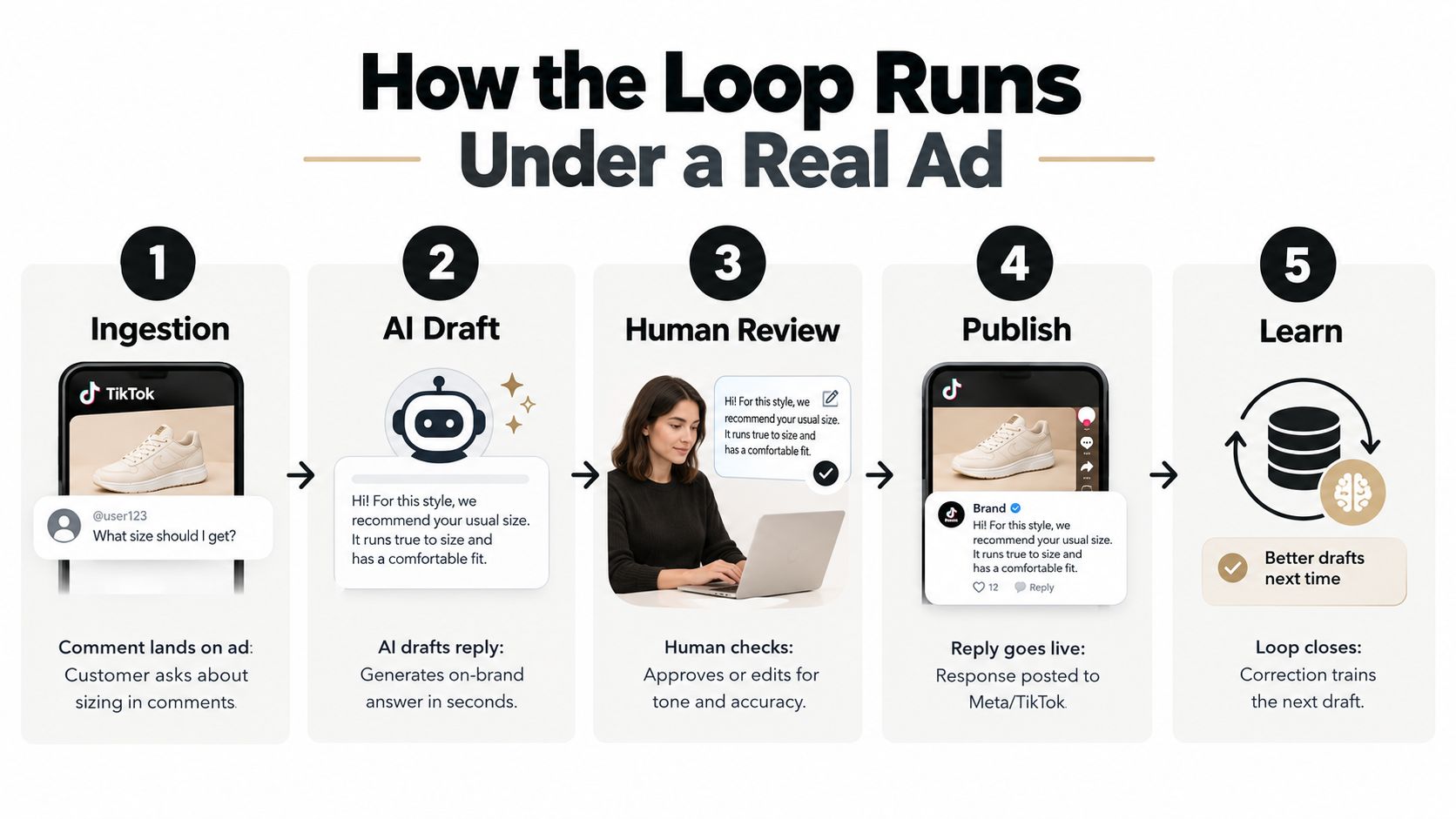
4. Human review. The reviewer sees the draft, confidence signals, the relevant product information, and the last five touches with that user. The operator approves, edits, or escalates against a defined target, under 60 seconds for purchase intent and under five minutes for complaints.
5. Feedback. The system records the decision. An edit becomes a labeled correction, an approval confirms an acceptable pattern, and an override signals that the routing or confidence threshold needs work.
What bypasses the queue
A team can't review everything. Clear praise and generic FAQs can be auto-handled when the response uses approved facts. Refund requests, medical claims, and legal language should always reach a person before the AI employee publishes a response.
The queue also needs a stop condition. If nobody reviews a high-risk case within its target window, the system should hold the reply, notify the assigned owner, and preserve the full thread. The Facebook ad comment moderation workflow should show not only what the AI did, but why it selected that action.
The Benefits and What They Cost You
HITL is a trade-off sheet, not a feature list. The benefit is usually clear, but every benefit creates an operating requirement that someone has to fund, staff, and measure.
First response coverage keeps Meta and TikTok DMs moving outside office hours. The cost is a review queue for anything the AI employee can't safely finish. A reviewer still needs to inspect uncertain purchase questions, sensitive objections, and complaints.
Consistent tone prevents every account manager from answering the same question differently. The cost is setup and tuning. Product facts, prohibited claims, promotion rules, and escalation language need regular maintenance as campaigns change.
Structured escalation gives refund requests, legal threats, and serious complaints a defined route. The cost is operational ownership. Someone must receive the alert, understand the context, and have authority to take over.
Compounding feedback turns human edits into future training signals. The cost is labeled review work. Teams need someone to read logs, identify repeated errors, and separate a true model problem from a missing policy.
A team managing 200 ads with 40 daily buying comments needs to budget review minutes, not just software spend. The exact queue size will vary by product, creative, objection rate, and escalation policy. The principle stays fixed: HITL shifts cost away from missed conversations and toward deliberate human attention.
Research supports the trade-off. A 2024 analysis found that incorrect machine recommendations can reduce human judgment accuracy, especially when algorithmic advice arrives before the person forms an initial opinion. A separate 2024 PLOS experiment found that human involvement increased uptake of automated decisions while decreasing decision accuracy, which makes interface design and reviewer discipline part of performance management, not decoration. (Evidence on algorithmic advice and human judgment)
Teams can reduce unnecessary labeling by prioritizing uncertain or high-value examples, a practice often described as active learning for labeling. The goal isn't to send more cases to people. It's to send the right cases.
Implementation Patterns You Can Ship Today
AI employees should act as the system of action. Humans should form the escalation layer. That split gives a DTC brand or agency a practical starting point without forcing a reviewer to read every low-risk interaction.

Comment triage
Trigger: A new comment lands on an active ad.
AI action: Classify price, stock, shipping, praise, objection, spam, and complaint intent. Draft approved answers for routine questions and route uncertain objections to the queue.
Human decision: Approve the response, edit the objection handling, or take over a return, refund, or product-safety discussion.
Start with the highest-volume FAQ categories. Don't begin by automating every sentiment label. A narrow set of reliable actions gives reviewers cleaner feedback.
DM concierge
Trigger: A user comments with buying intent or starts a DM.
AI action: Open the conversation, ask a qualifying question, provide the approved offer or checkout path, and record the intent.
Human decision: Take over when the conversation involves a high-value cart, a complex objection, or an exception to the offer rules.
Meta's 24-hour messaging window makes the handoff urgent. Businesses can send promotional messages only after a user action and within 24 hours of that action. Afterward, only limited non-promotional tags are available, so the AI employee should move a buyer into the thread quickly and alert a person before the opportunity expires. (Meta messaging policy details)
Negative sentiment
Trigger: The classifier detects anger, accusation, profanity, or a potential safety issue.
AI action: Hold the public reply, attach the complete thread, and notify the assigned reviewer.
Human decision: Decide whether to respond publicly, move to a DM, hide the comment, or escalate to support or legal.
Creative review
Trigger: A new ad or edited creative is prepared for spend.
AI action: Check the copy and visual against internal brand rules and platform policy, then flag questionable claims.
Human decision: Confirm the creative, request an edit, or stop it before distribution.
A workflow builder such as Exerta's workflow builder can represent these branches explicitly. Teams evaluating broader enterprise workflow automation agents should apply the same rule: define the action, the boundary, the owner, and the audit record before increasing autonomy.
Where HITL Quietly Breaks Down
The most dangerous HITL failure isn't a missing human. It's a human who approves everything without looking. A review badge can make a workflow appear controlled while the queue moves too quickly for anyone to inspect context.
Queue overload
A sudden campaign surge pushes hundreds of cases into review. The detection signal is approval latency collapsing while escalation volume rises and edits disappear. The fix is to lower the review surface, separate urgent purchase intent from routine cases, and pause low-confidence automation until coverage returns.
Prompt drift
A model or instruction update changes the tone or behavior of drafts. Reviewers skim because the interface still looks familiar. Watch for rising edit rates, repeated policy corrections, or a new cluster of complaints after a deployment. Sample 5 percent of approvals for re-review, compare results by reviewer and campaign, and keep a dated change log.
Silent routing failure
A refund or legal complaint never reaches a human because the rule depends on one keyword the customer doesn't use. Audit routing rules monthly with real historical conversations, then test paraphrases and multilingual variants. A dashboard should show cases that were auto-handled near a risk boundary, not only cases that successfully escalated.
The human layer only protects the brand when reviewers have enough time, context, and authority to change the outcome.
The field literature points to the same risk from another angle. Human review can degrade into automation bias, cognitive overload, or responsibility abdication when operators see long stretches of apparently correct output. A system that tracks only whether a person clicked approve won't tell you whether the person exercised judgment. (Human oversight and automation complacency)
Playbooks for Meta and TikTok
Meta and TikTok need different operating rules because the conversation surfaces and moderation controls differ. The common requirement is a clear handoff that preserves context and assigns a response owner.
On Meta, start with the comment-to-DM path. A buyer asks about price or an objection appears under the ad. The AI employee answers with approved information, extracts intent from the post and thread, and opens a message conversation when the buyer signals interest. Auto-handle simple product facts. Send refund language, legal threats, and creator partnership requests to a human reviewer. Staff the queue across time zones so first response remains below 10 minutes.
On TikTok, use the moderation layer before the public reply. The AI employee can filter obvious spam and hostile content, but claims involving medical, financial, or age-gated topics should wait for human approval. Creator collaboration requests should route to a named account manager rather than a general support queue.
The 24-hour DM clock needs its own sequence. The first message should confirm intent and present the next useful action. At hour 4, follow up with the missing product detail or checkout path. At hour 20, make the close attempt or hand the thread to a person. If the user raises a sensitive issue at any point, pause the AI employee and preserve the transcript for the reviewer.
Trigger | AI Employee Action | Human Reviewer Action | SLA |
|---|---|---|---|
Buying comment | Answer approved FAQ and invite a DM | Edit objection response or take over | Under 60 seconds |
Refund or legal language | Hold reply and route context | Approve, edit, or escalate | Under five minutes |
TikTok medical or financial claim | Flag before publishing | Verify claim handling | Before reply |
Creator partnership request | Classify and assign owner | Accept or redirect to account manager | Same working window |
Run three same-day moves: turn on comment-to-DM automation, create a two-rule escalation filter for refunds and legal language, and assign a named reviewer for each active queue. A structured social media moderation workflow helps teams keep those rules consistent across accounts.
Putting It All Together This Week
Start with a five-question account audit. Mark each answer pass or fix.
Buying-comment response: Can you see the current first-response time?
Routing split: Do you know which comments auto-handle and which reach a reviewer?
Queue depth: Can a reviewer see the oldest unresolved case immediately?
Escalation quality: Do refund and legal cases reach the right person?
DM outcome: Can you connect a qualified conversation to a purchase?
Each fix has one of three remedies. Tighten the AI employee's confidence threshold when drafts are too risky. Redraw escalation rules when the wrong cases enter the queue. Shift reviewer coverage when the right cases arrive but wait too long.
A practical first week
Day 1: Measure the current state without changing automation.
Days 2 and 3: Ship one escalation rule and one approved response template.
Day 4: Route 20 percent of comment volume through the loop and compare queue behavior with the existing process.
Day 5: Watch for rubber-stamping, missed alerts, and repeated edits.
Days 6 and 7: Document what changed, remove one weak rule, and queue the next improvement.
The benchmark that matters is operational, not theoretical: first-response time on buying comments under three minutes with escalation accuracy above 95 percent. HiL-Bench makes the broader point that agent quality depends on knowing when to ask for help, not only on solving a task once all information is available. Its benchmark covers 300 tasks, with 200 public and 100 private held-out tasks, and reported 24% combined Pass@3 when the model had to decide whether to ask for help, compared with 75 to 91% when information was provided upfront. (HiL-Bench selective-escalation benchmark)
Exerta deploys AI employees across Facebook, Instagram, TikTok, and website chat to answer routine comments and DMs, moderate harmful content, and route sensitive conversations to people with the full context. Visit Exerta to set up a paid social workflow that protects response speed without removing human judgment.