10 Comment Moderation Software Tools Compared
read
·

Your comment section is part of the ad. Buyers judge the offer, the brand, and the credibility of the campaign through the replies beneath it. A scam link left visible can weaken trust. A clear answer to “How much is shipping?” can move a buyer closer to checkout. A complaint about a missing order needs a private support path, not a public argument.
The scale makes manual review unreliable. One EU social-media moderation analysis found that more than 90 million decisions, or 60.67% of the analyzed total, were fully automated, while 31.48% were partially automated and 7.74% were not automated. (Grand View Research's content moderation analysis) Comment moderation software now has to make three decisions quickly: hide harmful content, reply to genuine questions, and escalate real customer problems.
This comparison treats each platform as an operating system for paid-social comment sections, not as a generic social media dashboard. I'm comparing Meta and TikTok ad coverage, response and sales workflows, rule depth, auditability, integrations, pricing signals, human review, compliance controls, and agency fit. The list separates moderation-only tools, social inboxes, enterprise governance platforms, managed services, and AI employees.
A useful same-day workflow is simple. Hide a comment containing a fake checkout link. Answer a legitimate price objection with approved information. Move a delivery complaint into Messenger or a support queue, while preserving the public context. The right platform helps your team do all three without losing the revenue signal. For more paid-social operating context, see PlatformDTC's social resources.
Table of Contents
1. Facebook Comment Moderation Tool: Hide Spam, Answer Buyers (Exerta)
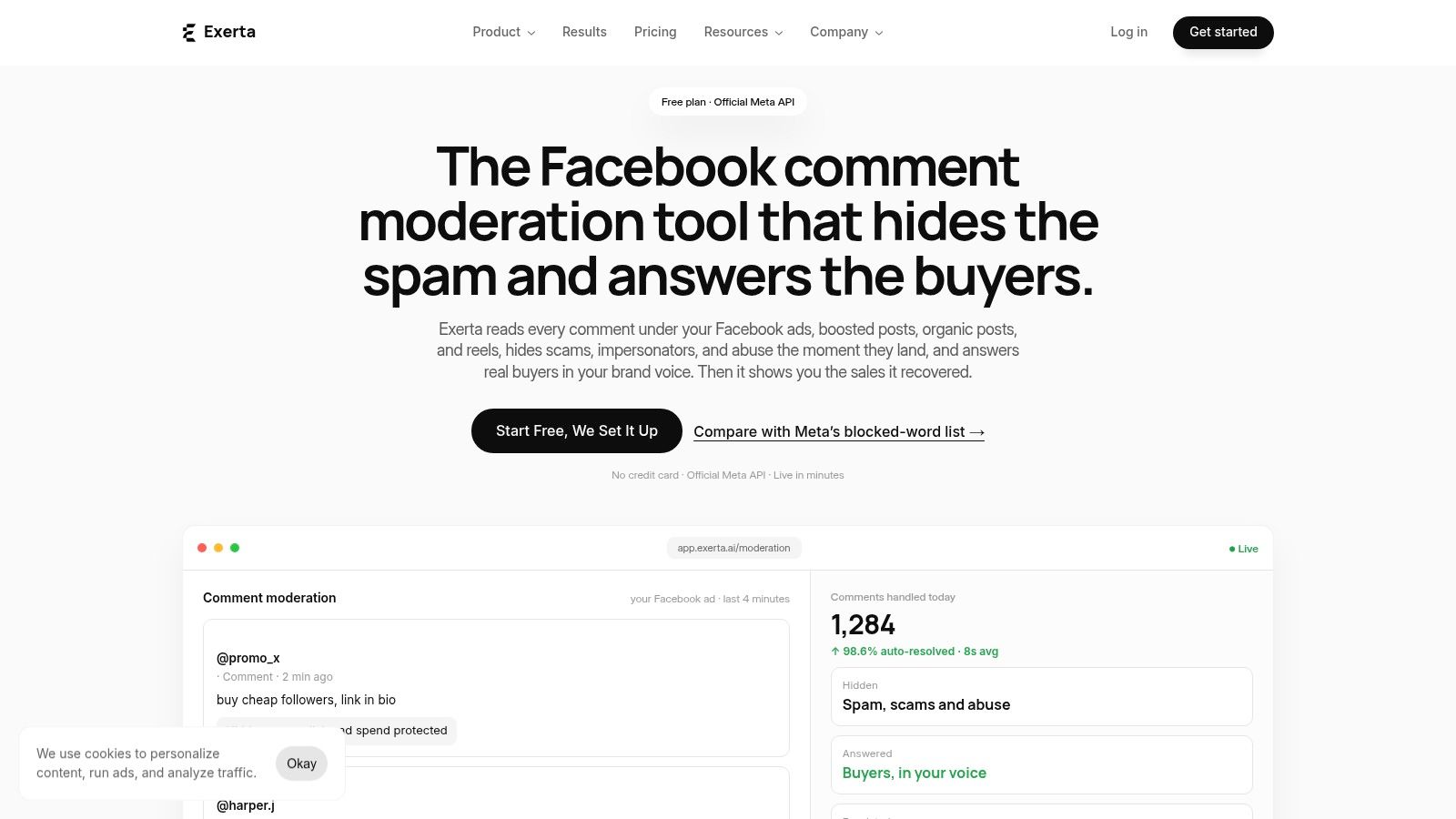
Exerta is designed for DTC brands that run paid social with comments functioning as both a sales queue and a support queue. It works as an AI employee, rather than a simple keyword filter. The system classifies comments as spam, scams, abuse, buying questions, or customer problems, then applies a separate action to each category.
Its operating model is focused on the comment sections beneath active ads. Exerta can hide harmful comments, reply in the brand's voice, and move a conversation into Messenger when private support or a sale requires follow-up. Coverage includes Facebook and Instagram ads, boosted posts, Reels, and organic Page content through Meta's official API. Logged, reversible actions give reviewers a clear record of what happened and allow them to correct a decision.
The sales workflow sets it apart from a moderation-only tool. Exerta can identify buyer intent, provide approved pricing or offer details, send checkout links, and follow up with prospects. Shopify attribution connects recovered revenue to the interaction that generated it. For a high-spend advertiser, that changes the review from comment volume to campaign protection, qualified conversations, and orders.
What works and what needs tuning
No-code setup through Meta Business Manager, a multi-branch workflow builder, real-time dashboards, and mobile sync support deployment by marketing teams and agencies. Exerta's product materials report adoption by brands, sales gains, recovered revenue, and high uptime. The Exerta site presents those performance figures, so teams should confirm the measurement method and attribution window before using them in a business case.
Channel scope is the main limitation. Facebook, Instagram, TikTok, and website chat are live, while SMS, email, and voice are planned for later. Teams also need Meta Business Manager access, plus an initial period of brand training and human review. Tuning is especially important when a brief complaint resembles abuse or a buyer uses unusual wording.
For a same-day test, connect one active Meta campaign, create separate rules for fake checkout links, purchase questions, and delivery complaints, then require human approval for replies during the first review cycle. Use Exerta's guide to Facebook ad comment moderation as the operating reference. The same approach can later inform SMS marketing workflows, but SMS is not part of Exerta's live coverage today.
Best for: DTC and ecommerce brands, lead-generation advertisers, telehealth teams, and agencies that need moderation, replies, escalation, and revenue recovery in one system.
2. BrandBastion
BrandBastion is built for advertisers that put brand safety and response coverage ahead of direct sales automation. Its AI-assisted moderation can triage, hide, and respond to ad and organic comments, while configurable rules support continuous coverage. The platform is also an official TikTok App Center partner, which makes it relevant for teams spending across Meta and TikTok.
Its main strength is operational choice. A brand can use pure moderation, AI-drafted replies with human approval through Agent+, or a managed service when the internal team doesn't want to staff the queue. That managed option matters for advertisers with strict service-level expectations, multiple markets, or campaigns that create comment spikes outside working hours.
The trade-off is commercial rather than functional. Pricing is sales-led and enterprise-style, so buyers should expect a quote rather than a simple self-serve checkout. The platform makes more sense at substantial comment volume, where a managed team or rapid response service offsets the cost.
Practical rule: Ask BrandBastion to demonstrate an actual paid-comment workflow, not only an organic inbox. The difference is whether the tool can see and act on the comments that sit beneath active ads.
Teams comparing specialist platforms should also review Exerta's analysis of social media moderation tools. BrandBastion is a strong safety layer, but brands looking for checkout links, Shopify attribution, and automated sales recovery may need a separate workflow.
Best for: High-volume advertisers and agencies that need specialist ad-comment protection, managed moderation, TikTok coverage, and human-approved replies.
3. SmartModeration
SmartModeration keeps the product narrow. It focuses on automated comment review for Facebook, Instagram, and YouTube, including pages and ads, instead of trying to become a full publishing, listening, or customer-care suite. That focus suits a team that needs real-time flagging and auto-hide actions without buying a large social operations platform.
The product supports unwanted-comment detection, Facebook and Instagram page and ad coverage, YouTube channels, and a HubSpot blogs integration. Paid plans offer unlimited comment processing, which is useful when a campaign suddenly attracts a large volume of repetitive spam. Published self-serve plans also make evaluation easier for smaller teams.
The limitation is TikTok. A Meta and TikTok advertiser would need another system for TikTok moderation, which creates a second queue, a second rule set, and potentially different evidence standards. SmartModeration also doesn't appear positioned as a sales-recovery platform, so a buyer asking for a product link still needs a human or another automation layer.
Use Exerta's comparison of Instagram comment moderation tools when defining the Instagram portion of your workflow. For SmartModeration, test false positives with real product questions, not only obvious abuse. A tool that hides spam well but suppresses legitimate objections can remove useful buying signals.
Best for: Teams wanting focused, self-serve moderation across Facebook, Instagram, and YouTube, especially when transparent plan options matter more than TikTok coverage.
4. Sprout Social
Sprout Social works best when comment moderation sits inside a broader social operations process. Its Smart Inbox brings messages, comments, and other interactions into a shared workspace. Automated Rules can label, assign, and hide spam or inappropriate comments where the connected network APIs allow those actions.
That workflow depth helps agencies and multi-brand teams. Managers can apply permissions, route conversations to the right person, and use approvals before a response goes live. Paid-comment monitoring in the Smart Inbox gives advertisers a place to review campaign interactions alongside organic community activity. Reporting and listening tools add context when a moderation decision depends on a broader conversation.
Sprout Social isn't a moderation-only product. A team that only wants to hide scam links may pay for publishing, analytics, listening, and collaboration features it won't use. Seat-based, enterprise-leaning pricing can also rise as more clients, reviewers, and approvers join the workspace.
For agency operating models, Exerta's guide to social media management for agencies provides a useful comparison point. Sprout Social is strongest when the agency needs governance and reporting around human workflows. It's less compelling when the priority is an autonomous AI employee that answers buying questions and recovers revenue.
Best for: Agencies and larger marketing teams that need mature inbox management, permissions, approvals, analytics, and listening in one social suite.
5. Agorapulse
Agorapulse puts the shared inbox at the center. Its Automated Moderation rules can apply conditions and actions such as tagging, assigning, replying, or hiding comments. Rule logs give teams a record of how automation behaved, which is useful when a client asks why a comment disappeared.
Facebook and Instagram ad-comment management requires connected ad accounts. The platform also supports replying to TikTok organic and ad comments through its mobile inbox, giving a multi-network team a practical way to keep conversations moving. Collision control helps prevent two people from answering the same customer at once.
The strength is controlled collaboration rather than autonomous sales recovery. An agency can build a repeatable moderation queue, assign a complaint to support, and retain oversight of the final response. The drawback is that some TikTok ad-comment capabilities are restricted by the network, so a demo must include the exact actions the team expects to use.
Per-user pricing can add up as more client managers, reviewers, and specialists join. Buyers should map required seats before comparing the headline plan. Exerta's social media monitoring tool comparison can help separate inbox coverage from deeper moderation and attribution requirements.
Best for: Multi-user teams and agencies that want documented inbox automation, clear ownership, and practical Meta coverage without a large enterprise CX stack.
6. Emplifi
Emplifi, formerly Socialbakers, targets organizations that need moderation inside a broader customer-care and social intelligence operation. Its Community Inbox brings together direct messages, comments, mentions, and ad comments. AI prioritization, sentiment, labeling, and triage help teams decide which interactions need attention first.
The platform becomes more valuable when a comment needs a case rather than a quick reply. Teams can create cases and connect care workflows for escalation, which suits regulated industries and multi-brand organizations with documented handoffs. Listening and influencer modules extend the system beyond the comment queue.
That breadth creates its main limitation. A single-brand DTC team looking only for ad-comment cleanup may find the product overbuilt. Pricing is enterprise-style and requires a demo, and buyers should ask how pricing changes affect future users, brands, modules, and support requirements.
Governance is the reason to consider Emplifi. A marketing team can preserve routing logic, show who handled a complaint, and connect public engagement to a care process. It doesn't replace the need to define approved answers, escalation triggers, and ownership by market.
Best for: Large or regulated organizations that need auditability, cross-team routing, customer-care cases, listening, and moderation in one enterprise suite.
7. Sprinklr
Sprinklr is designed for complex customer-experience programs, not a lightweight moderation deployment. Its dedicated Ad Comment Moderation module unifies paid and owned reporting, while AI categorization and sentiment help classify comments for routing. Advanced rules, compliance checks, metadata filters, approvals, and enterprise governance support global operating models.
The value appears when several departments share responsibility for the same public conversation. A marketing team can identify a buying question, customer care can own a service complaint, legal can review a sensitive issue, and compliance can require approval before publication. The system is suitable for agencies or global brands that need consistent controls across many accounts and markets.
Implementation is the cost. Sprinklr requires enterprise pricing and significant setup, and its capabilities exceed the needs of most DTC teams that only want to remove spam and answer simple questions. A buyer should define the required workflows before accepting a broad platform demonstration.
A governance platform earns its cost when the business needs to prove who made a decision, which rule applied, and what happened next.
Sprinklr is not the obvious choice for an advertiser seeking rapid no-code sales recovery from comment intent. It is a strong choice when compliance, approvals, metadata, and paid-versus-owned reporting matter more than a short deployment.
Best for: Global brands, regulated organizations, and agencies with complex governance, approval chains, and large paid-social programs.
8. Statusbrew
Statusbrew combines social management with a substantial Rule Engine for real-time moderation. Rules can hide or delete unwanted comments, tag interactions by keyword or sentiment, and hand conversations into direct messages where supported. Coverage includes Meta and TikTok ad comments, with conversation-type detection for distinguishing paid and organic activity.
That paid-comment distinction is important for agencies. A team can apply different rules to a product launch ad, a retargeting campaign, and an organic post instead of treating every comment as the same type of interaction. Real-time sync and multi-client governance also make the platform practical for managing several brands from one operating environment.
Published plan tiers and agency packaging offer clearer budget planning than a fully sales-led enterprise product. The limitations are scope and plan dependency. Statusbrew has fewer enterprise modules than Sprinklr or Emplifi, and advanced sentiment features may vary by plan, so buyers should confirm the exact tier required for each client.
Use it when the agency wants automation with human oversight. Don't assume every network supports every action. Test hiding, deleting, replying, and DM handoffs on both Meta and TikTok before moving a live campaign into the rule engine.
Best for: Agencies and multi-client teams that need Meta and TikTok moderation, rule depth, governance, and more predictable packaging than an enterprise CX platform.
9. NapoleonCat
NapoleonCat takes a moderation-forward approach for mid-market advertisers. Auto-moderation rules use keywords and sentiment to hide or delete unwanted interactions across Facebook and Instagram ads, while TikTok support includes viewing, replying to, and auto-hiding comments, including paid comments.
The platform also supports direct-message actions where the network allows them, along with multiple profiles and users. Auto-moderation is included in core plans, which makes the product easier to evaluate for a team that wants ad-comment cleanup without buying a broad enterprise system.
Network limits need close attention. TikTok may support hiding but not the same delete or DM actions available elsewhere. Reporting and listening are also less expansive than the top enterprise suites. Those aren't minor details, because a rule that works on Facebook may need a different fallback on TikTok.
A practical test is to create three sample interactions before purchase: a scam link, a genuine product question, and a complaint that requires private support. Check the visible result, the audit record, and the handoff for each network. Competitive pricing only matters if the action coverage matches the campaign workflow.
Best for: Mid-market brands that want affordable automation for Meta and TikTok ad comments without the complexity of an enterprise social platform.
10. Respondology
Respondology operates as a brand-safety layer for paid, organic, and influencer campaigns, rather than as a full publishing or customer-care suite. It combines business rules, keywords, AI, and human review to hide toxic, spam, and harmful comments. Coverage includes Facebook, Instagram, TikTok, YouTube, LinkedIn, and Threads, though teams should verify which actions each network permits for ad comments.
Its strongest paid-social use case is fast risk removal when a campaign draws abuse, scams, or repetitive attacks. Respondology states an average hide time under 10 seconds for toxic comments on its product page. Treat that as a vendor-reported figure and confirm it during a trial with live ad-comment tests.
The platform can run beside an existing social inbox or publishing system, so teams can keep their current response workflow. That separation also defines its limit. Respondology is not built to manage a full sales conversation, distribute checkout links, or attribute recovered revenue. Handle-based, sales-led pricing means agencies and high-spend advertisers should model cost against brand and campaign volume before rollout.
Set ownership rules before connecting the tools. Respondology should remove or contain risky comments, while the inbox or sales system handles legitimate questions, complaints, and buying intent. Test a scam reply, a product question, and a hostile comment today, then check hide speed, audit records, routing, and duplicate-response behavior.
Best for: Agencies and brands that need rapid comment protection across several networks while keeping sales and customer care in an existing system.
Top 10 Comment Moderation Tools Comparison
Product | Core features | Channel coverage | Unique selling point | Best for & pricing |
|---|---|---|---|---|
Facebook Comment Moderation Tool: Hide Spam, Answer Buyers, Exerta | Intent-based moderation; auto-replies in brand voice; sales-recovery flows; Shopify attribution; no-code workflows; audit logs | Facebook, Instagram, TikTok, Website chat (SMS/email/voice roadmap) | Automates revenue recovery with AI agents + measurable attribution; 24/7 reversible actions | DTC/ecommerce, telehealth, lead‑gen, agencies; Free → Starter → custom volume; proven ~15% sales lift |
BrandBastion | AI auto-moderation, AI-assisted workflows, human-managed options | Meta, TikTok (official partner), other major networks | Turnkey managed services + fast SLAs for ad‑safety at scale | Enterprise/high‑volume paid social; sales‑led pricing |
SmartModeration | Real‑time AI flagging & auto‑hide; HubSpot integration; unlimited processing on paid plans | Facebook, Instagram, YouTube | Transparent self‑serve pricing with high‑volume processing | Teams wanting narrow, automated moderation; clear self‑serve plans |
Sprout Social | Smart Inbox, Automated Rules, approvals, analytics & listening | Broad networks (where APIs allow) incl. paid‑comment monitoring | Mature workflows, governance and rich analytics for teams | Multi‑brand advertisers & agencies; seat‑based pricing (enterprise‑lean) |
Agorapulse | Automated Moderation rules, ad‑comment management, TikTok replies, team workflows | Facebook, Instagram, TikTok (some restrictions) | Strong team workflows and collision control without enterprise stack | Mid‑sized teams; per‑user pricing |
Emplifi | Unified Community Inbox, AI sentiment, automation, case/care workflows, listening | Broad enterprise networks | Scales for large teams with auditability, routing and care modules | Large/multi‑brand or regulated orgs; custom enterprise pricing |
Sprinklr | Ad Comment Moderation SKU, AI categorization, advanced rule engines, compliance checks | Global networks, unified paid/owned reporting | Deep governance, approvals and compliance for complex orgs | Global brands & agencies; enterprise pricing and implementation |
Statusbrew | Rule engine auto‑moderation, ad‑comment support, multi‑client governance | Meta, TikTok and other socials | Agency‑friendly automation and published plan tiers | Agencies & multi‑client managers; published tiers and price‑lock options |
NapoleonCat | Keyword/sentiment auto‑moderation, TikTok support, DM actions, competitive entry pricing | Facebook, Instagram, TikTok | Mid‑market focus: ad‑comment protection with competitive pricing | Mid‑market advertisers needing ad‑comment cleanup; inclusive plans |
Respondology | Sub‑10s hide times, AI + human moderators, cross‑network toxic‑comment analytics | Facebook, Instagram, TikTok, YouTube, LinkedIn, Threads | Laser‑focused rapid toxic‑content removal as a protective layer | Brands needing fast brand‑safety shielding; handle‑based sales pricing |
Build the Workflow Before You Buy
The best comment moderation software depends on what your team must do after classification. If the job ends with hiding spam, a focused moderation tool can be enough. If the comment is part of the buying journey, you need an operating system that can distinguish a scam from a product question, reply with approved information, escalate a complaint, and measure the resulting revenue.
Choose Exerta when you want AI employees across Facebook, Instagram, TikTok, and website chat. Its position is broader than brand-safety filtering. The platform combines moderation, brand-voice replies, escalation, checkout links, workflow logic, logs, dashboards, mobile access, and Shopify attribution. SMS, email, and voice are launching next, so teams needing those channels today will need additional systems.
Choose BrandBastion or Respondology when protection is the primary requirement. BrandBastion adds managed coverage and human-approved response workflows, while Respondology works well as a rapid safety layer alongside an existing social suite. Choose SmartModeration for focused self-serve moderation when Facebook, Instagram, and YouTube are sufficient.
Choose Agorapulse, Sprout Social, or Statusbrew when the main problem is shared inbox operations. These platforms suit agencies that need assignment, approvals, rule logs, permissions, and multi-client workflows. Choose Emplifi or Sprinklr when governance, case management, compliance controls, and enterprise routing justify a larger implementation.
The market context explains why buyers see such a wide range of products. The global content moderation market is projected to grow from USD 11.63 billion in 2025 to USD 26.09 billion by 2031, with a projected 14.42% compound annual growth rate from 2026 through 2031. The same estimate places 2026 revenue at USD 13.31 billion. (Mordor Intelligence's content moderation market estimate) Comment moderation is now part of a larger operational category built around handling abuse, spam, harmful speech, and policy violations at scale.
Use this purchase checklist
Connect the actual ad accounts: Don't evaluate only an organic Page or test profile. Connect the Facebook, Instagram, and TikTok ad accounts that carry real spend.
Test paid-comment visibility: Confirm that the tool can see comments beneath active ads, boosted posts, and the formats your team uses most.
Define hide, reply, and escalate rules: Write examples for scam links, price questions, delivery complaints, medical or regulated claims, and abusive language.
Verify TikTok action limits: Check whether each action means hide, delete, reply, or DM handoff. Network permissions vary.
Review logs and approvals: Inspect the audit trail, reversible actions, reviewer permissions, and evidence retained for each decision.
Confirm the pricing unit: Ask whether cost is based on seats, handles, profiles, users, comment volume, managed service, or enterprise modules.
Run a controlled campaign test: Use one campaign, compare automation with human review, and track both missed risks and missed buying intent.
A compliance-grade process needs more than a clean inbox. One analysis of EU transparency data found that 97% of potentially violating detections across major platforms were automated, with more than half of removals made fully automatically. (PwC's trust and safety outlook) That makes logs, approval paths, and explainable rules practical requirements, not optional reporting features.
Start today with four actions. Hide scam content and fake support accounts. Answer buying questions with approved prices, offers, and product information. Route real complaints into a private support workflow while keeping the public thread visible when appropriate. Then measure response volume, recovered revenue, unresolved risk, and the cases that still required human review.
Exerta provides AI employees that moderate comments, answer buyers, escalate customer problems, and recover revenue across Facebook, Instagram, TikTok, and website chat. Visit Exerta to connect your paid-social workflow and turn comment moderation into a measurable operating process.