Feedback Collection for DTC Brands: Channels, Timing
15 min read
read
·

Most advice on feedback collection starts with a survey. That's backwards for DTC brands buying attention on Meta and TikTok. Your highest-signal feedback often appears before a customer completes checkout, in the comment, reply, DM, or website chat message attached to a specific ad.
A question about shipping, shade range, ingredients, sizing, price, or returns arrives with context. You know the creative, audience, offer, and stage of consideration. You can answer the objection while intent is still active, then log the response as customer research. That makes the comment section a revenue channel, not a moderation queue.
The business case is direct. PwC's 2025 Customer Experience Survey found that 52% of consumers stopped using or buying from a brand because of a bad product or service experience, while 29% stopped because of poor customer experience overall. The survey covered 5,511 consumers and 406 executives in the United States between May 21 and June 30, 2025. Feedback collection protects revenue when it exposes friction early enough for a brand to respond.
Table of Contents
Why Your Best Feedback Is Already Public
A batch survey asks customers to remember what happened, switch tasks, and answer on your schedule. Ad comments capture what they're thinking while they're deciding whether to buy. That difference changes the quality of the signal.
A customer who writes “Does this come in black?” has revealed a product gap or a merchandising opportunity. “How long does delivery take to my area?” points to missing logistics information. “Is this safe for sensitive skin?” identifies a trust barrier that belongs in the ad, product page, and response script.
Those messages also carry attribution. A survey may tell you that customers dislike shipping. A comment tells you which ad produced the concern, which audience saw it, and whether the objection appeared before or after a purchase. A DM can show whether a clear answer moved the person toward checkout.
Practical rule: Treat every repeated public objection as both a customer-service issue and a creative-testing brief.
The survey-first mindset misses intent
Surveys still have a role. They help measure satisfaction across a defined customer group and can reach people who never comment publicly. Large programs now use broad samples for benchmarking. The Qualtrics XM Institute's 2025 Global Consumer Study gathered nearly 24,000 respondents across 20 industries and reported global consumer satisfaction at 76%, based on interactions receiving a 4- or 5-star rating.
That scale is useful for population-level measurement. It isn't the fastest way to learn why an ad is losing buyers today. Public conversations and DMs provide behavioral context that a periodic instrument strips away.
Teams working on B2B products can apply the same logic through feedback analysis for SaaS teams, especially when they need to connect raw customer language with product and support themes. For DTC advertisers, the equivalent raw material sits under paid creative and inside social inboxes.
Read conversations for buying friction
Start with comments that contain a question, doubt, complaint, comparison, or request. Ignore vanity engagement until you've handled intent-bearing messages.
Use a simple triage:
Purchase signal: “Where can I order?” or “Is there a bundle?”
Objection: “Why does this cost more?” or “Will this work for me?”
Operational friction: delivery, returns, stock, payment, or sizing.
Product research: missing colors, formats, ingredients, features, or use cases.
Brand risk: scams, harmful claims, repeated complaints, or hostile threads.
A useful operating model is simple. Reply publicly when the answer helps other shoppers. Move sensitive details into a DM. Tag the conversation with the objection and outcome. Then use the pattern in the next creative brief.
For a practical breakdown of the broader idea, see why your comment section is free ad research. The core point is operational: feedback collection works best when the person asking the question can still act on the answer.
Choosing Feedback Channels That Get Responses
Channel choice affects participation, bias, and the value of each reply. A high response rate does not guarantee useful feedback. A prompt inside an active product experience may produce stronger evidence than a broad message sent to an inactive list, while still overrepresenting people already willing to engage.
Published benchmarks show wide variation. SurveyMonkey's response-rate benchmarks report 3.65% for popup surveys, 7.61% for Facebook-distributed surveys, 18.54% for SMS, 29.95% for web-link surveys, 34.37% for mobile SDK or in-app surveys, and 49.17% for email surveys. For email-based NPS, the benchmark is 20% to 30%, with 30% or higher considered top-quartile performance.
These figures are reference points, not a leaderboard. Every channel reaches a different audience in a different context. Email supports broad, periodic measurement. An ad comment exposes an objection attached to a specific creative. A DM can reveal why someone hesitated, then give the brand a chance to recover the sale. Website chat captures the question that blocked checkout.
Compare channels by actionability
Channel | Response Rate | Signal Quality | Attribution Clarity | Best Use Case |
|---|---|---|---|---|
Ad comments and replies | Varies by campaign and prompt | High for objections and product questions | High when linked to the ad | Real-time objection handling |
DMs | Varies by intent and timing | High for personal barriers and recovery | High when conversation outcomes are logged | Sales recovery and sensitive feedback |
Website chat | Varies by placement and intent | High near product or checkout friction | High when tied to page and session | Conversion barriers and support |
Email surveys | 49.17% benchmark for email surveys | Broader, but less immediate | Moderate | Periodic customer measurement |
In-app prompts | 34.37% benchmark for mobile SDK or in-app surveys | Strong in-context product feedback | High inside the product journey | Experience and feature feedback |
SMS surveys | 18.54% benchmark | Direct, but often brief | Moderate to high | Short post-purchase questions |
Popup surveys | 3.65% benchmark | Often shallow or interruption-biased | Moderate | Narrow page-level diagnosis |
For a lean DTC team, start with comments, DMs, and website chat. They sit close to the buying decision and keep the response connected to the original ad, product page, or checkout session. That connection makes conversational feedback more useful than a delayed batch survey when the goal is to improve conversion or recover revenue.
Use email or SMS when you need structured measurement across quieter customers or a wider customer group. The trade-off is speed and attribution. A survey may collect cleaner answers, but a comment or DM can show the exact wording, creative, offer, and purchase context behind the objection.
SigOS's guide to collect feedback from customers can help teams organize a broader collection program. Keep the program tied to a decision. Assign an owner for each signal before adding another channel.
Use response rates without losing coverage
Ask, “Which customer segment does this channel exclude?” Public comments favor vocal shoppers. DMs favor people willing to start or continue a conversation. Email can reach quieter customers, including buyers who never engage socially.
Set separate targets by channel. Do not compare a popup with an email survey as if they measured the same behavior. Track response, objection type, resolution, purchase movement, and whether the insight changed a product, offer, or creative decision. A channel earns its place when the team can process and use the feedback, not only collect it.
For brands coordinating several inboxes, instant messaging for business offers a useful operating frame. Keep the workflow within team capacity. If nobody reviews tags or closes the loop, more replies create a larger backlog instead of better decisions.
Designing Questions That Fit Inside a Comment or DM
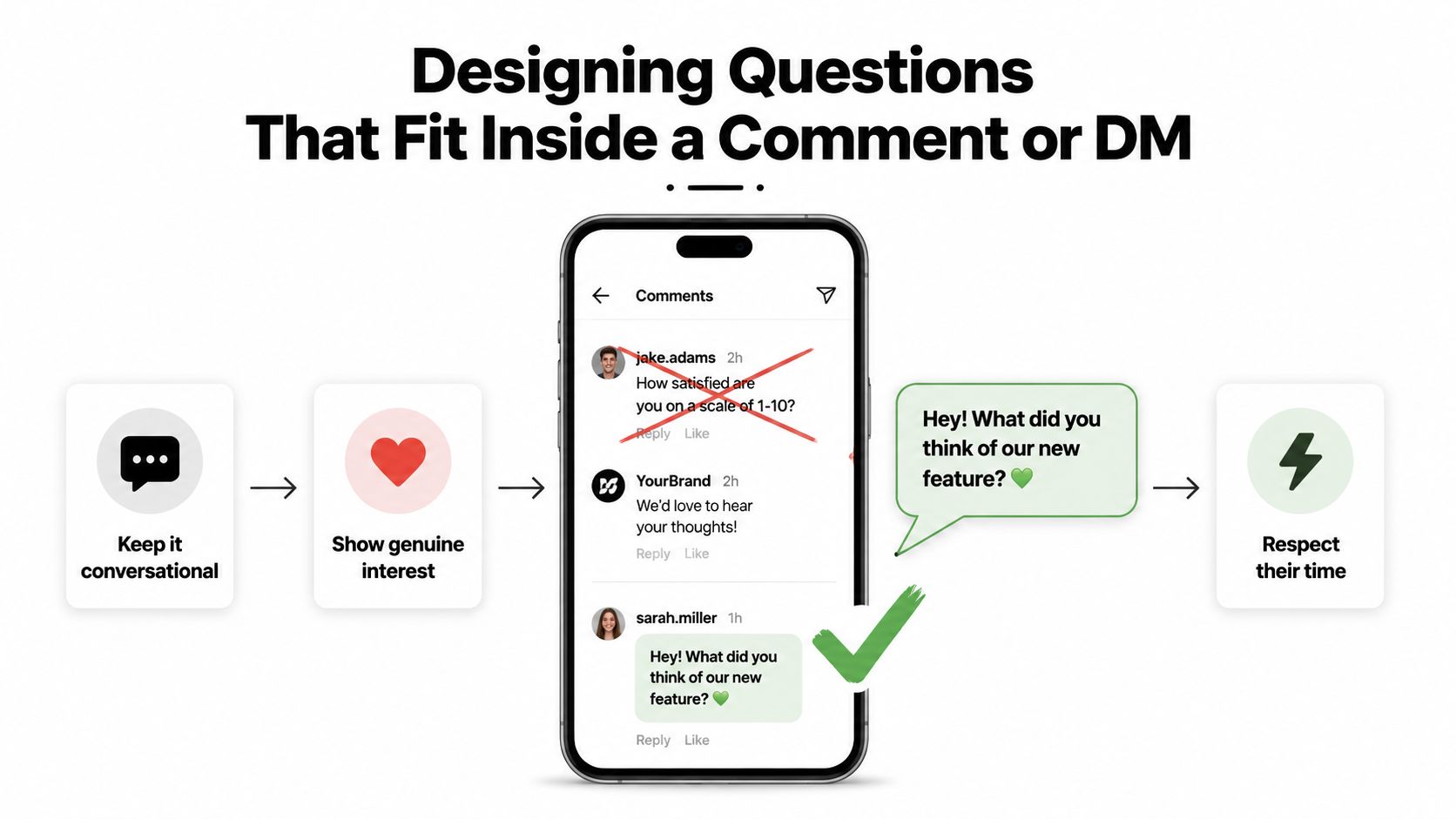
A public reply shouldn't read like a research form. “How satisfied are you on a scale of 1-10?” asks for effort before you've shown interest. It also produces a score without explaining the reason behind it.
Use a three-part structure instead:
Acknowledge the statement. Show that you understood the question or complaint.
Ask one focused follow-up. Choose the detail that will change a product, offer, or response.
Offer a useful next step. Give the answer, share the relevant link, or explain what you'll do with the feedback.
Keep comment questions under 15 words and DM questions under 40 words as working limits. These are editorial guardrails, not platform rules. Short prompts reduce cognitive load and make the exchange feel like help rather than an interview.
Turn common objections into useful prompts
Product question:
“Good question. What skin concern matters most to you?”
This turns “Does it work for oily skin?” into product-positioning research.
Pricing objection:
“Thanks for saying that. Is the concern the price, quantity, or expected result?”
You learn whether to adjust packaging, proof, or framing.
Competitor comparison:
“What are you comparing us on, ingredients, results, or price?”
The answer can expose the decision criterion your ad ignores.
Shipping concern:
“Where are you ordering from? We can check the delivery details for you.”
Location and timing reveal whether the issue is policy, expectation, or missing information.
Feature request:
“What would make this easier to use every day?”
This invites a concrete improvement instead of a vague wish.
Don't lead the customer toward your preferred answer. Avoid “Would faster shipping make you buy?” That question suggests the solution. Ask “What stopped you from ordering today?” and let the customer name the barrier.
Match tone without copying slang. A premium skincare brand can sound warm and concise. A streetwear brand can be looser. Neither should use a joke when someone reports a damaged order.
For principles that also apply to review outreach, this guide to review requests for restaurants offers a useful reminder: the request should respect the customer's context instead of forcing a formal script. You can apply the same discipline to Instagram welcome messages, especially when a new conversation starts from an ad interaction.
Timing Your Ask Around Attention and Platform Rules
Timing determines whether feedback feels helpful or intrusive. Ask while the customer is already discussing the product, not after a generic sequence has pulled them away from the original context.
Meta's most important constraint is the 24-hour messaging window. After a person messages a business page, the business can reply freely during that window. Once it closes, allowed reply options narrow sharply. That makes fast response a collection requirement, not just a service preference. The rule is documented in the Meta messaging policy working paper.
Use a timing matrix
Channel | Optimal Ask Window | Attention Half-Life | Hard Cutoff / Rule |
|---|---|---|---|
Meta ad comments | During the active comment thread | Falls as the thread moves down | Reply while the comment remains relevant |
Meta DMs | Immediately after the person messages | Usually declines as the conversation cools | 24-hour reply window after the message |
TikTok replies | Near the original comment or video interaction | Declines as the video loses attention | Follow platform moderation and messaging permissions |
Website chat | During product evaluation or checkout | Ends when the visitor leaves | Capture the issue before the session closes |
Thank-you page | Immediately after purchase | Moves from decision to reflection | Ask one focused question before adding more requests |
After a meaningful customer milestone | Slower, with delayed context | Stop if the customer doesn't engage or has recently answered |
The first response should solve the immediate issue. Then ask one research question. If someone asks about delivery, answer delivery first. Don't hide the answer behind a feedback request.
Stop before the customer feels managed
A good sequence has a clear endpoint. One public reply can answer the shared question. One DM can handle personal details or an offer. A later post-purchase prompt can ask whether the experience met expectations. Repeated nudges across channels create fatigue and contaminate the response.
The 24-hour DM window explained is useful for mapping the operational consequence. Configure alerts for new high-intent messages, assign ownership, and escalate refund threats, safety concerns, and viral complaints immediately.
TikTok also gives advertisers native comment controls inside Ads Manager. Brands can view, filter, reply to, like, block, export, hide, and manage comments in bulk, and they can maintain a Blocked Word list that automatically hides comments containing selected words or phrases. Use those controls to remove spam and harmful content, but don't hide legitimate product criticism just because it lowers the visual quality of an ad.
Turning Raw Conversations Into Product and Marketing Decisions
A thousand comments don't create insight until the team can sort them, count recurring themes, and connect them to an action. Store the original wording, the channel, the ad or page, the audience context, the product, and the outcome. A summary without source context makes it difficult to validate what the customer meant.
Start with a compact taxonomy. Don't create dozens of tags on day one. Use categories that map to decisions:
Purchase blocker: price, trust, proof, fit, availability, shipping, payment.
Product request: feature, format, color, size, ingredient, bundle.
Experience issue: delivery, damage, support, checkout, returns.
Creative signal: hook, claim, demonstration, comparison, offer.
Sentiment intensity: curiosity, hesitation, frustration, anger, advocacy.
Outcome: answered, escalated, recovered, unresolved, purchased, no purchase.
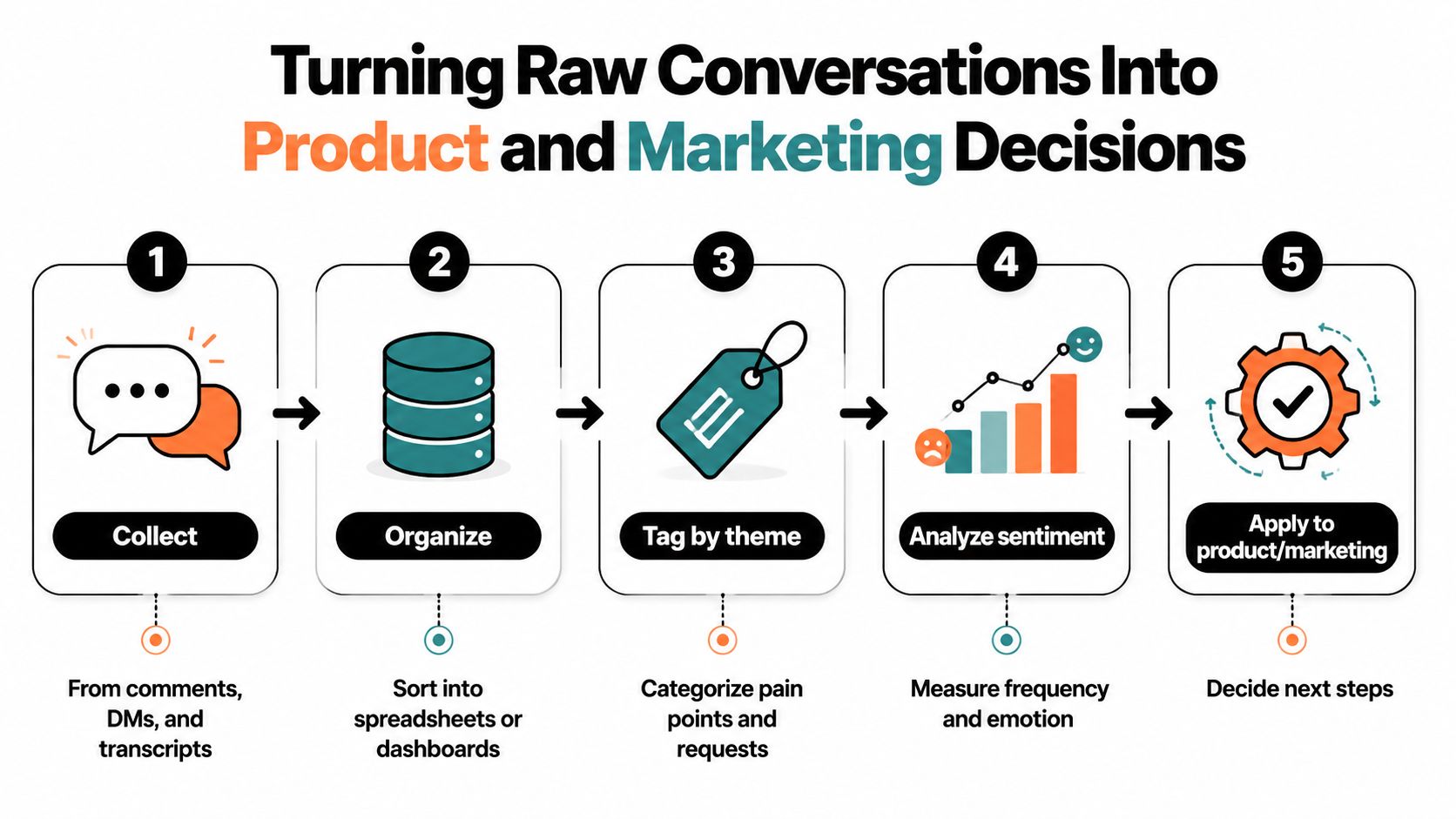
Connect themes to campaigns
Suppose a skincare brand sees repeated questions about whether a formula suits oily skin. The marketing action might be a new demonstration, a clearer product-page section, or a revised response. The product action might be a smaller trial format or a different finish. The comment alone doesn't tell you which action wins. It tells you where to investigate.
A supplement brand can use the same process for price objections. Tag each objection by the creative angle, offer, audience, and product. If one promise attracts attention but creates repeated skepticism in DMs, the team can test stronger proof or retire the angle. Don't treat the most frequent theme as automatically important. A low-volume safety concern may require faster escalation than a high-volume preference.
Use AI analysis with human validation
AI-assisted clustering can group similar comments, extract recurring language, and draft a weekly synthesis. It can reduce manual sorting, but it doesn't remove the need to inspect raw conversations. Fragmented feedback reflects the channel that collected it, so a strong in-app response rate may still miss quieter customers reached through other channels.
Recent coverage describes feedback platforms adding agents that pull from multiple sources and analyze feedback in real time. The operational question is whether the system preserves attribution and lets a reviewer trace a theme back to the original message. Treat automated themes as hypotheses until a human checks the sample, context, and customer segment.
Run a weekly feedback-to-action meeting with four outputs:
Top recurring blocker: Assign an owner and decide whether the fix belongs in creative, landing page, offer, or product.
High-risk issue: Escalate safety, fulfillment, refund, and policy concerns.
Creative test: Turn customer language into a new hook, objection-handling line, or proof angle.
Closed-loop update: Record what changed and whether future conversations reflect the change.
A dashboard should show more than sentiment. Track the conversation, response, resolution, and attributed outcome. That keeps feedback collection attached to decisions rather than stored as an attractive archive.
Deploying AI Employees to Collect Feedback at Scale
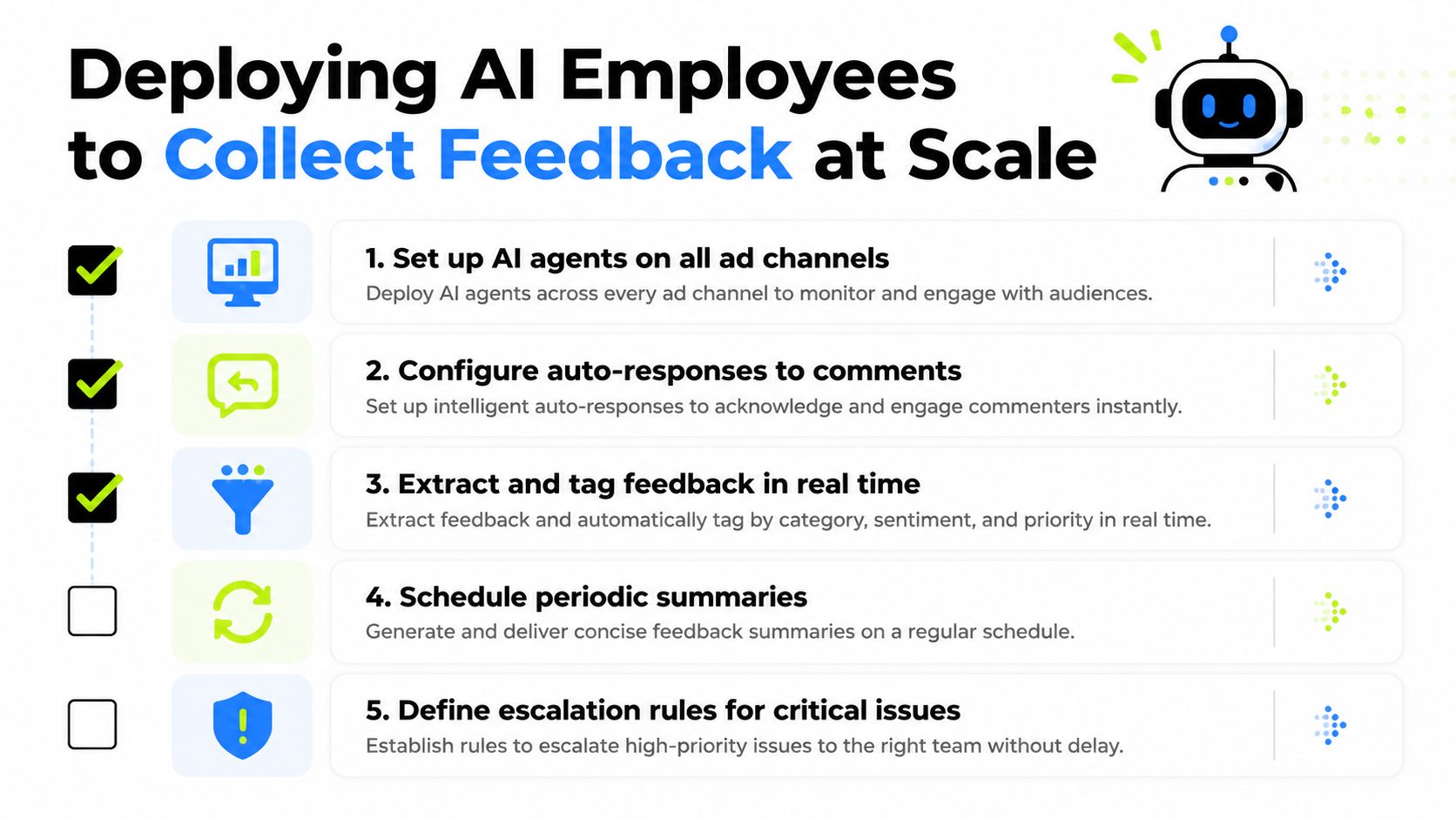
Manual monitoring breaks when several campaigns generate comments, DMs, and chat messages at once. An untrained bot replying to everything creates a second problem. Assign narrow responsibilities, define guardrails, preserve conversation context, and route uncertain cases to a person.
Use AI employees as role-based workers. For a deeper look at how these roles operate, see what an AI employee actually does all day.
Comment moderator: Hide spam, scams, and harmful content while preserving legitimate criticism for analysis.
DM responder: Answer product, price, availability, and offer questions in the approved brand voice.
Post-purchase surveyor: Ask a short question on the thank-you experience and capture the customer's reason.
Sentiment tracker: Tag frustration, curiosity, advocacy, and repeated objections across channels.
Escalation router: Send refunds, safety issues, legal concerns, payment problems, and viral complaints to the right person.
Configure the workflow before adding volume
Write approved answers before connecting more channels. Include product facts, delivery policies, returns language, offer conditions, and disallowed claims. Provide examples of the brand's tone, then require escalation when a customer asks something outside those examples.
Set triggers around intent, not every interaction. “Where can I buy?” should produce a purchase path. “Is this safe for me?” may need human review. “This arrived damaged” should create a support case, not trigger a promotional reply.
Review five operating controls:
Source coverage: Connect Facebook, Instagram, TikTok, and website chat.
Context capture: Save the ad, product, thread, customer message, response, and outcome.
Approval rules: Require human approval for sensitive claims, refunds, safety questions, and unusual requests.
Reporting cadence: Send summaries that separate message volume from actionable themes.
Quality review: Sample replies and compare automated tags with the original conversations.
Exerta provides AI employees for Facebook, Instagram, TikTok, and website chat. Its workflows can reply to comments and DMs, moderate harmful content, log conversations, and connect outcomes with recovered revenue. The product reports adoption by 250+ brands, a 15% average sales lift, $2M+ in recovered revenue, and 99.9% uptime, based on publisher-provided product data rather than a universal forecast.
Track resolved objections, escalations handled, feedback themes accepted by the team, creative changes made, and revenue outcomes connected to conversations. Reply volume alone can hide weak answers and missed buying intent. Automation should shorten the path from conversation to decision, while keeping attribution and human review intact.
Exerta deploys AI employees across Facebook, Instagram, TikTok, and website chat to respond to conversations, moderate harmful comments, collect feedback, and log outcomes tied to revenue. Visit Exerta to see how your team can turn ad comments and DMs into an always-on feedback collection and sales recovery workflow.