7 Instagram Welcome Message Templates That Convert
15 min read
read
·

The best Instagram welcome message gives the buyer a relevant next step immediately. Because Instagram's core messaging window is 24 hours after a user's interaction, the right template depends on intent, objection type, and whether a human needs to step in.
A welcome message isn't just a greeting. It decides whether the conversation qualifies a lead, answers a buying question, builds trust, or reaches the right specialist. The strongest flows keep the first reply short, match the brand voice, and give the buyer something useful to do next.
That timing matters. Instagram's rules allow standard business replies within the 24-hour period after a user interacts, while ordinary follow-ups can stop once the window closes unless the user re-engages or an approved message type applies, as outlined in Meta's messaging policy overview. A delayed response can therefore lose the chance to share a link, answer a concern, or route a sale.
The practical setup is simple. List recurring intents, prepare verified links and offer details, define escalation rules, then review outcomes. Exerta's AI employees can manage Instagram, Facebook, TikTok, and website chat with logged workflows and attribution. The examples below focus on messages an advertiser can apply today.
Table of Contents
1. Direct Message Qualifier Template
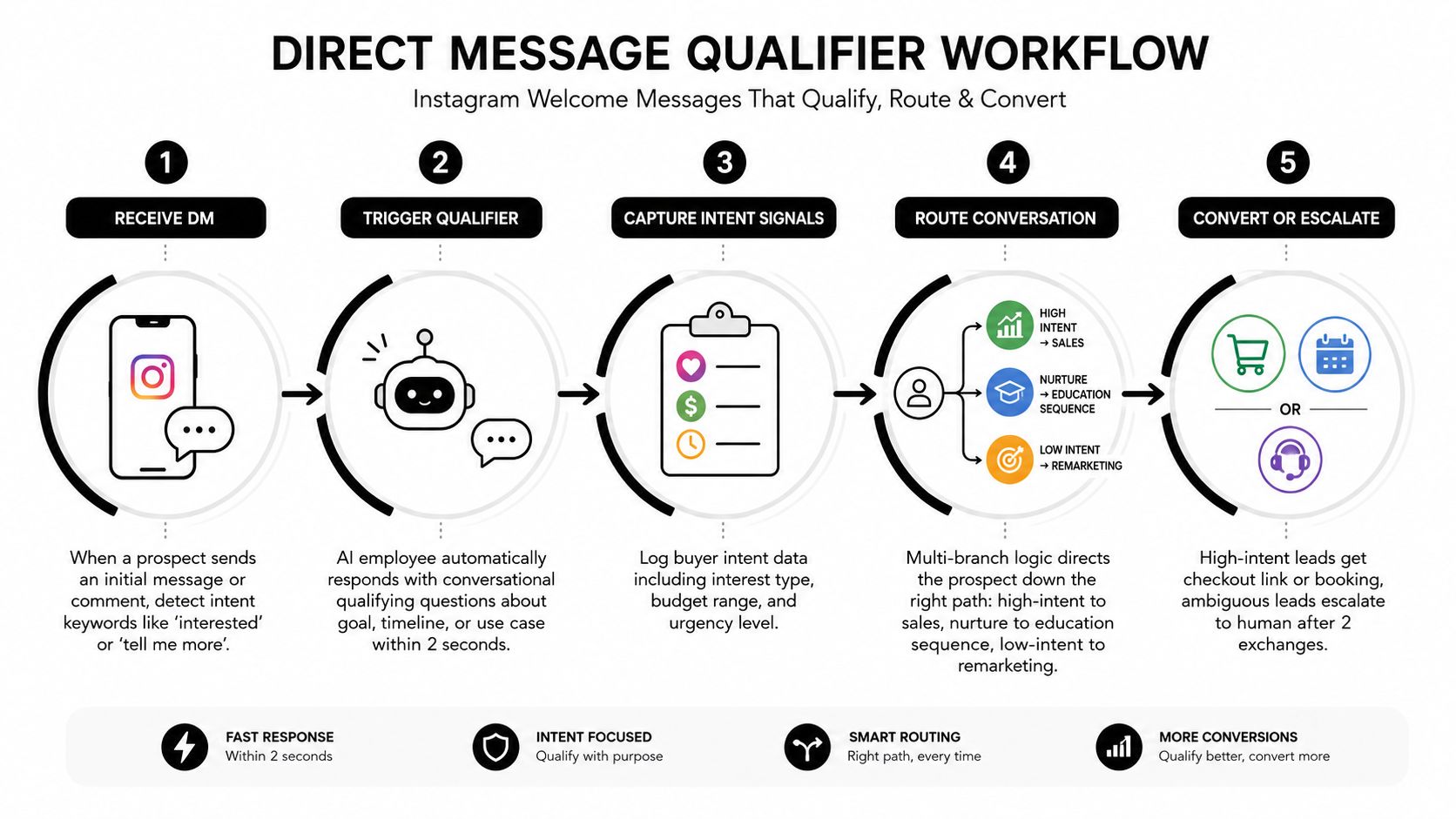
A buyer who sends “interested” has shown curiosity, not necessarily purchase intent. The first reply should uncover what they want without turning the conversation into a form.
Practical rule: Ask two useful questions before you ask for contact details.
For a fitness brand, try:
“What's your main goal, strength, endurance, or weight loss? Are you looking to start this month or next?”
That reply identifies the product path and the buyer's timeline. A SaaS advertiser could write, “Are you exploring this for your company or personal use? Are you evaluating a budget below $500 or a higher plan?” A telehealth clinic needs a safer route: “Are you a first-time patient or an existing client? What's the primary reason for your visit?” The clinic should avoid collecting sensitive medical details in an automated Instagram message.
Keep the opening to two or three questions. More than that feels like an intake form, especially when the user only commented on an ad. Use conversational wording rather than a sequence of robotic yes-or-no prompts.
Build the routing logic
Tag the response by product interest, customer type, timeline, and confidence. Send high-intent buyers to the relevant sales path. Route existing customers to support. If the AI employee still can't determine intent after two exchanges, hand the conversation to a person with the collected context.
A practical branch can look like this:
Product and near-term purchase: Send the relevant product or checkout page.
Product interest but unclear timing: Share one useful resource and ask one follow-up question.
Existing customer: Route to support instead of sales.
Unclear or sensitive request: Escalate with the conversation history attached.
Advertisers can use Exerta's Instagram DM automation workflow to connect these branches across Instagram, Facebook Messenger, and TikTok. The same logic works for comment-triggered messages, inbound DMs, and campaign-specific conversations.
2. Offer and Pricing Transparency Template
Price questions rarely need a brand story. They need a clear answer, a current offer, and a direct path to checkout.
For an ecommerce brand promoting a new collection, use:
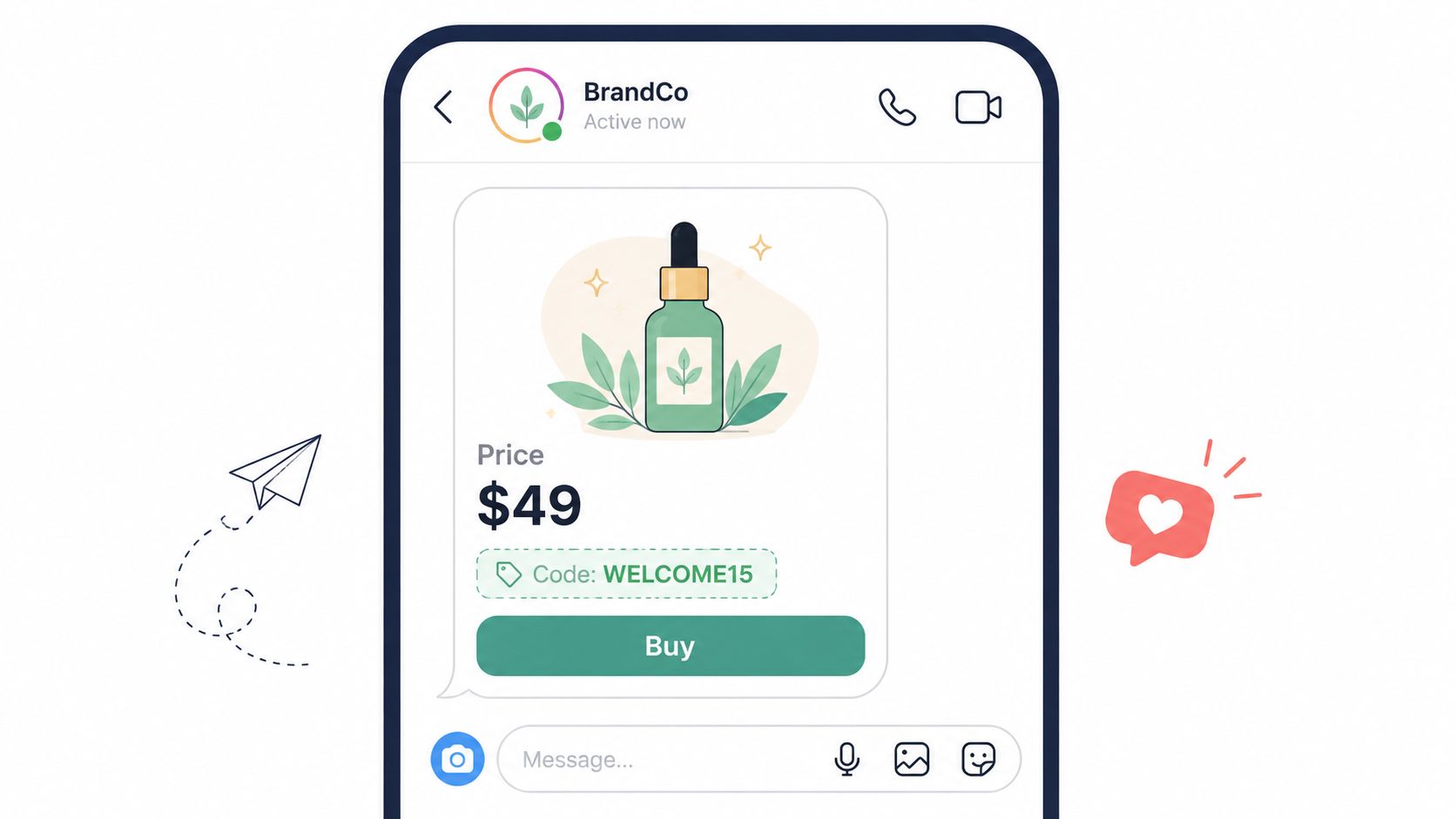
“The new collection is $45 to $89 depending on size. Use code WELCOME15 for 15% off your first order. Shop the collection.”
A subscription company might say, “Plans start at $29 per month. Annual plans include free shipping on the first box this week. See the plans.” A software company can answer a pricing-tier question with, “Starter is $99 per month and Pro is $299 per month. Teams evaluating advanced workflows often start with Pro. Book a demo.”
The message should stay close to two sentences. Put the detail on the linked pricing, product, or checkout page. Don't make the buyer ask a second time for the URL.
Prevent offer failures
Pricing automation only works when the underlying data stays accurate. Connect each campaign to the correct product page, discount code, currency, and eligibility rule. If an offer expires, the welcome message must change with it.
Verify the destination: Test the product, pricing, and checkout links from a mobile device.
Check the promotion: Confirm the code, expiry, exclusions, and minimum order rules.
Match the campaign: Keep ad-specific offers separate so a user doesn't receive the wrong incentive.
Review the trade-off: Test whether showing the discount immediately or presenting it after a qualification step produces better-quality buyers.
A price-first message can reduce friction, but it can also lead with a discount when the buyer really needs product education. Use it for direct price questions, product comments, and high-intent DMs. For vague curiosity, offer a choice between pricing and product details.
Exerta's omnichannel customer engagement workflows can keep prices, offers, and links consistent across supported social and web channels. Every response still needs a human-approved source of truth.
3. Concern Acknowledgment and Resolution Template
Objection replies fail when they dismiss the concern. “You'll love it” doesn't answer a shipping, returns, safety, or product-fit question. A better Instagram welcome message acknowledges the issue, provides verifiable information, and gives the buyer a next step.
A skincare brand could reply to “Will this work on sensitive skin?” with:
“That's a fair question. Our formula is hypoallergenic and tested on sensitive skin types. Read customer reviews, and our 60-day return policy applies if it isn't right for you.”
An apparel brand should answer shipping questions with the operational detail the buyer needs: “US orders ship in two business days, and most arrive in five to seven days. Express shipping is available at checkout. Review shipping details.”
For claims involving health, compliance, or regulated products, the response must point to approved evidence. A supplement brand can say, “We manufacture in an FDA-registered facility and third-party test batches. Review available certificates or reply if you'd like our team to help.” That wording gives the buyer a route to documentation without making an unsupported medical promise.
Build the objection library
Start with the objections appearing most often in support tickets, sales notes, comments, and DMs. Map each concern to a prepared answer, evidence source, and action.
Shipping concern: Give the verified processing and delivery information.
Fit concern: Provide dimensions, sizing, compatibility details, or a consultation route.
Quality concern: Use reviews, testing documentation, guarantees, or product specifications.
Policy concern: Link to the current return, refund, warranty, or cancellation policy.
The welcome message should never bury the answer under reassurance. Put the evidence first, then offer checkout, a support contact, or a specialist handoff. Brand reputation protection workflows can help teams organize these replies while preserving a consistent response standard.
4. Social Proof and Trust Building Template
Trust content works best when it answers the buyer's actual doubt. A generic “thousands of happy customers” line sounds interchangeable. Relevant proof gives the person a reason to continue.
For a software brand responding to “Is this enterprise-ready?”, a defensible structure is:
“Teams evaluating enterprise use can review our security documentation and service commitments here. See the technical details and read customer stories.”
A fitness app answering “Does this work?” should lead with verified results, not a broad slogan. A telehealth clinic responding to “Are your doctors real?” can point directly to credentials, licensing information, and independently verified patient feedback. An insurance advertiser can route a skeptical user to licensing records and carrier information before asking for more details.
Match proof to the objection
Use the proof type that reduces the specific risk:
Performance doubt: Show relevant customer outcomes, reviews, or demonstrations.
Security concern: Provide certifications, documentation, and service terms.
Professional credibility: Link to licenses, qualifications, or published credentials.
Product quality question: Share testing, sourcing, manufacturing, or warranty information.
Don't overload the first message with every award, rating, and testimonial. One relevant proof point and one verification link usually create a cleaner path than a wall of claims. If the buyer asks for more, the AI employee can send the next approved source or escalate.
For paid campaigns, keep proof aligned with the ad promise. A person responding to a product demonstration needs product-specific evidence. A person asking whether a service is legitimate needs credentials and policies. The message should help the buyer verify the claim independently, not pressure them to accept it.
5. Urgency and Scarcity Messaging Template
Accuracy matters more than dramatic wording. Scarcity must reflect real inventory limits, offer deadlines, seasonal releases, or enrollment cutoffs. Used correctly, urgency helps a ready buyer complete a decision. Used carelessly, it damages trust and creates avoidable support work.
An apparel brand with verified stock data might send:
“This style has limited availability in your size, and the sale ends at midnight tonight. Check current stock and shop.”
A seasonal subscription offer could say, “The holiday box ships on November 15 and is available through November 8. Reserve yours.” A course business can state the actual enrollment deadline and link to the enrollment page. Keep the claim tied to a business rule the team can verify.
Branch urgency by buyer intent
Send scarcity messages to users who have shown buying signals, such as asking about price, size, stock, or delivery. Someone who says “Tell me more” may need product education first. A countdown sent to every commenter can make the brand sound aggressive and weaken confidence in later offers.
Inventory-based urgency: Pull current stock data and limit the claim to the relevant size, color, or variant.
Deadline-based urgency: State the exact end time or date, then update the flow whenever the promotion changes.
Seasonal urgency: Explain what the deadline controls, such as shipping, enrollment, or availability.
Checkout path: Send the buyer directly to the relevant product or enrollment page. If stock or eligibility is uncertain, ask one clarifying question before routing.
Agencies should require a source field for every scarcity branch, such as an inventory feed, promotion brief, shipping schedule, or enrollment calendar. Pause the message when that source is missing or outdated. Use buyer-intent lessons from Exerta's engagement analysis to structure high-intent branches, while keeping every claim grounded in current business data.
DTC brands can implement this the same day by defining trigger phrases, connecting approved availability data, writing one reply per urgency type, and testing the checkout handoff. Review replies and support tickets before expanding the flow.

6. Video and Content Preview Template
Some buyers aren't ready for a checkout link. They want to see the product in use, compare options, inspect the curriculum, or understand the method before they decide. A content-preview welcome message should give them the most relevant asset, not a homepage with every possible resource.
For a SaaS company answering a comparison question, write: “Good question. Review our comparison guide for pricing, integrations, and support differences. Reply after you've read it and I'll help with the next step.” That response respects the buyer's research stage while keeping the conversation open.
A course creator can send a curriculum breakdown and sample lessons. A fitness brand can share a beginner guide that addresses different goals and starting points. A supplement company can link to the full ingredient list and a sourcing explanation. A telehealth provider can send a methodology guide, clinician biographies, and an invitation to book a consultation.
Turn content into a routing system
Map recurring questions to specific assets. The library should cover product demonstrations, comparison pages, case studies, FAQs, testimonials, guides, and policy explanations. Each asset needs an owner and a review date so the AI employee doesn't send outdated information.
Use one primary link in the first reply whenever possible. Two links can make sense when the buyer asks for both education and proof, but don't turn the message into a resource directory. Finish with a clear prompt:
“Questions after reading it?”
“Want help choosing the right option?”
“Ready to book a demo?”
Track clicks alongside purchases and escalations. A content asset that receives attention but never produces qualified conversations may need a stronger CTA or a different audience. Refresh the assets that consistently help buyers move forward.
7. Escalation and Specialist Routing Template
Automation should recognize when the right answer requires a person. A custom bulk order, technical integration, complex insurance question, refund dispute, or medical safety concern deserves a specialist, not a confident guess.
A useful handoff message says what happens next:
“Custom orders are handled by our B2B team. I'm connecting you with a specialist now, and they'll follow up within the stated response time. I'm passing along your request so you won't need to repeat it.”
For technical questions, route to engineering with the product, platform, and error details already captured. For a telehealth insurance question, send the user to billing and explain that coverage must be verified against the individual plan. For a medical question about drug interactions, escalate to the appropriate professional and avoid giving an automated clinical answer.
Define the handoff contract
A routing flow needs more than a transfer button. Set the triggers, destination, context, and response expectation before launch.
Trigger: Use question type, explicit specialist request, high-value intent, or unresolved intent after two exchanges.
Destination: Route sales, support, billing, engineering, compliance, or another named team.
Context: Pass the original message, ad or campaign source, product, prior answers, and relevant links.
Expectation: State when the person should hear back, but only promise a timeframe the team can meet.
Audit trail: Log escalations so recurring issues can become better automation or clearer documentation.
A missed handoff promise can damage trust faster than an initial automated reply. Use Exerta's escalation workflows to define approval paths and preserve conversation context across supported channels. The AI employee should make the human transition feel like progress, not a dead end.
7 Instagram Welcome Messages Compared
Template | Implementation complexity | Resource requirements | Expected outcomes | Ideal use cases | Key advantages |
|---|---|---|---|---|---|
Direct Message Qualifier Template | Medium, keyword detection + multi-branch logic | Conversation scripts, AI training on product/ICP, analytics | Rapid lead qualification; faster routing of high-intent buyers | DTC brands with high DM volume; agencies with lead-gen campaigns | Immediate intent capture; fast routing; conversion signal tracking |
Offer and Pricing Transparency Template | Medium, dynamic offer insertion + checkout integration | Accurate pricing/offer database, promo management, link generation | Reduced friction; shorter conversations; higher conversion on price-driven queries | DTC fashion & wellness, subscription services, SaaS with clear tiers | Answers pricing instantly; auto-applies discounts; revenue attribution |
Concern Acknowledgment and Resolution Template | Medium–High, objection mapping and templated rebuttals | Knowledge base (policies, proofs), human escalation support | Converts fence-sitters; consistent objection handling; lower repetitive support load | High-ticket DTC, wellness, telehealth, products with fit/quality questions | Proactively addresses concerns; includes proof/guarantees; documents common objections |
Social Proof and Trust Building Template | Low–Medium, dynamic proof insertion | Up-to-date testimonials, certifications, case studies, badges | Increased credibility; higher conversion among skeptical prospects | New brands, health/finance, B2B SaaS targeting enterprise buyers | Leverages third-party validation; quick credibility boost; reduces trust gaps |
Urgency and Scarcity Messaging Template | Medium, real-time inventory & timeline integration | Inventory sync, campaign timelines, live timers, accurate expiry data | Accelerated purchases; lift in conversion and AOV when scarcity is real | Fashion drops, limited editions, cohort enrollments, flash sales | Motivates immediate action; protects inventory; drives time-based conversions |
Video and Content Preview Template | Low–Medium, content mapping and routing | Curated content library, tagging/matching system, UTM tracking | Educates prospects; increases engagement time; reduces back-and-forth | SaaS, coaching, education, high-consideration categories | Delivers relevant education; nurtures leads; measures content-to-conversion |
Escalation and Specialist Routing Template | High, complex detection, context passing, queue management | Human specialists, SLA management, escalation logs, handoff tooling | Preserves high-value conversations; correct routing; improved close rates | B2B/enterprise, telehealth, compliance-heavy and high-touch services | Seamless human handoff with context; prevents misrouting; captures escalation analytics |
Turn the Best Template Into a Working Flow
Start with one high-volume intent. Don't automate every possible Instagram conversation on the first day. Choose the question that appears most often in your comments or DMs and that has a clear answer, such as price, shipping, product fit, or booking availability.
Write a first reply in two sentences. The first sentence should acknowledge the user's message. The second should provide one relevant next step, such as a product link, a qualifying question, a verified policy, or a specialist handoff. If the flow needs more information, ask one focused question rather than adding a long menu.
Before activating the automation, verify every operational detail:
Offer accuracy: Check prices, discount codes, eligibility rules, and expiry dates.
Link accuracy: Open each destination on mobile and confirm the page matches the message.
Evidence quality: Approve reviews, certifications, policies, and product claims before adding them.
Handoff readiness: Confirm the receiving team, context transfer, and response expectation.
Policy fit: Design around Instagram's 24-hour response window and the user's last interaction, as described in Instagram DM response guidance.
Test the flow from a real Instagram account. Comment on the relevant ad or post, send the expected reply, tap each option, submit an objection, and trigger the escalation condition. Also test what happens when the user doesn't respond. A welcome message should respect non-response rather than repeatedly pushing the conversation.
Review response volume, link clicks, escalations, and attributed sales. Replies alone don't show whether the flow helped revenue. A high reply count can reflect confusion, while a quieter flow may be doing its job by answering a question and sending the buyer directly to checkout.
For teams managing paid traffic across Meta and TikTok, Exerta's AI employees can deploy the selected flow across Facebook, Instagram, TikTok, and website chat, keep responses in a consistent brand voice, and log outcomes for refinement. Exerta reports 250+ brands, a 15% average sales lift, and $2M+ in recovered revenue attributed in-product on its platform materials. Treat those figures as product-level reported results, not a guarantee for any individual campaign. Start with one flow, inspect the evidence, and improve the next version from what buyers ask.
Exerta provides AI employees that respond to comments and DMs, moderate harmful content, and route purchase conversations across Instagram, Facebook, TikTok, and website chat. Visit Exerta to connect your welcome-message flow, verify your handoffs, and track which conversations lead to recovered sales.