Instant Messaging for Business: A Practical Guide
15 min read
read
·

You've paid for the click, the impression, and the conversation starter. Then a buyer asks, “Does this ship to Canada?” under the ad at 11:42 p.m., and nobody answers until the next morning. The campaign keeps spending while the highest-intent people wait in public comments, DMs, and checkout chat.
That's the operating problem behind instant messaging for business. For DTC brands and agencies running Meta or TikTok ads, messaging isn't just a support channel. It's the surface where paid attention becomes a sale, or disappears.
Table of Contents
Why Instant Messaging Has Become a Revenue Channel
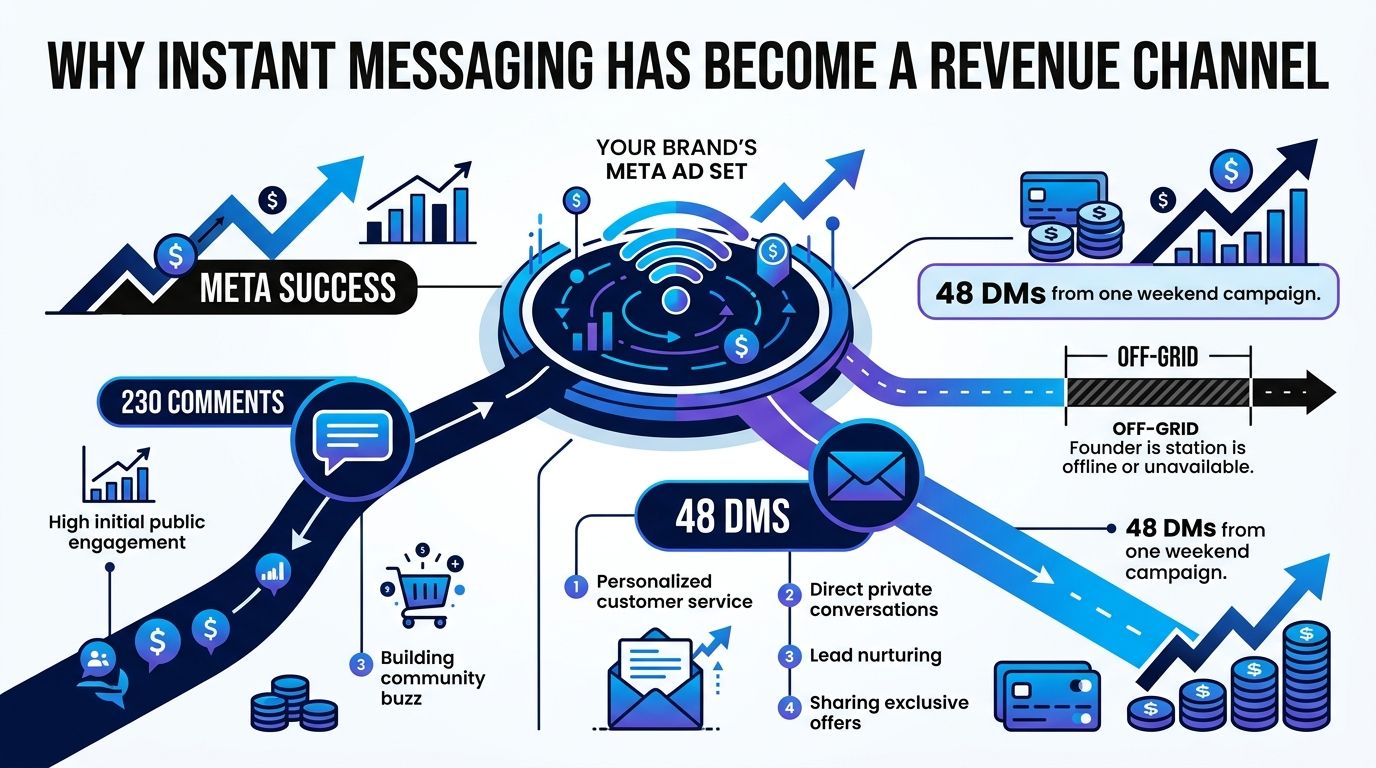
A DTC skincare brand ran a $4,000-a-day Meta ad set over a weekend. It produced 230 comments and 48 DMs while the founder was off-grid from Friday to Monday. Of those DMs, 31 asked about pricing, 9 asked about checkout problems, and 6 asked about shipping to Canada.
None received a reply before Monday morning. Two conversations included carts worth $148 and $312. Both buyers had moved on by Sunday night.
That's the cost of silence. The ad had already created demand, but the brand didn't have an operating system for handling it. A paid social campaign can send buyers directly into a conversation, so the conversation becomes part of the funnel rather than an afterthought.
The response-time curve makes the problem sharper. One independent lead-response analysis reports that contacting a lead within 5 minutes can make conversion odds up to 100 times higher than waiting 30 minutes, while another cited in the same analysis reports a 391% conversion lift when response happens within 1 minute rather than 2 minutes. See the lead-response time analysis for the underlying findings.
The inbox is part of the ad unit
A buyer who comments under an ad is still evaluating the offer. A buyer who sends a DM has taken another step. A buyer who opens website chat during checkout is often trying to remove one last objection.
Those moments carry different levels of intent, but they share one requirement: the answer must arrive while the buyer is still deciding. A useful reply can clarify price, product fit, delivery, returns, or payment options. A delayed reply forces the buyer to restart the research process somewhere else.
A 2021 Mobile Messaging Adoption Report found that 47% of organizations used mobile messaging overall, with adoption at 58% in enterprises and 39% in SMEs. The report also found that 89% of smartphone users usually receive messages from businesses, while OTT messaging platforms reached 2.47 billion users in January 2020. These figures are summarized in business messaging statistics from the 2021 report.
For paid social teams, the practical conclusion is simple. If ads create conversations, somebody, or something, must qualify, answer, route, and recover those conversations continuously. A deeper operating framework appears in this guide to social media marketing for DTC.
What Instant Messaging for Business Actually Covers
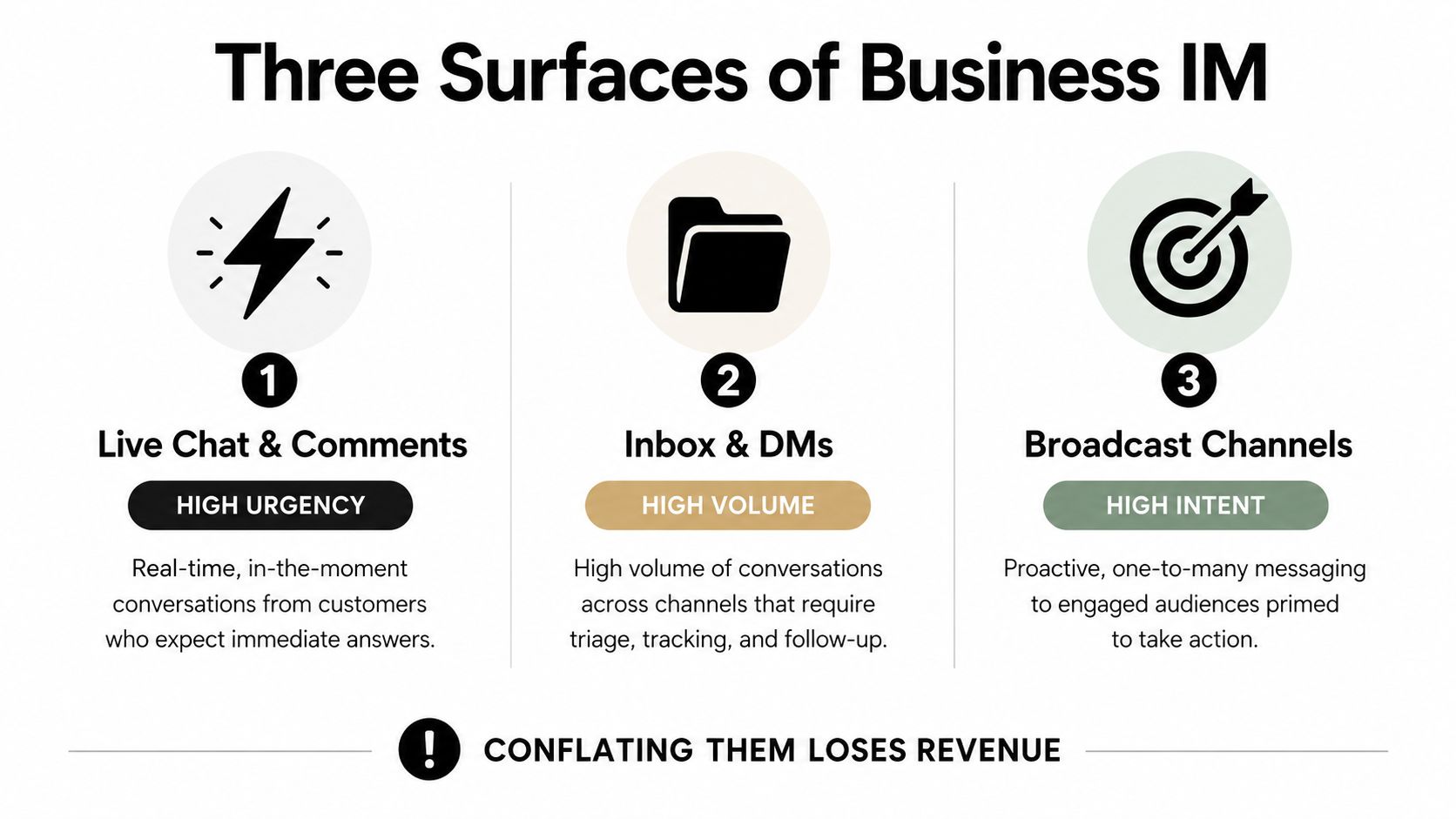
Instant messaging for business isn't one inbox. It's three operating surfaces, and each one has a different urgency, volume, and buyer intent.
Comments under paid ads
Comments are public and high-volume. Most individual comments have lower intent than a DM, but they influence the next person who sees the ad. A clear answer can remove an objection for many silent readers. An unanswered question can make the brand look absent.
Set a comment queue with a target of under 15 minutes for normal buyer questions. Hide spam, scams, and personal attacks. Reply to legitimate concerns in the brand's voice, then invite the person to continue privately when account-specific details are needed.
DMs from the ad
A “Send Message” click identifies a warmer lead. These buyers commonly ask about price, sizing, ingredients, availability, or delivery. Speed beats polish in this queue. A useful answer inside two minutes is more valuable than a carefully edited answer two hours later.
Route DMs by intent:
Purchase questions: answer directly and provide the next step.
Checkout problems: identify the broken step and return a working path.
Shipping questions: provide the relevant policy or collect the destination.
Complex cases: hand off with the conversation history attached.
If you need a simple way to create a direct WhatsApp entry point for customers, this WhatsApp link guide from taap.bio covers the setup clearly.
Website chat during checkout
Website chat has lower volume but stronger intent. The visitor is already on the product or checkout page, so the response should focus on removing friction. Use a target of under 60 seconds for the first response. If nobody is available, trigger a save-the-sale flow that captures the question, offers a relevant answer, and records the conversation for follow-up.
Meta also imposes a technical constraint on business messaging. Its rolling 24-hour customer-service window allows free-form replies for 24 hours after the customer's last message, and each new inbound message resets the clock. Once that window closes, ordinary promotional or free-form messages are blocked unless the business uses approved message types, as explained in this Facebook Messenger automation guide.
Comparing the Channels That Matter for Paid Social
Facebook, Instagram, TikTok, and website chat may sit beside one another in a reporting dashboard. They don't behave the same way operationally.
Facebook usually creates a large DM queue for DTC brands. Messenger supports attachments and connects closely with ad activity, which helps attribution. Manual teams struggle when sale-related comment volume rises quickly. Public comments can bury private conversations, so the person monitoring the page has to choose between visible moderation and direct sales follow-up.
Instagram tends to produce more product-specific intent. Buyers often ask about a SKU they saw in a Reel or product post. The challenge is triage. Personal conversations and brand messages share the same environment, and a human can lose time sorting context before answering. AI employees are useful here when they can interpret the message alongside the post or product context.
TikTok creates a different trade-off. Comment activity can be intense, but DM quality varies and automation access may be less mature. Most advertisers should moderate public comments carefully and move serious purchase conversations into a channel where the team can identify intent, preserve context, and attribute the outcome.
Website chat is the smallest queue in many stores, but it sits closest to checkout. A visitor asking about delivery or returns needs a direct answer, not a generic welcome message. A narrowly trained flow can outperform a broad bot here, provided the system can read the relevant product and policy information.
Channel | Typical DM Volume per $1k Ad Spend | Buyer Intent | Where Manual Teams Break | AI Employee Fit |
|---|---|---|---|---|
Varies by campaign, audience, and offer | Warm | Comment alerts bury private conversations | High for qualification, routing, and follow-up | |
Varies by creative and product context | Warm to high | Mixed personal and brand inboxes slow triage | High when post and product context are available | |
TikTok | Varies widely by creative and reach | Uneven | Heavy comment activity and limited workflow maturity | Strong for moderation and intent routing |
Website chat | Lower volume | Highest | Coverage drops outside staffed hours | Strong for instant answers and checkout recovery |
Practical rule: Use the channel that matches the buyer's moment, not the channel your team already knows how to monitor.
A cross-channel design matters once buyers move from comment to DM, or from social conversation to website chat. The useful question is how each handoff preserves intent and attribution. This omnichannel customer engagement framework provides a useful reference for designing those transitions.
AI Employees vs Human Teams vs Simple Chatbots
There are three common ways to run paid social messaging. None wins every category.
A human-only team offers the strongest nuanced tone. People can recognize sarcasm, handle unusual complaints, and make judgment calls when the product information doesn't fit the question. The trade-off is coverage. Nights, weekends, campaign spikes, and sudden comment volume create queues that grow faster than a manager can staff them.
Simple chatbots solve a different problem. They handle predictable questions at scale, but rigid decision trees often fail when a buyer raises an objection in natural language. The bot sends the shopper to a product or checkout page without resolving the concern, and the shopper leaves.
AI employees sit between those models. They can respond continuously, use the brand's product information and approved messaging, detect intent, and route conversations that require human judgment. The right design doesn't try to automate every conversation. It automates the repeatable portion and preserves a clear escalation path.
Criterion | Human Team | Simple Chatbot | AI Employee |
|---|---|---|---|
Response time | Depends on shifts and queue size | Fast for fixed flows | Fast for qualifying and answering supported questions |
Capacity per dollar | Limited by staffing | High for narrow scripts | Expands across recurring conversation types |
Attribution accuracy | Often manual | Can be incomplete | Can log replies, handoffs, and assisted outcomes |
Tone control | Strong but inconsistent across agents | Consistent but rigid | Brand-trained with approval and escalation rules |
Response time
Paid social creates demand in bursts. A human team may be excellent during business hours and unavailable when a campaign keeps running. An AI employee covers the gap, then passes the conversation to a person when the question involves an exception, complaint, refund decision, or sensitive issue.
Capacity and economics
A team should compare the cost of coverage with the value of recovered conversations. The goal isn't to replace every human. It's to stop paying humans to answer the same shipping, price, sizing, and availability questions repeatedly.
Tone and accountability
Automation without guardrails is risky. Define approved claims, prohibited promises, escalation triggers, and the exact point where a human must take over. Exerta describes this operating model in its guide to what an AI employee actually does all day.
Three Plays You Can Run This Week
You don't need a full rebuild to improve paid social messaging. Start with three flows that target visible leaks.
1. Answer the top objections under every ad
Trigger: A buyer asks one of the recurring questions about price, fit, delivery, ingredients, or returns.
Message shape: Answer the question in the first sentence. Add one approved proof point. Finish with a soft invitation to DM if the buyer needs help choosing.
Example:
Is this suitable for sensitive skin? The formula is designed for a gentle daily routine. If you share your current products, we can help you compare the fit before you order. Send us a DM.
Metric: Track comment-to-DM rate and assisted orders. Don't optimize for reply count alone. A shorter answer that starts a useful private conversation beats a longer public explanation that nobody follows.
2. Recover the DM that reached checkout
Trigger: A buyer receives a checkout link, then stops responding or doesn't complete the next step.
Message shape: Send one follow-up within 10 minutes. Ask whether the issue was product fit, payment, delivery, or something else. If the cart exceeds $80, include an approved payment-plan alternative when one exists.
Keep the follow-up singular and useful. Don't send a sequence of generic reminders. The buyer needs a reason to reply, not another notification.
3. Apply hide-or-reply moderation
Trigger: A new public comment arrives under a paid post.
Action: Hide spam, scams, and personal attacks. Reply to skeptical but legitimate comments within 5 minutes. Tag genuine buyer questions for human review when the answer requires account or order details.
Metric: Monitor hide rate, response time, comment-to-DM movement, and assisted revenue. Your Facebook comments playbook can help translate those rules into a repeatable moderation process.
For broader operating guidance, this CX strategy for global teams is useful when multiple regions, time zones, or teams share the queue.
Where the Real Money Is Recovered
Two actions deserve priority when paid social messaging is underperforming: protecting the ad comment section and recovering high-intent conversations after hours.
A hostile or irrelevant comment under a high-spend ad can change how new prospects judge the offer. The specified benchmark for this use case reports that a single unanswered “this is a scam” comment can reduce click-through rate by 30% to 40% on the next $500 of spend. That means the potential exposure is not limited to one unhappy commenter. It can affect every impression purchased while the comment remains visible.

Put a dollar frame around moderation
The audit is straightforward. Record the spend made while the comment was visible, compare click-through and downstream purchase performance with a comparable period, then separate the effect of moderation from changes in creative, audience, offer, and landing page.
Don't assume every negative comment should be hidden. A legitimate product complaint may need a public answer. Hide clear abuse and spam. Respond to genuine doubts with a factual answer that helps the next reader too.
Put a clock on missed DMs
The second leak appears when purchase-intent DMs arrive outside staffed hours or during checkout drop-off. A fast automated response can confirm the question, provide the right link, and route the conversation before the buyer forgets why they opened it.
Use a conservative recovery model. Count the number of eligible conversations, the share that receive a response inside your target window, the number that reach checkout, and the orders attributed to the conversation. Then compare recovered gross profit with the cost of coverage. The CFO doesn't need a promise. They need a traceable path from ad, to message, to order.
The Metrics That Tell You If It Is Working
Reply volume is easy to report and easy to misunderstand. A brand can produce thousands of replies while missing the buyers who asked about price, checkout, delivery, or product fit.
Track six operational metrics instead:
Metric | What It Measures | Why It Matters | Vanity Trap |
|---|---|---|---|
Median first-response time | How quickly buyers receive an answer | Shows whether coverage matches buyer intent | Counting replies without measuring delay |
DM-to-checkout conversion | Conversation progress toward purchase | Connects messaging to funnel movement | Reporting DM volume alone |
Comment-to-DM lift | Public conversation turning private | Shows whether replies create deeper intent | Celebrating comments with no handoff |
Hide rate on paid posts | Share of comments removed by rule | Signals moderation quality and brand safety | Hiding too broadly to improve appearance |
Recovered revenue from after-hours conversations | Orders linked to off-hours assistance | Measures coverage where humans are absent | Treating all late-night messages as equal |
Cost per assisted order | Operating cost divided by attributed orders | Gives finance a comparable efficiency measure | Looking only at automation cost |
Set a weekly report with campaign spend, median response time, assisted revenue, and cost per assisted order. Add a breakdown by channel and intent. For executive review, the clearest chart is assisted revenue per thousand impressions, because it connects messaging performance to the media activity that created the conversation.
A business texting report found that 66.8% of respondents save 1 to 5 hours per week through texting, while only 25% of organizations use texting for reviews and feedback, even though 32.3% say they should. The figures come from the 2025 State of Business Texting Report. The operational lesson is broader than texting. Use messaging after purchase too, especially for feedback, reviews, and reputation signals.
For teams building repeatable reporting, an automation guide for business analysts offers useful context for turning recurring data pulls into a defined workflow.
A 30-Day Rollout and the One Decision That Matters
Week one is an audit. Measure current response times, list unanswered buyer questions, and define hide rules for paid posts. Don't automate a process nobody has mapped.
Week two turns the audit into scripts. Write comment responses for recurring objections, then build the DM-to-checkout path with clear escalation triggers. Keep every approved answer tied to a product, policy, or offer source.
Week three adds an AI employee to comment moderation and after-hours DMs. Start with the highest-volume, lowest-risk questions. Review transcripts daily and adjust the rules before expanding the scope.
Week four connects the queue to ad spend. Review assisted revenue, response time, checkout movement, and cost per assisted order every week. In 2025, RCS was one of the fastest-growing messaging channels, 41% of US businesses planned to send more marketing messages with RCS, and 60% said deliverability was the most important factor when choosing a provider, according to the State of Messaging report. That reinforces a practical point: channel mix matters, but reliable delivery and attribution matter more.
The decision that determines the outcome is ownership. If social owns comments, support owns DMs, and growth owns revenue, nobody owns the customer's full path.
Paste this into Slack: “One owner is accountable for every paid-social conversation from first comment to recovered checkout, with support and growth as escalation partners.”
Exerta deploys AI employees across Facebook, Instagram, TikTok, and website chat to answer comments and DMs, moderate harmful content, and attribute recovered purchases. SMS, email, and voice are launching next. Visit Exerta to see how your team can turn its paid social inbox into an owned revenue workflow.