Offer Management System: A 2026 Guide for DTC Brands
15 min read
read
·

A founder checks a Meta ad at 10 p.m. on Saturday and sees buying intent everywhere. People ask about price, sizing, shipping, and stock. A few want the discount code they saw in the creative. Nobody on the team is online, so the replies wait until morning.
The offer itself isn't the problem. The brand may have strong creative, a working checkout, and a promotion that converts. The leak sits between the ad impression and the purchase, inside the comment thread, DM inbox, and website chat. That execution layer is where an offer management system earns its place.
Table of Contents
The Comment Section That Ate Your Weekend
By Sunday morning, roughly 200 comments sit beneath the ad. The average response time has reached six hours, and around 30% of commenters ask about price, sizing, or stock. One customer is ready to buy, asks a simple question, sees no answer, and scrolls away.
The sequence is easy to miss because no single event looks dramatic. A high-intent comment arrives. The brand stays silent. The prospect never clicks, starts checkout, or completes the purchase. The ad receives a weaker downstream signal, while the next shopper sees an unanswered question and starts to doubt the offer.
Meta gives businesses a 24-hour window after a customer messages first. During that period, a business can send free-form replies, including answers, links, order confirmations, and follow-up questions. Each new customer message resets the window. After it closes, ordinary promotional or free-form messages are not allowed.

The leak isn't in the promotion
Teams spend hours tuning the offer, audience, landing page, and creative. Those decisions matter, but they do not answer a buyer asking, “Does this come in my size?” beneath a paid post.
Intent fades after the first interaction. Fast response research reports 391% higher conversion when a lead receives an answer within one minute rather than later, while qualification odds are 21 times higher when contact happens within five minutes instead of 30 minutes. These findings illustrate why response speed belongs inside offer execution, not in a separate customer-service queue.
A practical response system should act immediately:
Recognize intent: Separate purchase questions from spam, complaints, and general discussion.
Answer in context: Provide the relevant product, price, code, or checkout link.
Preserve the path: Follow up before the customer loses access to the messaging window or abandons the purchase.
The operational gap is measurable in lost opportunities. An analysis of unanswered ad comments examines how unanswered questions can leave paid traffic without a clear route to purchase.
An offer management system closes that gap at the point of demand. It coordinates comments, DMs, and web chat so the offer reaches the person asking for it, with the right response and a clear next action.
What an Offer Management System Actually Does
An offer management system controls how a brand presents, routes, delivers, and measures an offer across customer conversations. It connects the offer to the audience, channel, trigger, response, follow-up, and approval rules instead of leaving each part in a separate tool or spreadsheet.
A CRM mainly stores contact records and interaction history. Marketing automation generally sends planned messages based on schedules or predefined journeys. An offer management system answers a different operational question: which offer should this person receive, through which channel, in response to which signal, and under what limits?
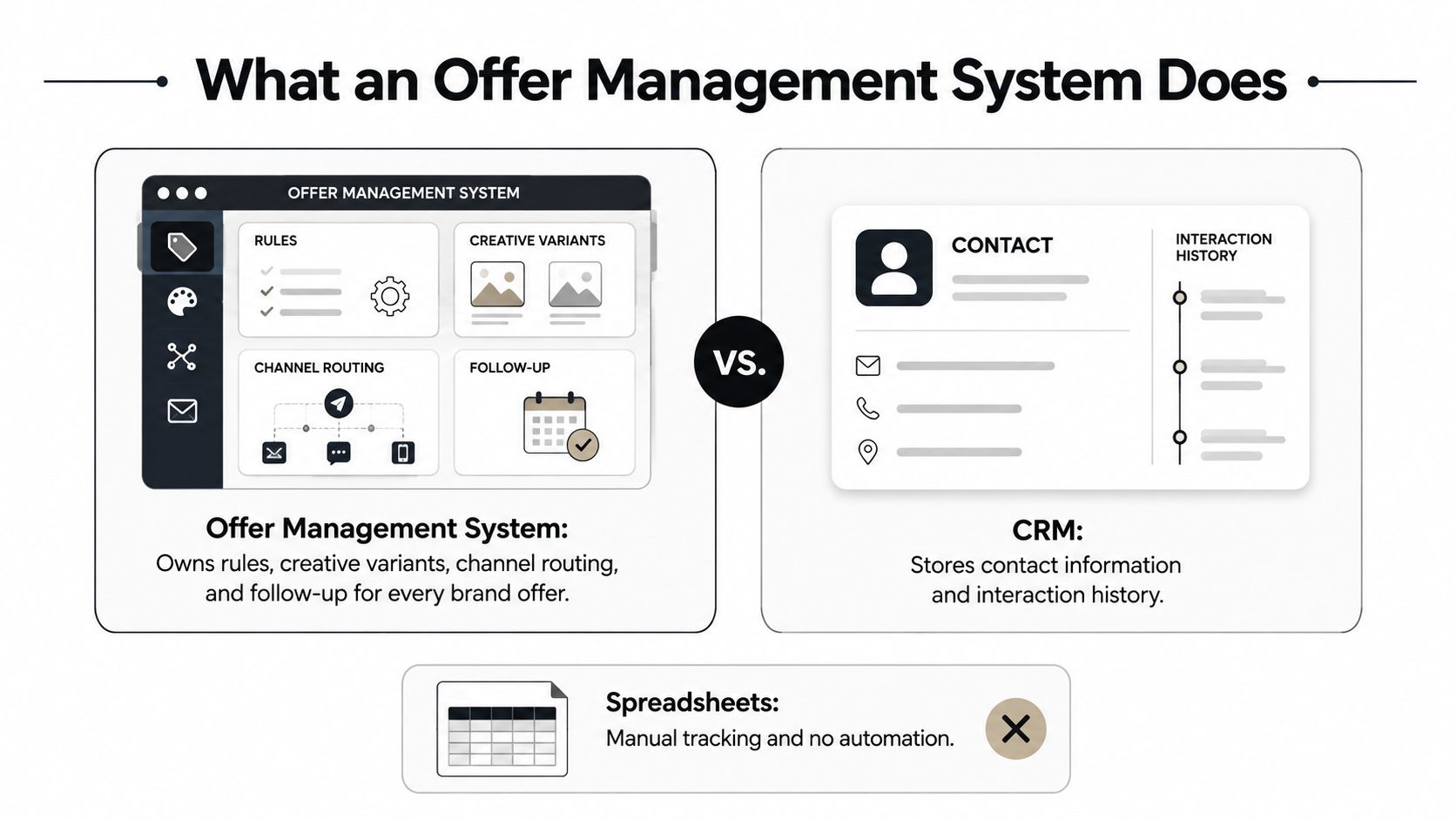
Think like an air-traffic controller
The offer is the aircraft. Meta comments, TikTok conversations, website chat, email, and SMS are runways with different rules and arrival speeds. The system acts as the control tower, deciding what can move, where it should go, and when a human must take over.
That analogy matters because the same discount shouldn't fire in every situation. A returning customer may qualify for loyalty treatment. A new visitor asking about shipping may need information rather than a code. A complaint about a defective product should go to support, not into a sales sequence.
A useful system owns four operational decisions:
Offer selection: Match the customer's question and context to a product, price, bundle, or incentive.
Channel routing: Decide whether the response belongs in a public comment, private DM, website chat, or human queue.
Guardrails: Prevent expired codes, unauthorized stacking, restricted claims, and off-brand language.
Measurement: Connect the conversation to checkout, order status, and recovered revenue.
The Exerta workflow builder reflects this kind of branching logic, with configurable routes and escalation paths.
A CRM remembers who the customer is. Marketing automation sends what was scheduled. Offer management coordinates the decision and execution that turns live intent into a sale.
The Five Building Blocks That Make It Work
A reliable offer management system needs more than a discount library. It needs five connected layers. If one layer is missing, the team usually falls back to manual judgment, duplicated rules, or untraceable exceptions.
1. Offers
Treat the SKU, price, code, eligibility, expiry, and creative variant as one offer object. Don't store the coupon in one document, the product link in another, and the approved wording in a chat thread.
For example, a skincare brand might define a product bundle with a specific price, an approved explanation of who it's for, and one checkout link. When a customer asks about dryness under the ad, the system can return the relevant bundle rather than a generic store link.
2. Channels
Each channel has its own format, permissions, and response expectations. A public Meta reply can answer a common question, while a private DM can deliver a personalized link. Website chat may support a longer product discussion, while a short-form social comment needs a concise response.
A practical channel record should include the available message types, the permitted offer format, and the escalation route. A TikTok comment might trigger a public answer first, followed by a private path when the platform permits it.
3. Rules
Rules translate intent into action. A keyword, product mention, question, or form submission can trigger an offer match, response, or escalation.
A simple example is a comment containing “code” or “price.” The system checks the campaign and product, confirms eligibility, then sends the approved offer through the permitted channel. A comment containing a safety concern should bypass promotion and reach a trained person.
4. Attribution
Attribution records which interaction preceded the purchase and which system action helped recover it. That doesn't mean every order belongs entirely to the comment responder. It means the operator can identify whether the journey included a public reply, DM, product link, code, or follow-up before checkout.
For a customer who asks about fit, receives a product page, and completes the order, the record should preserve that path. Without it, the team can't distinguish recovered demand from ordinary campaign revenue.
5. Governance
Governance defines who approves an offer, who can change its wording, who can pause it, and where the audit trail lives. This becomes essential when several teams manage the same catalog or an agency operates several accounts.
A sound approval rule might require a marketing owner to approve the incentive, a merchandising owner to confirm stock, and a support owner to review the customer-facing answer. The system should preserve the decision and the version that ran.
How It Runs on Meta and TikTok Ads
Paid social offer logic starts with the incoming signal. A comment, DM, lead-form submission, or website visit enters the workflow, and the system checks the campaign, product, customer intent, and available response route.
On Meta, the 24-hour messaging window creates a hard operational boundary. When a customer messages first, the brand can send free-form replies during the window. That makes an immediate response more than a customer-service preference. It determines whether the brand can still answer questions, send a link, or recover the purchase through ordinary messaging.
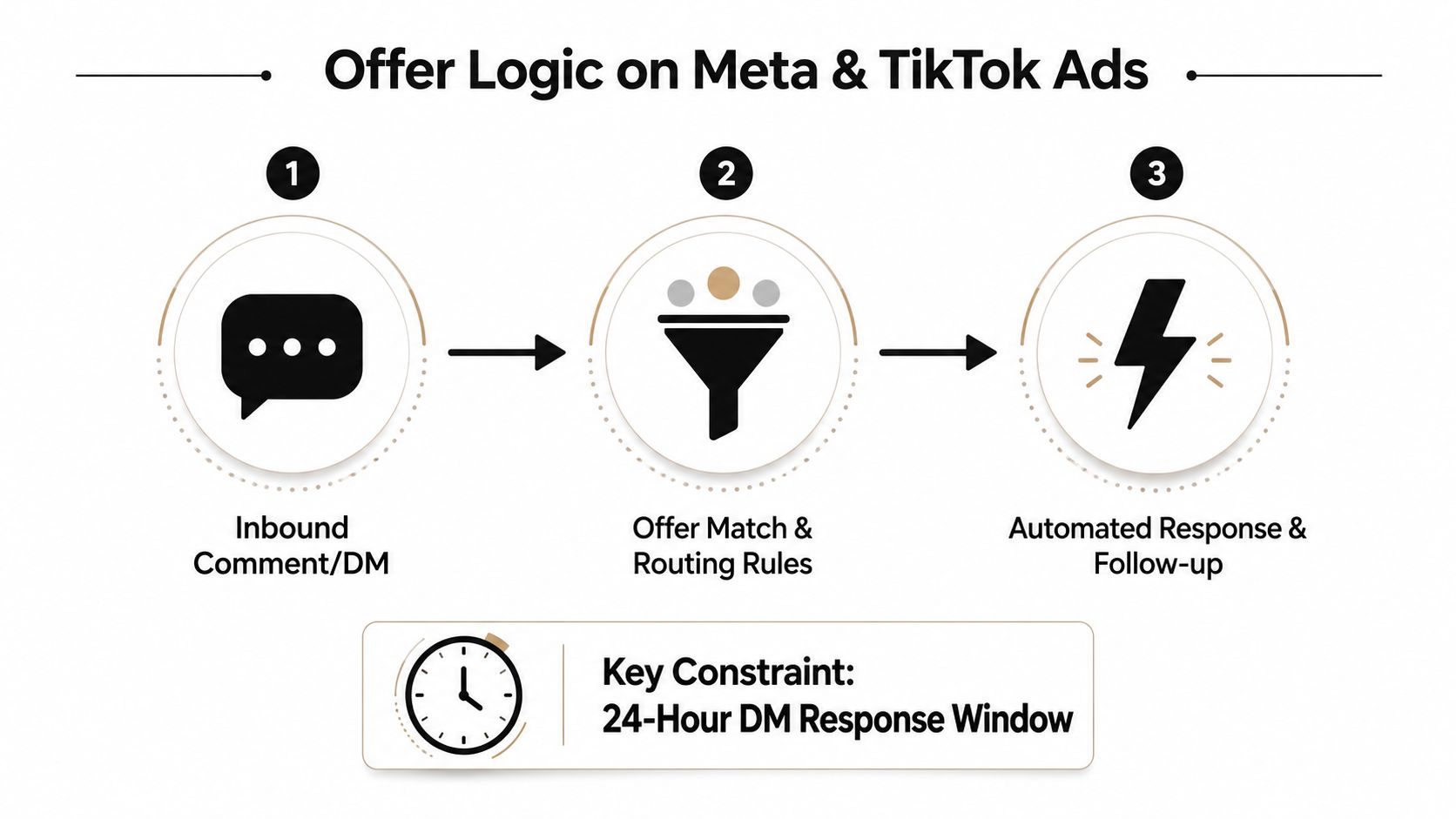
Public reply first, private route when needed
Moderation should classify the thread before it tries to sell. A useful rule set separates:
Spam and scams: Hide or remove according to platform and brand policy.
Competitor links: Triage or hide to protect the paid placement from diversion.
Product objections: Answer publicly when the response helps other shoppers.
Personal account questions: Move to a private message.
High-intent requests: Send the approved product or checkout path without making the customer repeat the question.
The comment thread remains part of the ad experience. A Harvard Business School field-and-lab program across Instagram, Facebook, and Trustpilot reported that automated moderation produced a 16% lift in click-to-registration rate and a 48% lift in return on ad spend in matched split tests. In the reported campaign, ROAS moved from 0.459 to 0.678, while purchases rose from 15 to 22 with the campaign variables held constant, according to the Harvard Business School publication.
One workflow should handle forms and drop-off
Lead forms shouldn't create a separate operating model. A completed form can enter the same offer and routing workflow as a comment, with qualification questions deciding whether the next step is a product link, a sales queue, or a support handoff.
The same applies to abandoned conversations. If a customer receives a code or checkout link and doesn't complete the purchase, the system can place the interaction into a recovery path while the messaging window remains available. The follow-up should answer the unresolved objection, not repeat the promotion without context.
Teams connecting a new account can use this resource to setup Meta Ads with SourceLoop. TikTok requires its own permissions, event mapping, and workflow checks, so document those separately in the TikTok integration workflow.
Attribution should pass meaningful events back to the ad platforms through the relevant server-side and platform event connections. The goal is to show whether a response led to a product view, checkout, or purchase, so optimization uses commercial outcomes rather than comment volume alone.
AI Employees Versus Manual Teams and Chatbots
Three operating models handle paid-social conversations today. Manual teams offer judgment but limited coverage. Rule-based chatbots offer speed but narrow comprehension. AI employees combine automated first response with human escalation.
Operating model | What works | What breaks |
|---|---|---|
Manual moderators | Nuance, empathy, and judgment in unusual cases | Delayed coverage, inconsistent replies, and variable handling cost |
Rule-based chatbots | Fast answers for fixed FAQs and exact triggers | Poor handling of sarcasm, ambiguity, objections, and changing context |
AI employees | Continuous first-line coverage, intent routing, and escalation | Require careful training, approval rules, and ongoing quality review |
Manual moderation costs roughly $0.40 to $1.50 per handled interaction after accounting for training, hours, and attrition. For a brand handling 5,000 ad interactions per month, that implies a rough monthly handling range of $2,000 to $7,500, calculated from those stated per-interaction costs. Coverage still depends on shifts and availability, so the brand may miss the most valuable conversations outside working hours.
Simple bots reduce the direct cost of each reply, but they often recognize only fixed keywords. A customer who says, “I love this, but will it work for sensitive skin?” may need a product recommendation and a qualification question. A rigid trigger may send a code without answering the concern, which creates activity without resolving intent.
Where AI employees fit
AI employees sit between the two models. They can handle the first 80% to 90% of inbound volume around the clock, escalate edge cases, and route high-intent interactions toward checkout. That range is an operating assumption for this model, not a guaranteed result. Actual coverage depends on catalog quality, training, offer complexity, and escalation policy.
The trade-off is control. Manual teams can improvise, but they need playbooks and review. Rule-based systems are predictable, but brittle. AI employees can interpret natural language more flexibly, but the brand must define boundaries, examples, approvals, and human handoffs.
For a deeper operational view, read what an AI employee actually does all day. The right choice isn't the model with the lowest reply cost. It's the model that answers enough real buying questions quickly while keeping the unacceptable cases away from customers.
Two Same-Day Scenarios You Can Copy
A useful test is whether the workflow makes sense during a sudden spike, not just during a quiet planning session. The following operating scenarios use the specified events and show where the system makes decisions.
A skincare brand catches a creator spike
A TikTok creator video sends 3,000 comments in six hours. The brand's offer management system connects the video to the featured SKU, checks the current promotion, and applies three actions.
First, it automatically hides 220 competitor links so shoppers don't encounter diversion beneath the paid or boosted content. Second, it sends discount codes by DM to 410 commenters whose messages show purchase intent, rather than sending the code to every person who comments. Third, it identifies stalled payment sessions and recovers 85 checkouts through the approved follow-up flow.
The operator doesn't judge the day by comment volume. That number shows attention, not revenue. The night-time review should focus on checkout recovery rate, along with the share of intent-positive commenters who received a valid route to purchase.
Practical rule: Separate moderation volume from sales intent. A hidden competitor link and a recovered checkout are both useful actions, but they belong to different performance reports.
An agency standardizes ten accounts
An agency manages 10 client accounts, each with a different catalog, brand voice, promotion policy, and escalation contact. The account manager creates a separate offer object for each client, connects each campaign to its permitted products, and assigns account-specific rules for public replies, private messages, and human review.
One client allows automatic discount delivery for a seasonal bundle. Another permits product links but requires a human to answer medical or fit-related questions. A third wants all negative comments visible to the account manager before any response. The same engine supports those differences without forcing one client's rules onto another.
The consolidated inbox gives the account manager a single place to review escalations, while each AI employee follows its assigned voice and approval boundaries. The nightly metric is comment-to-first-reply latency by account, because a blended agency average can hide one client with a serious response gap.
How to Choose and Roll Out the Right System
Start with the integration test, not the feature list. An offer management system can't coordinate a channel it can't read, write to, or measure.
Check the operating connections
Confirm native connections to Meta Ads Manager, TikTok Ads Manager, the ecommerce platform, and the systems that hold customer or support records. Webhook support matters when the brand needs to pass order status, inventory changes, lead qualification, or escalation events into the workflow.
Then inspect the actual data returned by each connection. Ask whether the system can identify the campaign, ad, product, conversation, customer, code, and order without manual copying. A connector that merely imports contacts won't support reliable offer execution.
Test governance before launch
Large teams need more than a shared login. Look for:
Role-based permissions: Limit who can create, approve, edit, or pause offers.
Audit logs: Preserve the rule, wording, timestamp, and actor behind each change.
Approval workflows: Require review before a new discount or claim reaches customers.
Promotion ownership: Assign one accountable person for eligibility, stacking, and expiry.
Escalation paths: Route sensitive questions to a named human team with a response standard.
Without centralized governance, promotions can sprawl, stack unexpectedly, diverge across channels, and become difficult to attribute. The harder operational problem isn't making an offer. It's preventing leakage and proving which activity created incremental revenue.
Set an honest measurement baseline
An offer management system amplifies demand that's already in motion. It doesn't invent demand from an unanswered comment. Track the metrics that expose execution:
Recovered carts and completed orders
DM-to-checkout rate
Comment-to-customer latency
First-response time
Offer redemption by campaign and SKU
Escalation rate and unresolved intent
A practical rollout takes 30 days:
Week one: Connect channels and audit catalog, offer, and event data.
Week two: Configure rules against two SKUs and review every response.
Week three: Run a full traffic test on one campaign.
Week four: Review revenue, response quality, attribution, and operating cost.
Buying speed usually means accepting less customization. Building every branch internally gives more control but creates a longer maintenance burden. Use this guide to workflow automation software to define the requirements before comparing implementation paths.
What to Change This Week
Choose one paid-social campaign with active comments and DMs. Don't start with the entire account. Write down how many purchase questions went unanswered last week, then set a reply target that the assigned owner can monitor.
Give the campaign one accountable person and one system. Turn on moderation for that campaign only. Route questions about price, sizing, stock, and product fit into a structured offer flow. Record the time of the first comment and the time of the first reply for every handled interaction.
Use the first week to learn, not to maximize automation. Review public replies, private messages, hidden comments, escalations, delivered links, and completed checkouts. When you tune product recommendations, document the factors AI uses for suggestions, then check whether the recommendations match your catalog and offer policy.
At the end of seven days, compare:
Unanswered intent: How many buying questions still received no response?
Response latency: How long did customers wait for the first answer?
Offer movement: How many conversations reached a product page or checkout?
Revenue recovery: Which replies preceded a completed order?
Quality control: Which interactions needed human correction?
An offer management system is an execution layer for humans and AI working the same queue. The brands that win on Meta and TikTok treat every hot comment as a checkout waiting to happen.
Exerta deploys AI employees that answer comments, DMs, and website chat, moderate harmful content, and route buying intent toward checkout with logged activity and attribution. Visit Exerta to connect your paid-social conversations to offer workflows and start with one campaign this week.