8 Customer Satisfaction Improvement Strategies
19 min read
read
·

Customer satisfaction starts before checkout. An ad's comments, DMs, and landing-page chat are part of the buying experience, not separate support queues. A prospect who asks about sizing and sees no answer, encounters visible spam, receives conflicting replies, or gets trapped in an unresolved edge case experiences friction while your paid traffic is still running.
That friction affects more than sentiment. The American Customer Satisfaction Index's federal government measure links improving satisfaction with better website quality, clearer information, process efficiency, and more courteous service. Academic research also connects satisfaction with retention, word of mouth, spending, willingness to pay, and firm-level financial performance, as summarized in this 40-year synthesis of satisfaction research.
For DTC brands and agencies buying traffic on Meta and TikTok, customer satisfaction improvement should therefore operate like a revenue and ad-efficiency system. The eight strategies below move from speed and public conversation control to intent recovery, personalization, channel coverage, attribution, and human escalation. You can configure the first tests today, then use the results to decide where automation belongs and where judgment still matters. For a broader view of feedback infrastructure, review these best customer feedback tools 2026.
Table of Contents
1. Deploy AI Employees to Answer Comments Within Seconds of Publication
2. Implement Real-Time Moderation Rules to Protect Ad Spend and Brand Safety
3. Build Sales Recovery Flows That Detect Buyer Intent and Convert Interest Into Orders
4. Use Cross-Channel Intelligence to Compound Learning and Avoid Siloed Responses
5. Leverage Workflow Builder Logic to Create Conditional Responses Based on Customer Context
6. Capture and Act on Every DM Within Meta's 24-Hour Messaging Window
7. Track Attribution and Dashboard Visibility to Prove ROI of AI Employee Deployment
8. Escalation and Approval Workflows Route Complex Conversations to Humans with Full Context
1. Deploy AI Employees to Answer Comments Within Seconds of Publication
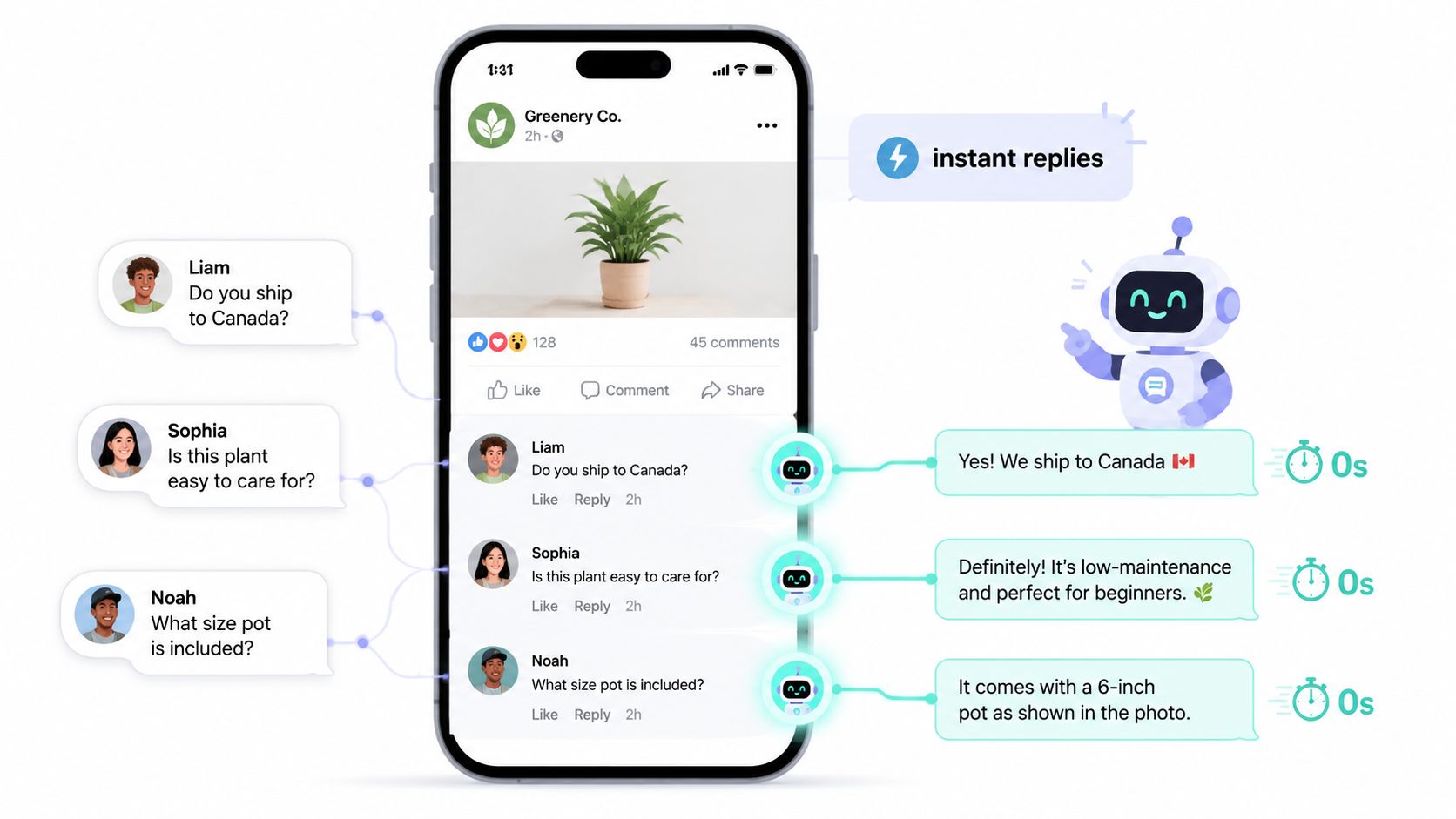
An unanswered ad comment creates a gap between interest and action. AI employees close that gap across Facebook, Instagram, and TikTok by monitoring new comments, identifying common questions, and replying in the brand's trained voice. That matters during product launches, creator whitelisting campaigns, and other periods when a manual team can't inspect every thread quickly.
The response should do more than say thanks. It should answer the question, provide the relevant product or collection link, and explain the next step. Exerta's product category is AI employees, not simple scripted bots. The practical distinction is that a trained employee can adapt the wording while following rules for prices, shipping, returns, offers, and escalation. Learn more about what an AI employee does all day.
Start with questions buyers already ask
Pull the five most common questions from recent ad threads. For an apparel brand, that may mean sizing, fabric, delivery timing, returns, and restock availability. Train the AI employee on those answers first, then add approved links and response boundaries.
Use a short pilot. Review replies for tone, factual accuracy, link selection, and escalation quality. Sensitive medical, legal, financial, or account-specific questions should go to a human before publication. Routine questions can remain automated.
Practical rule: Answer the question in public when the answer helps other shoppers. Move personal order details, eligibility questions, and sensitive complaints into a private workflow.
Configure separate templates for product links, tracking requests, policy questions, and discount handling. Keep the underlying policy consistent, but allow platform-specific phrasing. TikTok can sound more conversational, while Facebook may need a more explanatory response.
The payoff isn't only faster support. A useful public answer can rescue a buying moment for the original commenter and reduce uncertainty for everyone reading the thread.
2. Implement Real-Time Moderation Rules to Protect Ad Spend and Brand Safety
Your comment section is part of the ad creative. Spam, scams, impersonation attempts, and abusive content can change how prospects judge the offer before they click. Moderation won't fix a weak product or poor fulfillment, but it can stop unrelated content from dominating a paid conversation.
Build rules around the actual risks in your account. Start with hide actions rather than permanent deletion. That gives the team a reviewable record and lets you correct false positives without losing evidence. TikTok's ad tools support advertiser-controlled comment moderation, including filtering by rules, hiding comments, turning comments off, and analyzing comments through a dashboard, as described in its comment moderation and brand-safety guidance.
Separate protection from censorship
A useful moderation policy distinguishes between content that should be hidden and content that needs a response. A scam link or impersonation attempt belongs in a hide rule. A legitimate complaint about delivery should usually trigger a service-recovery path. Automatically hiding every negative comment can make the brand look evasive and can erase feedback your operations team needs.
Create campaign-level rule sets for products with different risks. A supplement campaign may need review for health claims. A financial lead-generation campaign may need approval for language about eligibility, rates, or outcomes. TikTok also highlights safety controls for comments and messages, alongside ongoing work on harmful-content detection, removal, and ad enforcement in its safety reporting.
Use a practical review rhythm:
Test on historical threads: Run proposed rules against past conversations before turning them on for live traffic.
Log every decision: Keep hidden-comment records available for weekly review and unhide legitimate comments when needed.
Escalate regulated edge cases: Send uncertain health, insurance, or financial content to the appropriate compliance queue.
Watch false positives: A rule that hides genuine product criticism may protect appearance while damaging trust.
Document the difference between moderation, response, and escalation. That separation keeps brand safety from becoming a blunt instrument.
3. Build Sales Recovery Flows That Detect Buyer Intent and Convert Interest Into Orders
A comment about price, stock, shipping, or a discount is often a buying signal. Treating it like ordinary engagement wastes the moment. Intent-based recovery flows identify those signals, answer the specific concern, and send the shopper toward checkout, scheduling, or another concrete action.
Exerta reports $2M+ in recovered revenue attributed in-product, but your team should still test incrementality rather than assume every attributed order was created by automation. A shopper who already intended to buy may click a link after an AI employee replies. That conversion has value, but it isn't the same as proving the reply created demand.
The workflow begins with an intent map. Group phrases into categories such as price inquiry, availability, shipping concern, discount request, appointment timing, and product comparison. Then connect each category to an approved response, destination, and follow-up condition. The buying-intent analysis from 3 million engagements can help frame the operating question, but your own comment history should determine the first rules.
Match the recovery offer to the economics
A discount isn't automatically good customer satisfaction improvement. If the shopper only needs a delivery answer, an unnecessary offer can cheapen the interaction. If the barrier is price, a margin-aware incentive may remove friction. Set rules by product margin, subscription value, inventory position, and customer status.
A same-day setup can include:
Top intent phrases: Map common purchase language to checkout links or scheduling links.
Contextual offers: Use a promotion only when it addresses the detected barrier and fits margin constraints.
Abandonment follow-up: Create reminders for link viewers who don't complete the next step, while respecting channel policy.
Weekly discovery: Review high-intent phrases with no configured response and add only the most useful branches.
For lead-generation accounts, route qualified conversations directly to the next sales action. For ecommerce, make the path short. A response that explains shipping, links to the right product, and states the relevant offer can outperform a generic “check our website” reply because it removes several decisions at once.
4. Use Cross-Channel Intelligence to Compound Learning and Avoid Siloed Responses
A shopper doesn't experience your channels as separate departments. They may see a TikTok ad, ask a question on Instagram, click through to the website, and return to Facebook with the same concern. If each channel uses different facts or starts from zero, the customer carries the cost of your internal structure.
Train one knowledge base around product facts, policies, offers, tone, and escalation boundaries. Deploy that intelligence across Facebook, Instagram, TikTok, and website chat. Exerta supports those channels today, with SMS, email, and voice planned next. The unified customer view explains the operational principle: preserve useful context so every interaction can improve the next one.
Keep the knowledge unified, not the wording identical
Consistency doesn't mean copying the same sentence everywhere. Platform behavior differs. TikTok comments often reward concise, conversational replies. Website chat can support longer answers, product links, and guided questions. The facts should remain stable while the delivery adapts to the channel.
Create platform-agnostic intent categories first:
Product questions: Explain use, fit, compatibility, ingredients, or availability.
Commercial questions: Handle price, discounts, bundles, subscriptions, and billing.
Fulfillment questions: Address shipping, returns, delivery timing, and order status.
Service questions: Route account-specific or unresolved issues to the right queue.
Then compare channel performance using the same definitions. Look for where high-intent conversations begin, which questions repeat, and where customers abandon the journey. That analysis can inform creative briefs and media allocation. If TikTok generates curiosity but website chat closes more purchase conversations, make the landing experience ready for the questions TikTok reveals.
Don't create a single giant workflow on day one. Start with shared facts and a small number of intent categories. Add channel-specific branches only after the common responses are accurate.
5. Leverage Workflow Builder Logic to Create Conditional Responses Based on Customer Context
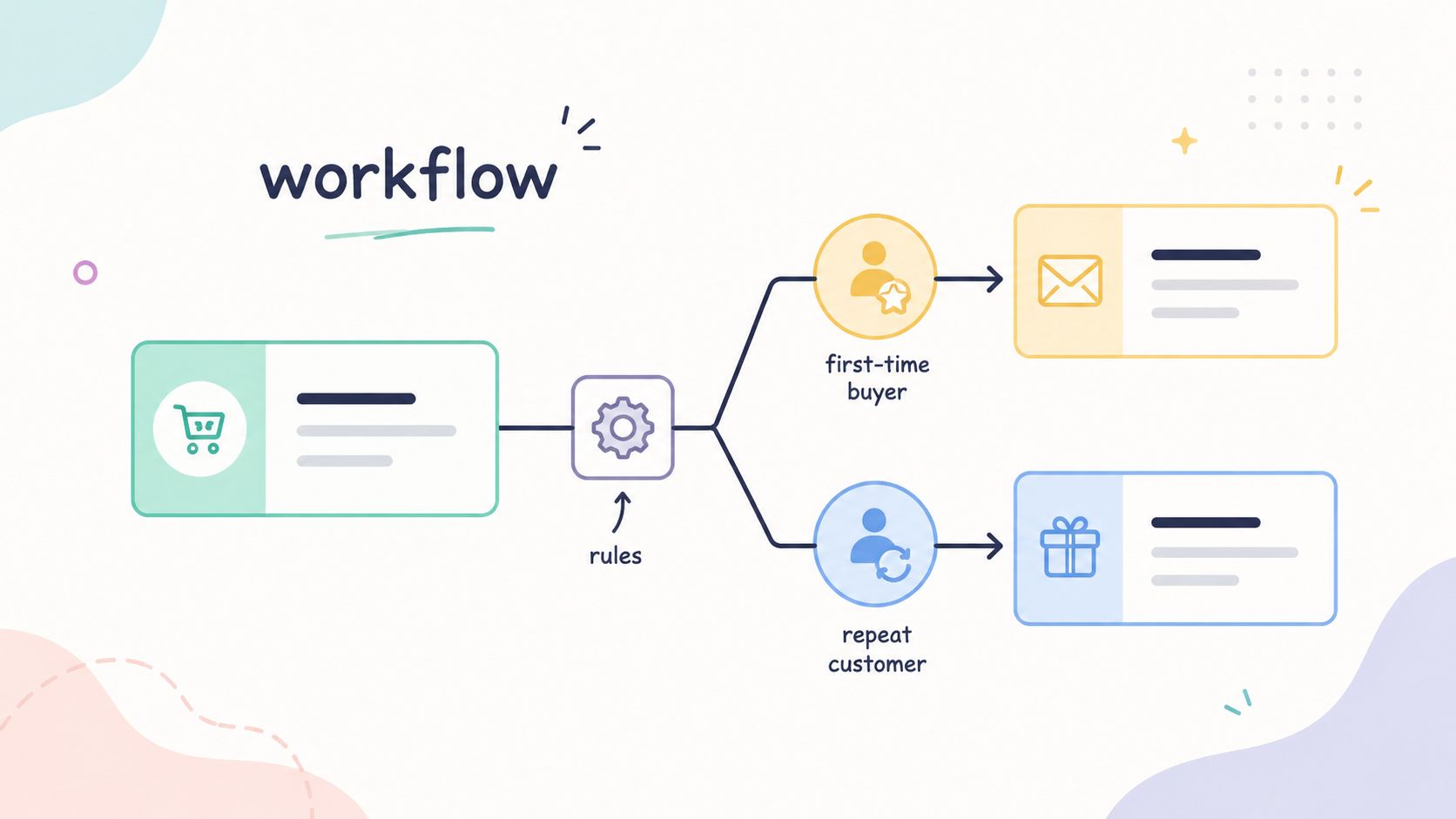
Personalization fails when it means inserting a first name into a generic reply. The useful version changes the action based on context. A first-time visitor may need reassurance and an introductory offer. A repeat buyer may need early access, product compatibility information, or a faster service route.
Use no-code conditional logic to make those distinctions explicit. A workflow can branch on intent, product interest, purchase history, audience segment, or the stage of the journey. The response should reflect the condition, not merely mention it.
Design branches around real decisions
Start with five scenarios from your recent conversations. For example, distinguish a new shopper asking about a product from a repeat customer asking about a new collection. Separate a price inquiry from a support complaint. Separate an appointment request from a question that requires professional review.
Keep each branch simple enough to audit. Every path needs:
A clear trigger.
An approved response or action.
A fallback for missing context.
An escalation condition.
A measurable outcome.
Customers don't experience your workflow diagram. They experience whether the next answer fits their situation.
Test branches against historical conversations before going live. Review not only conversion, but also escalation quality and customer effort. A branch that drives clicks while creating confusion at checkout isn't an improvement. A branch that routes every uncertain case to a human may protect quality but overwhelm the team.
Use a fallback response when the AI employee can't confidently identify the context. Ask one useful question rather than guessing. For regulated products, keep eligibility and claims logic conservative. For subscriptions, distinguish questions about the current plan from requests to change billing or cancel.
Review branch performance weekly. Retire paths that add complexity without helping the customer. Expand only when the current logic works reliably.
6. Capture and Act on Every DM Within Meta's 24-Hour Messaging Window
Meta messaging policy gives businesses a standard 24-hour window after a user's last message. Within that window, businesses can send free-form replies. After it closes, replies generally require a valid message tag such as HUMAN_AGENT. Comment-triggered private replies have a separate 7-day window for one reply per comment, according to this Meta direct-message policy explanation.
That policy makes response coverage an operating requirement. A lead who sends a DM after seeing an ad has already taken a high-intent step. If the team doesn't answer while the conversation is active, the next response may be restricted, delayed, or disconnected from the original buying moment.
Build separate paths for leads and support
Don't place every DM in one queue. A product-price question should receive a commercial answer and a product link. An order problem should create a support handoff with the conversation history attached. A sensitive complaint should route to a human owner rather than enter a promotional sequence.
Set monitoring around actual risk:
Immediate acknowledgement: Confirm receipt and ask only the question needed to route the conversation.
Lead qualification: Capture product interest, location, timing, or other relevant context before handoff.
Support routing: Send order-specific issues to the help process with the prior messages preserved.
Campaign readiness: Add AI employee capacity before launches, flash sales, or major creative tests.
Window reporting: Compare outcomes by conversation timing without assuming that timing alone caused the sale.
Don't promise a response standard your team can't maintain. A fast acknowledgement followed by a clear escalation is better than an instant answer that invents eligibility, delivery, or policy details.
Use the 24-hour DM window guide when mapping response rules. Test comment-triggered private replies separately because their policy window differs from ordinary message handling.
7. Track Attribution and Dashboard Visibility to Prove ROI of AI Employee Deployment
Customer satisfaction improvement needs an outcome model. If your dashboard only counts replies, you can't tell whether the system is helping revenue, lowering manual workload, improving lead quality, or increasing message volume.
Connect Shopify attribution on the first day of deployment. Link the originating comment or DM to the response, the link click, and the completed checkout when the data supports that path. Exerta's dashboards are designed to log actions and connect recovered sales, but teams should define attribution rules before reviewing results. Decide whether you count an order touched by an AI employee, an order influenced by a link, or only a conversion with a specified interaction sequence.
Review operational and commercial metrics together
Revenue alone can hide a poor customer experience. A campaign may generate orders while creating repeated complaints, excessive escalations, or discount dependency. Pair commercial metrics with quality signals:
Conversation volume: Track comments and DMs by campaign, platform, and intent.
Response quality: Sample replies for accuracy, tone, policy compliance, and useful next steps.
Recovery outcomes: Connect qualified conversations, checkout activity, and completed orders.
Escalation rate: Identify which topics require better training or human ownership.
Manual workload: Record the queues and repetitive tasks automation removes.
Customer feedback: Compare satisfaction and loyalty signals rather than relying on a single score.
The broader business case is credible because satisfaction research connects customer experience with retention, word of mouth, spending, and firm performance. But attribution still needs discipline. Use holdouts or controlled tests where practical, avoid counting the same order across multiple workflows, and separate assisted revenue from incremental revenue.
Schedule a weekly review with the growth lead and the person responsible for support quality. Segment results by product, campaign, audience, and channel. A response template that drives clicks but attracts low-quality leads needs revision. A quiet workflow that resolves routine questions may be valuable even when it produces fewer visible conversions.

8. Escalation and Approval Workflows Route Complex Conversations to Humans with Full Context
Automation should handle routine work, not remove judgment from sensitive interactions. Customers prefer AI agents in some company-failure scenarios when the bot can provide an explanation or monetary redress. They prefer human agents when the remedy requires an apology or functional redress, according to service-recovery research from J.D. Power.
That distinction gives advertisers a practical routing rule. Use AI employees for deterministic answers, links, order updates, scheduling, and approved compensation workflows. Send apology-heavy complaints, medical questions, complex billing issues, legal concerns, and relationship-sensitive cases to humans with the complete conversation attached.
Add approval where publishing risk is high
An approval workflow lets selected team members review an AI response before it appears publicly. Use it for regulated claims, eligibility language, rates, terms, product safety, and sensitive complaints. Don't require approval for every routine shipping question, or the review queue will recreate the delay automation was meant to remove.
Configure queues by responsibility:
Sales: Reviews qualified opportunities and commercial questions.
Support: Owns account, delivery, return, and order-resolution cases.
Compliance: Reviews regulated claims, eligibility, and sensitive product language.
Leadership: Receives reputational or high-risk complaints that need a coordinated response.
Give each queue a clear service-level expectation and require the AI employee to attach detected intent, conversation summary, relevant customer context, and a suggested next action. The human should improve the response, not ask the customer to repeat the entire story.
Use rejection patterns as training data. If reviewers repeatedly change the same wording, update the brand guidance or workflow branch. If a topic escalates too often, add a better knowledge source or make the human route permanent. The hybrid model works when humans receive fewer routine tasks and better context, not when they become a slow approval layer for every interaction.
8-Point Customer Satisfaction Comparison
Item | Implementation complexity | Resource requirements | Expected outcomes | Ideal use cases | Key advantages |
|---|---|---|---|---|---|
Deploy AI Employees to Answer Comments Within Seconds of Publication | Low–Medium, 15–30 min basic setup; 2–4 hrs for thorough brand training | No-code brand voice training, monitoring dashboard, minimal staffing for oversight | Near-instant replies; consistent messaging; reported ~15% average sales lift | High-volume ad posts, product launches, social engagement campaigns | Instant responses, elastic scale, consistent brand voice, audit trails |
Implement Real-Time Moderation Rules to Protect Ad Spend and Brand Safety | Medium, 1–2 hrs standard; 4–6 hrs for regulated industries | Rule configuration and testing, weekly tuning to avoid false positives | Improved ad quality scores; 12–20% reduction in wasted spend | Large-scale paid social campaigns, regulated or brand-sensitive ads | Prevents toxic spam, protects brand reputation, reduces manual moderation |
Build Sales Recovery Flows That Detect Buyer Intent and Convert Interest Into Orders | Medium, 2–3 hrs basic; 6–8 hrs for multi-step sequences | Shopify integration for attribution, offer/discount management, intent training | Converts comments/DMs to checkout links; reported $2M+ recovered; ~15% sales lift | DTC ecommerce, subscription offers, time-sensitive promotions | Real-time conversion of intent to orders, direct revenue attribution, higher conversion rates |
Use Cross-Channel Intelligence to Compound Learning and Avoid Siloed Responses | Medium, 3–4 hrs initial multi-channel training; ongoing weekly tuning | Unified training model, cross-channel dashboard, platform tone adjustments | 23% reduction in response inconsistencies; 8–12% cross-platform conversion lift | Brands active across FB/IG/TikTok and web chat seeking consistent voice | Unified learning, consistent voice, simpler performance tracking and scaling |
Leverage Workflow Builder Logic to Create Conditional Responses Based on Customer Context | Medium–High, 4–6 hrs for core workflows; ongoing refinement | No-code workflow builder, customer data integrations, testing resources | 18–25% improvement in conversion from personalized responses | Personalization at scale, segmentation-heavy businesses, complex routing needs | Conditional personalization, A/B-testable flows, fewer unnecessary escalations |
Capture and Act on Every DM Within Meta's 24-Hour Messaging Window | Low–Medium, 1–2 hrs basic routing; 3–4 hrs for qualification logic | Real-time DM monitoring, lead qualification rules, escalation paths | 28–35% improvement in lead capture within 24-hour window; higher conversion | Lead-gen, high-ticket sales, time-sensitive retargeting campaigns | Preserves low-cost messaging window, fast qualification, higher lead capture |
Track Attribution and Dashboard Visibility to Prove ROI of AI Employee Deployment | Low, ~1 hr Shopify integration; ~30 min dashboard setup | Shopify integration, dashboard maintenance, attribution model setup | Direct revenue attribution; average 15% sales lift; clearer payback metrics | Performance marketing teams needing ROI proof and budget justification | Real-time ROI visibility, conversion funnel tracing, informs budget decisions |
Escalation and Approval Workflows: Route Complex Conversations to Humans with Full Context and Controlled Publishing | Medium, 2–3 hrs rules; up to 6–8 hrs for regulated industries; ongoing SLAs | Human approvers, queue management, escalation rules, audit logging | Hybrid model reduces manual workload 80–90% while preserving brand safety and compliance | Regulated industries, sensitive topics, compliance-driven communications | Hybrid AI-human control, full conversation context, audit trails and approval controls |
Turn Faster Conversations Into a Repeatable System
Customer satisfaction improvement works best as a sequence of operating changes, not a large automation launch. Start with the top five customer questions in your Facebook, Instagram, and TikTok ad threads. Write the approved answers, attach the right product or scheduling links, and define which topics require a person before anything is published.
Next, configure instant comment and DM replies. Keep the first workflows narrow. A response that correctly handles sizing, shipping, returns, price, or appointment timing is more valuable than a broad system that guesses across every possible topic. Review the first conversations for factual accuracy, tone, useful links, and whether the customer reached the intended next step.
Add moderation rules after you understand the conversation patterns. Hide obvious spam, scams, impersonation, and unsafe content. Keep legitimate complaints visible when a response can help, and route regulated or uncertain content to compliance. Moderation should protect the buying environment without turning criticism into something your team can't learn from.
Then build intent-based recovery flows. Detect purchase language, send the next action, and use offers only when they fit margin and customer value. Add follow-ups carefully. A reminder can recover attention, but repeated promotional messages can increase irritation and weaken trust.
Connect Shopify attribution on day one. Review revenue, qualified leads, link activity, escalation rate, response quality, and manual workload together. A useful dashboard shows where conversations begin, which answers help, and where the customer still encounters friction. Review response quality and workflow branches weekly. Retire paths that add complexity without improving the experience.
Expand coverage from Facebook and Instagram to TikTok and website chat when the core rules are reliable. Exerta supports those channels today, with SMS, email, and voice planned next. The aim isn't to automate every conversation. It's to give routine buyers an immediate answer, protect paid traffic from harmful content, and give humans the context they need for conversations that require judgment.
The operational case is strong because speed, clarity, process efficiency, and service courtesy are measurable parts of satisfaction. Yet faster isn't always better. Verizon's 2025 CX annual insights report highlights customer frustration when automation blocks human access, forces people to repeat information, or loses context. Use AI employees to remove waiting and repetition, not to hide the human route.
Finally, measure loyalty rather than satisfaction alone. Qualtrics reported in its 2025 satisfaction and loyalty research that satisfaction can remain steady while trust, advocacy, and repurchase intent lag. PwC's 2025 customer experience survey found that 52% of consumers stopped buying from a brand because of a bad product or service experience, while 29% left because of poor online or in-person customer experience. Those findings point to the standard: repair the moments that cause churn, then prove that the repair improves both customer outcomes and advertising efficiency.
Exerta offers AI employees for comment and DM replies, moderation, sales recovery, workflow routing, and website chat across Facebook, Instagram, TikTok, and web channels. Visit Exerta to connect customer satisfaction improvement with paid-social conversations, recovered revenue, and logged attribution.