Social Media Moderation That Protects Ad Spend

read

·

An article by

A toxic comment thread can damage an ad before the creative itself changes. That's not a censorship problem. It's a merchandising problem.

Paid comments sit directly below the offer, product proof, price, and call to action. Buyers read them while deciding whether to click, ask a question, or leave. The European Union's Digital Services Act shows how seriously platforms now treat moderation at scale. Since September 2023, large platforms have had to submit detailed data on notices, takedowns, automated decisions, and the accuracy and error rates of automated systems. By late 2026, the EU database held over 735 billion content moderation decisions, while one analysis of a 24-hour period found more than 2.19 million cases across major platforms in a single day. The EU moderation analysis makes the operational reality clear: moderation is continuous infrastructure, not a side task.

For DTC brands and agencies, the practical question is simpler. Which comments should be hidden, which should receive a sales answer, and which require human judgment before anyone acts? The answer determines whether your ad's public conversation protects spend or works against it.

Table of Contents

Why Moderation Is an Ad Performance Problem

Most advertisers still treat comments as community management. That framing misses the commercial role of the thread. Comments beneath a paid creative are part of the ad itself, because prospects see the objections, answers, complaints, recommendations, and scams surrounding the original message.

A buyer asking about sizing creates a conversion opportunity. A customer asking about delivery needs a useful answer. A scam account posting a fake link creates risk. A hateful reply can make the brand look absent, even when the creative and landing page are strong.

The European moderation record provides the scale context. Large platforms reported about 1,109,746,815 moderation decisions across 50 days, at a median pace of 263 decisions per second, with about 42% fully automated. The same analysis reported more than 3.8 billion statements of reasons over 180 days. The platform moderation statistics analysis shows why manual review alone can't protect active ad sets. The volume moves too quickly, and the work spans languages, intent types, and risk levels.
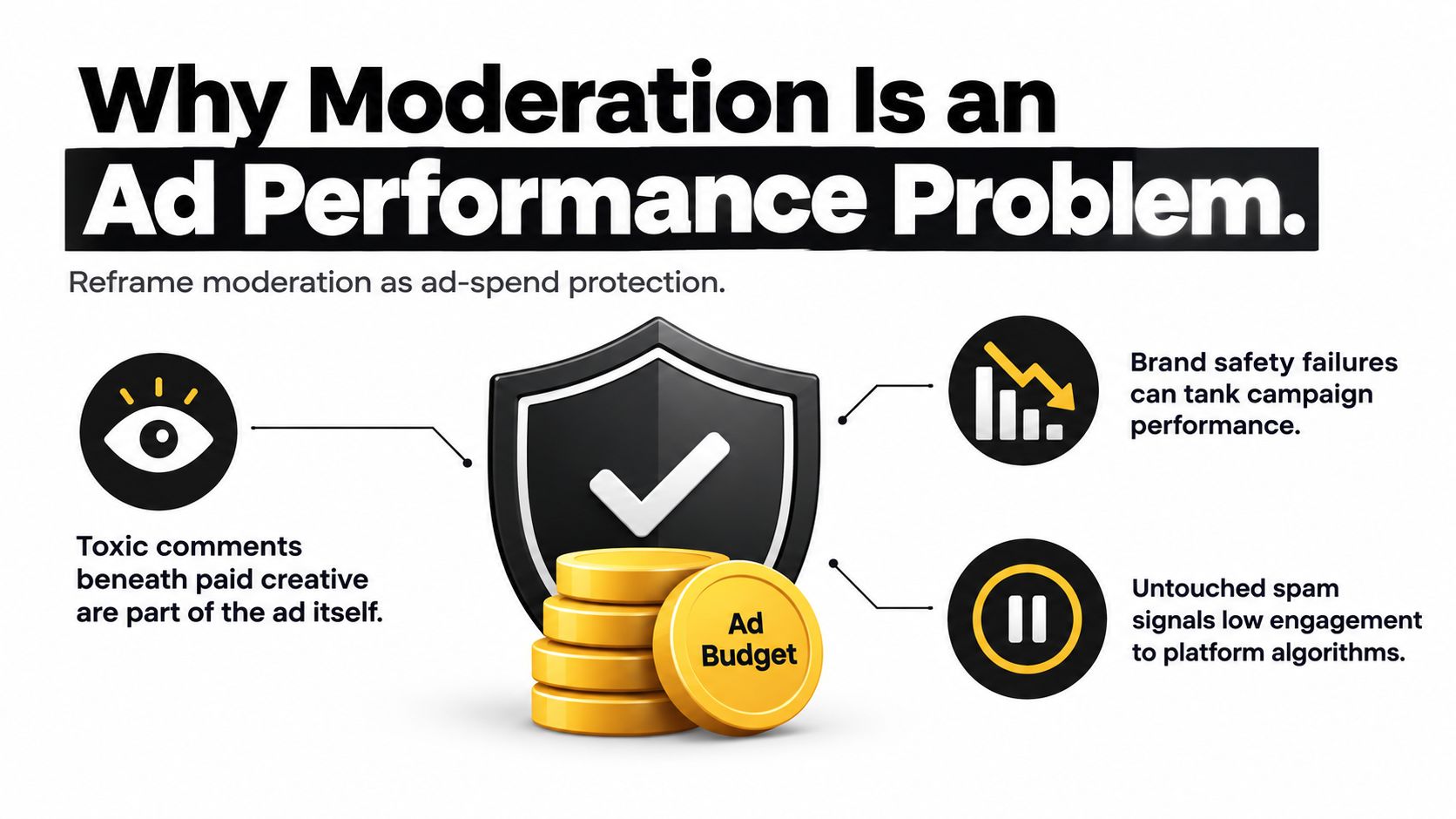
An infographic illustrating why social media moderation is essential for protecting ad performance and brand budgets.

The thread is merchandising real estate

Treat every public thread like a shelf beside the product. A useful answer removes friction. A visible scam link diverts attention. Repeated competitor poaching turns your paid audience into someone else's prospecting pool.

A six-study Harvard Business School program found that hiding harmful comments can causally improve ad performance, including conversion rates and return on ad spend. The effect depended on the platform's transparency design, so aggressive or inconsistent hiding can weaken the result. The Harvard Business School study supports a measured workflow: detect harmful comments, hide or suppress them before they accumulate, then compare downstream CTR, ROAS, and conversions across tested ad sets.

Operator rule: Don't optimize moderation for the number of comments removed. Optimize it for the quality of the buying environment.

That means moderation belongs in the same operating system as creative testing and budget management. Track what happens after an action. A hidden scam comment should reduce distraction. A reply to a shipping question should create a path to purchase. A sensitive health claim should reach a person before the brand publishes an answer. The right program protects attention without deleting useful objections.

For a broader framework on protecting public trust while managing response risk, see brand reputation protection. The commercial thesis remains direct: social media moderation protects ad spend when it preserves buyer confidence and routes legitimate intent toward revenue.

Hide, Reply, or Escalate

Every moderation decision should end in one of three actions: hide, reply, or escalate. Sentiment helps identify urgency, but intent determines the action.

A negative comment isn't automatically harmful. “Why does this cost more than the other option?” sounds hostile, yet it signals purchase research. Reply with the value proposition, a product comparison, or a relevant offer. A positive comment containing a scam link is not safe just because the tone is friendly. Hide it.

Hide removes visibility that adds no value

Hide comments that expose buyers to fraud, abuse, or distraction. Typical examples include scam links, impersonation, doxxing, targeted slurs, repetitive spam, and competitor poaching. TikTok's community rules prohibit harmful behavior including hateful conduct, harassment, violent content, and spam. Its enforcement also includes reporting, filtering, and removal actions. TikTok's moderation guidelines support a practical advertiser workflow: filter common fraud terms, review flagged comments, and keep real buyer questions visible.

Reply protects conversion when the question is useful

Reply to sizing questions, delivery concerns, product objections, pricing pushback, and mild criticism that a clear answer can resolve. A good reply should acknowledge the issue, answer the question, and offer the next step. If the person shows buying intent, route the conversation to a private message or checkout path.

Escalate when the consequence exceeds the workflow

Send legal threats, refund disputes, medical claims, safety allegations, privacy complaints, and emerging PR issues to a human queue. AI can classify the comment, preserve context, draft a response, and attach the ad and customer history. It shouldn't publish a high-consequence claim without an approval gate.

Comment Example

Intent Signal

Correct Action

Why

“Use this link for a cheaper version” from an unknown account

Scam or competitor diversion

Hide

Visibility adds risk and takes attention from the offer

“Does this run true to size?”

Purchase research

Reply

A specific answer can reduce friction

“I ordered last week and still haven't received it”

Support and possible refund intent

Reply or escalate

Start with support routing, escalate if compensation or dispute is involved

“This product cured my condition”

High-risk health claim

Escalate

A human must verify whether the brand can address the claim

“Your price is ridiculous”

Objection with possible purchase intent

Reply

Explain value without treating criticism as abuse

Targeted racist slur toward another commenter

Harassment or hate

Hide and escalate if repeated

Leaving it visible damages the buying environment

The line moves with context. A complaint about delivery can begin as a reply and become an escalation after repeated failure. A sarcastic remark can remain visible if it doesn't target anyone or mislead buyers. A keyword-only system misses these shifts.

Use the hide-or-reply moderation playbook for Meta ads to turn the matrix into action rules. The central discipline is intent routing, not sentiment suppression.

Building the Moderation Stack

Build the stack from fast, obvious decisions toward context-heavy judgment. Starting with a classifier before defining policy creates inconsistent outcomes and weak audit trails.

Layer one catches known patterns

Begin at the ad-set level with keyword and pattern blocks. Add common scam phrases, impersonation language, malicious links, repeated promotional patterns, doxxing terms, and direct competitor mentions. Keep the list narrow enough to avoid hiding legitimate product questions.

Review the block list against real comments, not hypothetical examples. “Where can I buy this?” shouldn't trigger a broad purchase phrase. “Message me for a better deal” from a recurring poaching account may deserve a hide. Pattern blocks should create a first pass, not make the final decision in every case.

Layer two classifies intent

Add classification for questions, complaints, praise, spam, abuse, purchase intent, support, and risk categories. The classifier should consider the comment, the parent thread, account behavior, ad context, and any attached link.

A buyer may use negative language while asking a useful question. Another account may write polite copy that directs customers to a fraudulent destination. Intent classification catches that difference better than a simple sentiment label.

A diagram illustrating a four-layer moderation stack for creating safer online community conversations.

Layer three applies brand and risk policy

Define restricted categories, competitor blocklists, language rules, and a do-not-engage list for recurring trolls. Separate policy by vertical. A supplement brand, financial advertiser, and apparel store shouldn't use identical response permissions.

Create approval gates for health, finance, insurance, refunds, legal complaints, and safety allegations. The AI employee can draft a response and place it in a queue. A human reviews the wording, checks the facts, and approves or rejects it.

Teams building the support layer can also use customer support automation tips to improve routing, queue design, and handoffs beyond the ad comment itself.

Layer four records every decision

Log the ad ID, comment ID, action, reason, confidence, response text, escalation destination, and approving operator. Keep the record tied to the CRM and revenue path where possible. Without that trail, you can't tell whether a rule protected spend or removed a customer who needed help.

Audit requirement: Every hide, reply, and escalation should answer three questions: what happened, why did the system act, and who could change the outcome?

Set response templates for recurring questions, but don't make them rigid. Templates should provide approved facts and next steps. The system needs room to answer the actual question in the customer's language and context.

A connected social media moderation tool can centralize those rules, queues, and logs. The technology matters less than the operating design. Detection without routing creates backlog. Routing without approval creates risk. Approval without attribution leaves marketing unable to prove value.

AI Employees vs Chatbots vs Human Teams

The choice isn't between automation and people. It's about assigning each layer to the type of work it handles well.

AI employees manage high-volume engagement across active ad sets. They read intent, apply moderation rules, draft or send replies within defined permissions, log actions, and connect conversations to CRM outcomes. Exerta is one example of this category, with AI employees operating across Facebook, Instagram, TikTok, and website chat today. The product reports adoption by 250+ brands, a 15% average sales lift, $2M+ in recovered revenue, and 99.9% uptime. Those figures are product claims, not a universal benchmark.

Rule-based chatbots work well for narrow jobs. They can hide a known phrase, send a fixed answer, or route a simple keyword. They struggle when the same words express different intent, and they usually can't recover a sale from a nuanced public conversation.

Human teams provide judgment where the consequence is high. They can assess context, handle sensitive disputes, and coordinate legal or crisis communication. They also face finite coverage, queues, training requirements, and fatigue when comment volume rises.

Criterion

AI Employees

Rule-Based Chatbots

Human Teams

24/7 coverage on active ad sets

Strong fit for continuous monitoring

Strong for narrow triggers

Limited by staffing and shifts

Response latency

Can operate in seconds or sub-minute workflows

Fast when a rule matches

Slower when queues build

Attribution to revenue

Can log intent, links, and CRM outcomes

Usually records the interaction, not the full buying path

Possible, but depends on disciplined logging

Cost per 10,000 comments

Elastic, based on configured capacity and volume

Efficient for repetitive filtering

Rises with review time and staffing

Nuance and high-consequence judgment

Classifies and routes, with approval gates

Weak outside predefined rules

Strongest fit

Best placement

The high-volume operating layer

Obvious pattern detection

Medical, legal, refund, and crisis decisions

Human-only moderation can work for low-volume accounts. It breaks when one campaign produces a steady stream of questions, complaints, and spam across several channels. Simple bots reduce repetitive work, but they don't replace intent-based sales routing.

For teams designing broader engagement coverage, scale support with conversational AI offers useful context on handling customer interactions beyond fixed replies. The placement rule is straightforward: AI employees own the volume layer, while humans keep control of medical, legal, refund disputes, and crisis communications.

See chatbot versus AI employees when choosing between fixed automation and a system that can classify, act, and preserve context.

Platform Playbooks for Meta and TikTok

Start with the controls available today, then connect them to a routing policy. Don't wait for a perfect system before removing obvious risk.

Meta same-day setup

At the ad level, enable profanity blocklists and configure auto-hide for clearly negative or abusive content. Keep the policy narrow. A blanket negative-sentiment rule can hide purchase objections that deserve an answer.

Route comments containing price, shipping, discount, sizing, or availability intent to a sales or support workflow. Meta's messaging policy gives businesses a 24-hour window for free-form replies after a customer messages them on Messenger or Instagram. Each new customer message resets the window, and once 24 hours pass, only approved out-of-window message types are allowed. Meta's 24-hour messaging guidance makes speed operationally important. Triage comments and DMs into sales intent, support, and spam, then move sales-intent conversations into the open window while the buyer is still engaged.

Review ad performance alongside the thread. If an ad attracts an unusual concentration of toxic comments, compare it with a moderated control before changing the creative or audience. Don't use a fixed threshold without testing how your account defines harmful volume.

TikTok same-day setup

Use keyword filters in the comment management tab for common scam phrases, impersonation language, malicious links, and coordinated spam. Pin approved replies that answer recurring product questions, and assign a community manager to keep useful information visible.

Review restricted comments regularly for false positives. TikTok's rules cover hateful conduct, harassment, violent content, and spam, but brand operators still need a campaign-specific policy for scams, competitor diversion, and buyer questions.

A diagram comparing comment moderation strategies for Meta and TikTok social media platforms using numbered lists.

Use brand-safety inventory filters in campaign settings where available, and check whether risky user-generated content is affecting placement or public response. Keep the review focused on the ad environment, not only on individual comments.

The connected workflow

Exerta's AI employees read comment intent, push approved replies through Meta and TikTok APIs, and send legal or refund cases to a human queue with the surrounding context attached. That model keeps routine actions moving while preserving a review boundary for sensitive decisions.

Same-day test: Choose one active ad, classify its latest comments into hide, reply, and escalate, then compare the response path and downstream revenue with an untreated ad.

Measuring Impact on Ad Performance

Moderation earns its place in the growth stack when the dashboard connects actions to outcomes. Don't report only how many comments were hidden. A high hide count may indicate strong protection, poor targeting, or a spam attack. The number needs context.

Track four operating metrics:

  • Comments hidden per week: Pull action logs from the moderation system and segment by scam, spam, abuse, competitor activity, and policy category. Review changes against creative launches and campaign events.

  • Median time to first reply: Measure only purchase-intent and support threads. A fast reply to a useless comment doesn't create value.

  • Recovered-attributed revenue: Connect DMs that began as comments to checkout, order, or qualified-lead outcomes in the CRM.

  • ROAS difference: Compare ad sets with active moderation against a paused or untreated control where the test design supports a fair comparison.

Metric

Source

Target

Frequency

Comments hidden

Moderation logs and platform records

Stable policy-consistent volume

Weekly

Median first reply

Comment and DM timestamps

Faster response without lower answer quality

Daily and weekly

Revenue from comment-started conversations

CRM and checkout attribution

Increasing recovered contribution

Weekly

ROAS by moderation status

Ad platform reporting and test controls

Positive contribution versus control

Weekly

Escalation rate

Human review queue

Appropriate routing for high-risk cases

Weekly

False-positive review

Approved and reversed actions

Fewer legitimate comments hidden

Monthly

Build one dashboard from platform APIs, moderation logs, and the CRM. Join records using campaign, ad, comment, conversation, and order identifiers. If the data can't connect those objects, label revenue as unattributed rather than guessing.

For teams improving the reporting layer, conversion-focused dashboard tips can help organize views around action and outcome rather than surface engagement.

The conversion attribution framework should distinguish revenue that started in a comment from revenue that would have occurred without moderation. Use holdouts or controlled comparisons where possible, and document the limitations.

The Harvard research provides the strongest evidence for this measurement approach. Hiding harmful comments can improve conversion rates and return on ad spend, but platform transparency design affects the outcome. The practical implication is clear: measure both protection and restraint. A system that hides everything may reduce visible abuse while also removing valuable objections.

Operating Rhythm and Continuous Tuning

Rules decay as soon as creative, offers, slang, and scam patterns change. Treat the moderation policy like a live campaign asset, not a document someone writes once.

Daily triage

Run a 15-minute review each day. Have AI employees surface sentiment shifts, unusual spam patterns, edge-case escalations, and ROAS anomalies. Approve flagged content, add immediate blocks for new scam language, and check whether sales-intent questions are reaching the right queue.

Review the exceptions first. A system can process routine volume while the operator focuses on a sudden impersonation pattern, a misleading product claim, or a support complaint spreading across several ads.

Weekly tuning

Hold a 60-minute rules review each week. Promote replies that resolved real objections, retire keywords that created false positives, and recalibrate sentiment thresholds against the latest creative. Compare moderation actions with response time, conversion activity, and ad performance.

Set checkpoint triggers:

  • CRR drops below 80%. Review whether comment-to-revenue routing is failing.

  • Response time crosses 15 minutes. Check queue capacity, permissions, and handoff logic.

  • Any ad is flagged in Brand Suitability Center. Pause automated expansion and review the surrounding conversation.

These thresholds are operating rules, not universal benchmarks. Your team should validate them against account history and risk tolerance.

A diagram illustrating an operating rhythm for continuous AI monitoring and tuning of social media moderation processes.

Monthly policy refresh

Run a monthly brand-safety audit across Meta and TikTok. Align policies with seasonal creative, new offers, and restricted categories. Stress-test escalation paths against a synthetic toxic-comment suite, including scam links, impersonation, racist replies, refund disputes, medical claims, and ambiguous sarcasm.

The wider regulatory environment reinforces the need for records. EU reporting requirements include automation accuracy and error rates, which turns automated moderation from an opaque feature into a measurable system. The EU platform transparency analysis shows why operators should retain decision reasons and review outcomes.

Ship small tweaks twice a week. Rewrite policy quarterly. Tie every change to recovered CPA, conversion quality, or ROAS lift, not moderation volume alone.

Exerta provides AI employees that moderate comments, answer buyer questions, route sensitive cases to human review, and connect social conversations with recovered revenue across Facebook, Instagram, TikTok, and website chat. Visit Exerta to see how to protect active ad spend while keeping legitimate buying conversations moving.

Get started today

Stop losing sales you already paid for.

Connect your channels in about a minute. Your AI employees start answering, moderating and closing the same day.

No credit card required

Live in under 5 minutes

250+ brands running

Cancel anytime

Get started today

Stop losing sales you already paid for.

Connect your channels in about a minute. Your AI employees start answering, moderating and closing the same day.

No credit card required

Live in under 5 minutes

250+ brands running

Cancel anytime

Get started today

Stop losing sales you already paid for.

Connect your channels in about a minute. Your AI employees start answering, moderating and closing the same day.

No credit card required

Live in under 5 minutes

250+ brands running

Cancel anytime

AI employees that answer every buyer, protect your ad spend and close sales around the clock.

All systems operational · 99.98% uptime last 90 days

SOC 2

Type II

GDPR

Compliant

99.9% SLA

Uptime

24/7

Support

1. Pricing and billing All prices displayed on exerta.ai are in US dollars and exclude applicable taxes unless stated otherwise. Prices are subject to change. Existing subscribers will receive at least 30 days’ written notice before any price increase takes effect on their account. Annual plan savings are calculated by comparing the annual billing rate to the equivalent monthly billing rate multiplied by 12.

2. Run and usage statisticsRevenue, engagement and success figures are based on aggregated platform data and customer-reported results across 250+ brands, and are updated periodically.

3. Time-to-value claims Statements such as “live in about a minute” reflect typical setup times observed for new accounts connecting through Meta Business Manager. Actual setup time may vary with the number of channels connected and the level of agent customization.

4. AI step suggestions Exerta’s AI features are powered by a blend of leading AI models, anchored by our own fine-tuned engagement model. Suggestion quality, accuracy and availability may vary. Exerta does not guarantee that AI-generated output will be accurate, complete or suitable for any particular use case. Review AI output before acting on it.

5. Integration availability The number of native integrations referenced on this website reflects integrations available at the time of last update. Integration availability may vary by subscription plan. Third-party integrations are subject to the terms, availability and API limitations of the respective third-party providers. Exerta does not guarantee the continued availability of any specific integration and is not responsible for disruptions caused by changes to third-party APIs or services.

6. Uptime and SLA The 99.9% uptime figure refers to our published Service Level Agreement (SLA) target for paid plan customers. Actual uptime may vary. Historical uptime statistics are available upon request.

7. Security and compliance certifications Exerta’s SOC 2 Type II (coming soon) certification covers the security, availability, processing integrity, confidentiality and privacy trust service criteria. GDPR compliance reflects our internal data protection practices and contractual commitments. HIPAA compliance is available exclusively on Enterprise plans and requires execution of a Business Associate Agreement (BAA). ISO 27001 certification is currently in progress. Compliance certifications are subject to annual renewal and audit. Copies of our most recent compliance reports are available to Enterprise customers under NDA upon request.

8. Customer testimonials and case studies Testimonials, quotes and case study results featured on this website reflect the experiences of individual customers. Results vary with ad spend, engagement volume, offer and configuration. Exerta does not guarantee that any customer will achieve similar results.

9. Third-party service marks and logos All third-party brand names, logos and service marks referenced on this website — including but not limited to Meta, Facebook, Instagram, TikTok, Shopify and Trustpilot — are the property of their respective owners. References to these services do not imply endorsement, sponsorship or affiliation.

10. Free plan limitations The Free plan does not require a credit card. Free plan usage is subject to the limits described on our pricing page, including a limited number of AI actions per month and comment hiding with stock replies only. Exerta reserves the right to modify the features and limits of the Free plan at any time.

11. Trial periods Free trial periods are available on paid plans as described at the time of signup. At the end of the trial period, the selected payment method will be charged at the applicable plan rate unless the subscription is cancelled before the trial expires. Trial periods are available once per customer and may not be combined with other promotional offers.

12. Data processing and privacy Exerta processes personal data in accordance with our Privacy Policy and Data Processing Agreement. Data residency options (US and EU) are available on all paid plans. The data residency region is selected at account creation and cannot be changed without contacting our support team. Customers responsible for processing personal data of EEA or UK residents are advised to execute our standard Data Processing Agreement, available at exerta.ai/legal/dpa.

13. Activity history retention Activity history is retained for 90 days on the Starter plan and for longer periods on larger plans, as described at signup. Exported data is the responsibility of the customer once downloaded.

14. AI model providers Exerta uses a blend of leading AI models together with our own fine-tuned engagement model, specialized for customer engagement. Model composition may change as we improve the product.

15. Mobile and desktop applications Exerta is available in the browser on desktop and mobile. Certain advanced configuration features are easiest on desktop. Application updates are released on a rolling basis.

16. Template library Prebuilt agent setups provided by Exerta are starting points and are not guaranteed to be suitable for any particular purpose. Customers are responsible for reviewing and testing agent behavior before enabling it on live channels.

17. Website content accuracy The information on this website is provided for general informational purposes only and is subject to change without notice. While we make every effort to keep the content accurate and up to date, Exerta makes no warranties or representations, express or implied, about the completeness, accuracy, reliability or suitability of the information contained on this website for any particular purpose.

18. Promotional offers and discounts Promotional pricing, discounts and special offers are subject to additional terms and conditions communicated at the time of the offer. Offers cannot be applied retroactively to existing subscriptions and may not be combined with other promotions unless explicitly stated. Exerta reserves the right to modify or discontinue promotional offers at any time.

19. Startup and non-profit programs Eligibility for our startup and non-profit discount programs is assessed at Exerta’s sole discretion based on the criteria described in our support documentation. Approved discounts apply to the base subscription price only and do not apply to add-ons, Enterprise features or professional services. Discount eligibility is subject to annual review.

20. Intellectual property This website is operated by Reascend LLC (d/b/a Exerta), a limited liability company formed in the State of Delaware, United States. References to “we”, “us” and “our” throughout this website refer to Reascend LLC (d/b/a Exerta). The use of this website and our Services is governed by the laws of the State of Delaware, United States, as described in our Terms of Service.

21. Accessibility Exerta is committed to making its website and application accessible to all users, including those with disabilities. We aim to conform to the Web Content Accessibility Guidelines (WCAG) 2.1 at Level AA. If you experience any accessibility barriers, please contact us at accessibility@exerta.ai and we will make every effort to provide an accessible alternative.

22. Governing jurisdiction This website is operated by Reascend LLC (d/b/a Exerta), a limited liability company formed in the State of Delaware, United States. References to “we”, “us” and “our” throughout this website refer to Reascend LLC (d/b/a Exerta). The use of this website and our Services is governed by the laws of the State of Delaware, United States, as described in our Terms of Service.

AI employees that answer every buyer, protect your ad spend and close sales around the clock.

All systems operational · 99.98% uptime last 90 days

SOC 2

Type II

GDPR

Compliant

99.9% SLA

Uptime

24/7

Support

1. Pricing and billing All prices displayed on exerta.ai are in US dollars and exclude applicable taxes unless stated otherwise. Prices are subject to change. Existing subscribers will receive at least 30 days’ written notice before any price increase takes effect on their account. Annual plan savings are calculated by comparing the annual billing rate to the equivalent monthly billing rate multiplied by 12.

2. Run and usage statisticsRevenue, engagement and success figures are based on aggregated platform data and customer-reported results across 250+ brands, and are updated periodically.

3. Time-to-value claims Statements such as “live in about a minute” reflect typical setup times observed for new accounts connecting through Meta Business Manager. Actual setup time may vary with the number of channels connected and the level of agent customization.

4. AI step suggestions Exerta’s AI features are powered by a blend of leading AI models, anchored by our own fine-tuned engagement model. Suggestion quality, accuracy and availability may vary. Exerta does not guarantee that AI-generated output will be accurate, complete or suitable for any particular use case. Review AI output before acting on it.

5. Integration availability The number of native integrations referenced on this website reflects integrations available at the time of last update. Integration availability may vary by subscription plan. Third-party integrations are subject to the terms, availability and API limitations of the respective third-party providers. Exerta does not guarantee the continued availability of any specific integration and is not responsible for disruptions caused by changes to third-party APIs or services.

6. Uptime and SLA The 99.9% uptime figure refers to our published Service Level Agreement (SLA) target for paid plan customers. Actual uptime may vary. Historical uptime statistics are available upon request.

7. Security and compliance certifications Exerta’s SOC 2 Type II (coming soon) certification covers the security, availability, processing integrity, confidentiality and privacy trust service criteria. GDPR compliance reflects our internal data protection practices and contractual commitments. HIPAA compliance is available exclusively on Enterprise plans and requires execution of a Business Associate Agreement (BAA). ISO 27001 certification is currently in progress. Compliance certifications are subject to annual renewal and audit. Copies of our most recent compliance reports are available to Enterprise customers under NDA upon request.

8. Customer testimonials and case studies Testimonials, quotes and case study results featured on this website reflect the experiences of individual customers. Results vary with ad spend, engagement volume, offer and configuration. Exerta does not guarantee that any customer will achieve similar results.

9. Third-party service marks and logos All third-party brand names, logos and service marks referenced on this website — including but not limited to Meta, Facebook, Instagram, TikTok, Shopify and Trustpilot — are the property of their respective owners. References to these services do not imply endorsement, sponsorship or affiliation.

10. Free plan limitations The Free plan does not require a credit card. Free plan usage is subject to the limits described on our pricing page, including a limited number of AI actions per month and comment hiding with stock replies only. Exerta reserves the right to modify the features and limits of the Free plan at any time.

11. Trial periods Free trial periods are available on paid plans as described at the time of signup. At the end of the trial period, the selected payment method will be charged at the applicable plan rate unless the subscription is cancelled before the trial expires. Trial periods are available once per customer and may not be combined with other promotional offers.

12. Data processing and privacy Exerta processes personal data in accordance with our Privacy Policy and Data Processing Agreement. Data residency options (US and EU) are available on all paid plans. The data residency region is selected at account creation and cannot be changed without contacting our support team. Customers responsible for processing personal data of EEA or UK residents are advised to execute our standard Data Processing Agreement, available at exerta.ai/legal/dpa.

13. Activity history retention Activity history is retained for 90 days on the Starter plan and for longer periods on larger plans, as described at signup. Exported data is the responsibility of the customer once downloaded.

14. AI model providers Exerta uses a blend of leading AI models together with our own fine-tuned engagement model, specialized for customer engagement. Model composition may change as we improve the product.

15. Mobile and desktop applications Exerta is available in the browser on desktop and mobile. Certain advanced configuration features are easiest on desktop. Application updates are released on a rolling basis.

16. Template library Prebuilt agent setups provided by Exerta are starting points and are not guaranteed to be suitable for any particular purpose. Customers are responsible for reviewing and testing agent behavior before enabling it on live channels.

17. Website content accuracy The information on this website is provided for general informational purposes only and is subject to change without notice. While we make every effort to keep the content accurate and up to date, Exerta makes no warranties or representations, express or implied, about the completeness, accuracy, reliability or suitability of the information contained on this website for any particular purpose.

18. Promotional offers and discounts Promotional pricing, discounts and special offers are subject to additional terms and conditions communicated at the time of the offer. Offers cannot be applied retroactively to existing subscriptions and may not be combined with other promotions unless explicitly stated. Exerta reserves the right to modify or discontinue promotional offers at any time.

19. Startup and non-profit programs Eligibility for our startup and non-profit discount programs is assessed at Exerta’s sole discretion based on the criteria described in our support documentation. Approved discounts apply to the base subscription price only and do not apply to add-ons, Enterprise features or professional services. Discount eligibility is subject to annual review.

20. Intellectual property This website is operated by Reascend LLC (d/b/a Exerta), a limited liability company formed in the State of Delaware, United States. References to “we”, “us” and “our” throughout this website refer to Reascend LLC (d/b/a Exerta). The use of this website and our Services is governed by the laws of the State of Delaware, United States, as described in our Terms of Service.

21. Accessibility Exerta is committed to making its website and application accessible to all users, including those with disabilities. We aim to conform to the Web Content Accessibility Guidelines (WCAG) 2.1 at Level AA. If you experience any accessibility barriers, please contact us at accessibility@exerta.ai and we will make every effort to provide an accessible alternative.

22. Governing jurisdiction This website is operated by Reascend LLC (d/b/a Exerta), a limited liability company formed in the State of Delaware, United States. References to “we”, “us” and “our” throughout this website refer to Reascend LLC (d/b/a Exerta). The use of this website and our Services is governed by the laws of the State of Delaware, United States, as described in our Terms of Service.

AI employees that answer every buyer, protect your ad spend and close sales around the clock.

All systems operational · 99.98% uptime last 90 days

SOC 2

Type II

GDPR

Compliant

99.9% SLA

Uptime

24/7

Support

1. Pricing and billing All prices displayed on exerta.ai are in US dollars and exclude applicable taxes unless stated otherwise. Prices are subject to change. Existing subscribers will receive at least 30 days’ written notice before any price increase takes effect on their account. Annual plan savings are calculated by comparing the annual billing rate to the equivalent monthly billing rate multiplied by 12.

2. Run and usage statisticsRevenue, engagement and success figures are based on aggregated platform data and customer-reported results across 250+ brands, and are updated periodically.

3. Time-to-value claims Statements such as “live in about a minute” reflect typical setup times observed for new accounts connecting through Meta Business Manager. Actual setup time may vary with the number of channels connected and the level of agent customization.

4. AI step suggestions Exerta’s AI features are powered by a blend of leading AI models, anchored by our own fine-tuned engagement model. Suggestion quality, accuracy and availability may vary. Exerta does not guarantee that AI-generated output will be accurate, complete or suitable for any particular use case. Review AI output before acting on it.

5. Integration availability The number of native integrations referenced on this website reflects integrations available at the time of last update. Integration availability may vary by subscription plan. Third-party integrations are subject to the terms, availability and API limitations of the respective third-party providers. Exerta does not guarantee the continued availability of any specific integration and is not responsible for disruptions caused by changes to third-party APIs or services.

6. Uptime and SLA The 99.9% uptime figure refers to our published Service Level Agreement (SLA) target for paid plan customers. Actual uptime may vary. Historical uptime statistics are available upon request.

7. Security and compliance certifications Exerta’s SOC 2 Type II (coming soon) certification covers the security, availability, processing integrity, confidentiality and privacy trust service criteria. GDPR compliance reflects our internal data protection practices and contractual commitments. HIPAA compliance is available exclusively on Enterprise plans and requires execution of a Business Associate Agreement (BAA). ISO 27001 certification is currently in progress. Compliance certifications are subject to annual renewal and audit. Copies of our most recent compliance reports are available to Enterprise customers under NDA upon request.

8. Customer testimonials and case studies Testimonials, quotes and case study results featured on this website reflect the experiences of individual customers. Results vary with ad spend, engagement volume, offer and configuration. Exerta does not guarantee that any customer will achieve similar results.

9. Third-party service marks and logos All third-party brand names, logos and service marks referenced on this website — including but not limited to Meta, Facebook, Instagram, TikTok, Shopify and Trustpilot — are the property of their respective owners. References to these services do not imply endorsement, sponsorship or affiliation.

10. Free plan limitations The Free plan does not require a credit card. Free plan usage is subject to the limits described on our pricing page, including a limited number of AI actions per month and comment hiding with stock replies only. Exerta reserves the right to modify the features and limits of the Free plan at any time.

11. Trial periods Free trial periods are available on paid plans as described at the time of signup. At the end of the trial period, the selected payment method will be charged at the applicable plan rate unless the subscription is cancelled before the trial expires. Trial periods are available once per customer and may not be combined with other promotional offers.

12. Data processing and privacy Exerta processes personal data in accordance with our Privacy Policy and Data Processing Agreement. Data residency options (US and EU) are available on all paid plans. The data residency region is selected at account creation and cannot be changed without contacting our support team. Customers responsible for processing personal data of EEA or UK residents are advised to execute our standard Data Processing Agreement, available at exerta.ai/legal/dpa.

13. Activity history retention Activity history is retained for 90 days on the Starter plan and for longer periods on larger plans, as described at signup. Exported data is the responsibility of the customer once downloaded.

14. AI model providers Exerta uses a blend of leading AI models together with our own fine-tuned engagement model, specialized for customer engagement. Model composition may change as we improve the product.

15. Mobile and desktop applications Exerta is available in the browser on desktop and mobile. Certain advanced configuration features are easiest on desktop. Application updates are released on a rolling basis.

16. Template library Prebuilt agent setups provided by Exerta are starting points and are not guaranteed to be suitable for any particular purpose. Customers are responsible for reviewing and testing agent behavior before enabling it on live channels.

17. Website content accuracy The information on this website is provided for general informational purposes only and is subject to change without notice. While we make every effort to keep the content accurate and up to date, Exerta makes no warranties or representations, express or implied, about the completeness, accuracy, reliability or suitability of the information contained on this website for any particular purpose.

18. Promotional offers and discounts Promotional pricing, discounts and special offers are subject to additional terms and conditions communicated at the time of the offer. Offers cannot be applied retroactively to existing subscriptions and may not be combined with other promotions unless explicitly stated. Exerta reserves the right to modify or discontinue promotional offers at any time.

19. Startup and non-profit programs Eligibility for our startup and non-profit discount programs is assessed at Exerta’s sole discretion based on the criteria described in our support documentation. Approved discounts apply to the base subscription price only and do not apply to add-ons, Enterprise features or professional services. Discount eligibility is subject to annual review.

20. Intellectual property All content on this website, including text, graphics, logos, icons, images, audio clips, digital downloads and software, is the property of Reascend LLC (d/b/a Exerta) or its content suppliers and is protected by applicable intellectual property laws. Exerta® is a registered trademark of Reascend LLC. Unauthorised reproduction, distribution or modification of any content from this website is prohibited without prior written consent.

21. Accessibility Exerta is committed to making its website and application accessible to all users, including those with disabilities. We aim to conform to the Web Content Accessibility Guidelines (WCAG) 2.1 at Level AA. If you experience any accessibility barriers, please contact us at accessibility@exerta.ai and we will make every effort to provide an accessible alternative.

22. Governing jurisdiction This website is operated by Reascend LLC (d/b/a Exerta), a limited liability company formed in the State of Delaware, United States. References to “we”, “us” and “our” throughout this website refer to Reascend LLC (d/b/a Exerta). The use of this website and our Services is governed by the laws of the State of Delaware, United States, as described in our Terms of Service.