Conversational AI for Ecommerce Practical Guide
read
·

Your Meta ad is getting clicks, but the comment section is filling with shipping questions. A shopper sends a direct message asking whether a discount still applies. Another lands on the product page, hesitates over sizing, and leaves before anyone answers. By the time your team replies, the buying moment has passed.
That gap sits between paid media and revenue. Conversational AI for ecommerce closes it by placing AI employees where shoppers already ask questions, compare products, and signal purchase intent. Instead of treating comments, DMs, and website chat as separate tasks, brands can connect them into one customer journey.
Table of Contents
Introduction to Conversational AI for Ecommerce
A DTC brand can run a strong ad and still lose sales after the click. Negative comments weaken trust in public, unanswered DMs leave high-intent shoppers waiting, and website visitors often abandon because they can't get a quick answer about price, delivery, fit, or returns.
AI employees give each channel an on-demand brand representative. They can answer routine questions in a consistent voice, share product links, identify buying intent, and route complex issues to a human. That makes conversational AI an operating layer across the funnel, not just a support widget added to a website.
The commercial case has already moved beyond experimentation. Industry research valued the conversational commerce market at US$7.6 billion in 2024 and projects it to reach US$34.4 billion by 2034, at a 16.3% CAGR. The same source reports chatbot service-cost reductions ranging from 15% to 70% and conversion rates that can be four times higher for assisted shoppers. See the conversational commerce market data for the underlying figures.
For advertisers, the immediate question isn't whether shoppers want conversations. They already ask questions under ads and on product pages. The question is whether your team can respond quickly enough, protect the public comment thread, and guide the shopper to checkout while intent is still strong.
Understanding AI Employees and Customer Journeys
An AI employee is an automated brand representative that can interpret customer messages, follow approved workflows, answer questions, and escalate issues. It isn't limited to a fixed menu or one scripted reply. Its value comes from combining a conversation with context, such as the product being viewed, the question asked, and the next action needed.
Think of an AI employee as a skilled store associate working across every entrance to your business. A store associate can explain the difference between two products, recommend a better fit, and help a customer complete a purchase. The associate still needs breaks and can only speak with one shopper at a time. An AI employee can handle many conversations at once, maintain the approved brand voice, and stay available outside normal team hours.

Follow the journey, not the channel
At the discovery stage, the AI employee can answer a public comment such as, “Does this work for sensitive skin?” It can provide a concise answer, link to the relevant product, and invite the shopper to send a direct message for more detail.
During consideration, it can compare two products, explain shipping, clarify a promotion, or answer a sizing question. During checkout, it can address hesitation and help the shopper return to the right product or cart. After purchase, it can handle routine order questions and pass unusual cases to a person with the conversation history attached.
A useful workflow has three layers:
Interpretation: Identify what the shopper wants, such as product advice, delivery information, or a discount.
Action: Answer, recommend, send a link, apply an approved offer, or start a recovery flow.
Escalation: Hand the conversation to a human when the issue involves judgment, dissatisfaction, exceptions, or sensitive information.
AI usage among ecommerce professionals rose from 69% in 2024 to 77% in 2025 and 96% in 2026, with social messaging the leading channel at 78%. The same report says 57% of brands use AI for 26% to 50% of customer interactions. Those figures appear in this ecommerce AI adoption report.
For a practical operating definition, read what an AI employee actually does all day. The key distinction is simple: a chatbot answers isolated questions, while an AI employee supports a connected customer journey.
Engaging Customers Across Social and Web Channels
Your audience doesn't experience your business as separate inboxes. A shopper may see a TikTok ad, ask a question in the comments, move to a DM, and then open website chat to confirm shipping. If each channel has different answers, the customer has to restart the buying conversation every time.
Exerta's live channels are Facebook, Instagram, TikTok, and website chat. SMS, email, and voice are launching next, which extends the same operating model beyond the current social and web touchpoints.
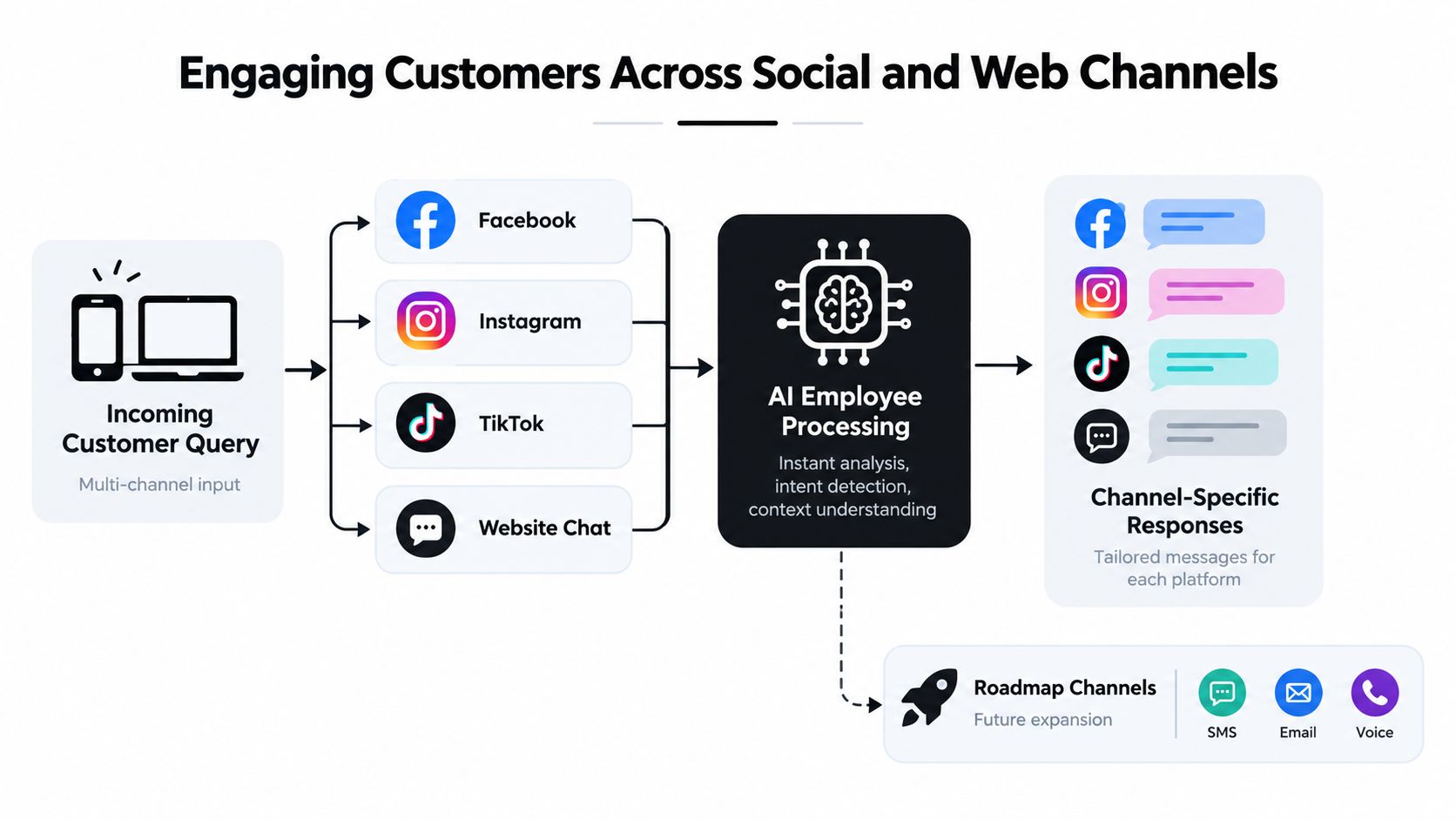
A practical channel flow
Start with the incoming message. The AI employee identifies the channel, reads the context, and applies the relevant response rules.
Public comments: Answer buyer questions clearly and briefly. Hide spam, scams, and harmful content when the rules allow it.
Direct messages: Continue the conversation privately, share prices or offers, and send the shopper toward the right product or checkout path.
Website chat: Respond to product, delivery, returns, and payment questions while the visitor remains on the page.
Escalations: Transfer complaints, unusual requests, or approval-required actions to a human.
Moderation matters because public comments influence how future shoppers assess the ad. In six empirical tests, including large-scale field experiments, automated moderation and engagement produced a 16% lift in click-to-registration rate and a 48% increase in return on ad spend in the strongest field results compared with identical unmoderated controls. The findings are detailed in the Harvard Business School study on automated comment management.
Don't hide every critical comment. A real question about delivery or product fit can become useful public proof when answered well. Hide content that damages the buying environment, then pin or surface questions that help other shoppers make a decision.
This channel discipline also matters inside the omnichannel customer engagement framework. The objective isn't to make every reply identical. It's to keep the facts, offer rules, tone, and escalation logic consistent while adapting the wording to each channel.
Personalization and Cart Recovery with AI Employees
Personalization works when it helps a shopper decide, not when it merely inserts a name into a generic message. An AI employee can greet a returning visitor, reference the product category they're exploring, recommend an alternative, or answer the specific objection that caused hesitation.
A useful recovery flow begins with a signal. The visitor adds an item, asks about shipping, opens a discount prompt, or starts checkout and leaves. The AI employee then chooses a response based on the conversation and available purchase context.
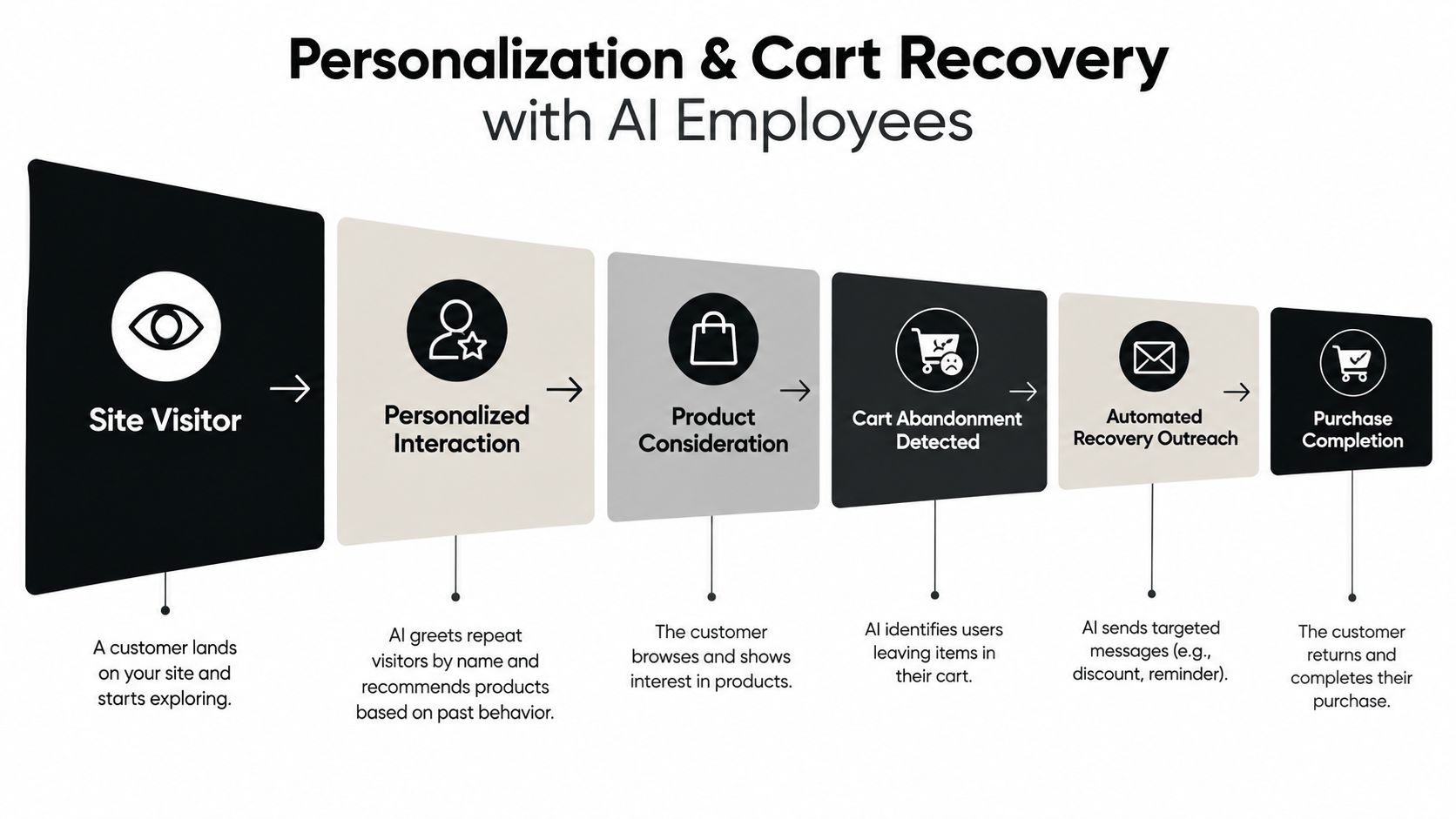
Build recovery around the objection
A generic reminder says, “You left something behind.” A useful recovery message answers the reason the shopper paused.
Price hesitation: Explain the current offer or provide an approved incentive.
Shipping uncertainty: State the delivery policy and direct the shopper back to checkout.
Product uncertainty: Compare the selected item with a relevant alternative.
Checkout friction: Send the shopper to the preserved cart rather than making them rebuild it.
Branching logic keeps the workflow controlled. If the shopper asks for a discount, the AI employee can check the offer rules. If the shopper asks an unusual question, it can stop the automated flow and request human review. If the shopper doesn't want messages, suppression rules should end the sequence.
Trust determines whether personalization helps or harms conversion. 66% of consumers would refuse to let AI make purchases on their behalf, and 39% have abandoned purchases after frustrating AI interactions. 91% believe brands should disclose when they're interacting with a bot, according to this consumer trust research on AI shopping assistants.
Tell the shopper when an AI employee is responding. Give them a clear path to a human. Keep recommendations tied to the products and information the system can verify. These controls also support broader work on improving conversions for SaaS products, where clarity and reduced friction matter just as much as the offer itself.
Offer governance belongs in the workflow. Define which discounts can be issued automatically, when approval is required, and how often a shopper can receive recovery messages. A structured offer management system helps keep recovery campaigns commercially useful without training customers to wait for a discount.
Measuring Performance and Attribution
AI employees need the same measurement discipline as paid media. Track the point where the interaction happened, the action the AI employee took, and the revenue outcome that followed.
For social campaigns, useful metrics include response volume, buyer-question resolution, moderation actions, DM continuation, and purchases linked to a conversation. For website chat, track assisted sessions, product-page engagement, checkout progression, and recovered orders. Keep the reporting tied to a defined audience or campaign so media buyers can compare performance rather than relying on total site revenue.
A production ecommerce benchmark found that chat-engaged shoppers converted at 12.3%, compared with 3.1% for shoppers without assistance, a roughly fourfold difference. The same source set places baseline ecommerce site conversion around 2.0% to 2.5%. See the chat-assisted ecommerce conversion benchmark.
Use attribution that a media buyer can audit
A practical attribution record should include:
Conversation source: Facebook, Instagram, TikTok, or website chat.
Customer intent: Product question, offer request, cart recovery, or support issue.
AI action: Reply, link, recommendation, discount, or escalation.
Outcome: Checkout, purchase, lead, or no conversion.
Campaign context: Ad, landing page, product, and audience.
Avoid claiming that every purchase after a chat was caused by the chat. Compare assisted and unassisted sessions, use consistent campaign tracking, and review the time between the interaction and the transaction. A dashboard should help you separate influence from coincidence.
Exerta reports 250+ brands, a 15% average sales lift, $2M+ in recovered revenue, and 99.9% uptime. Treat those as platform-reported figures and assess your own baseline before projecting an outcome. For the implementation details behind revenue measurement, use Exerta's conversion attribution guide.
Practical Examples and Quick Wins
You don't need to automate the entire customer journey before seeing where AI employees fit. Start with a live campaign, a repeated buyer question, or a landing page where paid traffic already creates demand.
Clean the comment section on active ads
Open your current Meta and TikTok campaigns. Review the public replies and create moderation rules for spam, scams, abusive language, and misleading claims. Then prepare approved responses for common buyer questions about price, shipping, availability, and fit.
Pin a helpful question and answer when it addresses a concern other shoppers may share. Send complex questions to a DM or human reviewer instead of writing a long public reply. This turns the comment section into part of the sales experience.
Recover a high-intent conversation
Create a workflow for shoppers who mention a product, ask for a discount, or request a checkout link. Configure the AI employee to confirm the relevant item, provide the approved offer, send the checkout path, and stop messaging after the shopper declines or completes the purchase.
Review every branch before activating it. The workflow should never invent availability, promise an unapproved discount, or continue after a clear opt-out. For Instagram-specific welcome flows, use the Instagram welcome message guide.
Add chat to a paid landing page
Place website chat on the product and landing pages receiving the most paid traffic. Start with short prompts such as, “Need help choosing a size?” or “Want to check shipping before you order?”
Train the AI employee on the product details and policies it can verify. Give it a small reply set for price, shipping, returns, and comparisons. Then review conversations daily and add new answers based on repeated objections. A peer-reviewed study found that live chat positively affects traffic-to-sales conversion, especially when product information is less complete and perceived product value is higher. The findings are available in this operations management study on live chat and ecommerce conversion.
Conclusion and Next Steps
AI employees connect the parts of ecommerce that teams often manage separately. They answer social comments, continue DMs, protect ad threads, guide product decisions, support website visitors, and recover carts with measurable actions.
Roll out the system in stages. Start with comment replies and moderation, add a cart recovery workflow, then place website chat on high-spend landing pages. Train the AI employee on your brand voice, product facts, offer rules, and escalation paths before expanding the scope.
Exerta supports Facebook, Instagram, TikTok, and website chat today, with SMS, email, and voice launching next. Its platform reports 99.9% uptime, while every reply and recovery action can be logged for review and attribution. Treat the first rollout as a measured operating process, not a one-time installation.
Exerta deploys AI employees that respond to comments and DMs, moderate harmful content, guide website shoppers, and recover revenue across paid social and web conversations. Visit Exerta to connect your channels and start with a focused workflow your team can measure today.