AI Content Moderation for Paid Ads: What Actually Works

read

·

An article by

Your ad is working at 11 a.m. The creative is clean. The offer is clear. Click-through is healthy, and the media buyer finally stops touching the campaign.

By mid-afternoon, performance falls apart.

Nothing changed on the ad itself. The landing page is the same. The audience is the same. The budget is the same. What changed is the comment section. A few unanswered threads stacked up. One person says the product is a scam. Another asks a basic pricing question and gets no answer. A third drops a competing offer right under your CTA.

That space under the ad is not customer support. It's merchandising real estate. Buyers read it the same way they read product reviews on a PDP. If it looks unmanaged, the ad looks risky.

Teams spend weeks on creative testing and offer strategy, then leave the last inch before conversion wide open. That's where a lot of paid social waste comes from. If you want practical digital ad brand safety tips, start there. Protect the comment section like it's part of the ad unit, because to the buyer, it is.

Three forces decide whether comments help or hurt spend. Speed of reply. Quality of moderation. Silence when silence is the wrong call. Get those right and weak comments stop killing strong ads.

Table of Contents

The Ad Your Buyer Reads Before the Ad

A buyer sees your ad. Then they scroll down.

That second step matters more than most brands admit. Plenty of shoppers don't trust the caption, don't click the landing page, and don't care how polished the creative looks until they read what other people are saying under the post. The comments become the proof layer.

What actually breaks the campaign

A paid social campaign can lose momentum without any obvious creative fatigue. It happens when visible friction starts collecting under the ad faster than the team can respond.

Three patterns show up constantly:

  • Unanswered objections that make normal purchase friction look like a red flag

  • Hostile pile-ons that shift the tone from curiosity to suspicion

  • Intent leakage where another brand, affiliate, or troll redirects attention away from your offer

Practical rule: If a buyer can see the objection, your team owns the objection, even if you didn't create it.

This is why comment operations sit closer to conversion than to community management. A product question under an ad isn't casual engagement. It's a sales moment. A scam accusation isn't just negativity. It's a public conversion blocker. A competitor mention isn't harmless noise. It's traffic theft in public.

The three levers that protect spend

The brands that manage this well usually do three things consistently.

  • They reply fast. Buyers asking about price, sizing, ingredients, shipping, or returns need an answer while they're still in market.

  • They moderate with intent. Hide what damages trust or hijacks the sale. Leave room for normal skepticism and answer it directly.

  • They know when silence is expensive. Some comments shouldn't be debated. But many should be addressed quickly before the thread writes the ad's story for you.

That's the lens that makes AI content moderation useful for advertisers. Not as abstract trust and safety infrastructure. As a system for protecting conversion in the few lines of text buyers read right before they decide whether to click.

What AI Content Moderation Actually Is

For advertisers, AI content moderation is a triage system that watches comments the moment they land, sorts them by risk and intent, then decides what gets hidden, what gets a reply, and what gets routed to a human.

It's not one model doing one job. It works better as a layered workflow.

An infographic illustrating the three-layered AI content moderation process from automated filtering to human review.

Layer one catches the obvious stuff

Think of the first layer as the triage nurse. It handles the fast, repetitive calls.

This layer uses simple filters and pattern checks to catch obvious spam, scam links, slurs, repetitive junk, and low-effort attacks. It should act quickly because these are the comments that don't need interpretation. They need removal or hiding.

Layer two scores meaning and intent

The second layer does the heavier reading. It looks at tone, phrasing, likely buyer intent, off-topic drift, competitor mentions, and signs that the comment needs a response instead of a hide.

That's where modern classification helps. Instead of asking only "is this bad," the system asks better questions. Is this a real shopper asking about shipping? Is this a refund complaint? Is this sarcasm? Is this someone trying to hijack the thread?

A good breakdown of how AI employees fit into this workflow sits in Exerta's piece on the AI social media agent.

Layer three handles the judgment calls

The third layer is the supervisor. A person sees the comments that fall into the gray area.

Those are usually the expensive ones to get wrong. Product safety claims. Refund disputes. Legal threats. Comments that look negative but come from real buyers. Comments that mention defects, chargebacks, or misleading advertising. Automation should route those, not bluff through them.

The goal isn't full automation. The goal is fast, consistent handling of the easy cases so humans can spend time on the costly ones.

What job it's doing for an advertiser

For a paid social team, moderation usually has three jobs:

  1. Hide harmful comments that damage trust or derail the thread.

  2. Surface buyer questions that deserve a reply because they can close a sale.

  3. Escalate edge cases to a human before a public comment becomes a support or legal problem.

This is also why advertisers often need a second moderation stack on top of the platform's defaults. The platform is enforcing broad community rules. The advertiser is protecting ad conversion.

The Main Techniques, From Filters to LLM Classifiers

Not all moderation stacks do the same job. Some are cheap and fast but dumb. Others read nuance better but cost more and move slower. Most paid social teams need a mix.

Keyword and pattern filters

This is the first pass. Simple word lists, phrase lists, and regex rules handle the obvious junk.

They work well for spam links, profanity, repeated scam phrases, and predictable abuse. They also give you the most control. If you know a specific competitor phrase, coupon bait, or impersonation pattern keeps showing up, you can block it directly.

Where they break is context. A filter doesn't know whether "this is sick" is praise or a complaint. It also misses evasive spelling and sarcasm.

Classical classifiers

The next step is a trained classifier that scores comments into categories such as likely toxic, off-topic, purchase intent, or support risk.

These models are useful because they generalize better than raw keyword lists. They can catch comments that look similar to past bad comments even when the exact wording changes. They're often enough for brands that need structure without a heavy model bill.

They still struggle with cultural nuance, coded language, irony, and rapidly changing slang.

Embedding similarity and vector matching

This layer is underrated for paid social.

It helps catch coordinated behavior. If people keep dropping near-duplicate competitor comments, affiliate spam, or recycled product attacks with slightly different wording, similarity search can group them and flag the pattern. That's especially useful when a thread is being manipulated, not just criticized.

LLM-based classifiers

Nuance improves. These systems read intent better, handle messy sentence structure better, and usually perform better on comments that mix objection, sarcasm, and purchase signals in the same sentence.

They still aren't magic. Context is a real failure point. Research and policy work continue to show that current systems struggle with coded language, reclaimed slurs, irony, and linguistic variation, especially across marginalized communities and culture-specific usage, as discussed in the FAccT 2025 paper on moderation failures across nuance and group-targeted language.

If your ads attract multilingual comments or high-conflict threads, don't trust a single model to make every final call.

A practical survey of workflows and categories is in this guide to social media moderation tools.

Moderation techniques compared for paid social

Technique

Accuracy on Toxic Comments

Latency

Cost per 1k Comments

Common Failure Mode

Keyword and regex filters

Low to moderate

Very low

Low

Misses evasive spelling, sarcasm, and context

Classical classifiers

Moderate

Low

Low to moderate

Struggles with irony, slang shifts, and culture-specific meaning

Embedding similarity

Moderate for repeat patterns

Low to moderate

Moderate

Flags similarity without understanding whether the new version is harmful

LLM-based classifiers

Higher on nuanced text

Higher

Higher

Overreads or underreads edge cases when the business context is missing

For smaller budgets, start with filters plus a lightweight classifier. Add similarity matching when spam or competitor attacks repeat. Add LLM-based review when comment volume, language variation, or public risk makes context worth paying for.

Designing a Moderation Policy for Paid Social

Most brands don't have a moderation problem first. They have a policy problem first.

If the rules live in one strategist's head, automation can't enforce them consistently and human reviewers won't make the same call twice. Write the policy like a creative brief. Short. versioned. operational.

Start with three buckets

Every inbound ad comment should land in one of three buckets: hide, reply, escalate.

That sounds simple because it is. The hard part is making each bucket concrete enough that both a reviewer and a machine can execute it the same way.

Bucket

Trigger Examples

Action

SLA

Hide

Spam links, impersonation attempts, repeated profanity, competitor redirects, obvious scam bait

Hide the comment and log the reason

Immediate

Reply

Price questions, shipping questions, sizing questions, product use questions, normal skepticism

Reply with approved guidance and direct next step

As fast as possible while buyer intent is active

Escalate

Defect claims, refund disputes, safety concerns, legal language, chargeback threats

Route to a human with full context and hold any public response until reviewed

Immediate queue placement

Write one-line rules, not essays

Your policy should be easy to scan. Examples:

  • Hide: Remove comments that exist to redirect purchase intent away from the ad.

  • Reply: Answer credible buyer objections in plain language if the team can do it briefly and accurately.

  • Escalate: Route any comment that alleges harm, fraud, refund refusal, or legal exposure to a person.

You can borrow a habit from operational teams that deal with public ad compliance every day. The people working on scraping for ad verification bureaus think in terms of repeatable checks, explicit criteria, and logged actions. Comment policy benefits from the same discipline.

A simple escalation macro

When a risky comment hits, your reviewer needs a default structure.

Escalation note: Public comment mentions product issue and possible refund dispute. Do not auto-hide yet. Check order history if available, review previous replies, draft a public acknowledgement, then move detailed resolution to private channel if appropriate.

The fields your policy doc needs

A usable moderation policy usually includes:

  • Category name so labels stay consistent

  • Trigger phrases or patterns that suggest the category

  • Examples that qualify and examples that don't

  • Allowed action such as hide, reply, or escalate

  • Approved response template if a reply is allowed

  • Escalation owner so the queue doesn't stall

  • Review notes for exceptions and policy changes

If you're running comment moderation at scale, this document is part playbook and part training data. Treat it that way.

Automation, Human Review, or Both

Pure automation is attractive because it's fast. Pure human review is attractive because it feels safer. For paid social, both extremes usually fail.

What automation handles well

Automation is excellent at repetitive work. Spam. obvious profanity. impersonation patterns. duplicate attacks. common pricing questions. comments that need a standard reply.

At internet scale, that's how moderation already works. The European Commission's Digital Services Act transparency data showed that by 2023, over 90 million moderation decisions, or about 60.67%, were performed fully automatically, with 31.48% partially automated and 7.74% not automated. The same analysis found 89.45% of violations were detected using some form of automation in the dataset, which makes the shift to hybrid moderation very clear in practice, as detailed in the analysis of DSA transparency data.

For ad comments, that first-pass automation is what keeps your queue from collapsing.

Where humans still matter

Humans still need to handle nuance. That's not theory. It's where systems break.

A useful example comes from moderation error patterns in language models. In one analysis, when a moderation system disagreed with human moderators, 86.9% of its errors were false negatives and 13.1% were false positives. At the median subreddit, the split was 87.8% false negatives versus 12.1% false positives, which means missed harm can dominate the error profile if thresholds are too loose, according to the study of GPT-3.5 moderation behavior.

That's exactly why human review belongs in the middle band. The expensive mistakes aren't usually obvious spam. They're subtle misses and bad judgment calls.

The default setup that works

The practical answer is hybrid.

  • Automation first: Score every comment as it arrives.

  • Automatic action on high confidence: Hide or reply when the policy is clear and the score is strong.

  • Human queue in the middle: Route ambiguous comments to a reviewer with suggested action and policy notes.

  • Audit the edge cases: Use reviewer outcomes to tighten rules and thresholds every week.

If you want a plain-language overview of why this structure keeps working, this summary of hybrid content moderation models is useful. For teams building internal workflows, a strong reference point is human-in-the-loop AI.

This is also where one product mention is enough. Exerta falls into this category. It runs AI employees across Facebook, Instagram, TikTok, and website chat today, with SMS, email, and voice launching next, and supports moderation plus comment and DM handling in one workflow.

Metrics That Matter and Metrics That Mislead

If a moderation vendor leads with accuracy, ask better questions.

Accuracy hides bad systems. In a comment stream full of harmless posts, a model can look impressive while missing the few comments that cost you conversions. For moderation, that's a useless comfort metric.
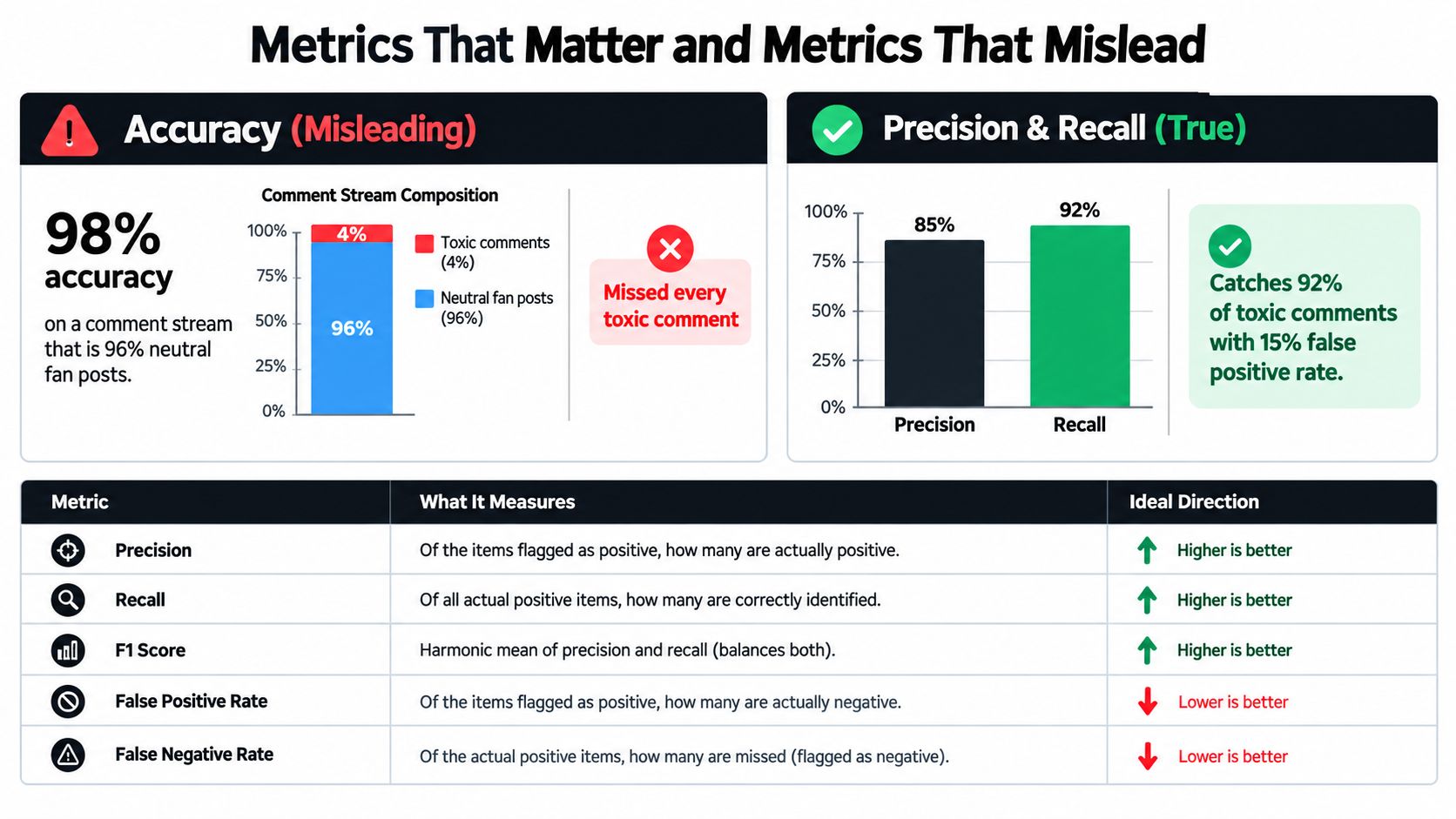
An infographic explaining why accuracy is misleading in AI content moderation compared to precision and recall metrics.

Read moderation through error cost

What matters is the split between false positives and false negatives.

A false positive hides a safe comment. Maybe that costs you a valid shopper question. A false negative leaves a harmful comment visible. That can poison the thread in public. Those aren't equal business mistakes.

AWS's moderation guidance gets this right. It recommends evaluating systems with separate false-positive rate and false-negative rate rather than accuracy alone, and defines them as FPR = FP/(TN+FP) and FNR = FN/(FN+TP) in its guide to moderation evaluation metrics.

The dashboard to ask for

A paid social team should care about operational outputs, not vanity scores.

  • Median response time: How long buyer questions sit unanswered

  • Hide rate by reason: Spam, abuse, competitor mention, scam, off-topic

  • Recovered conversion rate: Which comment replies led to a tracked purchase or lead event

  • Negative-comment visibility half-life: How long harmful comments remain visible after posting

A separate but related point matters for teams that connect comment handling to revenue. If you can't tie replies back to conversion paths, you won't know whether moderation is preserving spend or just cleaning up optics. That's where a cleaner view of conversion attribution becomes operational, not academic.

A moderation dashboard should tell you what stayed visible, what got hidden, what got answered, and what revenue moved after that. Anything less is partial reporting.

Two Days in the Life of a Comment Section

The easiest way to understand AI content moderation is to watch what happens when two brands handle the same problem differently.

Day one with active moderation

A skincare brand launches a TikTok Spark Ad and starts seeing strong top-of-funnel engagement. The first wave of comments is normal. Product questions. Shipping questions. A few skeptical takes.

A risky comment appears claiming the product caused a reaction. The moderation system flags it as a product-safety claim and routes it to a human. The reviewer checks the policy, sees that safety allegations always escalate, then posts a measured public reply that acknowledges the concern and points shoppers toward clearer usage guidance and supporting proof already approved by the brand.

The thread doesn't disappear. It gets managed.

Other comments asking how to use the product and whether it works for sensitive skin get fast, plain answers. The ad keeps doing its job because the public conversation under it doesn't turn into a free-for-all.

Day two without active moderation

A supplement brand leaves a Meta ad alone because the creative is converting and the team is busy.

A negative thread starts. Nobody replies. Then a second one appears. Then a handful of copycat comments pile in below it. A buyer asks a genuine question but gets ignored while the negative comments stay visible longer and keep getting read.

By the next day, the comment section tells a different story than the ad does. The creative says confidence. The comments say risk. The team finally steps in, but now they're cleaning up a narrative that already had time to settle.

What the buyer experiences

The difference isn't only moderation quality. It's time.

One buyer sees an ad with live objections answered in public. Another sees an ad where suspicion sits unanswered and becomes social proof by default. That's why this work belongs with performance marketing. The comment section changes how the next buyer interprets the click.

Buyers don't separate media buying, moderation, and sales ops. They see one thing. The ad and the comments together.

A Week-One Playbook for Advertisers

Start simple. Ship the first version. Tighten it after live traffic gives you real edge cases.
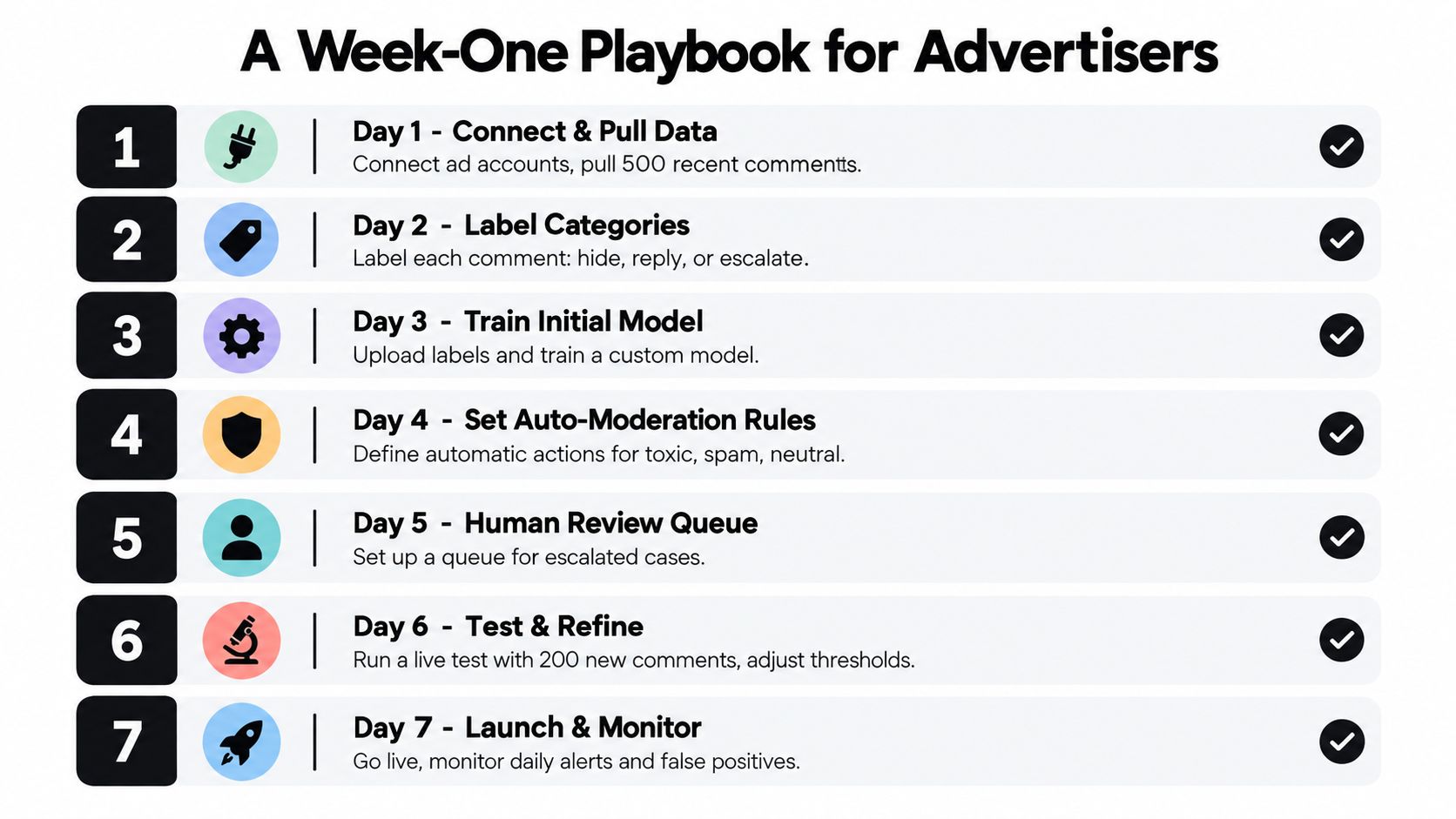
A seven-day action plan for advertisers to implement AI-powered social media comment moderation and management workflows.

The first seven days

  • Day 1: Connect ad accounts and pull a recent sample of comments. Label each one as hide, reply, or escalate.

  • Days 2 to 3: Turn on basic filters for spam, scams, profanity, and obvious redirects. Add classification and require review on flagged comments.

  • Days 4 to 5: Write reply templates for the questions you see most often. Price. shipping. sizing. returns. product fit. Assign human coverage for escalations.

  • Days 6 to 7: Go live, monitor every queue, and tighten the policy where reviewers hesitate or disagree.

A practical framework for structuring these workflows is in this guide to social media moderation.

What to track in week one

Don't drown yourself in reports. Track the handful of signals that prove whether your setup is helping:

  • Response time on buyer questions

  • Hide rate by reason, so you don't over-moderate

  • Recovered revenue attributed to comment-driven replies

  • Negative visibility after moderation, so bad comments don't sit in public too long

Exerta has been adopted by 250+ brands, with 15% average sales lift, $2M+ recovered, and 99.9% uptime. Those numbers matter because they frame the category correctly. This isn't about making your page look cleaner. It's about protecting paid traffic and converting conversations that would've been lost.

Exerta gives brands AI employees that moderate comments, reply to buyers, and recover revenue across Facebook, Instagram, TikTok, and website chat today. If your paid social team is tired of watching good ads slow down under unmanaged comment sections, visit Exerta and see how the workflow is built.

Get started today

Stop losing sales you already paid for.

Connect your channels in about a minute. Your AI employees start answering, moderating and closing the same day.

No credit card required

Live in under 5 minutes

250+ brands running

Cancel anytime

Get started today

Stop losing sales you already paid for.

Connect your channels in about a minute. Your AI employees start answering, moderating and closing the same day.

No credit card required

Live in under 5 minutes

250+ brands running

Cancel anytime

Get started today

Stop losing sales you already paid for.

Connect your channels in about a minute. Your AI employees start answering, moderating and closing the same day.

No credit card required

Live in under 5 minutes

250+ brands running

Cancel anytime

AI employees that answer every buyer, protect your ad spend and close sales around the clock.

All systems operational · 99.98% uptime last 90 days

SOC 2

Type II

GDPR

Compliant

99.9% SLA

Uptime

24/7

Support

1. Pricing and billing All prices displayed on exerta.ai are in US dollars and exclude applicable taxes unless stated otherwise. Prices are subject to change. Existing subscribers will receive at least 30 days’ written notice before any price increase takes effect on their account. Annual plan savings are calculated by comparing the annual billing rate to the equivalent monthly billing rate multiplied by 12.

2. Run and usage statisticsRevenue, engagement and success figures are based on aggregated platform data and customer-reported results across 250+ brands, and are updated periodically.

3. Time-to-value claims Statements such as “live in about a minute” reflect typical setup times observed for new accounts connecting through Meta Business Manager. Actual setup time may vary with the number of channels connected and the level of agent customization.

4. AI step suggestions Exerta’s AI features are powered by a blend of leading AI models, anchored by our own fine-tuned engagement model. Suggestion quality, accuracy and availability may vary. Exerta does not guarantee that AI-generated output will be accurate, complete or suitable for any particular use case. Review AI output before acting on it.

5. Integration availability The number of native integrations referenced on this website reflects integrations available at the time of last update. Integration availability may vary by subscription plan. Third-party integrations are subject to the terms, availability and API limitations of the respective third-party providers. Exerta does not guarantee the continued availability of any specific integration and is not responsible for disruptions caused by changes to third-party APIs or services.

6. Uptime and SLA The 99.9% uptime figure refers to our published Service Level Agreement (SLA) target for paid plan customers. Actual uptime may vary. Historical uptime statistics are available upon request.

7. Security and compliance certifications Exerta’s SOC 2 Type II (coming soon) certification covers the security, availability, processing integrity, confidentiality and privacy trust service criteria. GDPR compliance reflects our internal data protection practices and contractual commitments. HIPAA compliance is available exclusively on Enterprise plans and requires execution of a Business Associate Agreement (BAA). ISO 27001 certification is currently in progress. Compliance certifications are subject to annual renewal and audit. Copies of our most recent compliance reports are available to Enterprise customers under NDA upon request.

8. Customer testimonials and case studies Testimonials, quotes and case study results featured on this website reflect the experiences of individual customers. Results vary with ad spend, engagement volume, offer and configuration. Exerta does not guarantee that any customer will achieve similar results.

9. Third-party service marks and logos All third-party brand names, logos and service marks referenced on this website — including but not limited to Meta, Facebook, Instagram, TikTok, Shopify and Trustpilot — are the property of their respective owners. References to these services do not imply endorsement, sponsorship or affiliation.

10. Free plan limitations The Free plan does not require a credit card. Free plan usage is subject to the limits described on our pricing page, including a limited number of AI actions per month and comment hiding with stock replies only. Exerta reserves the right to modify the features and limits of the Free plan at any time.

11. Trial periods Free trial periods are available on paid plans as described at the time of signup. At the end of the trial period, the selected payment method will be charged at the applicable plan rate unless the subscription is cancelled before the trial expires. Trial periods are available once per customer and may not be combined with other promotional offers.

12. Data processing and privacy Exerta processes personal data in accordance with our Privacy Policy and Data Processing Agreement. Data residency options (US and EU) are available on all paid plans. The data residency region is selected at account creation and cannot be changed without contacting our support team. Customers responsible for processing personal data of EEA or UK residents are advised to execute our standard Data Processing Agreement, available at exerta.ai/legal/dpa.

13. Activity history retention Activity history is retained for 90 days on the Starter plan and for longer periods on larger plans, as described at signup. Exported data is the responsibility of the customer once downloaded.

14. AI model providers Exerta uses a blend of leading AI models together with our own fine-tuned engagement model, specialized for customer engagement. Model composition may change as we improve the product.

15. Mobile and desktop applications Exerta is available in the browser on desktop and mobile. Certain advanced configuration features are easiest on desktop. Application updates are released on a rolling basis.

16. Template library Prebuilt agent setups provided by Exerta are starting points and are not guaranteed to be suitable for any particular purpose. Customers are responsible for reviewing and testing agent behavior before enabling it on live channels.

17. Website content accuracy The information on this website is provided for general informational purposes only and is subject to change without notice. While we make every effort to keep the content accurate and up to date, Exerta makes no warranties or representations, express or implied, about the completeness, accuracy, reliability or suitability of the information contained on this website for any particular purpose.

18. Promotional offers and discounts Promotional pricing, discounts and special offers are subject to additional terms and conditions communicated at the time of the offer. Offers cannot be applied retroactively to existing subscriptions and may not be combined with other promotions unless explicitly stated. Exerta reserves the right to modify or discontinue promotional offers at any time.

19. Startup and non-profit programs Eligibility for our startup and non-profit discount programs is assessed at Exerta’s sole discretion based on the criteria described in our support documentation. Approved discounts apply to the base subscription price only and do not apply to add-ons, Enterprise features or professional services. Discount eligibility is subject to annual review.

20. Intellectual property This website is operated by Reascend LLC (d/b/a Exerta), a limited liability company formed in the State of Delaware, United States. References to “we”, “us” and “our” throughout this website refer to Reascend LLC (d/b/a Exerta). The use of this website and our Services is governed by the laws of the State of Delaware, United States, as described in our Terms of Service.

21. Accessibility Exerta is committed to making its website and application accessible to all users, including those with disabilities. We aim to conform to the Web Content Accessibility Guidelines (WCAG) 2.1 at Level AA. If you experience any accessibility barriers, please contact us at accessibility@exerta.ai and we will make every effort to provide an accessible alternative.

22. Governing jurisdiction This website is operated by Reascend LLC (d/b/a Exerta), a limited liability company formed in the State of Delaware, United States. References to “we”, “us” and “our” throughout this website refer to Reascend LLC (d/b/a Exerta). The use of this website and our Services is governed by the laws of the State of Delaware, United States, as described in our Terms of Service.

AI employees that answer every buyer, protect your ad spend and close sales around the clock.

All systems operational · 99.98% uptime last 90 days

SOC 2

Type II

GDPR

Compliant

99.9% SLA

Uptime

24/7

Support

1. Pricing and billing All prices displayed on exerta.ai are in US dollars and exclude applicable taxes unless stated otherwise. Prices are subject to change. Existing subscribers will receive at least 30 days’ written notice before any price increase takes effect on their account. Annual plan savings are calculated by comparing the annual billing rate to the equivalent monthly billing rate multiplied by 12.

2. Run and usage statisticsRevenue, engagement and success figures are based on aggregated platform data and customer-reported results across 250+ brands, and are updated periodically.

3. Time-to-value claims Statements such as “live in about a minute” reflect typical setup times observed for new accounts connecting through Meta Business Manager. Actual setup time may vary with the number of channels connected and the level of agent customization.

4. AI step suggestions Exerta’s AI features are powered by a blend of leading AI models, anchored by our own fine-tuned engagement model. Suggestion quality, accuracy and availability may vary. Exerta does not guarantee that AI-generated output will be accurate, complete or suitable for any particular use case. Review AI output before acting on it.

5. Integration availability The number of native integrations referenced on this website reflects integrations available at the time of last update. Integration availability may vary by subscription plan. Third-party integrations are subject to the terms, availability and API limitations of the respective third-party providers. Exerta does not guarantee the continued availability of any specific integration and is not responsible for disruptions caused by changes to third-party APIs or services.

6. Uptime and SLA The 99.9% uptime figure refers to our published Service Level Agreement (SLA) target for paid plan customers. Actual uptime may vary. Historical uptime statistics are available upon request.

7. Security and compliance certifications Exerta’s SOC 2 Type II (coming soon) certification covers the security, availability, processing integrity, confidentiality and privacy trust service criteria. GDPR compliance reflects our internal data protection practices and contractual commitments. HIPAA compliance is available exclusively on Enterprise plans and requires execution of a Business Associate Agreement (BAA). ISO 27001 certification is currently in progress. Compliance certifications are subject to annual renewal and audit. Copies of our most recent compliance reports are available to Enterprise customers under NDA upon request.

8. Customer testimonials and case studies Testimonials, quotes and case study results featured on this website reflect the experiences of individual customers. Results vary with ad spend, engagement volume, offer and configuration. Exerta does not guarantee that any customer will achieve similar results.

9. Third-party service marks and logos All third-party brand names, logos and service marks referenced on this website — including but not limited to Meta, Facebook, Instagram, TikTok, Shopify and Trustpilot — are the property of their respective owners. References to these services do not imply endorsement, sponsorship or affiliation.

10. Free plan limitations The Free plan does not require a credit card. Free plan usage is subject to the limits described on our pricing page, including a limited number of AI actions per month and comment hiding with stock replies only. Exerta reserves the right to modify the features and limits of the Free plan at any time.

11. Trial periods Free trial periods are available on paid plans as described at the time of signup. At the end of the trial period, the selected payment method will be charged at the applicable plan rate unless the subscription is cancelled before the trial expires. Trial periods are available once per customer and may not be combined with other promotional offers.

12. Data processing and privacy Exerta processes personal data in accordance with our Privacy Policy and Data Processing Agreement. Data residency options (US and EU) are available on all paid plans. The data residency region is selected at account creation and cannot be changed without contacting our support team. Customers responsible for processing personal data of EEA or UK residents are advised to execute our standard Data Processing Agreement, available at exerta.ai/legal/dpa.

13. Activity history retention Activity history is retained for 90 days on the Starter plan and for longer periods on larger plans, as described at signup. Exported data is the responsibility of the customer once downloaded.

14. AI model providers Exerta uses a blend of leading AI models together with our own fine-tuned engagement model, specialized for customer engagement. Model composition may change as we improve the product.

15. Mobile and desktop applications Exerta is available in the browser on desktop and mobile. Certain advanced configuration features are easiest on desktop. Application updates are released on a rolling basis.

16. Template library Prebuilt agent setups provided by Exerta are starting points and are not guaranteed to be suitable for any particular purpose. Customers are responsible for reviewing and testing agent behavior before enabling it on live channels.

17. Website content accuracy The information on this website is provided for general informational purposes only and is subject to change without notice. While we make every effort to keep the content accurate and up to date, Exerta makes no warranties or representations, express or implied, about the completeness, accuracy, reliability or suitability of the information contained on this website for any particular purpose.

18. Promotional offers and discounts Promotional pricing, discounts and special offers are subject to additional terms and conditions communicated at the time of the offer. Offers cannot be applied retroactively to existing subscriptions and may not be combined with other promotions unless explicitly stated. Exerta reserves the right to modify or discontinue promotional offers at any time.

19. Startup and non-profit programs Eligibility for our startup and non-profit discount programs is assessed at Exerta’s sole discretion based on the criteria described in our support documentation. Approved discounts apply to the base subscription price only and do not apply to add-ons, Enterprise features or professional services. Discount eligibility is subject to annual review.

20. Intellectual property This website is operated by Reascend LLC (d/b/a Exerta), a limited liability company formed in the State of Delaware, United States. References to “we”, “us” and “our” throughout this website refer to Reascend LLC (d/b/a Exerta). The use of this website and our Services is governed by the laws of the State of Delaware, United States, as described in our Terms of Service.

21. Accessibility Exerta is committed to making its website and application accessible to all users, including those with disabilities. We aim to conform to the Web Content Accessibility Guidelines (WCAG) 2.1 at Level AA. If you experience any accessibility barriers, please contact us at accessibility@exerta.ai and we will make every effort to provide an accessible alternative.

22. Governing jurisdiction This website is operated by Reascend LLC (d/b/a Exerta), a limited liability company formed in the State of Delaware, United States. References to “we”, “us” and “our” throughout this website refer to Reascend LLC (d/b/a Exerta). The use of this website and our Services is governed by the laws of the State of Delaware, United States, as described in our Terms of Service.

AI employees that answer every buyer, protect your ad spend and close sales around the clock.

All systems operational · 99.98% uptime last 90 days

SOC 2

Type II

GDPR

Compliant

99.9% SLA

Uptime

24/7

Support

1. Pricing and billing All prices displayed on exerta.ai are in US dollars and exclude applicable taxes unless stated otherwise. Prices are subject to change. Existing subscribers will receive at least 30 days’ written notice before any price increase takes effect on their account. Annual plan savings are calculated by comparing the annual billing rate to the equivalent monthly billing rate multiplied by 12.

2. Run and usage statisticsRevenue, engagement and success figures are based on aggregated platform data and customer-reported results across 250+ brands, and are updated periodically.

3. Time-to-value claims Statements such as “live in about a minute” reflect typical setup times observed for new accounts connecting through Meta Business Manager. Actual setup time may vary with the number of channels connected and the level of agent customization.

4. AI step suggestions Exerta’s AI features are powered by a blend of leading AI models, anchored by our own fine-tuned engagement model. Suggestion quality, accuracy and availability may vary. Exerta does not guarantee that AI-generated output will be accurate, complete or suitable for any particular use case. Review AI output before acting on it.

5. Integration availability The number of native integrations referenced on this website reflects integrations available at the time of last update. Integration availability may vary by subscription plan. Third-party integrations are subject to the terms, availability and API limitations of the respective third-party providers. Exerta does not guarantee the continued availability of any specific integration and is not responsible for disruptions caused by changes to third-party APIs or services.

6. Uptime and SLA The 99.9% uptime figure refers to our published Service Level Agreement (SLA) target for paid plan customers. Actual uptime may vary. Historical uptime statistics are available upon request.

7. Security and compliance certifications Exerta’s SOC 2 Type II (coming soon) certification covers the security, availability, processing integrity, confidentiality and privacy trust service criteria. GDPR compliance reflects our internal data protection practices and contractual commitments. HIPAA compliance is available exclusively on Enterprise plans and requires execution of a Business Associate Agreement (BAA). ISO 27001 certification is currently in progress. Compliance certifications are subject to annual renewal and audit. Copies of our most recent compliance reports are available to Enterprise customers under NDA upon request.

8. Customer testimonials and case studies Testimonials, quotes and case study results featured on this website reflect the experiences of individual customers. Results vary with ad spend, engagement volume, offer and configuration. Exerta does not guarantee that any customer will achieve similar results.

9. Third-party service marks and logos All third-party brand names, logos and service marks referenced on this website — including but not limited to Meta, Facebook, Instagram, TikTok, Shopify and Trustpilot — are the property of their respective owners. References to these services do not imply endorsement, sponsorship or affiliation.

10. Free plan limitations The Free plan does not require a credit card. Free plan usage is subject to the limits described on our pricing page, including a limited number of AI actions per month and comment hiding with stock replies only. Exerta reserves the right to modify the features and limits of the Free plan at any time.

11. Trial periods Free trial periods are available on paid plans as described at the time of signup. At the end of the trial period, the selected payment method will be charged at the applicable plan rate unless the subscription is cancelled before the trial expires. Trial periods are available once per customer and may not be combined with other promotional offers.

12. Data processing and privacy Exerta processes personal data in accordance with our Privacy Policy and Data Processing Agreement. Data residency options (US and EU) are available on all paid plans. The data residency region is selected at account creation and cannot be changed without contacting our support team. Customers responsible for processing personal data of EEA or UK residents are advised to execute our standard Data Processing Agreement, available at exerta.ai/legal/dpa.

13. Activity history retention Activity history is retained for 90 days on the Starter plan and for longer periods on larger plans, as described at signup. Exported data is the responsibility of the customer once downloaded.

14. AI model providers Exerta uses a blend of leading AI models together with our own fine-tuned engagement model, specialized for customer engagement. Model composition may change as we improve the product.

15. Mobile and desktop applications Exerta is available in the browser on desktop and mobile. Certain advanced configuration features are easiest on desktop. Application updates are released on a rolling basis.

16. Template library Prebuilt agent setups provided by Exerta are starting points and are not guaranteed to be suitable for any particular purpose. Customers are responsible for reviewing and testing agent behavior before enabling it on live channels.

17. Website content accuracy The information on this website is provided for general informational purposes only and is subject to change without notice. While we make every effort to keep the content accurate and up to date, Exerta makes no warranties or representations, express or implied, about the completeness, accuracy, reliability or suitability of the information contained on this website for any particular purpose.

18. Promotional offers and discounts Promotional pricing, discounts and special offers are subject to additional terms and conditions communicated at the time of the offer. Offers cannot be applied retroactively to existing subscriptions and may not be combined with other promotions unless explicitly stated. Exerta reserves the right to modify or discontinue promotional offers at any time.

19. Startup and non-profit programs Eligibility for our startup and non-profit discount programs is assessed at Exerta’s sole discretion based on the criteria described in our support documentation. Approved discounts apply to the base subscription price only and do not apply to add-ons, Enterprise features or professional services. Discount eligibility is subject to annual review.

20. Intellectual property All content on this website, including text, graphics, logos, icons, images, audio clips, digital downloads and software, is the property of Reascend LLC (d/b/a Exerta) or its content suppliers and is protected by applicable intellectual property laws. Exerta® is a registered trademark of Reascend LLC. Unauthorised reproduction, distribution or modification of any content from this website is prohibited without prior written consent.

21. Accessibility Exerta is committed to making its website and application accessible to all users, including those with disabilities. We aim to conform to the Web Content Accessibility Guidelines (WCAG) 2.1 at Level AA. If you experience any accessibility barriers, please contact us at accessibility@exerta.ai and we will make every effort to provide an accessible alternative.

22. Governing jurisdiction This website is operated by Reascend LLC (d/b/a Exerta), a limited liability company formed in the State of Delaware, United States. References to “we”, “us” and “our” throughout this website refer to Reascend LLC (d/b/a Exerta). The use of this website and our Services is governed by the laws of the State of Delaware, United States, as described in our Terms of Service.