Short Form Video Strategy for Paid Social Conversions
13 min read
read
·

You know the move. You shoot five decent UGC clips in one afternoon, two of them catch fire, and the dashboard still looks wrong. Views are there. ROAS is stuck. Then the comments start filling up with price questions, skepticism, and people asking for a size or shade check, and nobody is answering fast enough. That's where short form video stops being a creative problem and becomes a revenue problem.
Short form video is not just a post format. For paid social, it's a distribution surface with a comment thread attached. You buy attention with media spend, then you win or lose the sale in the replies, DMs, and profile visits that follow.
Table of Contents
What Short Form Video Means for Paid Social
A paid clip can win cheap reach and still lose the auction's real objective. The useful question is what happens after the first wave of comments. If viewers ask about price, fit, shipping, or proof, those questions create fresh signals and buying opportunities. A reply that arrives while intent is high can keep the conversation active. A silent thread leaves the ad doing less work for the same spend.
Set up the campaign around that behavior. Track comment volume, question type, reply time, profile taps, DMs, and assisted purchases beside clicks and purchases. Tag recurring objections. Turn strong answers into new creative angles, pinned replies, and automated chat prompts. Your paid social team should know which comments deserve a public answer and which ones require a private conversation.
Short-form creative also gives the auction more usable variations. Fast cuts, clear product context, and a direct offer help the system find viewers who respond to the message. The comment layer then reveals whether attention has commercial intent. This makes the format useful for testing both the ad and the objection handling around it.
The market is large and still expanding. Industry analysis reports that short-form video takes 58% of social media time, while videos under one minute can reach about a 52% engagement rate. Short-form formats generate roughly 2.5× more engagement than long-form social content. The same analysis reports more than 200 billion daily views globally for short-form video on a major video platform by early 2026, compared with 70 billion in March 2024. Its 2026 projection values the global market at about $59.09 billion, with a projected $640.9 billion by 2035 and a 30.33% CAGR source.
Practical rule: build the reply path before you scale the media budget.
Use a hybrid operating model. Creative earns the first interaction. Community management answers uncertainty. Commerce automation routes qualified questions into DMs or chat. Brands building a wider DTC system can use this social media playbook for DTC brands to connect those pieces. The winning setup treats comments as measurable recovery inventory, not leftover engagement.
TikTok, Reels, and Shorts Compared for Advertisers
Buying short form video across platforms requires separate operating rules. Each surface attracts a different audience, supports different ad units, and gives advertisers different control over the comment layer. Those differences affect both conversion and revenue recovery after the initial view.
Platform | Max Ad Length | Audience Skew | Ad Unit | Comment Moderation | Best Use |
|---|---|---|---|---|---|
TikTok | Longer uploads exist, but paid response is usually strongest in shorter cuts | Skews younger | Spark-style social ad units and boosted posts | Keyword filters, hiding comments, turning comments off, dashboard review | Cold discovery and impulse action |
Reels | Short, mobile-native cuts work best | Leans older than TikTok, with strong buying power in many DTC categories | Boosted posts and feed placements | Hidden comments and private reply mechanics | Retargeting and warm audiences |
Shorts | Short, direct clips with a simple offer | Broadest reach, with a male tilt in many accounts | Shorts placements and masthead-style reach | Platform moderation status and channel-level control | Incremental reach and search-adjacent intent |
Choose TikTok for fast cold-market testing and impulse discovery. Its public comment activity can expose objections while the ad is still spending. Set keyword filters, review comments in the dashboard, and route buying questions into a reply or chat flow.
Use Reels for warmer traffic and retargeting. The audience often arrives with more brand context, so the comment section can focus on proof, delivery, price, and product fit. Build a response process that moves qualified users into DMs before the platform's response window closes. Keep the detailed messaging-rule reference in the section that explains that window.
Shorts suits incremental reach and YouTube-style intent. Keep the offer direct and the path to action obvious. Channel-level moderation and platform status require a different review routine, so assign someone to monitor replies rather than copying the TikTok workflow.
The moderation layer belongs in the media plan. TikTok supports filtering, hiding unsuitable comments, turning comments off, and dashboard analysis TikTok ad comment controls. Those settings protect the ad, but they also determine how many commercial questions remain visible for follow-up.
Creative still needs to match the placement. Before launching another batch, review this guide on making converting TikTok ads. For Shorts, this walkthrough on increasing Shorts views covers distribution considerations.
Set budgets by job. Start TikTok for discovery and rapid testing. Put Reels behind retargeting and warmer traffic. Add Shorts when incremental reach supports an active-intent offer. Track comments, DMs, and chat outcomes with the same discipline as clicks and purchases.
Creative Best Practices That Win the First Three Seconds
The hook decides the auction. Not the beauty shot. Not the logo. Not the polished ending. The first three seconds decide whether someone keeps watching, and research summarized in B2B video guidance says the first 5 seconds determine 80% of viewer retention video attention findings. In practice, that means your opening has to do one job fast. State the problem, show the product in use, or call out the exact audience.
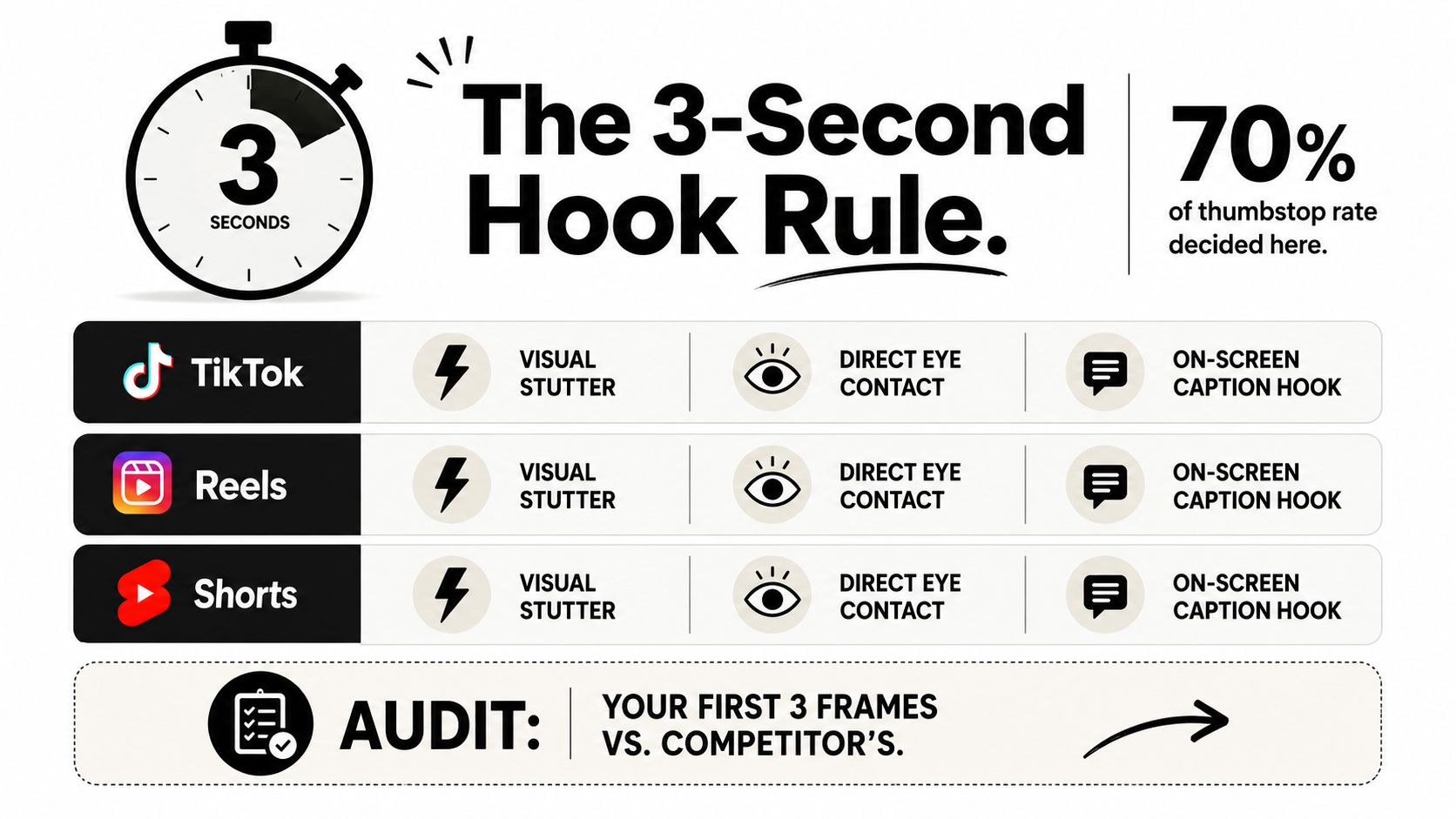
There are four hook patterns that keep showing up in paid accounts:
Pattern interrupt: a hard cut, a loud visual change, or on-screen text that looks nothing like the scroll feed.
Native UI mockup: show the app, cart, or comment thread immediately, so the viewer knows this is a buying conversation.
Before and after flash: open on the outcome, then backfill the process.
Direct callout: speak to a specific buyer, like “if you have oily skin” or “if your ad CPA jumped last week.”
Keep the structure tight. For cold prospecting, aim for 15 to 25 seconds. For retargeting, 30 to 45 seconds gives you room to answer objections without dragging. On-screen text should stay short. Use 8 words max per frame, keep captions inside a 2 inch safe zone, and don't put your logo in the first frame. The viewer should understand the offer before they remember the brand mark.
The caption matters too. Write a keyword-rich first line, keep one CTA, and don't stuff in external links that pull attention away from the feed. The algorithm needs a clear topic signal, not a paragraph that reads like a landing page.
For voice and tone, stay consistent with the way your brand speaks in replies. If you need that locked down, use this brand voice reference before your next edit pass. And if you're turning creator clips into ad cuts, make sure the final export keeps the opening visual honest. That's where attention is won or lost.
Why the Comment Section Is Now Part of Your Ad
A viewer watches your video, opens the comments, and sees “is this legit?” with no answer. That unanswered question becomes part of the ad. The thread is a second creative asset, and buyers often check it before they commit. Treating comments as aftercare leaves conversion work unfinished.
Short form video ads usually attract three types of commercial discussion. Price objections collect under the post. Competitor replies try to pull attention away. Confused viewers ask for a one-line clarification because the video earned attention without resolving the buying question. Each pattern affects performance. Hesitation slows clicks, weakens engagement quality, and can raise effective CPA.
Practical rule: if the top comments do not reinforce the offer, they work against it.
Your team should review the opening comments as part of the ad, not as a separate community task. Pin a clear answer to the biggest objection, correct inaccurate claims, and remove spam that makes the offer look unreliable. Keep legitimate criticism visible, then answer it with specific facts. The thread should make the next action easier.
TikTok describes technology-based moderation and says a global team reviews content flagged by technology, reported by users, or reaching a viewership threshold, operating 24/7 TikTok moderation policy. Engagement is monitored continuously. Reply quality and comment activity therefore shape the environment around the ad, alongside the creative itself.
Read the thread as a second funnel. The first three to five comments can provide social proof, address objections, and repair trust. Empty or hostile comments create friction. Clear answers shorten the path from interest to the offer link.
Comment patterns also reveal what the next creative should fix. Use this comment-research note to turn repeated questions and objections into new hooks, FAQ replies, and follow-up messages. A public reply is conversion work, not customer service theater.
Turning Video Engagement Into Sales the Same Day
Speed wins here. You do not get days to clean this up. During business hours, every high-intent comment and DM should land in a shared inbox with keyword triggers, and the first response should go out within 15 minutes. If the user is warm, the reply needs to feel human and direct. If the user is confused, the reply should remove friction and point to the next step.
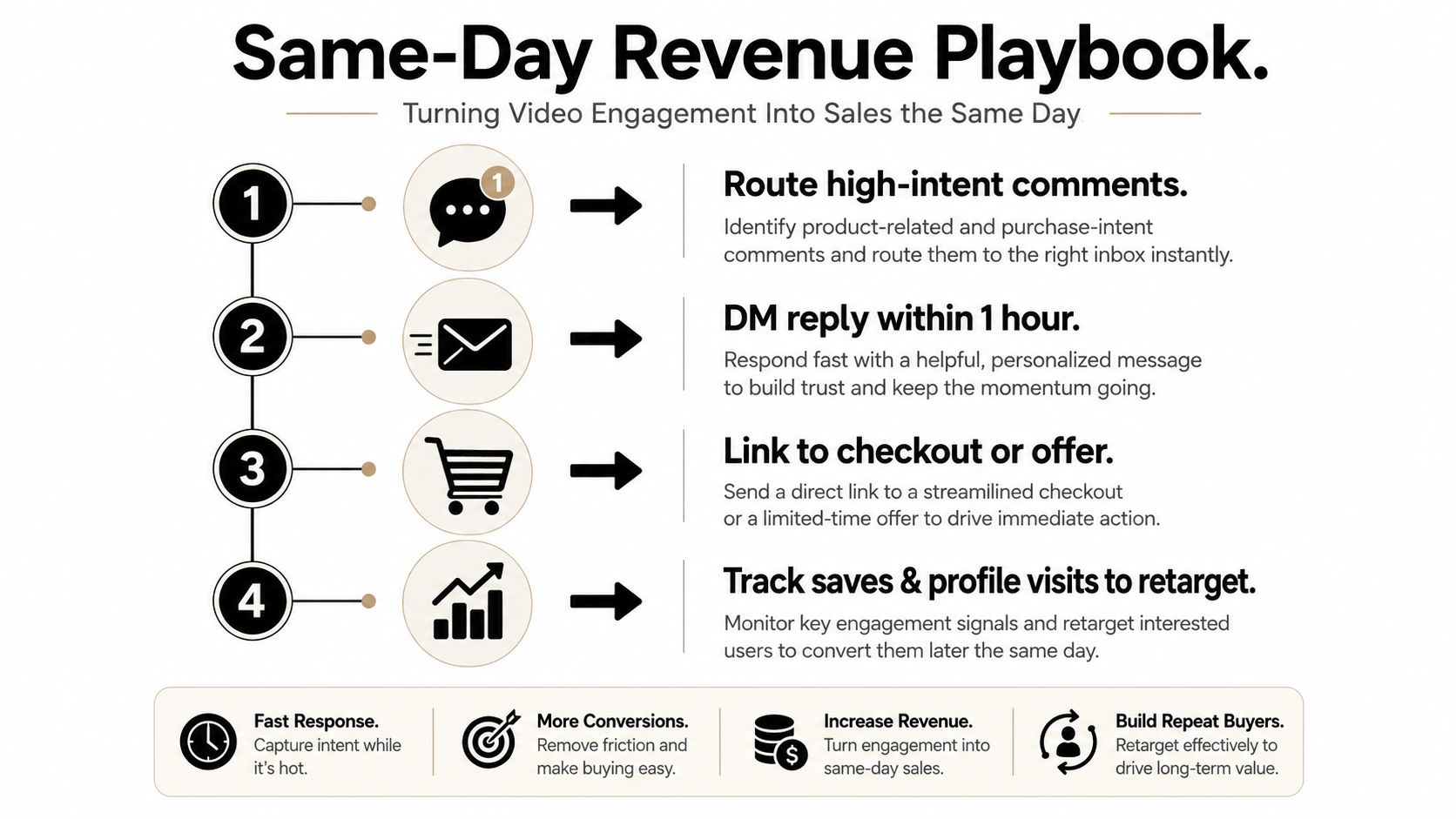
Use a simple same-day stack:
Route the intent. High-intent comments and DMs go into one inbox. If someone asks about price, shipping, fit, or compatibility, that's a sales signal, not a casual remark.
Pin the FAQ reply. Put one public answer under each ad that handles the top objection. Rotate it weekly so it matches the comments showing up.
Send one tap to checkout. Warm leads should get a direct link, not a catalog dump or a long explanation.
Moderate with intent. Hide spam and off-brand noise fast. Keep negative reviews visible when they're real, then answer them publicly with facts.
Meta's private reply mechanics give you a 24-hour window around user messages, so you need to work inside that clock Instagram DM rules. That window matters because a warm lead cools fast. If the reply misses the same day, you're usually spending more later to recover the sale.
Ownership should be split cleanly. The media buyer watches comments, flags ad-level patterns, and updates the hook. CX handles reply quality and escalation. If you're automating the recovery side, this real-time engagement guide is the right internal reference point. For teams repurposing creator assets into ad flows, this note on repurposing influencer video content is a solid operational shortcut.
Exerta is one option in this category of AI employees. It handles comments, DMs, and website chat on Facebook, Instagram, TikTok, and web, with SMS, email, and voice coming next. The point is not to add more conversation. The point is to catch the one that was already about to convert.
Measuring Short Form Video as a Conversion Channel
View count is not the score. Revenue is. If you can't tie a video to a recovered order, you're still buying attention without a close. The cleanest measurement stack keeps the list short and focused on action.
Metric | What it Measures | Target Benchmark |
|---|---|---|
Hook hold rate at 3 seconds | Whether the opening stops the scroll | Strong enough to justify the next edit |
Comment to DM rate | How often public intent becomes private conversation | Rising after objection handling improves |
DM to checkout rate | How well the reply path closes the sale | Consistent enough to scale spend |
Cost per recovered DM | The spend needed to turn a conversation into a real lead | Lower than your current paid recovery cost |
Incremental ROAS versus holdout | Whether the video actually adds revenue | Positive against the control group |
You need attribution that follows the sale off platform. UTM-tagged DM links, unique discount codes per ad, and platform-level conversion events let you tie a TikTok or Reels ad to a closed order even when the checkout happens elsewhere. That matters because branded search lift can look good while revenue stays flat. Ignore the vanity version. Follow the order.
Rule: if the creative can't be traced to a checkout path, it doesn't deserve more budget.
One more thing. If you're not logging comment threads, DM transcripts, and the order outcome in the same place, you're missing the reason a sale happened. Exerta's attribution layer is built around that problem, but the measurement logic itself is what matters. The workflow is simple. Capture the click, capture the message, capture the order.
For a deeper framework on linking conversations to closed revenue, this conversion attribution guide is the right next read. Keep the measurement tight. If the path from impression to order is fuzzy, scale is just guesswork with better branding.
A 7 Day Operating Loop for Short Form Video Ads
The weekly loop is where many teams either compound or stall. You do not need a bigger team to run it. You need a strict rhythm that connects creative, comments, DM handling, and reporting.

Monday through Sunday
Day 1, pull last week's top comments. Turn objections into new hook angles and launch three fresh variants.
Day 2, watch comment velocity. Hide spam, pin useful replies, and flag anything that signals confusion.
Day 3, reply to purchase intent. Move warm comments into DMs inside the response window.
Day 4, refresh based on sentiment. Use the language buyers wrote, not the language the brand prefers.
Day 5, reconcile the numbers. Match recovered revenue back to the specific video and thread that started it.
Day 6, brief the next creator batch. Give them real buyer language from comments, not a generic script.
Day 7, review CPA and comment-to-DM rate. Reset the loop and cut the weakest angle.
The order matters. If the comments show one repeated objection, that's your next hook. If DMs are high but checkout is soft, the offer or the link path is weak. If the ad gets views but no meaningful comments, the video may be entertaining but not persuasive.
That's the whole operating model. Creative feeds moderation. Moderation feeds conversion. Conversion feeds the next creative brief. The teams that win this channel stop treating short form video like a posting habit and start treating it like a weekly revenue loop.
Use this checklist before you launch the next batch:
Pull the top three organic comments from the last ad.
Rewrite one hook around the strongest objection.
Set a reply SLA for business hours.
Pin one FAQ answer under every active post.
Send warm leads to a single checkout path.
Log every recovered sale against the original video.
Review the thread before you scale spend.
Exerta deploys AI employees that answer comments, DMs, and website chat, moderate noise, and recover sales across Facebook, Instagram, TikTok, and web. If your short form video is getting attention but not enough orders, visit Exerta and see how the comment section can become part of the close.