Social Media Chatbot: What It Does and When to Use One

read

·

An article by

You launch a Meta campaign in the morning. By lunch, the ad has traction, but the comments are working against you. Buyers ask whether the product is legitimate, competitors drop discount codes, and fake customer-service accounts post phishing links. Your media buyer is watching creative and ROAS while the conversion leak sits directly below the ad.

That's where a social media chatbot becomes more than a support widget. Used properly, it becomes a paid-media performance layer. It answers buyer questions, routes high-intent conversations into DMs, hides harmful comments, and gives human agents a clear boundary for the interactions they need to own.

Table of Contents

The Comment Section Problem Most Ad Buyers Ignore

A DTC skincare brand can spend $15,000 on Meta ads and reach a 2.3 ROAS in 48 hours, yet still lose sales in the comment section. The ad attracts attention, but the discussion underneath it becomes a second funnel. Buyers scan that discussion before they click, and every unanswered objection can make the offer feel less certain.

The first failure mode is click hijacking. A scammer posts a fake support link or impersonates the brand. A buyer who intended to visit the product page may click the wrong destination instead. The ad paid for that attention, but the brand no longer controls where the customer goes.

The second is objection decay. Someone asks, “Does this work for sensitive skin?” or “Is shipping included?” Nobody replies for hours. By the time a team member sees it, the buyer has moved on. Social customer service has become an expectation, with 73% of consumers expecting a response within 24 hours or sooner when contacting a brand on social channels, according to Sprout Social's 2025 customer-service research.

The third is comment-to-DM drop-off. A prospect writes “price” or “link,” but the brand has no automated path from that public signal to a private conversation. The intent is visible, but nobody captures it.

Practical rule: Treat every comment under a paid ad as a possible conversion event, a moderation event, or both.

A social media chatbot closes that gap at the speed the ad is served. It can identify a trigger, reply publicly, open a DM flow, and flag sensitive language before a human notices the thread. The workflow should support paid media, not operate as a separate customer-service inbox. Exerta's perspective on why unanswered ad comments are costing you sales follows that same operating logic.

What a Social Media Chatbot Does

A social media chatbot reads and replies to comments and direct messages across connected channels. It can follow fixed rules, use an AI employee trained on approved information, or combine both. The useful test is operational: does the system know what to answer, what to suppress, and when a person must take over?

A rule-based bot matches a known phrase such as “PRICE,” “LINK,” or “SIZE,” then sends a prepared reply. This makes the workflow predictable and easy to audit. It also fails when customers express the same request in unfamiliar language.

An AI employee works from a knowledge base, product information, previous support patterns, and brand-voice instructions. It can interpret “How much is the smaller bottle?” as a pricing question without requiring the word “price.” It can also maintain a multi-turn DM conversation instead of sending one isolated response.

A hybrid setup assigns each intent to the appropriate layer. If someone comments “scam?”, a rule-based bot can send an approved safety response. For a nuanced product question, the AI employee can review the post context and product information before replying. That separation reduces risky improvisation while keeping routine conversations fast.
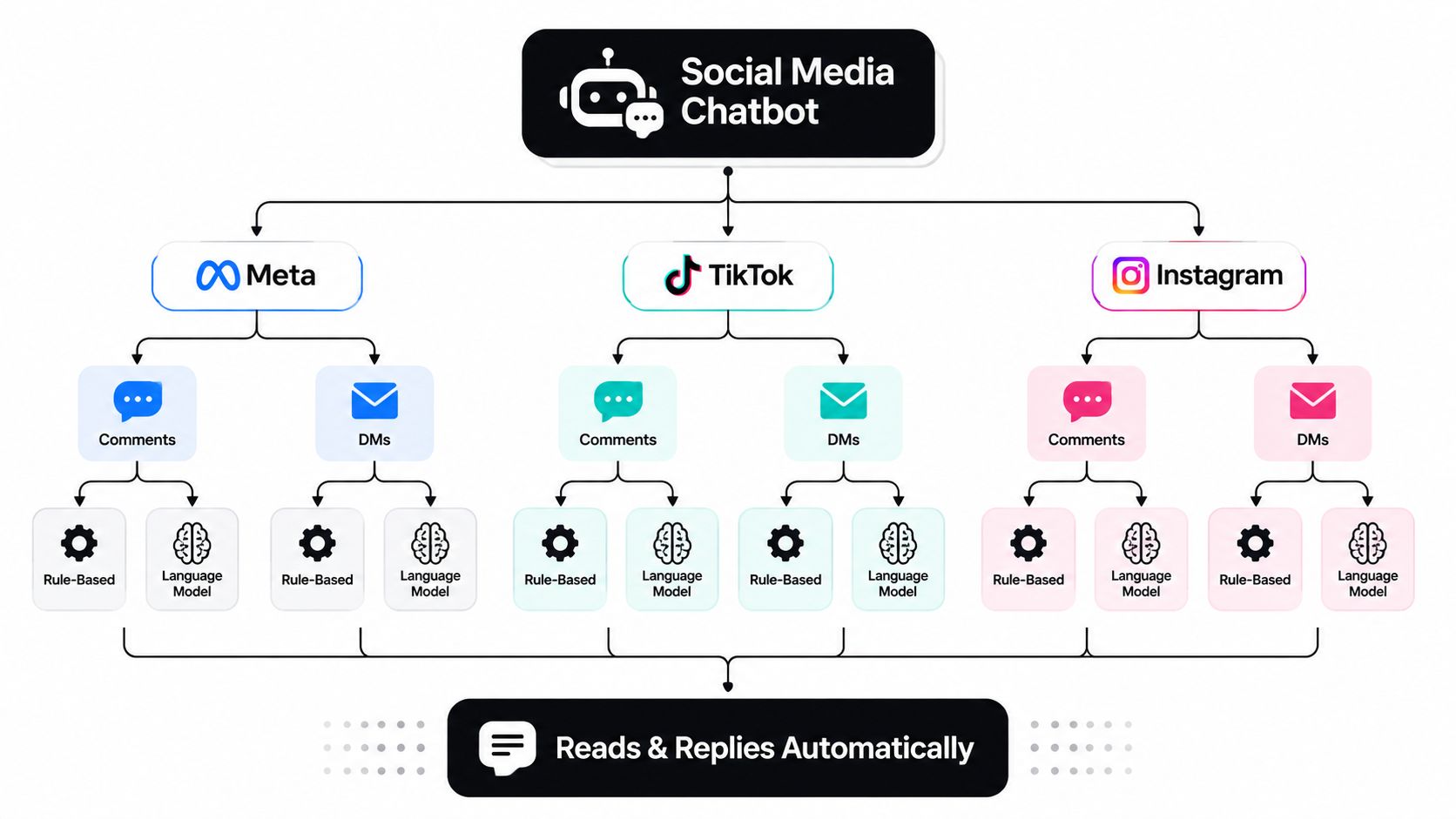
A flowchart diagram showing a social media chatbot platform integrated with Meta, TikTok, and Instagram, managing comments and DMs.

The systems behind the reply

The bot needs more than access to a comment feed. A practical setup connects the ad account, product feed, storefront or checkout destination, order data, and moderation logs. Those connections let it distinguish “Where's my order?” from “Send me the product link,” while preserving a record of what the system said and why.

For agencies, account structure affects risk. Each client needs separate brand rules, approved claims, escalation paths, and access controls. One generic prompt across multiple stores can produce incorrect offers, prohibited claims, or the wrong destination. The agent should know product names, current offers, shipping language, restricted claims, and the exact link for each action.

Teams evaluating Instagram comment automation should review the technical trade-offs before choosing an implementation. A practical starting point is to compare Meta Graph API vs the capabilities and constraints of an automated reply workflow. The goal is reliable action after a buyer or spammer creates a signal, not a needlessly elaborate system.

For a deeper operational view of what an AI employee does all day, examine the full loop: read, classify, respond, log, and escalate. That loop is the performance layer. It connects paid attention to a controlled conversation and defines the boundary where human judgment takes over.

Core Capabilities That Move Ad Revenue

A social media chatbot earns its place in a paid-social stack when it connects a conversation to a measurable ad-spend problem. Four jobs matter most.

Public replies protect the conversion environment

The first job is replying under the ad. A trigger such as “Is this safe?” can prompt an approved answer about ingredients, use, or the product page. The ad buyer watches reply rate, response quality, and whether legitimate questions receive visible answers before the thread becomes a source of doubt.

Public replies also preserve useful social proof. A clear response to a real objection can help the next buyer make a decision. The bot shouldn't argue with critics or flood every thread with identical language. Relevance matters more than volume. A 2025 peer-reviewed Weibo study found that posts receiving bot-generated comments received 23% more comments and 11% more likes, but the original posters didn't become more active overall, as reported by INFORMS. That's a useful warning for advertisers. More activity on one post doesn't automatically create stronger account-level engagement.

DMs recover intent that never becomes a click

A comment containing “link,” “price,” or “bundle” should create a direct path to the product page. The bot can send the relevant URL, ask a qualifying question, and record whether the conversation reaches checkout.

Meta's messaging rules make timing operational. The customer-service window lasts 24 hours from the user's last message, and each new user message resets the clock, according to Meta messaging-window documentation. Track DM-to-checkout conversion, not just the number of automated messages.

Moderation keeps paid discussion usable

Moderation handles phishing links, profanity, scams, competitor bait, and repetitive spam. The action may be hiding a comment, flagging it for review, or escalating it when the language is ambiguous. The ad buyer should monitor hidden-comment count alongside the reason codes. A high count can signal an attack, a bad creative angle, or a legitimate customer concern being misclassified.

Sales recovery turns unresolved conversations into revenue

A buyer may ask a question, open a checkout page, and stop. Another may leave a DM unanswered after receiving a product explanation. A recovery flow can send an approved follow-up, clarify the objection, or provide a permitted offer. Measure recovered-cart revenue, but also inspect the conversation quality. A discount sent to every silent prospect trains customers to wait for discounts and can reduce margin.

Capability

Ad-Spend Problem It Solves

Typical Trigger

KPI to Track

Public comment replies

Unanswered objections weaken buyer confidence

“Is this legit?”

Reply rate

DM replies

High-intent comments fail to become sessions

“Price” or “link”

DM-to-checkout conversion

Moderation

Scams and abuse damage the paid discussion

Link, profanity, impersonation terms

Hidden-comment count

Sales recovery

Interested buyers abandon the conversation or checkout

Cart intent or unanswered DM

Recovered-cart revenue

The operating principle is simple. Use automation to capture intent while it's warm, then use real-time customer engagement reporting to see whether those interactions produce commercial outcomes.

AI Employees vs Human Teams and Simple Bots

These three layers solve different problems. A rule-based bot offers control. An AI employee offers context. A human team offers judgment.

Rule-based automation is the cheapest layer to operate because the response is fixed. It works well for “LINK,” shipping destinations, store hours, and known scam language. It fails when phrasing changes, when a customer combines several questions, or when the answer depends on order history.

AI employees sit between scripts and human support. They can use product FAQs, previous tickets, and brand-voice rules to handle multi-turn conversations. They're faster than a queue and more flexible than a keyword trigger, but they require guardrails. If the knowledge base is incomplete, the agent can produce a confident answer the brand didn't approve.

Human teams remain essential for refunds, sensitive complaints, unusual order issues, and emotionally charged conversations. They can interpret context and make exceptions. Their constraint is coverage. During a campaign spike, response speed falls precisely when buyer attention is highest.

Layer

Speed

Cost / Interaction

Coverage

Brand-Voice Risk

Rule-based bot

Instant

Low after setup

Always-on

Repetitive or brittle replies

AI employee

Instant to near-instant

Variable by workflow

Always-on

Unsupported or overconfident answers

Human team

Minutes to hours

Highest operational cost

Scheduled or queue-based

Tone varies by agent and workload

The trade-off is direct. Pure automation kills nuance. Pure human support misses the ad-traffic moment. The AI employee holds the first-response line until a real person is needed.

Latency also affects the experience itself. A 2022 human-chatbot interaction study found that delayed responses influence perceived social presence and usage intentions differently for novice and experienced users, as documented by Springer. New visitors often need immediate confirmation that someone, or something clearly identified as an automated agent, understood the question.

Security belongs in the comparison too. Give the agent only the permissions it needs, log every action, and test hostile prompts before launch. Teams designing controls around mitigating AI agent threats should treat prompt manipulation, data exposure, and unauthorized actions as operational risks, not theoretical concerns.

Platform Rules That Decide How You Reply

An ad comment can create a sale, expose a policy violation, or start a support case. The channel determines which response is allowed, how long the conversation can continue, and when a human must take over. Configure those rules before tuning the brand voice.

Meta requires timing discipline

The Meta customer-service window begins with the user's last message, and each new message resets it. During that window, the brand can continue a free-form support conversation. After it closes, unrestricted follow-up is no longer available through the normal reply path. Set an escalation route or an alternative contact path before the first campaign launches.

For a detailed explanation, read our guide to the 24-hour DM window explained.

A practical same-day flow looks like this:

  1. Hide the threat. Suppress a phishing comment and record the reason.

  2. Answer the objection. Reply to “How much?” with the approved price and product link.

  3. Continue the thread. Ask whether the buyer needs help choosing a size or bundle.

  4. Escalate the complaint. Send refund demands, safety concerns, or public service failures to a named human.

  5. Respect the boundary. Do not send promotional messages outside the permitted window, and honor an opt-out.

A human-agent tag, or another approved routing method, matters when a case needs continued human handling. Keep automation on the business account rather than personal accounts. Limit permissions to the required actions, and document how customer messages are stored and reviewed.
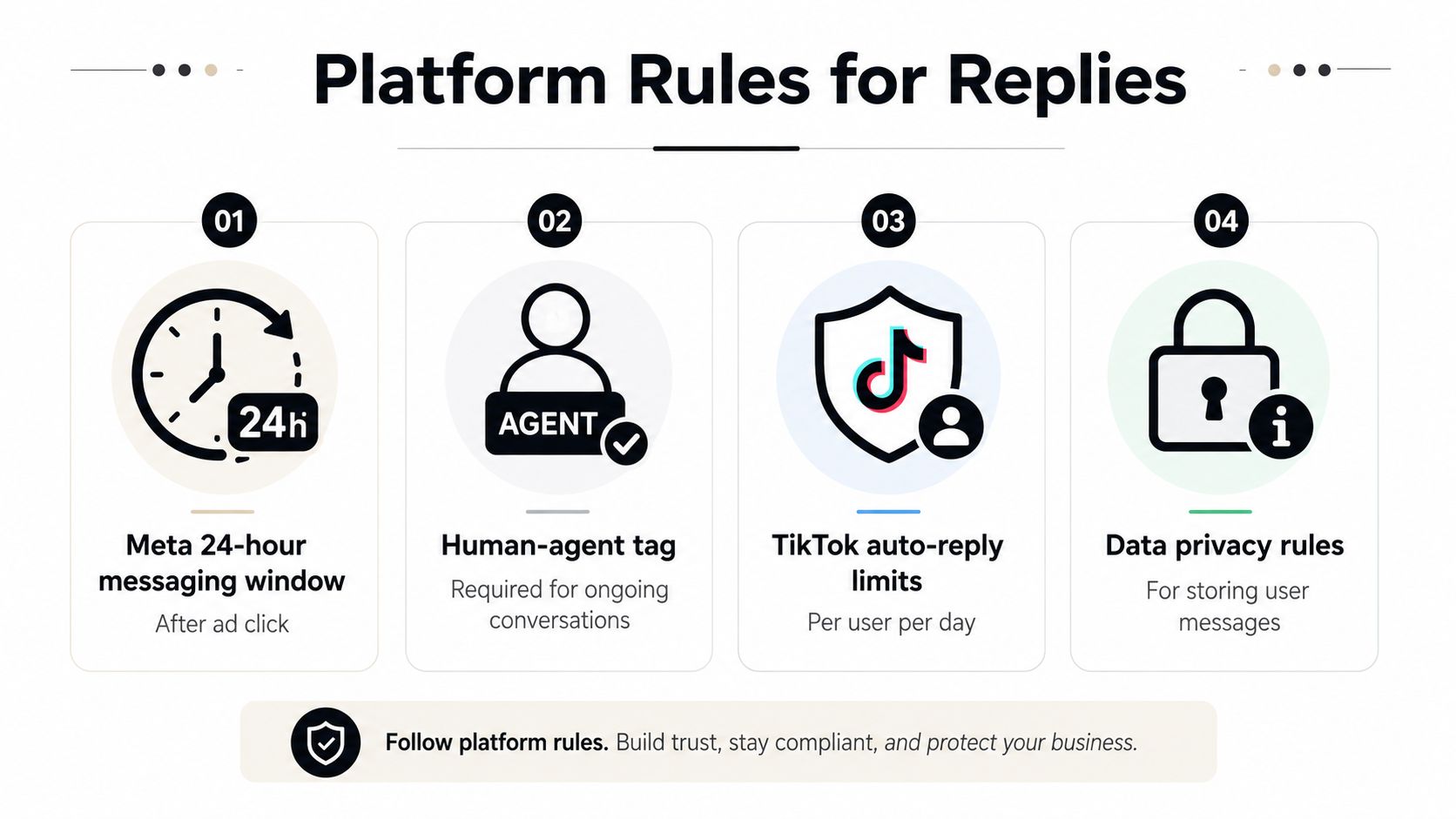
An infographic titled Platform Rules for Replies illustrating requirements for Meta messaging, human agents, TikTok auto-reply limits, and privacy.

TikTok puts moderation close to the campaign

TikTok Ads Manager lets advertisers view, reply to, like, block, pin, export, hide, and filter comments in the ad console. That includes comments on ads, not only organic posts, as described in TikTok's ad comment management documentation. Use that access during launch: hide scam replies in the first review, pin a clarifying answer, and export comments for a recurring sentiment review.

DM automation needs restraint. A long sequence can feel invasive when the user asked only a public question. Start by answering the stated intent. Ask permission before extending the conversation, and stop when the customer opts out.

Operating rule: Platform policy comes before brand voice. A polished reply that violates messaging rules is still a failed workflow.

Record the channel, trigger, response, permission state, and escalation reason. Agencies can then explain why a comment was hidden or why a conversation stopped, without relying on memory or screenshots.

Brand Safety and Moderation Without Breaking Trust

Many operators assume bots create brand-safety risk. The unmanaged comment section already creates it. Under a high-spend ad, scam links, competitor bait, and abusive replies can push genuine buyer questions out of view while making the brand appear absent.

A moderation system adds structure to that environment. It can identify likely phishing language, hide obvious spam, and preserve a log of every action. Human-only teams often have judgment but lack a consistent audit trail. With logs, the brand can review false positives, adjust rules, and show an agency client which categories were suppressed.

Escalation needs more than sentiment

Sentiment can help prioritize a queue, but it shouldn't decide everything. A mildly worded comment about a serious safety issue may need faster escalation than an angry complaint about shipping. Use keyword flags for medical, legal, financial, and safety claims, then route those messages to a named human.

Refund language deserves its own path. The bot can acknowledge the request, collect an order identifier through an approved private flow, and hand the case to support. It shouldn't promise a refund unless the business has explicitly authorized that action.

Train the voice and restrict the claims

Brand-voice training should include approved product names, prohibited claims, tone boundaries, and examples of acceptable replies. For a skincare brand, the agent might explain an ingredient's intended product role but avoid medical promises. For a lead-generation advertiser, it might collect basic intent while avoiding advice that belongs with a licensed professional.

Disclosure also matters. Tell the user when they're interacting with an automated agent, especially before transferring the conversation to a human. Consistency across public comments and DMs builds more trust than pretending every reply came from a person.

The safer baseline isn't “no automation.” It's logged automation with narrow permissions and a clear human handoff.

Watch response time, repeat questions, false-positive hides, escalations, and sentiment after the reply. Independent reporting has cited 30% of comments under brand ads as negative and estimated that CPM can rise by 30% to 40% without a response, while Resolver's consumer survey findings indicate that nearly two-thirds of people hold brands responsible for addressing inappropriate or negative comments on owned social pages, with 63% expecting a response within an hour. Those figures support rapid review, but they don't justify hiding legitimate criticism. A useful moderation program removes abuse while answering fair objections in public.

When to Use Automation and When to Escalate to Humans

Automate work that is repeatable, time-sensitive, and low-stakes. Escalate work involving money, trust, legal exposure, safety, or emotional judgment.

A product-link request belongs in automation. So does an order-status question when the system can retrieve accurate information, a basic FAQ, or a scam warning under an ad. Refund approval requires a human. So does a public complaint attracting replies, a healthcare question, a financial recommendation, or any message that could materially affect someone's safety.

A practical ownership split

Bots can handle the first 70% of volume. Humans should own the 10% that shapes brand perception, while the remaining 20% should be triaged by risk and intent. Treat this as a starting framework, not a fixed account-wide rule.

Use five tests:

  • Automate repeatability. The answer is stable, documented, and easy to verify.

  • Automate urgency. Delay could lose purchase intent, miss a useful link, or create confusion.

  • Escalate consequence. The reply could approve money, create legal exposure, or affect safety. For a deeper framework, see our guide to escalation of issues.

  • Escalate visibility. A public complaint is gaining attention or makes a serious allegation.

  • Stop on uncertainty. If the agent lacks the required data, it should ask for help rather than guess.

Measure response time under 10 minutes, DM-to-purchase rate, sentiment change in comments, and escalation count per 1,000 ad clicks. Pair those measures with recovered revenue and hidden-comment reasons. This separates revenue recovery from deflecting messages.

A framework for DTC operations showing tasks to automate versus tasks to escalate to human support.

Start with one controlled workflow

Choose one Meta ad set and enable DM auto-reply for a single SKU. Add a keyword trigger for refund requests, then route those cases to a named human. Review escalations every 48 hours and adjust the knowledge base, blocked terms, and reply templates.

Apply the same pattern to TikTok ad comments or website chat. Exerta provides AI employees for Facebook, Instagram, TikTok, and website chat, including automated comment and DM replies, moderation, sales-recovery workflows, and action logs. SMS, email, and voice are planned channels, not live coverage today.

Use automation to extend team capacity while keeping human judgment in the workflow. It should take repetitive work off the queue, not decide high-consequence cases alone.

Exerta deploys AI employees that reply to comments and DMs, moderate harmful content, and recover purchase intent across Facebook, Instagram, TikTok, and website chat. Start with one paid campaign and one SKU, then visit Exerta to see how the workflow can fit your moderation and sales-recovery process.

Get started today

Stop losing sales you already paid for.

Connect your channels in about a minute. Your AI employees start answering, moderating and closing the same day.

No credit card required

Live in under 5 minutes

250+ brands running

Cancel anytime

Get started today

Stop losing sales you already paid for.

Connect your channels in about a minute. Your AI employees start answering, moderating and closing the same day.

No credit card required

Live in under 5 minutes

250+ brands running

Cancel anytime

Get started today

Stop losing sales you already paid for.

Connect your channels in about a minute. Your AI employees start answering, moderating and closing the same day.

No credit card required

Live in under 5 minutes

250+ brands running

Cancel anytime

AI employees that answer every buyer, protect your ad spend and close sales around the clock.

All systems operational · 99.98% uptime last 90 days

SOC 2

Type II

GDPR

Compliant

99.9% SLA

Uptime

24/7

Support

1. Pricing and billing All prices displayed on exerta.ai are in US dollars and exclude applicable taxes unless stated otherwise. Prices are subject to change. Existing subscribers will receive at least 30 days’ written notice before any price increase takes effect on their account. Annual plan savings are calculated by comparing the annual billing rate to the equivalent monthly billing rate multiplied by 12.

2. Run and usage statisticsRevenue, engagement and success figures are based on aggregated platform data and customer-reported results across 250+ brands, and are updated periodically.

3. Time-to-value claims Statements such as “live in about a minute” reflect typical setup times observed for new accounts connecting through Meta Business Manager. Actual setup time may vary with the number of channels connected and the level of agent customization.

4. AI step suggestions Exerta’s AI features are powered by a blend of leading AI models, anchored by our own fine-tuned engagement model. Suggestion quality, accuracy and availability may vary. Exerta does not guarantee that AI-generated output will be accurate, complete or suitable for any particular use case. Review AI output before acting on it.

5. Integration availability The number of native integrations referenced on this website reflects integrations available at the time of last update. Integration availability may vary by subscription plan. Third-party integrations are subject to the terms, availability and API limitations of the respective third-party providers. Exerta does not guarantee the continued availability of any specific integration and is not responsible for disruptions caused by changes to third-party APIs or services.

6. Uptime and SLA The 99.9% uptime figure refers to our published Service Level Agreement (SLA) target for paid plan customers. Actual uptime may vary. Historical uptime statistics are available upon request.

7. Security and compliance certifications Exerta’s SOC 2 Type II (coming soon) certification covers the security, availability, processing integrity, confidentiality and privacy trust service criteria. GDPR compliance reflects our internal data protection practices and contractual commitments. HIPAA compliance is available exclusively on Enterprise plans and requires execution of a Business Associate Agreement (BAA). ISO 27001 certification is currently in progress. Compliance certifications are subject to annual renewal and audit. Copies of our most recent compliance reports are available to Enterprise customers under NDA upon request.

8. Customer testimonials and case studies Testimonials, quotes and case study results featured on this website reflect the experiences of individual customers. Results vary with ad spend, engagement volume, offer and configuration. Exerta does not guarantee that any customer will achieve similar results.

9. Third-party service marks and logos All third-party brand names, logos and service marks referenced on this website — including but not limited to Meta, Facebook, Instagram, TikTok, Shopify and Trustpilot — are the property of their respective owners. References to these services do not imply endorsement, sponsorship or affiliation.

10. Free plan limitations The Free plan does not require a credit card. Free plan usage is subject to the limits described on our pricing page, including a limited number of AI actions per month and comment hiding with stock replies only. Exerta reserves the right to modify the features and limits of the Free plan at any time.

11. Trial periods Free trial periods are available on paid plans as described at the time of signup. At the end of the trial period, the selected payment method will be charged at the applicable plan rate unless the subscription is cancelled before the trial expires. Trial periods are available once per customer and may not be combined with other promotional offers.

12. Data processing and privacy Exerta processes personal data in accordance with our Privacy Policy and Data Processing Agreement. Data residency options (US and EU) are available on all paid plans. The data residency region is selected at account creation and cannot be changed without contacting our support team. Customers responsible for processing personal data of EEA or UK residents are advised to execute our standard Data Processing Agreement, available at exerta.ai/legal/dpa.

13. Activity history retention Activity history is retained for 90 days on the Starter plan and for longer periods on larger plans, as described at signup. Exported data is the responsibility of the customer once downloaded.

14. AI model providers Exerta uses a blend of leading AI models together with our own fine-tuned engagement model, specialized for customer engagement. Model composition may change as we improve the product.

15. Mobile and desktop applications Exerta is available in the browser on desktop and mobile. Certain advanced configuration features are easiest on desktop. Application updates are released on a rolling basis.

16. Template library Prebuilt agent setups provided by Exerta are starting points and are not guaranteed to be suitable for any particular purpose. Customers are responsible for reviewing and testing agent behavior before enabling it on live channels.

17. Website content accuracy The information on this website is provided for general informational purposes only and is subject to change without notice. While we make every effort to keep the content accurate and up to date, Exerta makes no warranties or representations, express or implied, about the completeness, accuracy, reliability or suitability of the information contained on this website for any particular purpose.

18. Promotional offers and discounts Promotional pricing, discounts and special offers are subject to additional terms and conditions communicated at the time of the offer. Offers cannot be applied retroactively to existing subscriptions and may not be combined with other promotions unless explicitly stated. Exerta reserves the right to modify or discontinue promotional offers at any time.

19. Startup and non-profit programs Eligibility for our startup and non-profit discount programs is assessed at Exerta’s sole discretion based on the criteria described in our support documentation. Approved discounts apply to the base subscription price only and do not apply to add-ons, Enterprise features or professional services. Discount eligibility is subject to annual review.

20. Intellectual property This website is operated by Reascend LLC (d/b/a Exerta), a limited liability company formed in the State of Delaware, United States. References to “we”, “us” and “our” throughout this website refer to Reascend LLC (d/b/a Exerta). The use of this website and our Services is governed by the laws of the State of Delaware, United States, as described in our Terms of Service.

21. Accessibility Exerta is committed to making its website and application accessible to all users, including those with disabilities. We aim to conform to the Web Content Accessibility Guidelines (WCAG) 2.1 at Level AA. If you experience any accessibility barriers, please contact us at accessibility@exerta.ai and we will make every effort to provide an accessible alternative.

22. Governing jurisdiction This website is operated by Reascend LLC (d/b/a Exerta), a limited liability company formed in the State of Delaware, United States. References to “we”, “us” and “our” throughout this website refer to Reascend LLC (d/b/a Exerta). The use of this website and our Services is governed by the laws of the State of Delaware, United States, as described in our Terms of Service.

AI employees that answer every buyer, protect your ad spend and close sales around the clock.

All systems operational · 99.98% uptime last 90 days

SOC 2

Type II

GDPR

Compliant

99.9% SLA

Uptime

24/7

Support

1. Pricing and billing All prices displayed on exerta.ai are in US dollars and exclude applicable taxes unless stated otherwise. Prices are subject to change. Existing subscribers will receive at least 30 days’ written notice before any price increase takes effect on their account. Annual plan savings are calculated by comparing the annual billing rate to the equivalent monthly billing rate multiplied by 12.

2. Run and usage statisticsRevenue, engagement and success figures are based on aggregated platform data and customer-reported results across 250+ brands, and are updated periodically.

3. Time-to-value claims Statements such as “live in about a minute” reflect typical setup times observed for new accounts connecting through Meta Business Manager. Actual setup time may vary with the number of channels connected and the level of agent customization.

4. AI step suggestions Exerta’s AI features are powered by a blend of leading AI models, anchored by our own fine-tuned engagement model. Suggestion quality, accuracy and availability may vary. Exerta does not guarantee that AI-generated output will be accurate, complete or suitable for any particular use case. Review AI output before acting on it.

5. Integration availability The number of native integrations referenced on this website reflects integrations available at the time of last update. Integration availability may vary by subscription plan. Third-party integrations are subject to the terms, availability and API limitations of the respective third-party providers. Exerta does not guarantee the continued availability of any specific integration and is not responsible for disruptions caused by changes to third-party APIs or services.

6. Uptime and SLA The 99.9% uptime figure refers to our published Service Level Agreement (SLA) target for paid plan customers. Actual uptime may vary. Historical uptime statistics are available upon request.

7. Security and compliance certifications Exerta’s SOC 2 Type II (coming soon) certification covers the security, availability, processing integrity, confidentiality and privacy trust service criteria. GDPR compliance reflects our internal data protection practices and contractual commitments. HIPAA compliance is available exclusively on Enterprise plans and requires execution of a Business Associate Agreement (BAA). ISO 27001 certification is currently in progress. Compliance certifications are subject to annual renewal and audit. Copies of our most recent compliance reports are available to Enterprise customers under NDA upon request.

8. Customer testimonials and case studies Testimonials, quotes and case study results featured on this website reflect the experiences of individual customers. Results vary with ad spend, engagement volume, offer and configuration. Exerta does not guarantee that any customer will achieve similar results.

9. Third-party service marks and logos All third-party brand names, logos and service marks referenced on this website — including but not limited to Meta, Facebook, Instagram, TikTok, Shopify and Trustpilot — are the property of their respective owners. References to these services do not imply endorsement, sponsorship or affiliation.

10. Free plan limitations The Free plan does not require a credit card. Free plan usage is subject to the limits described on our pricing page, including a limited number of AI actions per month and comment hiding with stock replies only. Exerta reserves the right to modify the features and limits of the Free plan at any time.

11. Trial periods Free trial periods are available on paid plans as described at the time of signup. At the end of the trial period, the selected payment method will be charged at the applicable plan rate unless the subscription is cancelled before the trial expires. Trial periods are available once per customer and may not be combined with other promotional offers.

12. Data processing and privacy Exerta processes personal data in accordance with our Privacy Policy and Data Processing Agreement. Data residency options (US and EU) are available on all paid plans. The data residency region is selected at account creation and cannot be changed without contacting our support team. Customers responsible for processing personal data of EEA or UK residents are advised to execute our standard Data Processing Agreement, available at exerta.ai/legal/dpa.

13. Activity history retention Activity history is retained for 90 days on the Starter plan and for longer periods on larger plans, as described at signup. Exported data is the responsibility of the customer once downloaded.

14. AI model providers Exerta uses a blend of leading AI models together with our own fine-tuned engagement model, specialized for customer engagement. Model composition may change as we improve the product.

15. Mobile and desktop applications Exerta is available in the browser on desktop and mobile. Certain advanced configuration features are easiest on desktop. Application updates are released on a rolling basis.

16. Template library Prebuilt agent setups provided by Exerta are starting points and are not guaranteed to be suitable for any particular purpose. Customers are responsible for reviewing and testing agent behavior before enabling it on live channels.

17. Website content accuracy The information on this website is provided for general informational purposes only and is subject to change without notice. While we make every effort to keep the content accurate and up to date, Exerta makes no warranties or representations, express or implied, about the completeness, accuracy, reliability or suitability of the information contained on this website for any particular purpose.

18. Promotional offers and discounts Promotional pricing, discounts and special offers are subject to additional terms and conditions communicated at the time of the offer. Offers cannot be applied retroactively to existing subscriptions and may not be combined with other promotions unless explicitly stated. Exerta reserves the right to modify or discontinue promotional offers at any time.

19. Startup and non-profit programs Eligibility for our startup and non-profit discount programs is assessed at Exerta’s sole discretion based on the criteria described in our support documentation. Approved discounts apply to the base subscription price only and do not apply to add-ons, Enterprise features or professional services. Discount eligibility is subject to annual review.

20. Intellectual property This website is operated by Reascend LLC (d/b/a Exerta), a limited liability company formed in the State of Delaware, United States. References to “we”, “us” and “our” throughout this website refer to Reascend LLC (d/b/a Exerta). The use of this website and our Services is governed by the laws of the State of Delaware, United States, as described in our Terms of Service.

21. Accessibility Exerta is committed to making its website and application accessible to all users, including those with disabilities. We aim to conform to the Web Content Accessibility Guidelines (WCAG) 2.1 at Level AA. If you experience any accessibility barriers, please contact us at accessibility@exerta.ai and we will make every effort to provide an accessible alternative.

22. Governing jurisdiction This website is operated by Reascend LLC (d/b/a Exerta), a limited liability company formed in the State of Delaware, United States. References to “we”, “us” and “our” throughout this website refer to Reascend LLC (d/b/a Exerta). The use of this website and our Services is governed by the laws of the State of Delaware, United States, as described in our Terms of Service.

AI employees that answer every buyer, protect your ad spend and close sales around the clock.

All systems operational · 99.98% uptime last 90 days

SOC 2

Type II

GDPR

Compliant

99.9% SLA

Uptime

24/7

Support

1. Pricing and billing All prices displayed on exerta.ai are in US dollars and exclude applicable taxes unless stated otherwise. Prices are subject to change. Existing subscribers will receive at least 30 days’ written notice before any price increase takes effect on their account. Annual plan savings are calculated by comparing the annual billing rate to the equivalent monthly billing rate multiplied by 12.

2. Run and usage statisticsRevenue, engagement and success figures are based on aggregated platform data and customer-reported results across 250+ brands, and are updated periodically.

3. Time-to-value claims Statements such as “live in about a minute” reflect typical setup times observed for new accounts connecting through Meta Business Manager. Actual setup time may vary with the number of channels connected and the level of agent customization.

4. AI step suggestions Exerta’s AI features are powered by a blend of leading AI models, anchored by our own fine-tuned engagement model. Suggestion quality, accuracy and availability may vary. Exerta does not guarantee that AI-generated output will be accurate, complete or suitable for any particular use case. Review AI output before acting on it.

5. Integration availability The number of native integrations referenced on this website reflects integrations available at the time of last update. Integration availability may vary by subscription plan. Third-party integrations are subject to the terms, availability and API limitations of the respective third-party providers. Exerta does not guarantee the continued availability of any specific integration and is not responsible for disruptions caused by changes to third-party APIs or services.

6. Uptime and SLA The 99.9% uptime figure refers to our published Service Level Agreement (SLA) target for paid plan customers. Actual uptime may vary. Historical uptime statistics are available upon request.

7. Security and compliance certifications Exerta’s SOC 2 Type II (coming soon) certification covers the security, availability, processing integrity, confidentiality and privacy trust service criteria. GDPR compliance reflects our internal data protection practices and contractual commitments. HIPAA compliance is available exclusively on Enterprise plans and requires execution of a Business Associate Agreement (BAA). ISO 27001 certification is currently in progress. Compliance certifications are subject to annual renewal and audit. Copies of our most recent compliance reports are available to Enterprise customers under NDA upon request.

8. Customer testimonials and case studies Testimonials, quotes and case study results featured on this website reflect the experiences of individual customers. Results vary with ad spend, engagement volume, offer and configuration. Exerta does not guarantee that any customer will achieve similar results.

9. Third-party service marks and logos All third-party brand names, logos and service marks referenced on this website — including but not limited to Meta, Facebook, Instagram, TikTok, Shopify and Trustpilot — are the property of their respective owners. References to these services do not imply endorsement, sponsorship or affiliation.

10. Free plan limitations The Free plan does not require a credit card. Free plan usage is subject to the limits described on our pricing page, including a limited number of AI actions per month and comment hiding with stock replies only. Exerta reserves the right to modify the features and limits of the Free plan at any time.

11. Trial periods Free trial periods are available on paid plans as described at the time of signup. At the end of the trial period, the selected payment method will be charged at the applicable plan rate unless the subscription is cancelled before the trial expires. Trial periods are available once per customer and may not be combined with other promotional offers.

12. Data processing and privacy Exerta processes personal data in accordance with our Privacy Policy and Data Processing Agreement. Data residency options (US and EU) are available on all paid plans. The data residency region is selected at account creation and cannot be changed without contacting our support team. Customers responsible for processing personal data of EEA or UK residents are advised to execute our standard Data Processing Agreement, available at exerta.ai/legal/dpa.

13. Activity history retention Activity history is retained for 90 days on the Starter plan and for longer periods on larger plans, as described at signup. Exported data is the responsibility of the customer once downloaded.

14. AI model providers Exerta uses a blend of leading AI models together with our own fine-tuned engagement model, specialized for customer engagement. Model composition may change as we improve the product.

15. Mobile and desktop applications Exerta is available in the browser on desktop and mobile. Certain advanced configuration features are easiest on desktop. Application updates are released on a rolling basis.

16. Template library Prebuilt agent setups provided by Exerta are starting points and are not guaranteed to be suitable for any particular purpose. Customers are responsible for reviewing and testing agent behavior before enabling it on live channels.

17. Website content accuracy The information on this website is provided for general informational purposes only and is subject to change without notice. While we make every effort to keep the content accurate and up to date, Exerta makes no warranties or representations, express or implied, about the completeness, accuracy, reliability or suitability of the information contained on this website for any particular purpose.

18. Promotional offers and discounts Promotional pricing, discounts and special offers are subject to additional terms and conditions communicated at the time of the offer. Offers cannot be applied retroactively to existing subscriptions and may not be combined with other promotions unless explicitly stated. Exerta reserves the right to modify or discontinue promotional offers at any time.

19. Startup and non-profit programs Eligibility for our startup and non-profit discount programs is assessed at Exerta’s sole discretion based on the criteria described in our support documentation. Approved discounts apply to the base subscription price only and do not apply to add-ons, Enterprise features or professional services. Discount eligibility is subject to annual review.

20. Intellectual property All content on this website, including text, graphics, logos, icons, images, audio clips, digital downloads and software, is the property of Reascend LLC (d/b/a Exerta) or its content suppliers and is protected by applicable intellectual property laws. Exerta® is a registered trademark of Reascend LLC. Unauthorised reproduction, distribution or modification of any content from this website is prohibited without prior written consent.

21. Accessibility Exerta is committed to making its website and application accessible to all users, including those with disabilities. We aim to conform to the Web Content Accessibility Guidelines (WCAG) 2.1 at Level AA. If you experience any accessibility barriers, please contact us at accessibility@exerta.ai and we will make every effort to provide an accessible alternative.

22. Governing jurisdiction This website is operated by Reascend LLC (d/b/a Exerta), a limited liability company formed in the State of Delaware, United States. References to “we”, “us” and “our” throughout this website refer to Reascend LLC (d/b/a Exerta). The use of this website and our Services is governed by the laws of the State of Delaware, United States, as described in our Terms of Service.