Best Chatbot for Ecommerce: Top AI Employees for 2026
read
·

Ecommerce chatbot engagement can lift conversion from about 3.1% to 12.3%, so the best chatbot for ecommerce is the one that answers in seconds, recovers intent, and attributes revenue. If it can't tie recovered orders back to the conversation that moved the sale, it's not revenue infrastructure.
Most buyers still evaluate chat like it's a support add-on. That's the wrong frame. For brands spending on Meta and TikTok, chat sits inside the funnel now. It shapes whether a paid click turns into a product question, a DM, or a purchase.
The gap shows up fast in real campaigns. A strong ad can pull high-intent comments all day, then lose momentum because nobody answers sizing, shipping, or price questions fast enough. Worse, the comment section turns into a mess. Spam piles up. Competitors show up. One bad thread anchors the whole ad.
That's why the best chatbot for ecommerce isn't the one with the longest feature list. It's the one that protects paid traffic, moves buyers into private conversation, and makes revenue recovery visible.
Table of Contents
The Revenue Case for Ecommerce Chatbots
The core number is simple. Shoppers who engage with AI chat convert at 12.3%, while shoppers who don't engage convert at 3.1% (conversion benchmark coverage). That gap matters because ecommerce conversion is usually low to begin with. The same coverage says global ecommerce conversion rates often sit around 1% to 4%, with one benchmark citing 1.4% for Q1 2026.
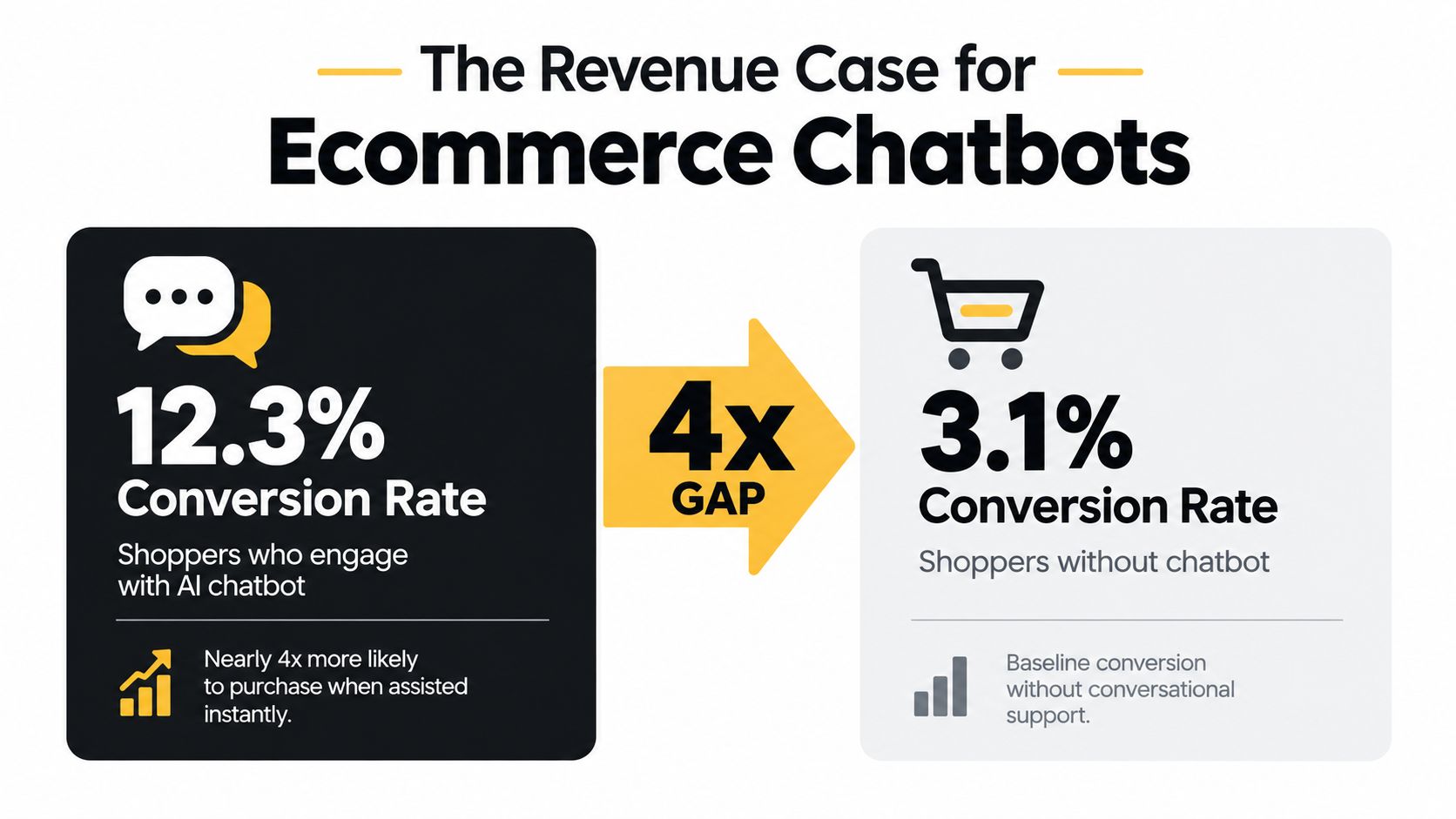
A small lift matters more when the baseline is thin. If paid traffic lands on a product page and the buyer hesitates on fit, shipping, ingredients, or returns, the chat layer can either catch that moment or miss it. That is why the buying question isn't "should we add chat?" It's "which system reliably turns conversation into tracked orders?"
Why the category became standard
This stopped being experimental a while ago. Business chatbot adoption grew about 4.7x between 2020 and 2025, and 91% of businesses with 50+ employees now use AI chatbots, up from roughly 58% in 2023 according to a 2026 roundup (industry adoption data). The same roundup says retail and ecommerce account for about 30.34% of chatbot usage.
That matters because retail teams don't keep operational layers around for novelty. They keep what shortens response time, absorbs repetitive demand, and helps close more orders.
Practical rule: If a platform can't show you which conversation recovered which order, treat every claimed sales lift as unproven.
What buyers should measure first
The weak point in most chatbot evaluations is attribution. Teams compare reply quality, templates, and setup screens, then realize later they can't prove revenue impact. Start with the reporting model instead.
Use this filter:
Recovered sales visibility: Can you trace a checkout back to the exact conversation that moved it?
Intent handling: Can the system answer pre-purchase objections without sending buyers into a help center loop?
Escalation control: Can it hand off the right conversations instead of trapping edge cases in automation?
Channel fit: Does it work where your ad spend lands?
Brands also need to think beyond chat itself. If your funnel depends on repeat engagement after purchase, creative and retention should work together. A practical companion read is how to build customer loyalty with video, especially if you're pairing paid traffic with post-purchase education.
For a deeper look at what clean revenue logging should look like, review conversion attribution for conversational flows.
Best Chatbot for Ecommerce at a Glance
A feature list rarely answers the buying question. Revenue teams need to know whether a chatbot can capture demand where ads create it, keep public threads under control, and tie conversations back to orders.
The cleanest way to evaluate the category is by job type, not by vendor count.
Capability pattern | Best fit | Channels covered | Moderation need | Setup reality |
|---|---|---|---|---|
Website-only support chat | Stores where buyer questions mostly happen on product or checkout pages | On-site chat | Low. Limited exposure to public comments | Low |
Website chat plus support automation | Teams handling higher support volume with routing, canned answers, and agent handoff | On-site chat, sometimes email or help inboxes | Low to medium. Built more for support than ad-comment control | Moderate |
Social DM automation | Brands running campaigns that need message capture and follow-up in private threads | Social messaging channels | Medium. Good for reply flows, lighter on public comment risk | Moderate |
Paid-social conversation capture and moderation | DTC brands and agencies spending on Meta or TikTok and dealing with comment volume daily | Comments, DMs, landing-page chat, and site chat | High. Needs spam filtering, scam control, negative-comment handling, and handoff rules | Moderate to high |
Multichannel revenue workflow layer | Teams that want one system for conversation handling, attribution, and repeatable recovery flows across accounts | Social, site chat, and adjacent retention channels | High. Strong moderation plus reporting discipline required | High |
Exerta fits the last two patterns. That matters for buyers who care less about having a chat widget and more about protecting ad efficiency while recovering sales from conversations.
What actually separates the options
Four trade-offs decide the shortlist:
Where intent starts. On-site tools work if objections happen on product pages. Paid-social tools matter if interest starts in comments or DMs.
How public the risk is. A missed website chat can cost a session. Bad ad comments can hurt conversion rate and creative performance at the same time.
Whether attribution is real. Reply automation is easy to demo. Tying a recovered order to a conversation is harder, and more useful.
How much operational control you need. Simple flows are easier to launch. Complex brands usually need routing, approvals, escalation logic, and reusable playbooks.
The common buying mistake is category mismatch.
Teams buy a web-first chatbot for a paid-social problem, then wonder why ad comments still rot under spend. Or they buy a broad automation layer without clean revenue logging, so every win turns into an argument in reporting.
A practical read for ecommerce teams
Smaller stores with light social volume can often start with a narrower setup. The requirement set changes once paid social becomes a meaningful acquisition channel. At that point, comment moderation, DM capture, and order-level attribution stop being nice extras. They become operating requirements.
That is the lens for this guide. Ecommerce chatbots are revenue infrastructure first, support software second.
If you want a quick definition refresh, the chatbot glossary at taap bio's link-in-bio tool covers the terms vendors often blur together. If your team expects branching logic, approvals, and reusable systems across campaigns or accounts, review these workflow automation software patterns before choosing.
How Ecommerce Chatbots Work in Practice
The operational question is simple. Where does buyer momentum die first?
For most ecommerce brands running paid social, it happens in four places: Facebook comments, Instagram DMs, TikTok conversations, and website landing pages. The best chatbot for ecommerce covers all four without changing tone or forcing the customer to restart the conversation.
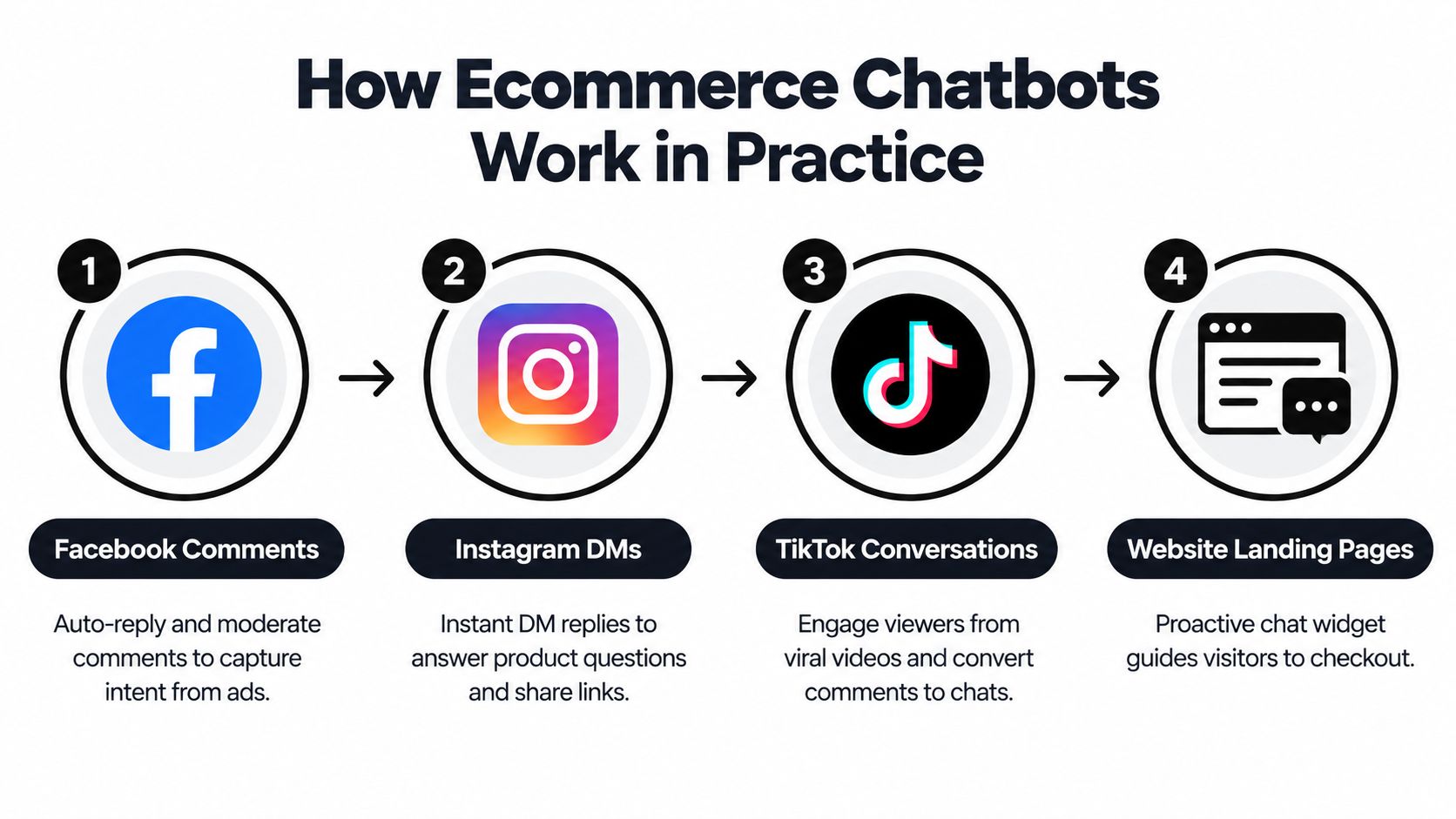
Facebook comments and the 24-hour window
Comment sections are high intent and high risk. Someone asks if the product runs true to size, whether shipping is free, or if the offer still works today. If nobody answers quickly, the lead cools off in public.
Meta's messaging rules matter here. Businesses can send promotional content inside the 24-hour window after a person's last action, and that window resets each time the person takes a new qualifying action such as a message, a Click-to-Messenger ad, an m.me link, or a reaction. For ecommerce teams, that means a comment-to-DM flow can answer the question, send an offer or checkout link, and keep the conversation live if the shopper replies again.
Same-day tactic: route product-question comments into DMs immediately, answer the buying objection, and only follow up while the conversation remains active under platform rules.
Instagram, TikTok, and landing pages
Consumers prefer speed. 82% prefer chatbots over waiting for a representative, and 64% say 24/7 availability is the most helpful feature (consumer preference data). That preference maps directly to Instagram and TikTok, where buyers don't want to leave the app just to ask whether a bundle includes a refill or whether a product works for a specific use case.
Website chat plays a different role. It catches hesitation after the click. On a paid landing page, the first reply should handle the most common purchase question and push the visitor back toward checkout.
Three workflows usually work first:
Comment to DM recovery: A buyer comments on an ad. The system replies, opens DM, and shares the next step privately.
Objection handling in DM: A shopper asks about shipping, fit, or offer terms. The reply stays on brand and includes a direct purchase path.
Landing-page chat assist: A visitor stalls on product detail or checkout. Chat answers the blocker and returns the user to purchase.
For teams mapping these flows, conversational AI for ecommerce use cases is a solid framework for deciding what to automate and what to escalate.
Why Exerta Fits Paid-Social Ecommerce Brands
Paid-social ecommerce has a specific problem set. Comments stack fast. DMs come in uneven bursts. Website traffic spikes when a creative hits. Most chat systems were built for support queues first, not for ad-driven demand capture.
That is where AI employees make more sense than a basic chatbot. The job isn't only answering questions. It's protecting campaign efficiency, recovering intent before it fades, and keeping logs clean enough to tune what the system says next.
Where the fit is strongest
Exerta is built for brands and agencies that need AI employees across Facebook, Instagram, TikTok, and website chat today, with SMS, email, and voice launching next. It handles instant replies in brand voice for comments, DMs, and web chat. It also runs moderation rules that hide spam, scams, and visible negativity before threads get away from the team.
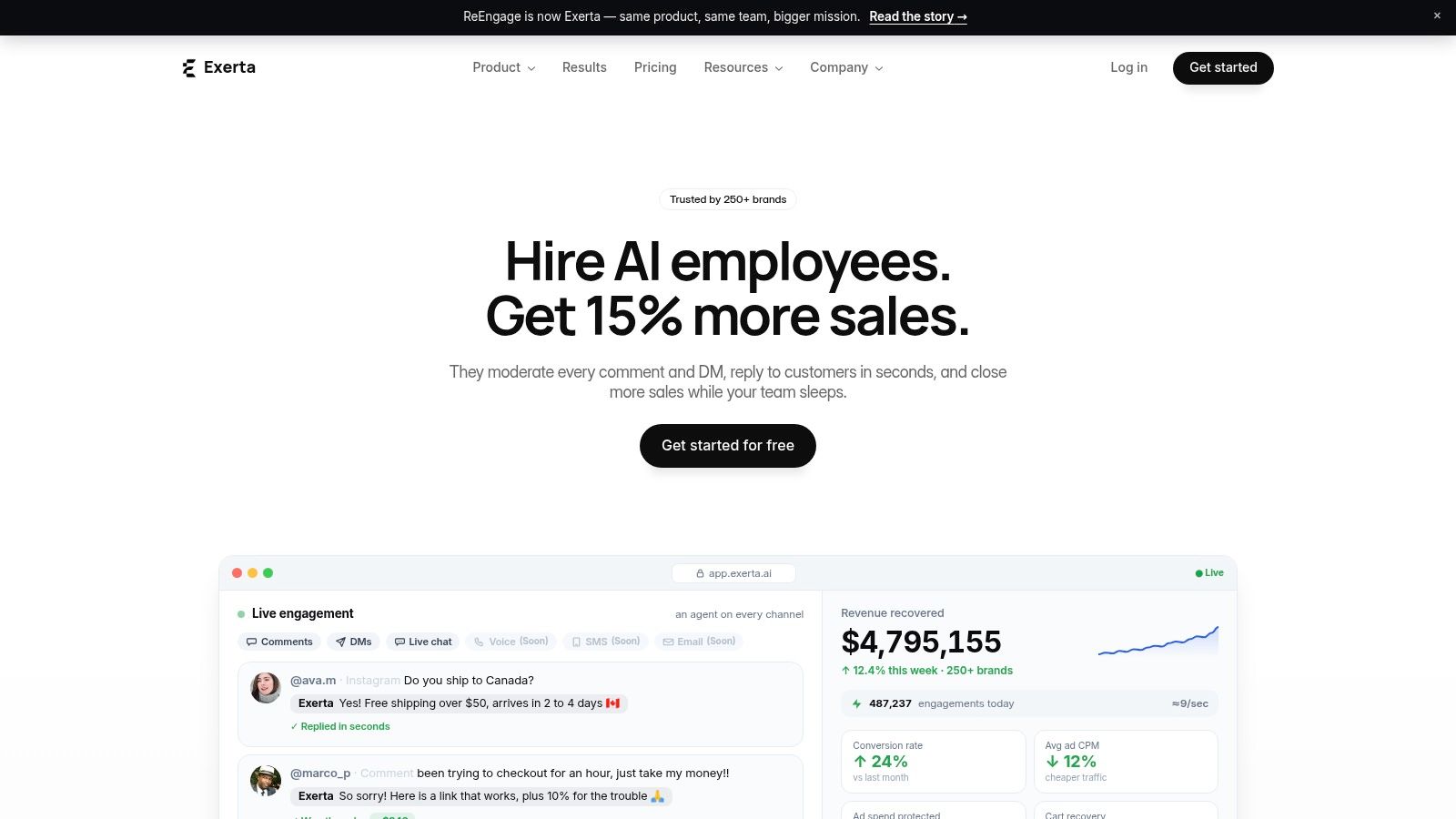
The product-side numbers matter because they tie back to the revenue frame, not just responsiveness. Exerta reports 250+ brands, 15% average sales lift, $2M+ recovered, and 99.9% uptime. For a paid-social operator, that combination matters more than a generic automation claim because it connects channel coverage, recovery, and reliability in one system.
What that means inside a live campaign
A few same-day examples make the fit clearer:
Ad comments under a winning creative: Auto-reply to pricing and product questions, hide junk comments, then move qualified buyers into DM.
Instagram product drops: Answer story or DM questions in brand voice and send buyers to the right product or bundle without waiting on a human queue.
TikTok spikes: Catch sudden bursts of interest after a video lifts, then keep tone consistent while the brand team is still reviewing spend.
Landing-page support: Use website chat to handle objections from paid traffic while attribution logs connect the purchase back to the conversation.
This is distinction. A cheap widget can answer a few FAQs. A paid-social AI employee has to do more. It needs to work where attention starts, not only where support tickets end.
If your media team spends all day buying clicks and your engagement layer still answers like a help desk afterthought, the handoff is broken.
The parts buyers should check carefully
No system is universal. There are real trade-offs.
Platform dependence is one. If most of your buying journey starts inside social channels, social-first coverage is a strength. If your volume is almost entirely post-purchase service or email-led support, you may not use the full channel depth.
Privacy and approval controls also matter. Brands in regulated or sensitive categories need configurable escalation paths, logging, and clear boundaries around what AI employees can say automatically.
The strongest use case is straightforward: teams that care about recovery velocity, comment quality, and in-product attribution. Those teams usually benefit from a single system that can learn across channels instead of running a disconnected widget on the site and manual moderation under ads.
For teams comparing this operating model with broader engagement stacks, AI customer engagement software is the right lens.
Alternatives When the Job Is Different
The best chatbot for ecommerce depends on the job. That's not a dodge. It's the practical truth most buying guides skip.
Not every brand needs a paid-social engagement system. Some need a simple store helper. Some need visual campaign flows. Some need a unified inbox with stronger live-agent habits than sales recovery depth.
When a simpler store setup is enough
A Shopify-native store with low comment volume and straightforward site questions can do well with a lightweight website-first setup. That kind of team usually cares more about answering basic buyer questions on the storefront than moderating active ad threads.
The trade-off is obvious. You gain simplicity. You give up deeper public-comment control and cross-channel recovery.
When campaign builders matter more than moderation
Some small teams want visual flow building for giveaways, launches, and DM campaign paths. In that case, a campaign-focused automation option may fit better, especially if the operator values flow editing over a broader AI employee layer.
That choice usually sacrifices a few things. Brand-voice consistency can get brittle when flows multiply. Attribution can also get fuzzy if the system was built more for messaging automation than revenue recovery.
Most teams don't need more branches in a flowchart. They need fewer dead ends between ad click and checkout.
When live-agent handoff is the center of the stack
If the business runs heavier support volume and wants one inbox for agent coverage, a support-first option can be the better call. The gain is operational familiarity for support teams. The cost is often weaker coverage for the public side of paid social, where ad comments need active protection and fast routing.
This limit matters because current AI still has boundaries. Recent synthesis suggests ecommerce AI tops out around 75% to 80% end-to-end resolution, so human escalation remains essential (service-expectation synthesis). Buyers still prefer humans for emotionally charged issues, nuanced reasoning, and more complex problem-solving.
If you're mapping automation spend against business return, this guide to boosting ROI with automation is a useful companion read.
The cleaner framing is this: choose the system that fits your dominant bottleneck. If your bottleneck lives under ads and inside DMs, use a social-first AI employee model. If it lives in basic site support or agent inbox management, choose accordingly. For a sharper distinction between the categories, read chatbot vs AI systems in practice.
Launch Checklist and Next Steps
A chatbot test should take a week, not a quarter. If a team can't validate the basics quickly, they usually end up debating features instead of measuring outcomes.
Start with the paths closest to paid revenue. Comments. DMs. Landing pages. Checkout assists. The point isn't to automate everything. It's to prove whether the system catches intent, keeps the channel clean, and logs the result.
Your one-week evaluation plan
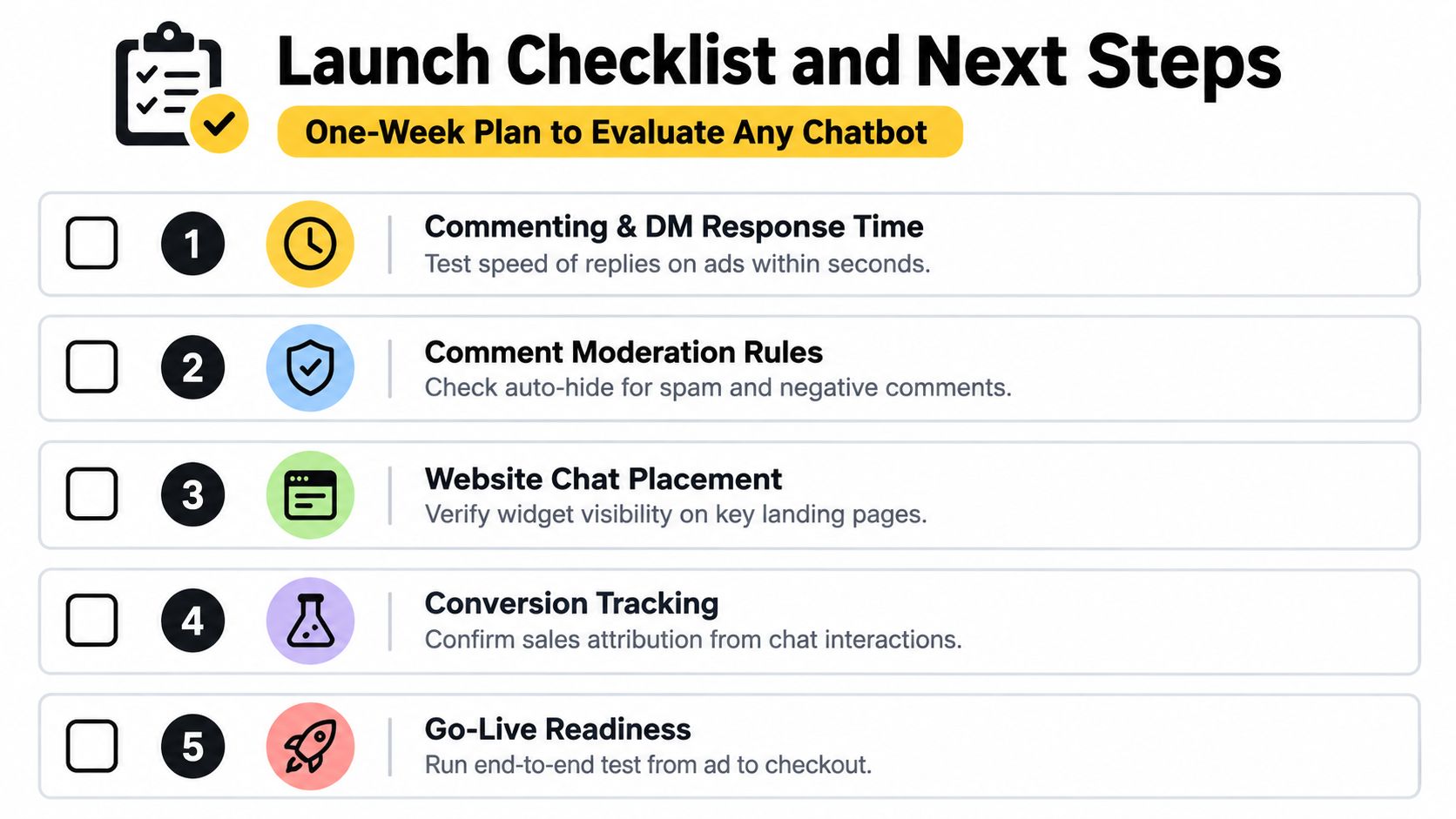
Use this checklist in order:
Comment and DM response speed Run test comments and DMs from real buyer scenarios. Ask price, shipping, product-fit, and offer questions. The reply should land in seconds, stay on brand, and move the buyer to the next action.
Moderation rules under live ads Check what happens when spam, scam language, or hostile comments show up. Negative Facebook ad comments can reduce click-through rates by up to 37% for ecommerce brands, and significantly negative comment sections can pull average CTR down by about 15% to 25% across most verticals. That's not a support issue. That's media efficiency.
Website chat placement Put chat on the pages where paid traffic hesitates. Product detail pages. Offer pages. Pricing or bundle pages. Independent live-chat research reports that adding live chat increases website conversions by an average of 20% (live chat benchmark).
Revenue attribution check Confirm that the platform logs assisted purchases and connects them to the originating conversation. You want a clear audit trail, not a claim that "chat helped."
End-to-end purchase test Start from the ad or landing page, enter through comment or chat, and complete a real purchase path. Then verify that reporting captured every step.
What to measure and what to ignore
A lot of teams waste the first month staring at chat volume. That isn't the scorecard.
Measure these instead:
Assisted purchases: Orders that happened after a tracked conversation
Recovery rate: Conversations that moved from hesitation to checkout intent
Response speed: Whether buying questions were answered while interest was still warm
Escalation quality: Whether edge cases reached a human without forcing the customer to repeat everything
Comment health: Whether ad threads stayed useful and brand-safe
Ignore vanity metrics unless they support one of the five above. More conversations don't matter if none of them close.
A same-day campaign test
Run two campaigns with similar intent. Protect one with moderation and automation. Leave the other on your usual process. Keep creative, offer, and landing page as close as possible.
Then review logs every week.
Look for repeated blockers. Shipping confusion. Eligibility questions. Sizing objections. Coupon requests. Return concerns. Feed those back into the response logic so the AI employees stop treating common buying friction like edge cases.
There is also a straightforward paid-social lesson from moderation research. A Harvard Business School working paper found that automated comment management improves ad performance across Facebook studies and preregistered online experiments (HBS working paper on automated comment management). If you've watched a good ad lose efficiency after bad comments stack up, that finding tracks with what operators already see in accounts.
The best chatbot for ecommerce earns its place quickly. It should answer real buying questions, route high-intent traffic into private conversation, protect active ad spend, and prove what it recovered.
If it can't do those four things in week one, keep looking.
Exerta gives ecommerce brands and agencies AI employees for Facebook, Instagram, TikTok, and website chat that reply in brand voice, moderate harmful comments, and log recovered revenue back to the conversation. If your buying journey starts under ads and you need cleaner comments, faster replies, and clearer attribution, visit Exerta.