6 Reminder Advertising Example Tactics That Convert
14 min read
read
·

A reminder ad can create a measurable sales response even when people already know the brand. In a 2022 Journal of Marketing Research study, radio ads reaching 1% of the population were followed by a 1.55% rise in online sales during the next four hours, while TV ads produced a 0.78% lift. The point isn't that every reminder campaign will deliver the same result. The point is that timing and follow-through can turn a familiar message into immediate action.
A reminder advertising example succeeds or fails after the impression. A prospect asks about delivery, raises a pricing objection, comments about sizing, or needs a direct route to checkout. Six practical workflows cover the main buyer stages, from abandoned cart to qualified sales conversation. Exerta's AI employees can support comments, DMs, and website chat across Facebook, Instagram, and TikTok, with each workflow tied to an audience trigger, timing decision, copy angle, conversation path, escalation rule, and attributable outcome. For broader context, review these AI-driven campaign examples.
Table of Contents
1. Cart Abandonment Recovery Ads
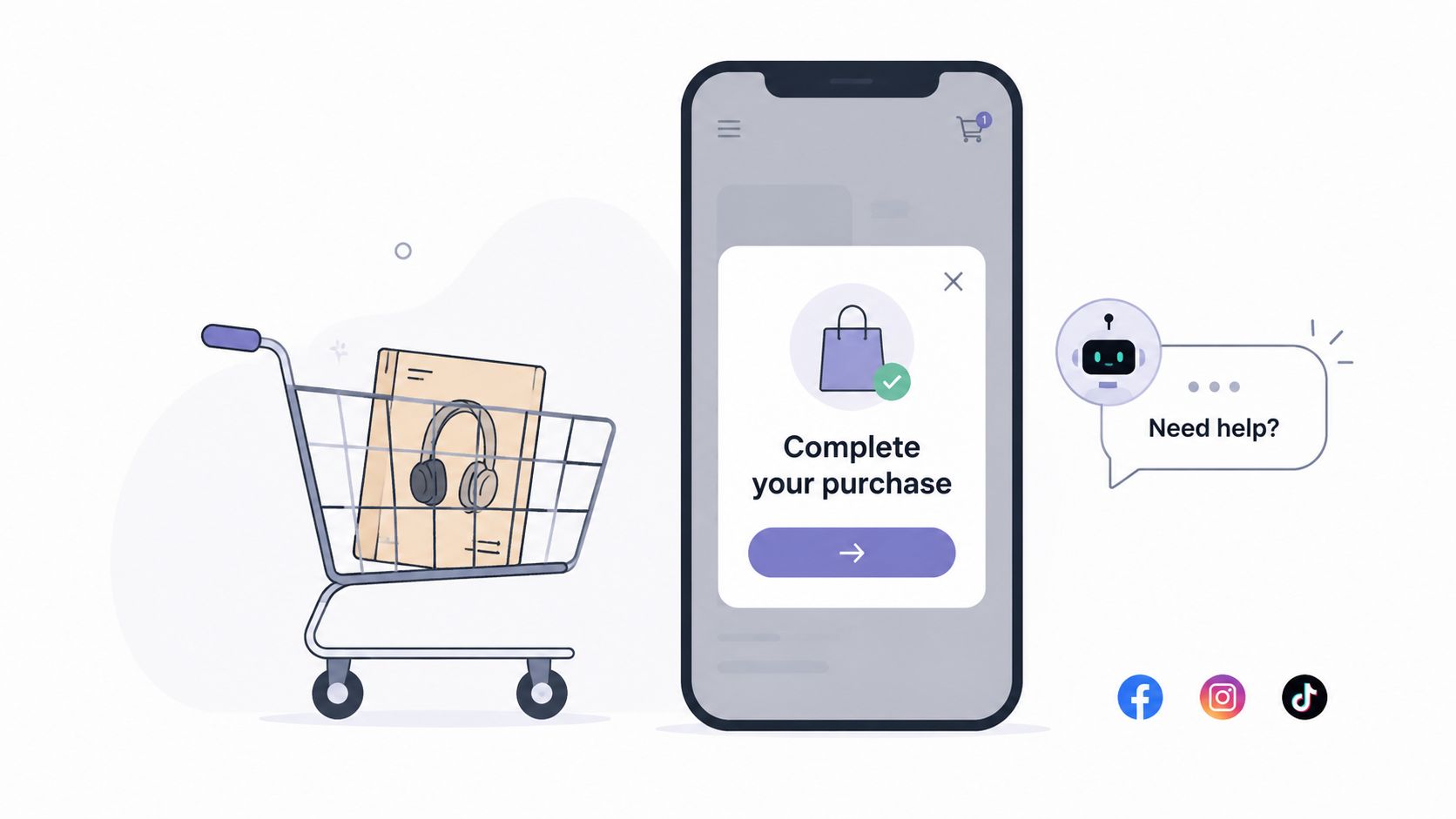
Cart abandonment reminders work best when the message reflects the exact action the buyer took. Show the product left behind, keep the route to checkout direct, and reach the person while the purchase is still active in their mind. The campaign shouldn't act like a generic brand impression. It should answer the reason the buyer stopped.
Run the reminder across Facebook, Instagram, and TikTok after abandonment, then connect the ad to a DM and website chat workflow. A shopper might ask whether an item runs small, whether delivery reaches their area, or whether returns are free. Exerta's AI employees can answer those questions in the brand's voice, provide relevant links, and escalate exceptions instead of leaving the buyer to search.
Practical rule: Treat the ad, comment thread, DM, and checkout link as one recovery path. Measuring the impression alone hides the action that creates the sale.
The best same-day setup is simple:
Start with objections: Train responses around shipping time, return policy, price justification, and product fit.
Limit the sequence: Use two or three touches over 48 hours, then stop. Repetition can create fatigue rather than urgency, a trade-off supported by research on ad wearout and repetition.
Match proof to hesitation: Add reviews or an unboxing video when the buyer needs reassurance, not when the problem is a missing size.
Test the offer: Compare a percentage discount, a larger discount, and free shipping to find the point where margin and recovery balance.
Track the product viewed, question asked, response delivered, checkout click, purchase, and revenue attributed to the interaction. Exerta's conversion attribution workflow helps connect those actions rather than treating them as separate channels.
2. Post-Purchase Follow-Up Engagement Ads
The purchase starts a new engagement workflow. The buyer now has questions, usage needs, and reasons to return. A supplement reminder can explain when reordering fits the product cycle. A fitness apparel ad can suggest a compatible accessory. A skincare message can teach correct use before asking for another purchase.
Start with the buyer's stage and product category. Skincare customers need care guidance. Subscription customers need reorder context. Apparel buyers may need help completing a set. Order confirmation emails and receipts can reinforce the same guidance, including a link to your order confirmation. Exerta's AI employees can monitor comments and DMs, answer tracking and product-care questions, and record each interaction against the customer journey across the ad, message thread, and website chat.
Post-purchase replies also reveal intent. A question about a matching product may support an upsell. Words such as “defect,” “broken,” or “arrived late” signal dissatisfaction and should reach a human reviewer quickly. Sending a promotional answer in that situation can turn a service problem into a return or public complaint.
Build the follow-up around product use
Use the early post-purchase window for confidence and education. Invite customers to ask how to use the product, request feedback, or share a review. A future-purchase discount can encourage participation, but it should follow a useful answer rather than replace one.
Configure the workflow to:
Segment by category: Give skincare, fitness, subscription, and other buyers separate knowledge paths and message intent.
Escalate risk language: Route defect, damage, and late-delivery messages for human review within two hours.
Review the knowledge base: Check recurring questions weekly and revise responses where customers still need clarification.
Ask for improvement feedback: Use “How can we improve?” to collect language for future ads and support content.
Set an outcome path: Record the product view, reply, DM, chat handoff, review, return, repeat purchase, and attributed revenue.
Connect comments, DMs, and website chat through a post-purchase engagement workflow, so the next action remains visible without making the buyer feel chased.
The trade-off is contact frequency. Too little follow-up wastes a useful relationship. Too much promotion makes the brand appear interested only in another transaction. Lead with product usefulness, then make the next purchase relevant.
3. Event Reminder and Waitlist Conversion Ads
An event reminder becomes valuable when it removes the final uncertainty before registration. Webinar prospects ask whether they need particular software. Coaching prospects ask whether the program suits beginners. Lead-generation prospects want to know what happens during a consultation and whether they qualify.
The ad should answer the most common objection before the user opens a DM. Then the conversation workflow should handle the remaining questions. Exerta's AI employees can respond across comments, DMs, and website chat, collect basic qualification details, and route complex cases to sales.
For a webinar, the reminder might focus on the topic, time, and technical prerequisites. For an insurance, solar, or Medicare campaign, it might focus on eligibility and the consultation process. Those audiences shouldn't receive the same script. A technical question needs a precise answer. A regulated or high-consideration lead needs controlled escalation.
Turn waitlist activity into a decision path
Use comment questions as live research. If people repeatedly ask whether an event is suitable for beginners, make that answer prominent in the next creative. If price is the concern, explain the value and format without automatically discounting. If timing is the barrier, offer a clear replay or alternative path only when that option exists.
Set up two levels of handling:
Tier one: The AI employee answers event details, prerequisites, pricing structure, and registration questions.
Tier two: A human receives complex qualification cases, underwriting questions, or requests that require professional judgment.
Pre-event follow-up: Send a reminder through website chat or DM before the event, with the registration or attendance link.
Outcome tracking: Record the original ad, objection, response, registration, attendance, consultation booking, and eventual sale.
The internal workflow can also follow Instagram DM automation guidance, while keeping approval rules appropriate to the offer and industry.
The main risk is over-qualification. Asking too many questions before giving a useful answer creates friction. Start with the minimum information sales needs, then expand only when observed conversations show that an extra question improves routing.
4. Brand Safety and Negative Comment Suppression Ads
Reminder ads can lose performance in the comment section, even when creative and targeting are sound. Spam, scam offers, abusive remarks, and misleading claims alter how prospects judge the entire ad. The workflow needs two actions: remove harmful content and answer legitimate criticism.
Exerta's AI employees can apply moderation rules to Facebook, Instagram, and TikTok comments in real time. Hide clear scams and hate speech. Preserve ambiguous complaints about price, delivery, or product quality, then route them for review. Deleting every negative comment may make the feed look cleaner while reducing trust.
A Harvard-affiliated field study found that automated removal of harmful comments increased click-to-registration rate by 16% and return on ad spend by 48%, with campaign variables held constant. In the matched Instagram and Facebook split, the moderated arm delivered 0.678 ROAS versus 0.459 in the control, with 22 purchases versus 15 and a lower cost per purchase of $454.34 versus $666.56. The field study on comment moderation supports treating comment-state management as a performance workflow, not only a safety task.
Moderate with a clear boundary
Start conservatively. Hide obvious scams and abusive content, then audit decisions before expanding the rules. Route competitor criticism, pricing complaints, and unclear claims to a person. Record what was hidden, why it was hidden, and whether the rule interrupted a valuable conversation.
Use the audit trail to find recurring patterns by time, post type, and audience segment. Reply to valid criticism with empathy and a specific next step. A public response can protect the conversation better than silent removal.
Connect moderation to the reminder campaign's next action. A clean comment thread supports the ad's message, while an unresolved complaint needs a public reply, DM, or website chat handoff. Tag each action by ad, issue, response, and resulting click or inquiry. Review brand reputation protection workflows before setting escalation rules, and keep human approval for claims that require context.
5. Seasonal and Flash Sale Reminder Ads
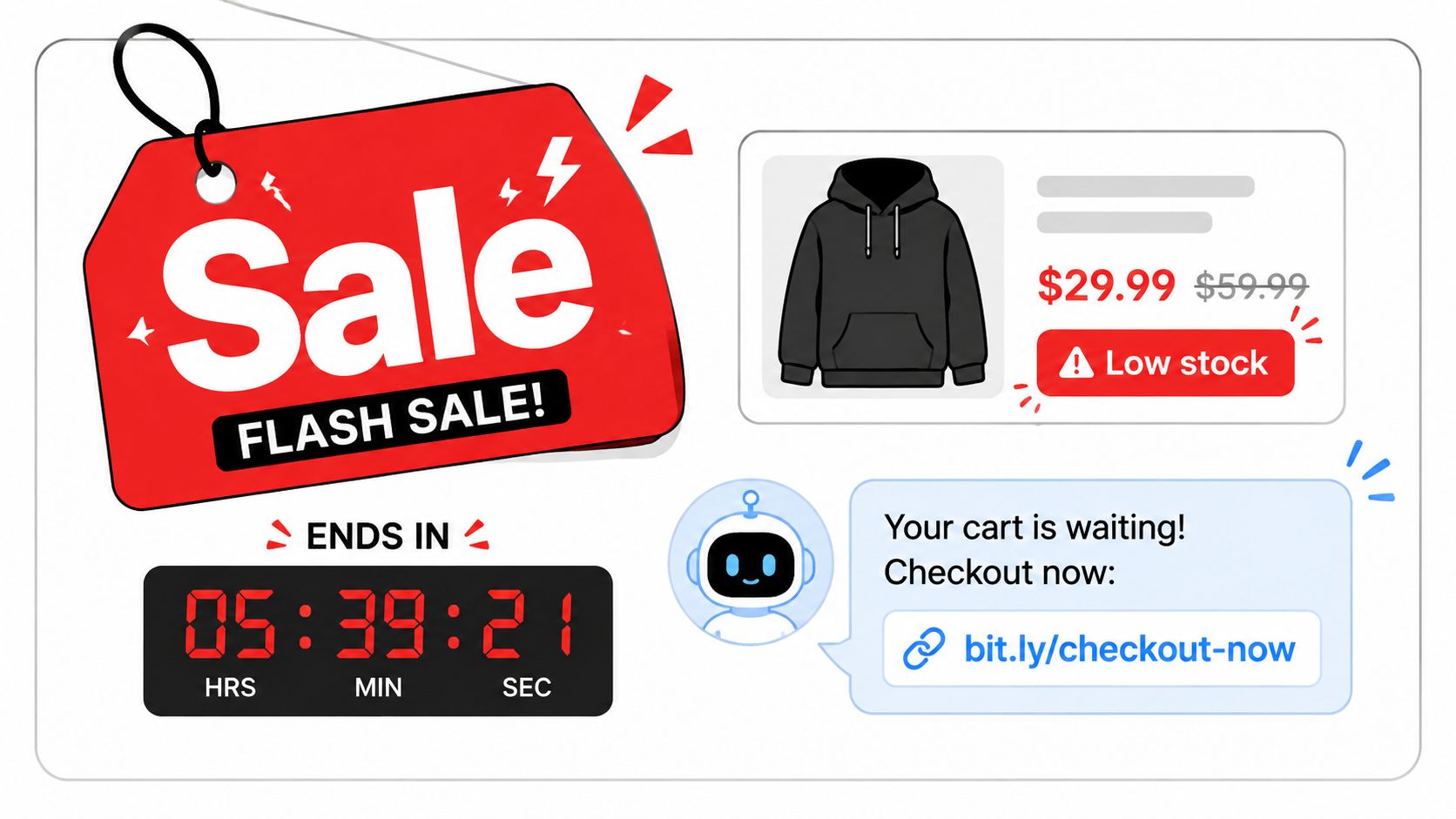
Urgency creates demand and support volume at the same time. During a flash sale, shoppers ask whether a size remains available, whether a discount code works, whether an electronics product includes a warranty, or whether an alternative item matches the one that sold out. A reminder ad that sends only another impression leaves those questions unresolved.
Use the ad to restate the offer and the deadline. Use comments and DMs to remove friction. Exerta's AI employees can answer stock, sizing, compatibility, and discount questions, then send a checkout link when the buyer shows clear intent. Website chat can carry the same offer logic for paid traffic that reaches the store directly.
Prepare the workflow before launch
Load the sale terms and the most common product questions before the campaign starts. Test the responses with real scenarios. The agent needs current inventory information, valid offer rules, and a defined route for exceptions.
Set inventory rules: When stock becomes limited, give an accurate availability message and suggest a relevant alternative when the primary item is unavailable.
Use demand signals: Monitor comment volume and the ratio of comments to clicks. A sudden rise can justify a creative or budget review, but don't scale without checking stock and service capacity.
Route valuable leads: Send wholesale and bulk-order questions to sales instead of treating them like ordinary retail comments.
Keep alternatives visible: Prepare a short video or product link for substitute items before the main product sells out.
The biggest risk is false urgency. Don't claim scarcity unless inventory supports it. Don't promise a discount the checkout cannot honor. A broken code or inaccurate stock answer can turn a high-intent comment into a public complaint.
For operational consistency, connect the workflow to an offer management system. Then measure assisted checkout clicks, purchases, product substitutions, discount issues, response time, and attributed revenue by campaign and conversation type.
6. Lead Qualification and Sales Funnel Reminder Ads
Lead reminder ads should move a prospect toward the next sales step, not restart the entire pitch. The audience has already shown interest. The useful question is whether the person has the need, timing, budget, and fit for a conversation.
Exerta's AI employees can ask qualification questions in comments and DMs, branch based on the answers, and send qualified leads to a sales calendar with context attached. For agencies, that creates a repeatable process across client accounts without forcing each salesperson to copy details manually into a CRM.
A solar workflow might ask about roof type, shading, utility costs, and installation timing. An executive coaching workflow might ask about the prospect's current role and desired outcome. A financial-services workflow may require carefully controlled questions about age, state, current coverage, and decision timing. The wording and escalation rules must match the industry.
Keep qualification proportional to intent
Start with three useful questions. Expand toward five or seven only after conversation data shows which signals predict a meaningful sales action. For high-ticket B2B, offer the calendar link after the required questions are answered. For lower-friction offers, an earlier link may preserve momentum.
Use branching logic rather than a single script:
Match budget to route: A prospect mentioning a budget below $5,000 needs a different response from one mentioning more than $50,000.
Use sales language: Map AI questions to the discovery framework the sales team already follows.
Protect calendar capacity: Don't offer appointments to leads who haven't met the minimum qualification standard.
Audit early decisions: Review classifications daily during the first two weeks and compare “high-intent” labels with actual bookings.
The measurement chain should include comment, DM, answer, qualification completion, calendar click, booked call, show-up, proposal, and revenue. A reminder ad can create activity without creating pipeline, so the workflow must distinguish curiosity from a sales-ready lead.
6-Point Reminder Ad Comparison
Reminder Ad Type | Implementation Complexity | Resource Requirements | Expected Outcomes | Ideal Use Cases | Key Advantages |
|---|---|---|---|---|---|
Cart Abandonment Recovery Ads | Low, plug-and-play via Shopify & Meta; minimal dev work | Moderate, product feed sync, AI training on top objections | ~15% sales lift; fast DM resolution; direct revenue attribution | DTC ecommerce, subscriptions, retailers with online carts | Rapid recovery of abandoned carts; dynamic discounts; instant objection handling |
Post-Purchase Follow-Up Engagement Ads | Medium, needs customer-match and coordinated timing | Moderate, customer data integration, shipping/tracking feeds, upsell logic | Improved retention; fewer returns/chargebacks; measurable repeat purchases | Brands focused on retention, subscriptions, reducing returns | Converts post-purchase queries into retention/upsell touchpoints; automated tracking |
Event Reminder & Waitlist Conversion Ads | Medium, timezone logic and event integrations required | Moderate, event/booking integrations, waitlist management, FAQ training | Higher signups and bookings; reduced no-shows; stronger lead qualification | Webinars, product launches, lead-gen consultations (insurance, solar) | Instant FAQ handling and waitlist conversion; lead scoring for sales prioritization |
Brand Safety & Negative Comment Suppression Ads | Medium, moderation rules and audit trails; ongoing tuning | Moderate, configurable rules, monitoring, escalation workflows | Protects ad performance; higher CTR/conversion; reduced moderation time | High-spend advertisers, regulated industries, reputation-sensitive brands | Real-time toxic comment detection/hiding; consistent brand-voice moderation |
Seasonal & Flash Sale Reminder Ads | Medium–High, must pre-scale infra and sync inventory | High, real-time inventory sync, dynamic codes, scalable DM handling | Converts urgency into same-day revenue; handles high interaction spikes | Flash sales, Black Friday, limited-time promotions, fast-moving inventory | Converts hesitation into orders during peaks; high-volume DM handling and urgency messaging |
Lead Qualification & Sales Funnel Reminder Ads | Medium, multi-branch logic and CRM/calendar integration | Moderate, qualification rules, CRM/calendar sync, scoring logic | 24/7 lead qualification; faster sales cycles; higher-quality handoffs | B2B, agencies, high-ticket services where pre-qualification matters | Automates lead qualification and booking; improves sales velocity and handoff quality |
Turn Reminder Impressions Into Measurable Next Steps
The six examples fall into three operating choices. First, recover an existing purchase, using cart abandonment and flash-sale workflows to move known intent toward checkout. Second, advance an active decision, using post-purchase, event, waitlist, and lead-qualification sequences to answer the next question. Third, protect the conversation around the ad, using moderation to keep harmful content from competing with the offer while preserving legitimate feedback.
Launch one workflow today. Pick one audience trigger, such as cart abandonment, waitlist activity, or a comment containing a buying question. Write one objection-led message. Define what the AI employee can answer, what requires approval, and when a human must take over.
Then set timing and frequency limits before the campaign runs. Track impressions only as context. The useful measures are clicks, conversations, qualified leads, purchases, repeat orders, and attributed revenue. Review response accuracy, escalation volume, unresolved questions, and moderation decisions alongside those outcomes.
Exerta supports this operating model across Facebook, Instagram, TikTok, and website chat. Its AI employees respond to comments and DMs, moderate harmful content, send purchase links, and log actions for attribution. Exerta reports adoption by 250+ brands, an average 15% sales lift, more than $2M in recovered revenue, and 99.9% uptime in its product information. Treat those figures as platform-reported context, not a promise for your account.
Review the dashboard and logs weekly. Update creative from actual buyer questions. Retrain prompts when shoppers repeat the same objection. Tighten moderation rules when valid criticism disappears. Reminder advertising works when the follow-up workflow improves with evidence instead of assumptions.
Exerta provides AI employees for comments, DMs, moderation, and website chat across Facebook, Instagram, and TikTok, with each action logged for revenue attribution. Visit Exerta to connect your paid-social conversations to faster answers, controlled escalation, and measurable recovery workflows.