Social Media AI Tools That Actually Drive Revenue
read
·

AI already makes 94% of Facebook moderation decisions and 98% of Instagram decisions, while TikTok reports 45% automated decisions in the 2023 transparency analysis. The platform-governance analysis shows where social media AI tools have delivered operational value first: not captions, but high-volume governance.
That distinction matters for brands buying Meta and TikTok traffic. A generated caption can save a few minutes. A fast answer to “price?”, a hidden scam comment, or a routed purchase question can protect the conversion path behind the ad. The right question isn't which tool writes the most posts. It's which system helps turn paid attention into revenue without losing control of brand voice, consent, or escalation.
Table of Contents
What Social Media AI Tools Actually Do in 2026
Social media professionals have moved past experimentation. Metricool's 2026 study surveyed more than 700 professionals and found that 95% use AI tools, with nearly three-quarters using them daily. Most users regain one to six hours per week, and ChatGPT is used by around 85% of respondents. Metricool's study captures the adoption shift, but adoption alone doesn't prove commercial value.
Organizations still deploy AI in the visible part of the workflow. They generate captions, rewrite hooks, produce content calendars, resize creative, and summarize dashboards. Those tasks help, particularly when a brand needs more variations for testing. They don't automatically solve the part of paid social where a prospect asks a public question, waits for an answer, and decides whether to buy.
The revenue layer sits below the post
The engagement layer includes comment replies, DMs, sentiment triage, spam filtering, buyer-intent detection, and human handoff. It operates after an ad has created interest. That timing makes it commercially different from content generation.
Audience expectations create a service-level problem. Around 40% expect brands to respond to DMs and comments within three hours, while roughly a quarter expect a response within an hour, according to Sociality's AI in social media report. A content tool can create another post. An engagement system can answer a pricing question while the prospect is still ready to act.
AI's value is therefore shifting from text production to response orchestration. The system needs to recognize intent, follow approved rules, send the right link or answer, and escalate sensitive conversations instead of improvising.
Practical rule: Judge an AI employee by the paid-social outcome it changes, not by how polished its demo caption looks.
A better measurement framework
For ad accounts, “drives revenue” means measurable movement in ROAS, cost per lead, conversion rate, recovered checkout activity, and DM-to-order conversion. Likes and reach can inform diagnosis, but they shouldn't be the final score.
This article rates social media AI tools across four jobs:
Engagement automation: Does the system respond quickly and route high-intent conversations?
Moderation: Can it remove spam and flag risk while preserving legitimate complaints?
Content generation: Does it produce usable copy under platform, brand, and disclosure constraints?
Analytics: Can the team connect activity to commercial outcomes rather than stopping at impressions?
For a practical look at how an engagement-focused system fits into this workflow, see AI social media agents. The useful stack isn't the one with the longest feature list. It's the one that closes the largest leak first.
The Four Job Categories Every Buyer Should Compare
A buyer should score each social media AI tool against the job it must perform. “AI-powered” describes a technology layer, not a business result. A publishing assistant and a moderation employee may both use AI, but they carry different risks and affect different parts of the funnel.
Engagement automation
Good looks like: fast, context-aware replies that identify purchase intent and route conversations according to consent, sentiment, and urgency.
The system should handle common questions about price, delivery, availability, and offers. It should also know when a public answer belongs in a private message. The quiet failure is a missed conversation window. A prospect receives no answer, asks a competitor, or leaves before the team sees the notification.
A useful test is to send the same product question through a comment and a DM. Check whether the tool preserves context, uses approved information, and records the next action.
Moderation
Good looks like: clear rules for spam, scams, abuse, and crisis language, supported by searchable logs and human escalation.
Automation should not mean indiscriminate hiding. A real complaint needs a response path. A scam link may need immediate removal. A regulated claim may require approval before anyone replies. Buyers should inspect how the system records the original message, rule triggered, action taken, reviewer, and final disposition.
The failure mode is either visible toxicity under an ad or excessive false positives that silence customers.
Content generation
Good looks like: platform-specific drafts that match the brand, respect ad requirements, and remain editable before publishing.
AI is useful for variations, hooks, product angles, and repurposing. It performs poorly when teams publish generic copy without checking claims, offer terms, audience fit, or disclosure requirements. Meta and TikTok placements also have different creative expectations, so one universal prompt rarely produces production-ready assets everywhere.
Analytics
Good looks like: reporting that connects creative, conversation quality, lead handling, and orders.
An impressions dashboard can tell you what happened at the top of the funnel. It can't tell you whether a buyer question became a checkout or whether hostile comments weakened the campaign experience. The failure mode is last-click reporting that assigns credit without showing which interaction helped recover demand.
Use these four tests before comparing contracts. If a tool can't expose the workflow behind its output, its performance claim is difficult to audit.
Engagement and Moderation Platforms Side by Side
Engagement and moderation platforms solve different operational problems, even when they share an inbox. The important comparison isn't feature count. It's whether the system can respond quickly, cover the channels where ads run, preserve approved voice, and show an audit trail.
Platform | Response Speed | Channel Coverage | Brand-Voice Control | Audit Logs | Best For | Starting Price |
|---|---|---|---|---|---|---|
ManyChat | Fast for configured flows | Messenger and Instagram DM workflows | Rule-based prompts and approved flows | Workflow history, depth varies by setup | Comment-to-DM campaigns | Check current vendor pricing |
Sprinklr | Fast with enterprise routing | Broad enterprise coverage, confirm current channel scope | Advanced governance and approvals | Strong enterprise audit capability | Regulated or high-volume teams | Custom |
Brand24 | Alert-driven, not primarily reply automation | Broad listening coverage, confirm ad-channel actions | Alert and keyword controls | Monitoring history | Sentiment and reputation alerts | Check current vendor pricing |
Lately AI | Routing depends on configuration | Social workflow coverage varies by plan | Classification and campaign controls | Confirm required log depth | Comment classification and routing | Custom or plan-dependent |
Exerta | Automated replies and moderation across live channels | Facebook, Instagram, TikTok, and website chat | Brand training, approval, and escalation workflows | Logged actions and attribution | DTC ad engagement and recovery | Free, Starter, and custom volume plans |
For a high-volume DTC brand, the winning setup is the one that turns a comment into a useful next step. A buyer asking for a price should receive an answer or DM route. A repeated scam comment should disappear without consuming a moderator's time. A complaint should remain visible to the team and move into a support workflow.
A telehealth advertiser needs a different bias. Human approval and auditability matter more than maximum automation. Enterprise moderation suites can make sense when regulated workflows require permissions, logs, and review gates. A listening platform helps surface sentiment, but it shouldn't be mistaken for a complete response or compliance system.
Buyer test: Ask the vendor to show the exact record created when an AI employee hides a comment, drafts a reply, escalates a risk, and closes a conversation.
Don't overbuild for a small account. If monthly ad spend is below $5,000, an enterprise moderation contract is often the wrong first purchase unless legal or reputational exposure justifies it. Start with native controls, clear response rules, and a lightweight workflow. Teams that need to connect engagement data to broader marketing systems can also review this SaaS data enrichment tool as part of their data architecture.
For the operational details behind comment handling, see social media moderation tools. The core decision is simple: choose the platform that protects the conversion path you operate.
Content Generation and Analytics Tools Side by Side
Content and analytics tools are valuable, but they sit farther from the transaction than comment and DM automation. A caption generator can increase creative velocity. An attribution system can explain performance. Neither replaces the response layer when a prospect asks a question under a live ad.
Tool | Output Quality | Native Scheduling | Attribution Depth | Team Workflow | Starting Price |
|---|---|---|---|---|---|
ChatGPT | Flexible drafts, quality depends on inputs | Limited without connected workflow | None by itself | Strong prompt-based collaboration | Check current pricing |
Claude | Strong long-form and reasoning drafts | Limited without connected workflow | None by itself | Good for review and editing | Check current pricing |
Jasper | Brand-focused campaign copy | Workflow dependent | Limited without analytics integration | Strong for marketing teams | Check current pricing |
Copy.ai | Fast campaign and sales drafts | Workflow dependent | Limited by itself | Useful for structured workflows | Check current pricing |
Canva Magic Studio | Useful visual and copy assistance | Publishing support varies | Limited | Strong for creative collaboration | Free tier available |
Predis.ai | Fast social variations and creative packaging | Social scheduling included by plan | Basic platform analytics | Useful for lean content teams | Check current pricing |
Sprout Social | Strong reporting and listening workflows | Deep scheduling | Stronger operational reporting | Strong approvals and collaboration | Check current pricing |
Hootsuite | Broad publishing and reporting support | Deep multi-channel scheduling | Reporting depth varies by plan | Good for larger publishing teams | Check current pricing |
Buffer AI | Practical drafting and scheduling | Strong for lightweight publishing | Basic to moderate | Simple team workflow | Free tier available |
Later | Visual planning and scheduling | Strong for visual channels | Moderate | Good for content calendars | Check current pricing |
Brandwatch | Not a content-first tool | Limited publishing focus | Strong listening and intelligence | Enterprise-oriented | Custom |
Iconosquare | Limited generation, strong channel diagnostics | Scheduling support varies | Platform-focused | Useful for focused teams | Check current pricing |
Sprinklr | Broad enterprise content operations | Deep enterprise scheduling | Strong when configured | Strong governance | Custom |
Triple Whale | Not a content generator | None as a primary function | Ecommerce attribution focus | Useful for growth teams | Check current pricing |
The dividing line is output versus closed-loop measurement. A content platform helps produce and schedule variants. An analytics platform helps explain which campaigns, audiences, and interactions contribute to revenue. A mature account often needs both, but it should avoid treating organic engagement as a substitute for transaction data.
AI-generated creative still needs a human check before it enters Advantage+ placement budgets. Inspect product claims, image composition, offer language, landing-page consistency, and comments on the first live delivery. Automation increases the number of assets you can make. It doesn't make inaccurate assets safe.
For short-form video teams, a specialist such as the best clip maker tool can help turn longer footage into usable variations. That addresses creative supply, not customer interaction.
Use the best social media monitoring tool when the problem is visibility into mentions and sentiment. Use a revenue-linked analytics layer when the problem is budget allocation. These are related jobs, but they shouldn't share one vague success metric.
Use Case Scenarios for DTC, TikTok, Telehealth, and Agencies
The right stack depends on where the account loses money. A DTC brand with unanswered product questions needs a different sequence from a telehealth advertiser that can't allow an unapproved reply.
DTC skincare on Meta
Start with comment-to-DM automation for product questions, shade or ingredient requests, delivery concerns, and offer prompts. Pair the engagement flow with a support router and an ecommerce attribution layer so the team can separate assisted orders from ordinary clicks.
Pick a comment-to-DM engagement system as the primary tool. Skip a content-only platform if the brand already has enough creative to keep campaigns live. Track DM-to-order conversion and recovered checkout activity within the pilot window, then compare those outcomes with the untreated ad set.
Meta's Messenger policy permits businesses to send any message, including promotional content, inside a 24-hour window after a person's last qualifying interaction. The Messenger policy explanation describes the practical mechanic. Route a question such as “Does this ship to Canada?” into a useful answer quickly, while the interaction is still active.
TikTok product launch
A launch needs creative iteration and comment discipline. Use a content system to create batches of hooks and formats, then use TikTok's native comment controls to filter or hide unsuitable replies and review the dashboard.
Pick creative-variation software for production. Skip a broad enterprise suite if the team only needs launch content and basic comment rules. Measure conversion rate, cost per acquisition, and the ratio of comments requiring escalation rather than counting generated assets.
TikTok says advertisers can filter comments by their own rules, hide unsuitable comments, turn comments off, and analyze comments in a dashboard. It also says it removes more than 96% of violative content proactively, as described in TikTok's brand-safety guidance. Use those controls deliberately. Turn comments off on creative attracting abuse, but preserve comments on ads where social proof helps.
Telehealth under compliance pressure
Choose an enterprise engagement and moderation system with approval gates, permissions, and searchable logs. Add a manual compliance review before any AI reply reaches a patient or prospect. Skip fully automatic replies for sensitive health questions, even if the workflow handles routine administrative requests.
The proof metric is approved-response time and escalation accuracy, not raw automation volume. TikTok may select ads for further review after people hide, block, report, or otherwise provide negative feedback, according to TikTok's ad policy guidance. That makes comment quality part of campaign operations.
Agencies managing 30 client pages
Use a shared inbox and seat-based governance layer. Build separate brand instructions, escalation rules, prohibited claims, and approval paths for each client. Add listening only when the agency can act on the alerts, otherwise it creates another queue without reducing workload.
Pick a centralized workflow platform. Skip disconnected tools that force account managers to copy conversations between systems. Measure response-time compliance, escalations per account, and client-level revenue attribution.
A practical chatbot ROI framework should include labor avoided, conversations handled, and purchases assisted. AgentStack's chatbot ROI tactics offers useful context for defining that measurement before deployment. For DTC operating models, social media marketing for DTC provides a related framework for connecting paid traffic with customer conversations.
Pricing Tiers and the Real Cost of Cheap
Pricing is easy to compare and hard to evaluate. A low subscription can still produce a high operating cost if it leaves the team moderating manually, misses buyer questions, or locks useful automation behind another seat.
The market generally breaks into four practical bands:
Free or under $50 per month: Basic scheduling and single-channel publishing for solo creators.
$50 to $300 per month: Multi-channel management, analytics, and small-team seats.
$300 to $1,000 per month: Advanced automation, AI copywriting, and API access.
$1,000 or more per month: Enterprise suites with security, SSO, governance, and dedicated support.
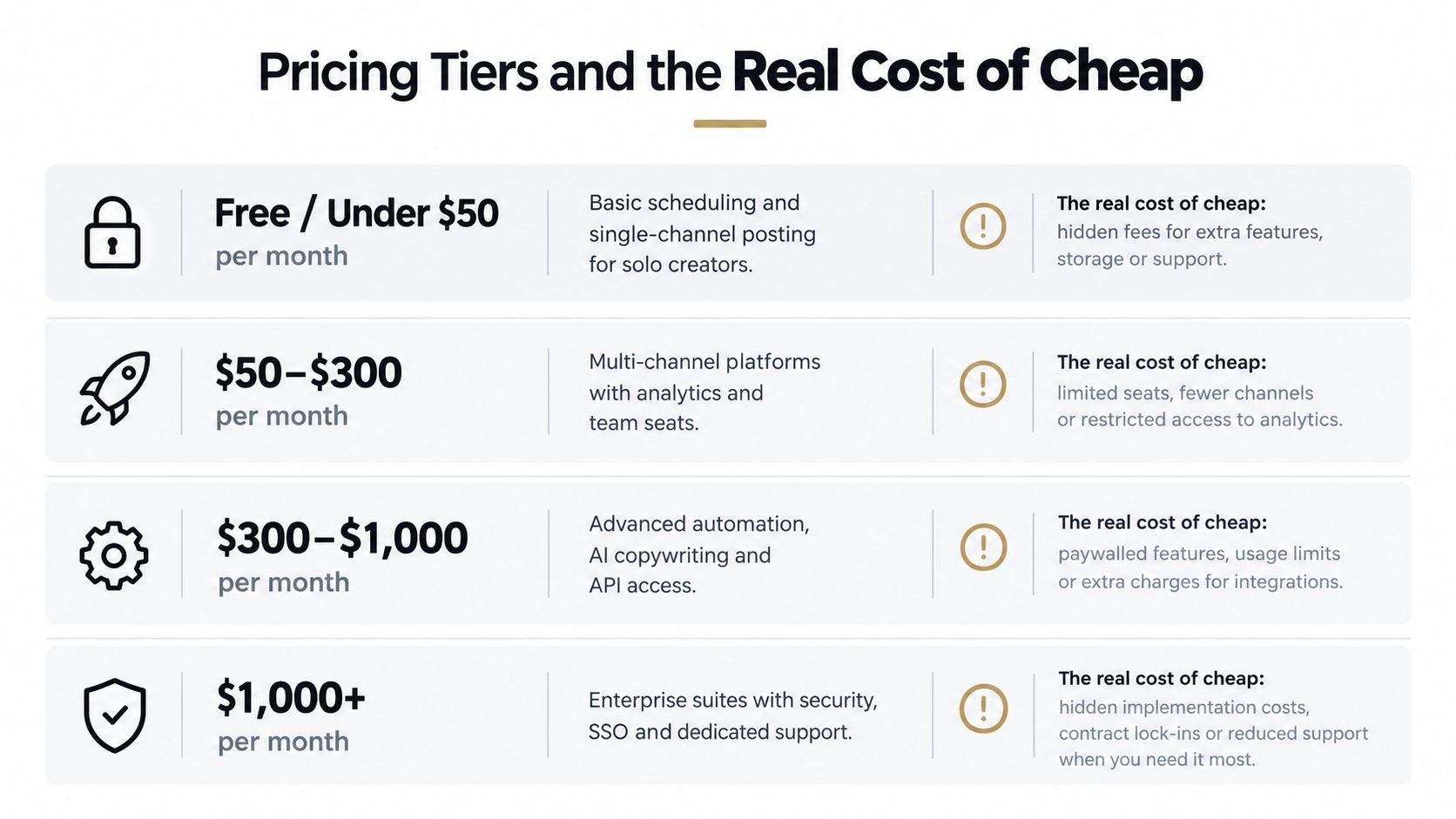
The cheap tier becomes expensive when it handles only the easy part. Someone still reads every comment, copies product links into DMs, checks for scams, and reports outcomes manually. Agencies add retainer margin on top of that labor, while ad teams pay again when creative variation is restricted by seats or usage limits.
A better comparison asks what one resolved conversation is worth. If the system can't show whether a reply helped create a lead, order, or escalation, the subscription is only one line in the cost model.
Cost rule: If a tool costs less than the hourly value of one moderator seat, check whether it automates moderation or merely organizes the queue.
The right tier is the lowest one that closes the actual leak. A creator may need scheduling. A DTC advertiser needs response logic, moderation, and attribution. An agency may need permissions and auditability across clients. Buying enterprise features before the workflow is defined wastes budget, but buying a cheap inbox that leaves revenue recovery manual does too.
How to Pick the Right Stack This Week
Start with three questions:
Where does revenue leak first? Unanswered DMs, public comments, slow content production, or unclear attribution?
How many ad accounts and pages need coverage? One brand and one market require less governance than a multi-client agency.
Is the vertical regulated? If health, finance, insurance, or sensitive personal data is involved, approval and audit controls move ahead of speed.
Then assign one primary job, one supporting capability, and one hard skip.
Persona | Primary Pick | Complementary Tool | Skip |
|---|---|---|---|
DTC founder | Engagement automation | Lightweight content generation | Enterprise listening before response coverage |
TikTok creator | Content generation | Native moderation controls | Complex attribution suites without purchase data |
Telehealth advertiser | Governed moderation | Approved analytics and manual review | Fully automatic sensitive replies |
Agency operator | Centralized workflow and permissions | Cross-client listening | Disconnected single-account tools |
Most teams should start with one engagement tool plus one content tool. Add dedicated moderation when the brand handles regulated topics or faces recurring abuse. Add deeper analytics only when the account has enough transaction volume to justify the integration and reporting work.
A 48-hour pilot checklist
First, define the event. Choose one ad set, one comment class, and one measurable outcome, such as a pricing question becoming a qualified DM.
Next, verify access. Confirm Meta Business verification, TikTok permissions, page ownership, and the exact inboxes the system can read and write.
Then, write the guardrails. List approved claims, prohibited replies, escalation triggers, opt-out language, and the circumstances that require a human.
Finally, capture consent and attribution. Record the user's qualifying action, the reply sent, the handoff, and the eventual lead or order. Keep a control group or untreated workflow so you can judge incremental value rather than activity.
For teams looking beyond isolated social tools, workflow automation software can help connect approval, routing, and reporting into one operating process. Exerta provides AI employees for replies and moderation across Facebook, Instagram, TikTok, and website chat, with brand controls, escalation workflows, logged actions, and revenue attribution. Its current customer proof includes 250+ brands, a 15% average sales lift, $2M+ recovered, and 99.9% uptime, as stated in the publisher's verified product information.
Run the pilot before expanding spend. If response coverage improves but orders don't, inspect the offer, routing, and landing page. If moderation improves but the team can't explain decisions, strengthen the logs and approval rules before adding more automation.
If paid comments and DMs are leaving revenue on the table, start with one Exerta workflow for buyer questions, spam moderation, or stalled conversations. Connect your live Facebook, Instagram, TikTok, or website chat traffic and measure the conversations that become leads or orders by visiting Exerta.