Guide
Social Media Marketing for DTC: Revenue Guide 2026
Social media marketing for DTC brands drives real revenue. Learn proven strategies to boost sales and grow your brand in 2026.
13 min read
read
·


Your ad account is still spending. The creative is still getting clicks. But the comment section under the best-performing ad is full of the same questions, price pushes, shipping objections, and one-line spam that nobody on the media team owns. That's where social media marketing for DTC stops being a content problem and starts becoming a revenue recovery problem.
The hard part isn't making people see the ad. In 2025, 65.7% of the global population were active social media users, the typical user visited 6.84 platforms per month, people spent about 141 minutes per day on social media, and social ad spend was projected to exceed $276.72 billion according to Sprinklr's 2025 social media marketing statistics. The hard part is catching demand while it's still warm, before the buyer scrolls, doubts, and leaves.
That's why the conversation layer matters. On DTC accounts, the ad is no longer just the paid asset. The comment thread, the DM inbox, and the website chat widget are part of the same buying path, and if they're slow, messy, or silent, they leak revenue you already paid to create.
Table of Contents
Why the Comment Section Is Now Part of Your Ad
A buyer sees a winning Meta ad. CPA looks fine. Creative is still fresh. Then the comments fill up with “Is this legit?”, “How much is shipping?”, and “Does it fit true to size?” The ad didn't really lose to the audience. It lost to its own thread.
That shift matters because social is no longer just a branding layer. In the 2025 DTC marketing survey, 58% of respondents allocated at least 41% of their marketing budgets to digital channels, and they expected social commerce (53%) and social media influencers (47%) to drive conversions in the first half of the year, with social media influencers (70%) and retail media (59%) taking over in the second half per Digiday's summary of the survey. The point isn't the exact mix. The point is that DTC teams already treat social as a revenue channel, not just a content channel.
The thread changes the click
Shoppers now use social to research and buy in the same session. One DTC roundup says 82% of consumers use social media to discover and research products before buying, and another projects the U.S. social commerce market will surpass $100 billion in 2026 according to Statista's social networks topic page. That makes every public objection a pre-purchase event, not a side conversation.
If a stranger can read the objection under the ad, the objection becomes part of the ad.
That's why the comment section, DMs, and chat shouldn't sit with support alone. They need the same ownership as the creative. A polished testimonial can help, but one timely reply to a real objection often does more work because it answers the exact friction a buyer is already carrying.
For a deeper breakdown of that shift, see why your comment section is free ad research.
The DTC Social Funnel From Discovery to Checkout
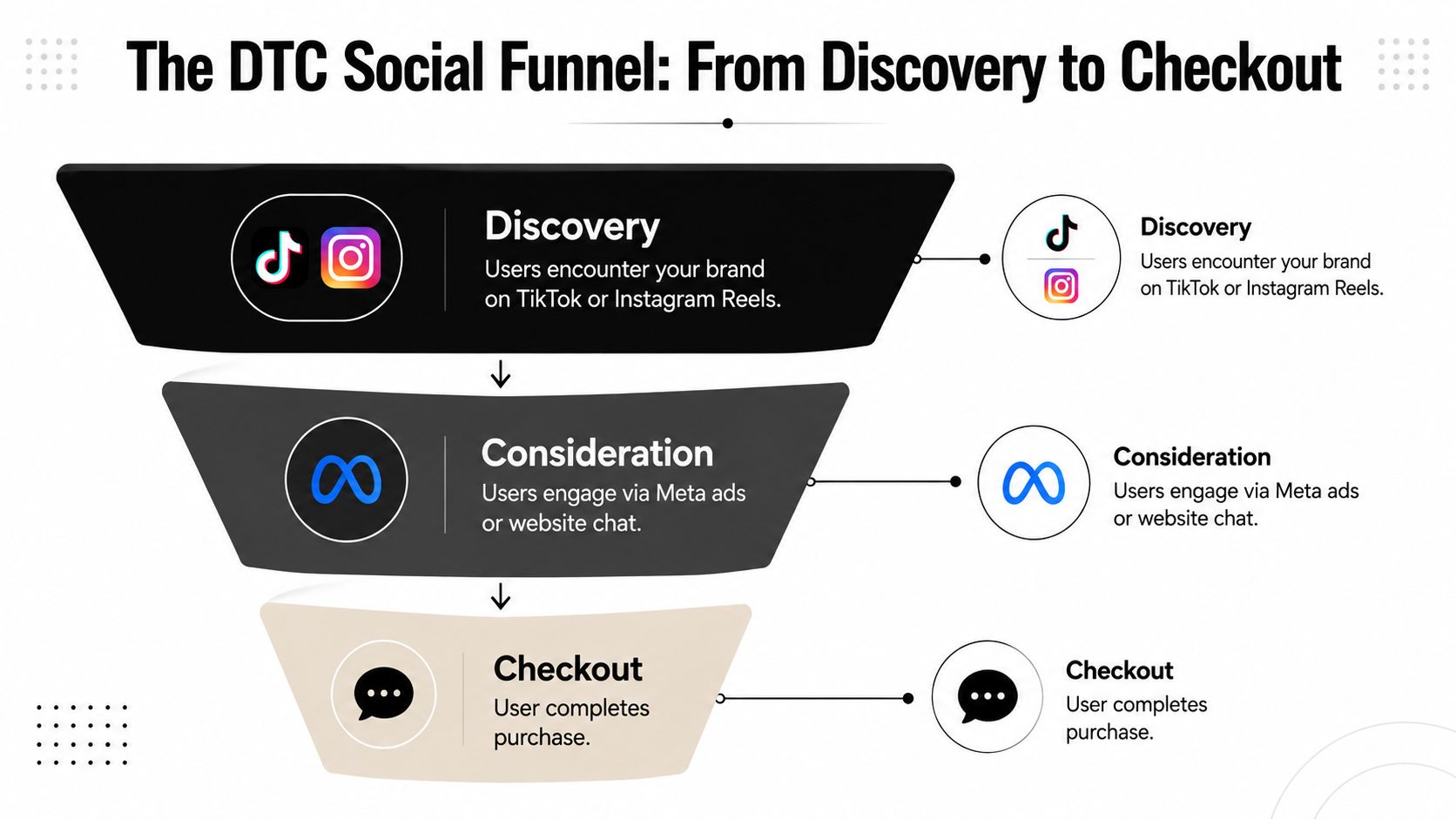
DTC audiences don't move through social in a straight line. They bounce between discovery on short-form video, validation in comments, retargeting through paid social, and last-mile questions in chat. If you want the channel to pay back, each surface needs a specific job.
Match the channel to the job
Use TikTok and short-form Reels for discovery. That's where new people meet the offer, the hook, and the creator-style proof. Use Meta and Instagram for retargeting and conversion. That's where intent gets compressed into a purchase decision, especially when the buyer has already seen the product once.
Use web chat for high-intent landing pages. If someone lands on a product page and asks about fit, stock, or shipping, that's not a casual browse anymore. It's a buying question.
The technical discipline is simple, even if the execution isn't. Split paid creative, organic content, and conversation surfaces, then measure them as one revenue system. The best DTC teams connect the discovery layer to MER, CAC payback, and net-new revenue, not likes or shares.
A useful operating rule is to keep the funnel role obvious in the asset itself. Top-of-funnel content should look like discovery. Mid-funnel content should answer objections. Bottom-of-funnel ads should push a clean product action or retargeting outcome. That kind of funnel alignment is what keeps media buying from turning into guesswork.
Where the next layer fits
The tactical pieces below sit on top of that funnel map. Comment moderation protects the ad, DM speed protects the buyer window, and sales recovery flows turn social intent into tracked orders. If those three pieces aren't connected, the funnel breaks at the exact moment a customer is ready to spend.
Hide, Reply, or Escalate, A Comment Playbook
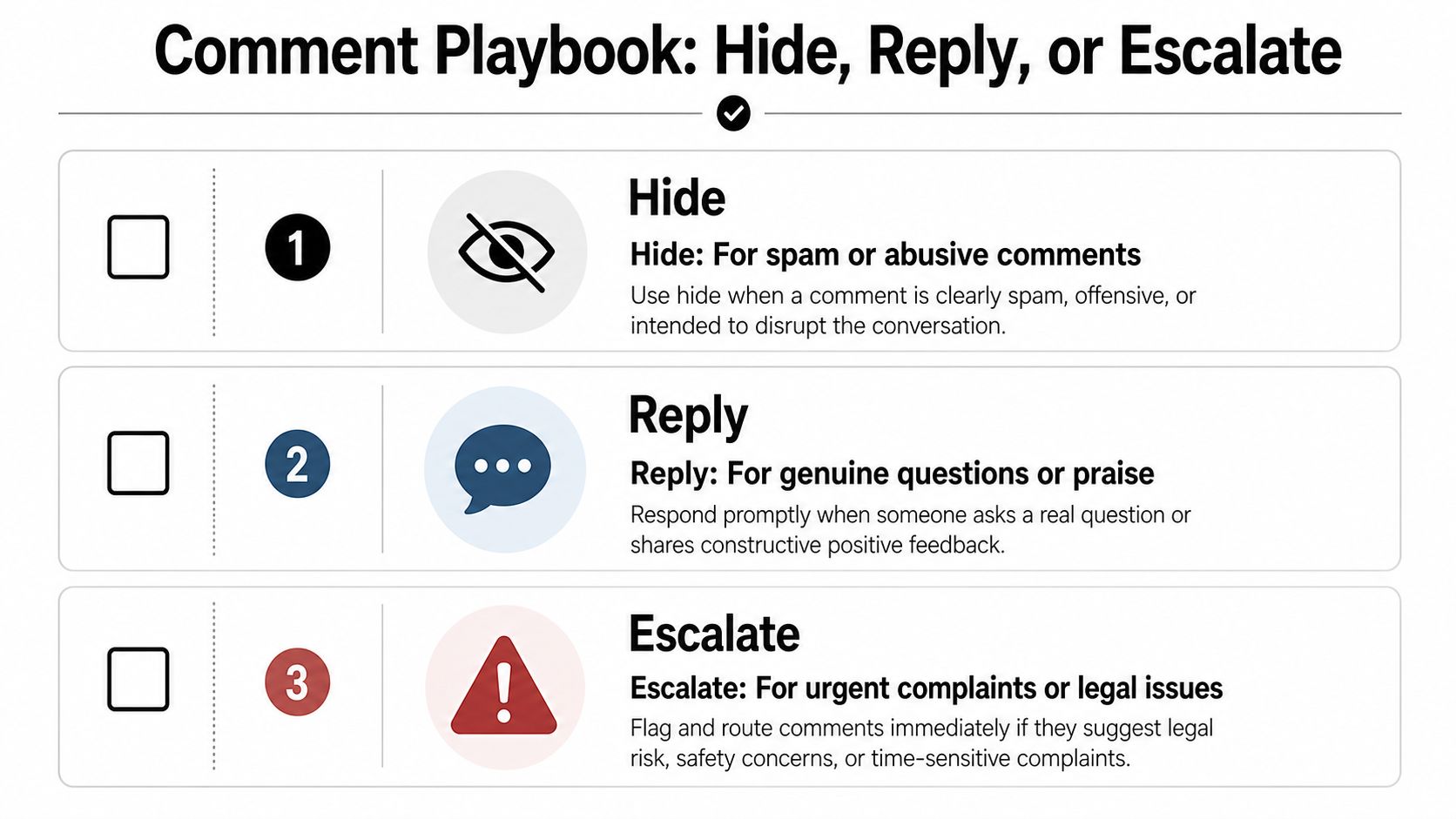
A paid comment thread can either recover revenue or burn it. Every comment needs one of three actions, hide, reply, or escalate. Anything outside those three wastes attention.
Hide the junk fast
Hide crypto spam, DM-me-to-collab bots, competitor links, and pure abuse. Those comments pull attention away from real buyers and drag the thread off topic. On Meta, hiding is invisible to the commenter, so there's no public blowback.
That matters because the thread has to stay useful for people who might still buy. If a comment takes value from the audience instead of adding to the conversation, hide it.
Reply to buying signals
Reply to real questions, objections, and near-buyers. “Too expensive” deserves an answer. So does “Is this a scam?” and any comment asking about price, stock, fit, or discounts.
A strong reply doesn't need a speech. It needs a clean next step.
Price objection: “Fair question. Here's the price, and here's what's included.”
Trust objection: “Totally fair to ask. We can share the details that help you verify it.”
Fit question: “Here's the sizing note. If you're between sizes, start with the larger one.”
Stock question: “This color is moving fast. If you want it, the link in the reply is the quickest path.”
One good objection reply can outperform a polished testimonial because it answers the exact concern blocking the click. It keeps the buyer in motion instead of forcing them to hunt for the answer elsewhere.
Escalate issues that need a human owner
Escalate actual customer complaints, legal concerns, damaged orders, or any thread that can turn into a public support ticket. Acknowledge publicly, then move the conversation private with a clear handoff. That keeps the ad thread from turning into a service desk.
For a tighter handoff process, use this practical escalation guide. The rule is simple. Answer what helps the sale, hide what poisons the thread, and escalate what needs a human owner.
A comment policy only works when the team can use it in seconds.
The 24-Hour DM Window and Why Slow Teams Lose Sales
A DM at 9 p.m. on Friday can be a real buying signal. By Monday morning, it can be dead. That's the business reality behind the 24-hour messaging window in Meta-style messaging workflows. The window opens when the buyer sends the message, and the sales pipeline inside it expires if the team waits too long.
Treat the clock like revenue, not compliance
The mistake is to file DMs under support etiquette. They're closer to live demand. If someone asks about shipping, sizing, or a discount code and gets no answer until the next day, the intent cools. The click never turns into an order.
Public comments don't have the same hard cutoff, but the attention decay is similar. A slow reply under the post can still cost the sale because the buyer is reading in the moment. That's why comments and DMs need the same urgency when the question is clearly tied to purchase intent.
Reply in seconds when the signal is hot.
Build an always-inside-the-window operating model
The clean model is simple. New comments and DMs trigger an instant response. High-intent questions route to a trained flow. Human escalation only happens when the message turns into a complaint, edge case, or back-and-forth that needs judgment.
That means your team shouldn't measure response speed in hours. Measure it in seconds. If a buyer reaches out during an evening drop, a weekend promo, or a holiday push, the system should still answer while the buyer is still in the session.
For the underlying mechanics, see the messaging automation guide. The main point is operational, not technical. If the answer arrives after the moment of intent, it's often too late.
AI Employees, Chatbots, and Hired Moderators Compared
Many teams choose the conversation layer poorly by comparing shiny features instead of operational outcomes. For paid social, the core question is simple. Who answers fast, stays on voice, escalates cleanly, and leaves a usable revenue trail?
What each option is good at
Rule-based chatbots are cheap and predictable, but they're rigid. They fail when the buyer asks something slightly off script, and the reply often sounds stiff or off-tone. That can help with basic routing, but it's weak for nuanced sales conversations.
Hired moderators are flexible and human, but they're expensive and usually tied to office hours. They can handle edge cases well, yet the voice drifts across shifts and the response gap gets wider after hours.
AI employees sit in the middle in the right way. They can answer comments, DMs, and chat fast, keep a trained brand voice, and log attribution in a way media teams can use. They still need escalation rules and oversight on edge cases, but they solve the part where speed is a common financial loss.
Pick the right job for each layer
Layer | Best fit | Main risk |
|---|---|---|
Simple routing | Rule-based chatbot | Rigid replies |
High-volume brand voice | AI employee | Needs escalation rules |
Complex complaints | Hired moderator | Slow coverage |
The comparison only matters if you're honest about what the team is trying to protect. If the job is basic FAQ handling, a simple bot may be enough. If the job is recovering paid social demand at speed, AI employees are the more practical fit because they combine always-on coverage with measurable action.
For a closer look at the trade-offs in moderation systems, see this moderation tools guide.
A Same-Day Playbook for Recovering Sales From Social Conversations
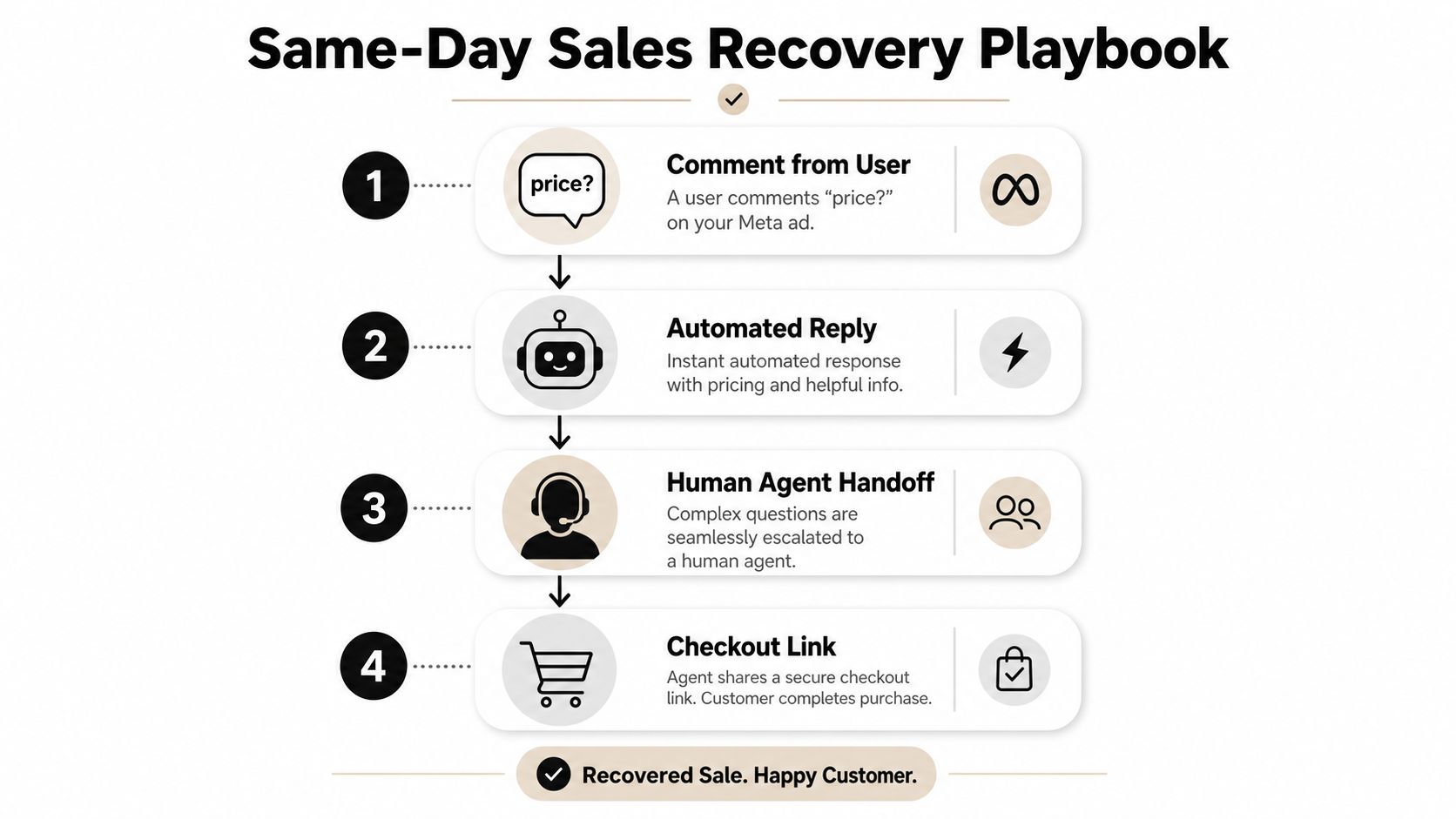
A buyer sees the ad, leaves a price question, and the thread starts to decide whether that visit turns into cash or disappears. The fastest way to prove value is to run one ad through a recovery flow before the day ends, then watch comments, DMs, and chat handle the sales work that ad traffic already created.
Start with the price question
A buyer comments, “price?” The system replies immediately with a one-line answer and a tracked checkout link. Keep the copy short.
Use something like this:
“It's [price]. Here's the product page with today's offer.”
The link needs to preserve attribution so the order can be traced back to the ad, the thread, and the reply. If the cart gets abandoned within the window, send a follow-up in DM with the same voice and a clear next step. Don't bury the offer in a paragraph.
Mirror the flow on TikTok and in agency work
TikTok needs a lighter tone. Reply in the thread first, then move to DM if the buyer asks for details or hesitates. Short links matter here because the interaction feels creator-led, not checkout-led.
Agencies should run the same flow across multiple client pages, but keep brand voice separate. One client can sound blunt. Another needs a softer hand. The reply logic stays the same, but the wording should change with the account.
Watch the four triggers that move money
The most consistent revenue triggers are price, stock, discount code, and shipping time. Those are the questions that tell you someone is close to buying.
You can test this today without rebuilding the whole account. Turn on instant replies for those four triggers, route the hottest questions to a checkout link, and compare recovered orders against the previous week. The goal is to recover the orders already trying to happen, not to flood the thread with automation.
Adoption data from Exerta shows 250+ brands running this model, averaging 15% more sales with over $2M in recovered revenue attributed in-product and 99.9% uptime according to Exerta. That is the kind of proof teams want before they touch the workflow again.
Measuring Revenue Impact and Attribution
If the conversation layer can't be tied back to revenue, it will lose budget. Media buyers trust what they can see in the dashboard, so the job is to make comments, DMs, and chat visible as recovered sales, not just engagement.
Track the metrics that matter
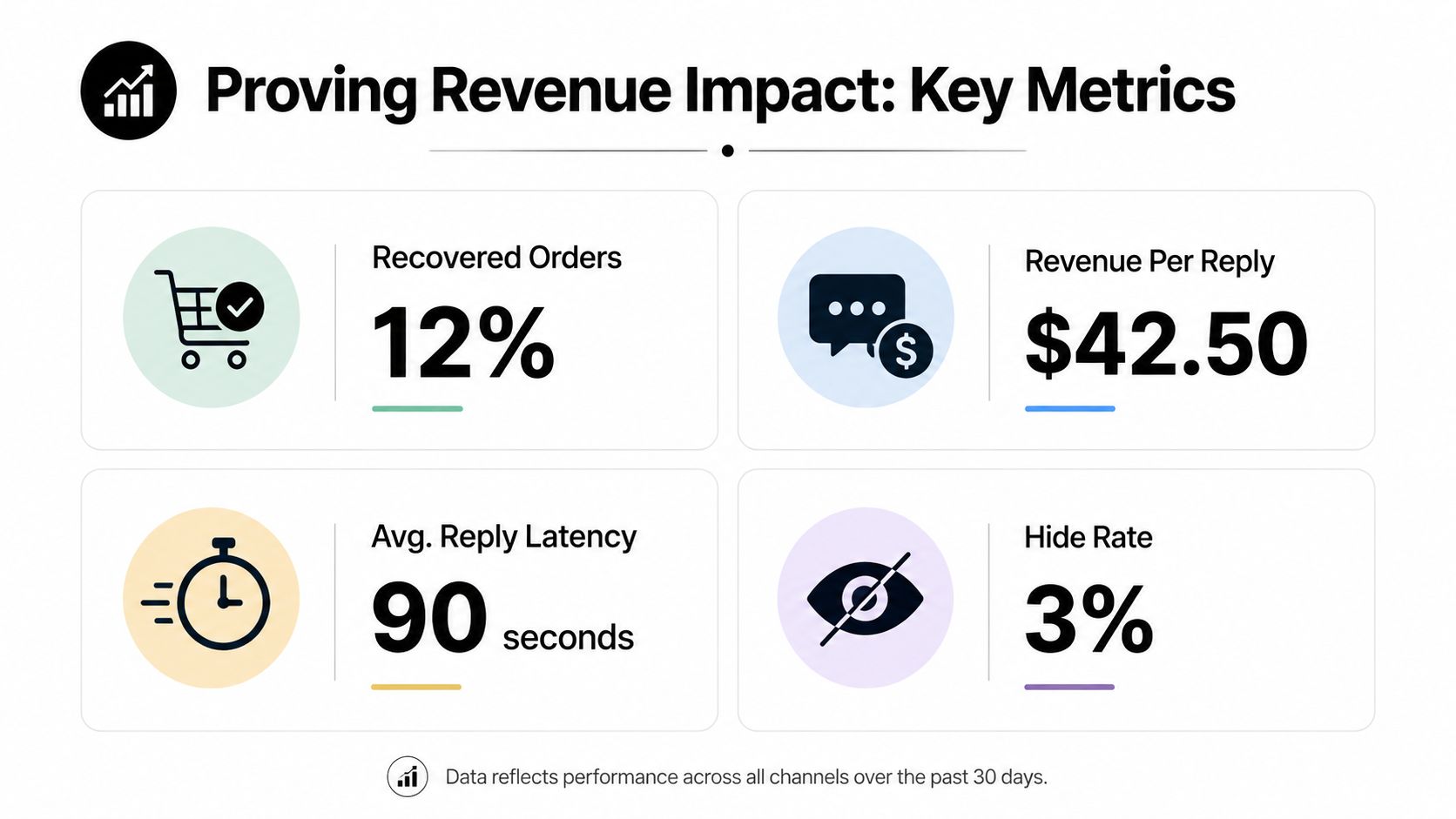
The core metrics are recovered orders, revenue per reply, reply latency, hide rate, escalation rate, and the downstream impact on MER and CAC. Those are the numbers a CFO can read without guessing what the team did.
The dashboard should show action volume on one axis and recovered revenue on the other, with latency and channel filters on top. Week one, you're looking for signal. Month three, you're looking for consistency across ads, products, and audiences.
Wire the thread to the order
Every recovered sale needs a path from comment to order. That means the reply, the tracked link, and the Shopify order need to sit in the same attribution chain. Without that, the media team can't tell whether the thread helped close revenue or just created noise.
That matters because vanity metrics hide leaks. A post can look active while the comment section scares off buyers. Once you map the reply to the order, you can see which message, format, and audience combination moves revenue.
The first 30-day test is straightforward. Hold spend steady, turn on the playbook, and compare recovered revenue per dollar of media before and after. If the number moves in the right direction, the model earned its keep. If it doesn't, the team can see where the leak sits.
What to Change This Week and What to Ask Before You Buy
Start next Monday with four changes. Audit the comments under your top five spenders. Set hide rules for spam and abuse. Write reply templates for the four highest-value question types. Pick one ad and test instant replies against it.
Ask better questions before you buy
Any vendor pitching AI employees, chatbots, or moderation tools should answer these questions plainly.
Response latency: What does production timing look like in live accounts?
Revenue attribution: Can the system connect replies to recovered orders?
Voice control: How tightly can brand tone be trained and reviewed?
Escalation path: What happens when the thread needs a human?
Channel coverage: Which surfaces are live today, and what's only roadmap?
Uptime proof: How stable is the system in real use?
For a broader workflow lens, this automation workflow guide is a useful reference point.
The right question isn't whether AI belongs in social. It's which conversation surfaces are leaking revenue right now, and which system closes the loop from ad click to recovered order.
If your comment sections and DMs are already influencing purchase decisions, Exerta gives you a way to manage them like a revenue channel instead of a support queue. It deploys AI employees across Facebook, Instagram, TikTok, and website chat to reply, moderate, and recover sales in brand voice with every action logged. Visit Exerta if you want the conversation layer tied back to revenue instead of left to chance.

