Guide
What Does DM Mean on Instagram for Brands and Creators
What does DM mean on Instagram? Learn the direct message definition, common use cases, the 24-hour window rule, and why brands automate DMs to recover sales.
9 min read
read
·


DM means Direct Message on Instagram, a private inbox conversation, and it's the difference between a buyer getting a checkout link tonight or disappearing by Monday. I've watched that happen because the clock keeps running after the comment is posted, and a slow reply can turn a hot lead into a lost order.
Table of Contents
The Short Answer for Anyone in a Hurry
DM means Direct Message, and on Instagram it's the private inbox channel, not a public comment or story reply. Instagram's own feature page says DMs are an in-app tool for exchanging text, photos, Reels, and posts with one or more people, which makes them the platform's private interaction layer rather than a public engagement surface. Instagram's Direct feature page
A Friday night is where meaning shows up. A buyer comments on an ad, then sends a DM asking for size, stock, or a link. If your team waits until Monday, the conversation often isn't just stale, it's dead. The buyer has already moved on, and the order is gone.
That's why DMs matter for brands, agencies, and creators. They're not slang. They're the private path where interest turns into action, especially when public attention from paid social needs a fast follow-up. If your current engagement process still treats Instagram like a broadcast channel only, start with this DTC social media marketing guide and then come back to the inbox.
Practical rule: If the question is transactional, move it to DM fast. Public comments can support visibility, but the deal closes in the private inbox.
What DM Actually Means Inside Instagram
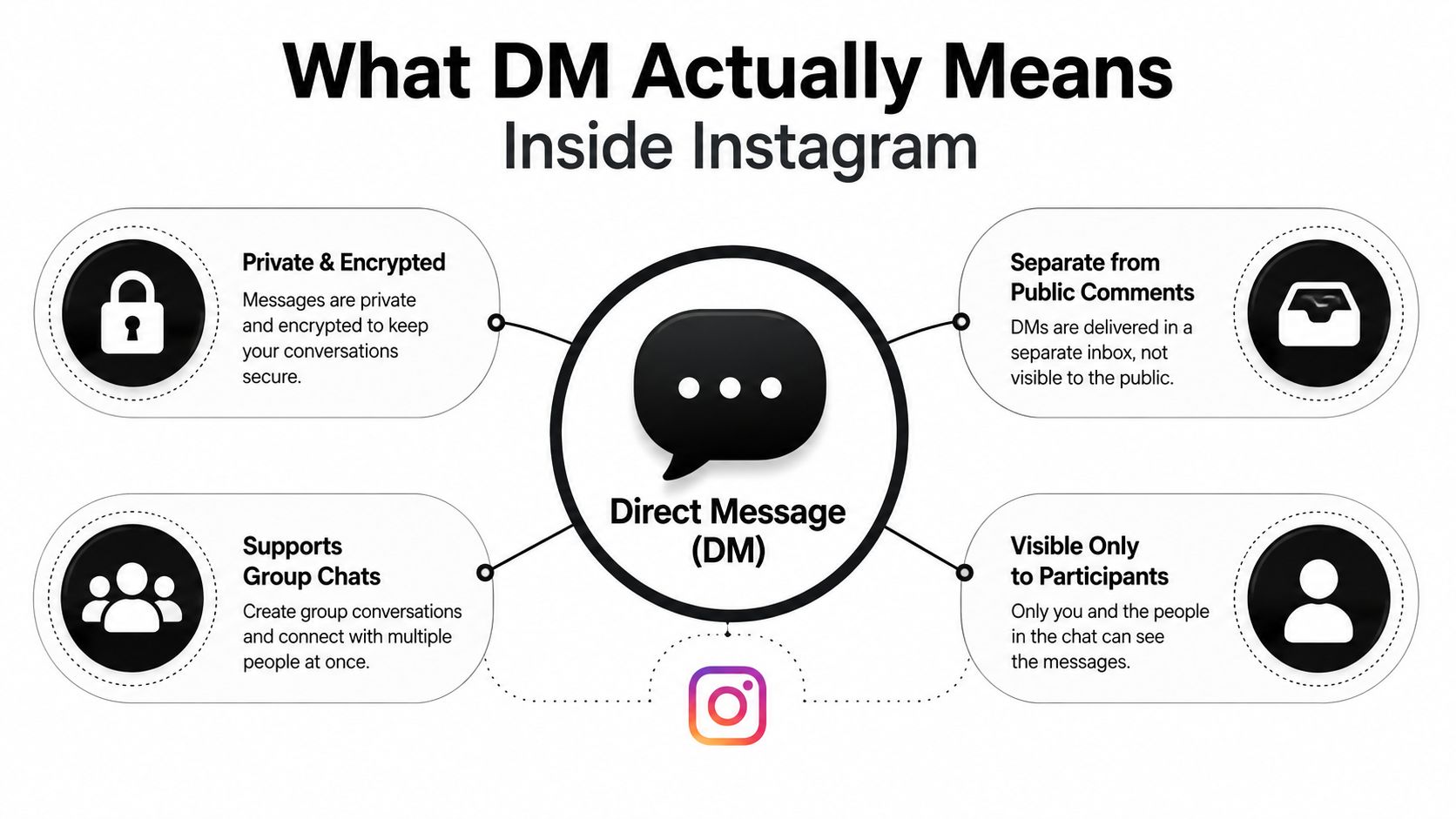
Instagram uses DM as shorthand for Direct Message, a private conversation visible only to the sender and the recipient, or to everyone inside a small group chat. That's different from public comments, and it's also different from story replies, which can look conversational but still don't function like a full private inbox thread. Instagram's Direct feature page
The share icon is where many users meet DMs
Users first run into DMs through the paper-airplane share icon. They tap it to forward a Reel, a post, or a product link into a private thread. That mechanic matters because it shows DMs aren't just replies to stories, they're a separate communication surface for sharing content one-to-one or in a small group. Instagram's Direct feature page
DM also works as both a noun and a verb. A marketer can say, “We got a DM,” or “DM me the link.” That dual use is useful because it matches how teams work, a message can be the unit of work, and sending it can be the action that moves a buyer forward. QuillBot's DM glossary
For brands, the format matters as much as the definition. DMs can carry text, photos, Reels, posts, and links, so the channel supports both conversation and handoff. If you want a deeper workflow example for Reels-driven engagement, UGC Reels for ecommerce is a useful way to see how private follow-up can sit behind public content.
If you're wiring this into your own stack, the channel itself matters more than the phrase. Exerta's Instagram integration is one example of a system built around that private inbox layer.
How Brands Actually Use DMs Day to Day
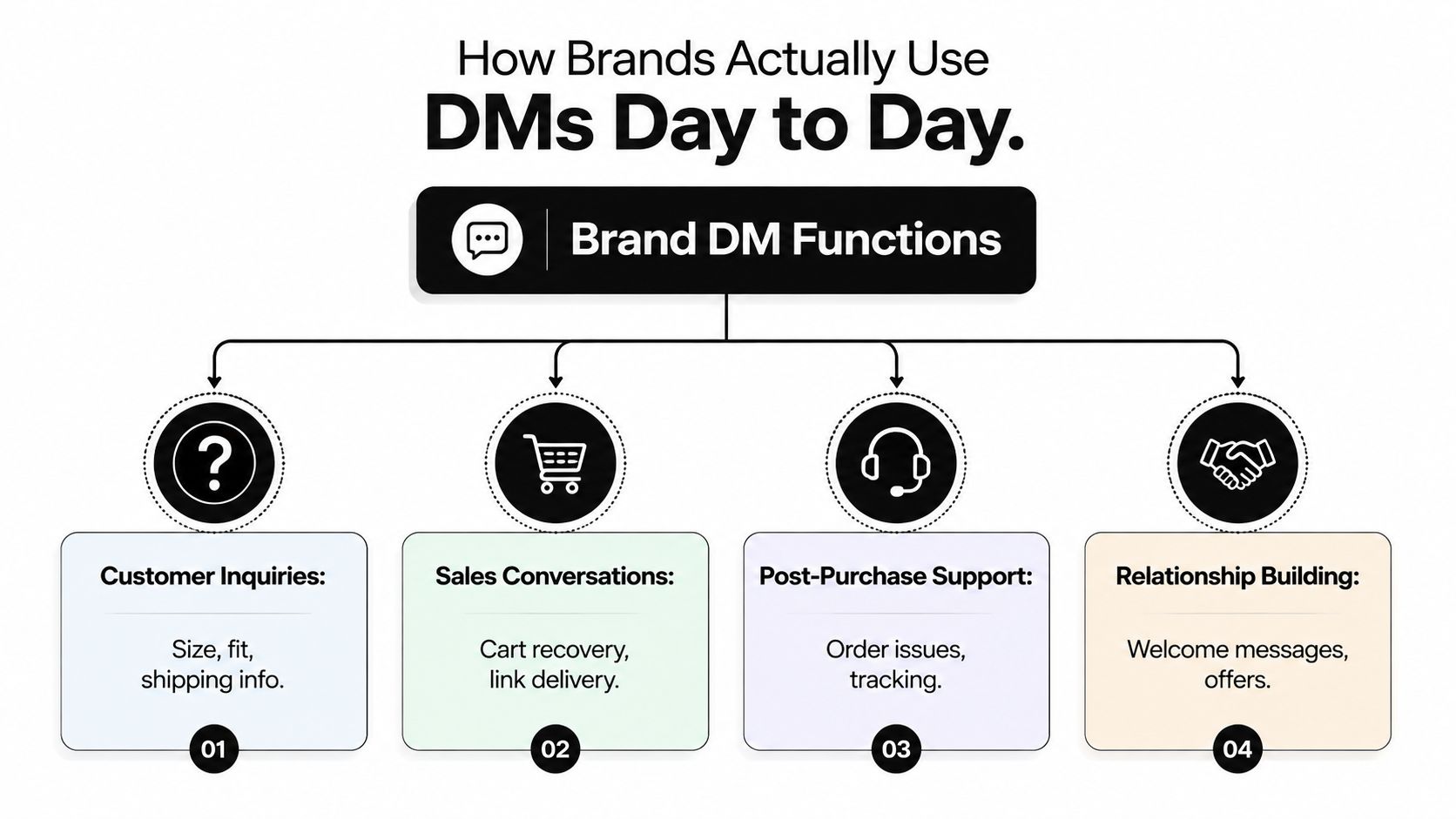
The useful way to think about Instagram DMs is not as a feature, but as a job. In practice, brands use them for pre-sale questions, post-sale support, and short private exchanges that can't happen well in public. One industry guide said 150 million users message businesses on Instagram every month in its 2026 reporting, which lines up with what most operators already feel in the inbox.
The four workflows that matter most
Customer inquiries are usually the first one. A buyer wants sizing, fit, shipping timing, ingredient details, or a quick yes-or-no answer before they buy. That message is short, but it carries buying intent.
Sales conversations happen when the buyer is close to checkout. The team sends the right product link, answers an objection, or shares a private offer that doesn't belong in public. That's where DMs often beat the comment thread, because the exchange stays focused on one person's path to purchase.
Support is the next major use. Order status, returns, refund questions, and missing package issues all fit better in a private inbox than under a public post. The brand protects the customer experience, and the customer doesn't have to expose personal order details in front of everyone.
Relationship building is the last one, and it's more useful than people think. A brand can use DMs for gifting coordination, creator outreach, B2B intros, or a simple follow-up after someone engages with a campaign. These are small conversations, but they keep momentum alive.
Brands that treat DMs as a utility channel get faster answers and cleaner handoffs. Brands that treat them like a side task lose the thread.
A practical way to judge this channel is simple. If the message needs speed, privacy, or a link, it belongs in DM. If it needs visibility, social proof, or discovery, it belongs in public. Exerta's guide on scaling engagement without scaling headcount fits this exact decision point because the inbox is where teams feel volume first.
The 24-Hour Window That Quietly Kills Pipelines
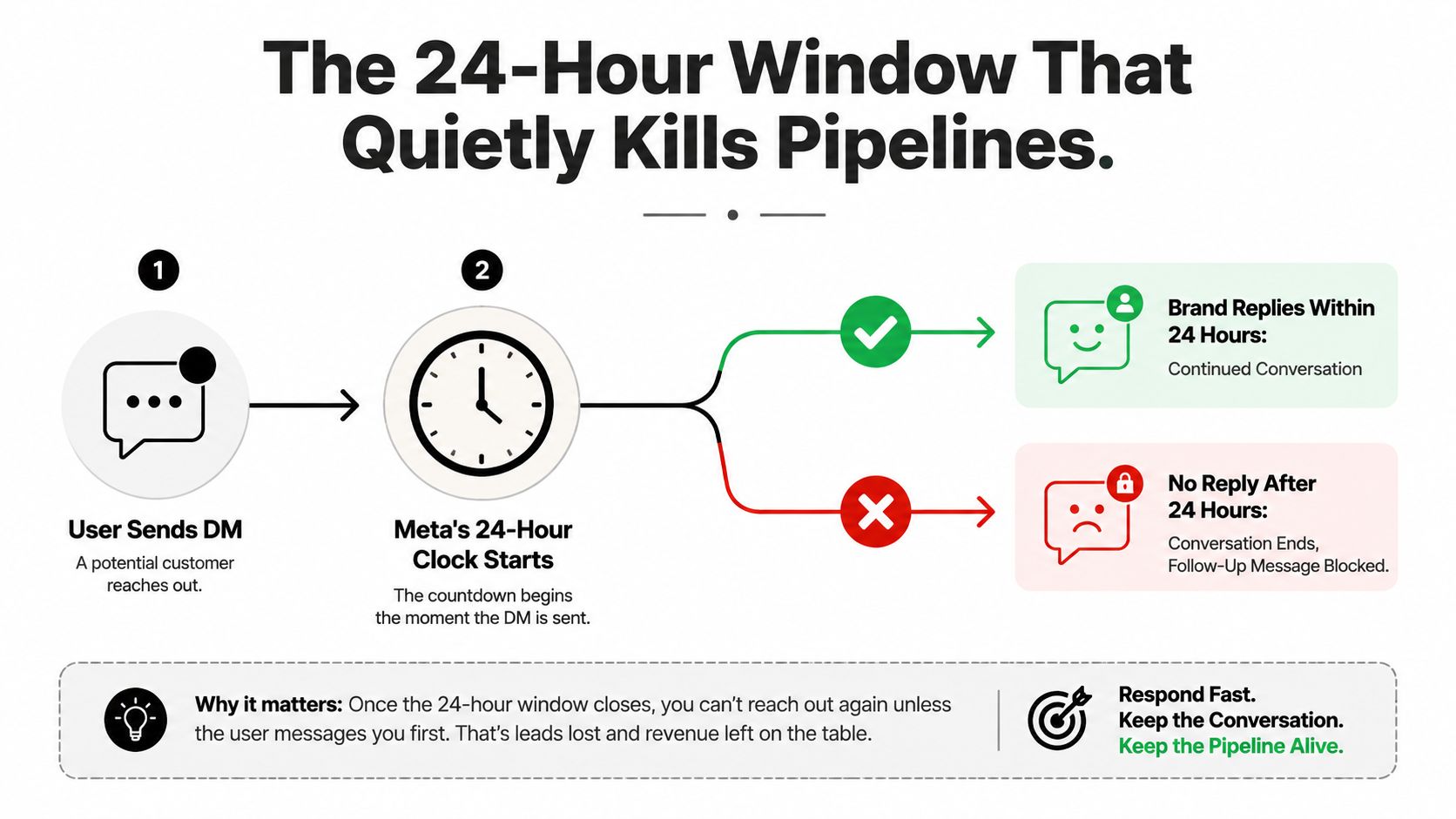
The operational detail many miss is the 24-hour messaging window. When a user messages your business, the platform opens a clock that lets you reply freely during that period. After that, the thread is no longer open in the same way, and your follow-up options narrow. That's the part that kills pipelines when response times slip. Sprout Social's DM glossary
What actually happens when the clock runs out
A buyer DMs at 9pm Friday. Your team sees it Monday morning. By then, the moment is gone. The buyer has likely bought somewhere else, or at minimum the urgency is gone and the thread is harder to revive.
A public comment doesn't carry the same hard messaging deadline, but it still loses momentum fast. A DM is different because it has a built-in expiration for easy follow-up. That's why slow inbox handling isn't just messy, it's expensive.
The common failure case is simple. Someone asks, “Is this still in stock?” at 11pm. The response lands 30 hours later. The buyer has already found another seller. The brand didn't just miss a reply, it missed the purchase path.
Operational truth: Once the window closes, the conversation usually becomes a recovery task, not a live sales thread.
That's also why automation exists in this channel at all. If your media spend generates night and weekend messages, human coverage alone won't protect every opportunity. The window forces a response-time standard, and the inbox either meets it or leaks revenue. If you want the messaging layer that sits behind this workflow, Facebook Messenger automation covers the same operational logic in another inbox.
Why Brands Running Paid Social Automate DMs
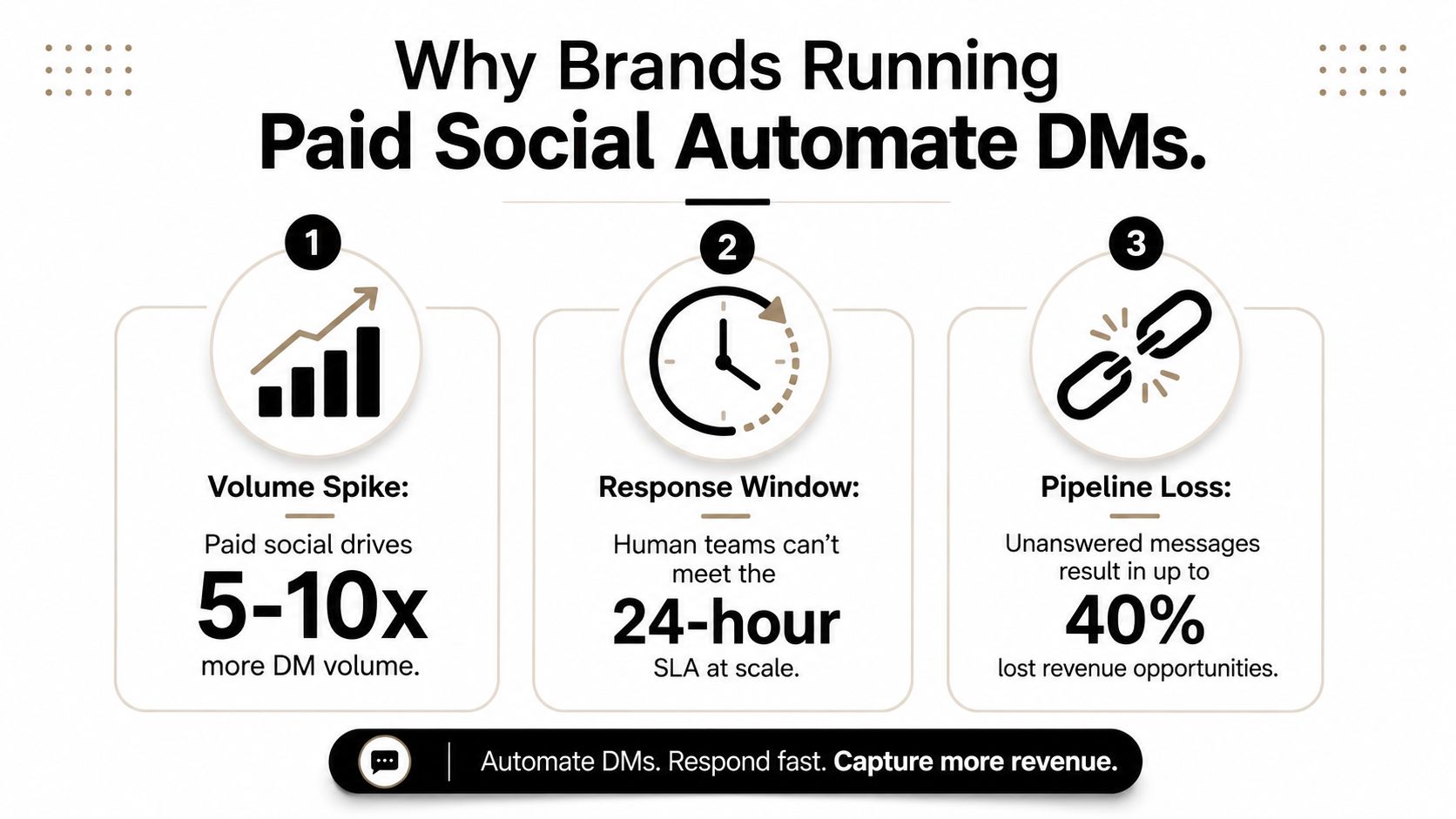
Paid social creates more inbound conversations than companies can answer in real time. That's the core business case for automation. When a brand uses AI employees for comment and DM engagement, Exerta says it sees 250+ brands, an average 15% sales lift, and $2M+ recovered in-product. Those numbers matter because the inbox isn't just support, it's a place where demand either gets captured or lost.
What automation actually does in the inbox
Good automation doesn't try to replace the brand voice. It replies instantly, shares the right link, handles obvious objections, and routes edge cases to a human. It also logs which conversation led to which result, so the team can see what's working instead of guessing.
That matters because response delay compounds. If your team needs to read, route, and answer every message manually, the 24-hour window becomes a bottleneck. Automation keeps the conversation alive while the buyer is still interested, which is the point of the channel in the first place.
Brands also use it to protect consistency. A bad reply can stall a sale as quickly as a slow one. If the answer changes from one teammate to the next, the buyer notices. Automated first-response workflows reduce that drift and keep offers, links, and policy language aligned.
Exerta is one option in this category. It handles comments, DMs, website chat, and social follow-up today, with SMS, email, and voice launching next. For teams who want tighter ad reporting alongside inbox workflows, Instagram ad measurement control is useful context for how campaign tracking discipline connects to revenue attribution.
What works: instant replies, controlled handoff, and clear attribution.
What doesn't: waiting for the next business day and hoping the buyer comes back.
Three Same-Day Examples An Advertiser Can Copy
A good DM workflow is boring in the best way. It fires fast, gives the buyer the next step, and doesn't make the team rewrite the same answer all day. The strongest setups usually look like this.
Comment to checkout handoff
A buyer comments “price?” under a Reel or ad. The public reply stays short and on-brand, then the system sends a private message with the checkout link and a relevant offer. The result is a faster response and a cleaner path from curiosity to purchase.
Objection handling in two steps
A comment says “is this a scam?” The public reply answers the concern with social proof or a plain-language assurance. Then the DM follows with the FAQ, return policy, and order link so the buyer can decide privately. This pattern works because the public thread builds trust while the DM removes friction.
After-hours lead capture
A DM lands at 11pm. The system replies in seconds with the right product, offer, or next step, then either books the lead or tags it for human follow-up at 9am. The full exchange stays logged, which gives the advertiser a record of what happened and what closed.
For teams that want a broader framework for the underlying mechanics, conversational AI business concepts helps explain why the inbox can be treated as a workflow, not just a chat thread.
If the buyer already raised their hand, the job is to remove friction before attention disappears.
DM Is Infrastructure, Not a Feature
DM means Direct Message, but for paid social teams it functions as a private, time-bound conversion layer between ad spend and revenue. The brands that win don't just answer messages, they keep the conversation inside the window, in the right voice, with the right link, and with a follow-up that doesn't drop the thread.
That's the operational shift. The inbox is no longer a place to tidy up later. It's part of media performance, customer support, and sales recovery at the same time. If you treat it like admin, you leave money on the table. If you treat it like infrastructure, you can measure it, tune it, and scale it.
The next layer is already moving toward a unified automation stack, with SMS, email, and voice joining the same workflow. That's where the channel is headed, and it's why the brands that build around inbox speed now will be harder to outpace later.
If you're running Meta or TikTok ads and your DMs are slowing down sales, Exerta can take over the first response, keep the conversation moving, and log what closed the order. Visit Exerta to see how its AI employees handle comments, DMs, and web chat in one place, then decide whether your inbox is working like a revenue surface or just another tab.

