AI Community Management for DTC Brands: A Practical Guide
read
·

A Facebook ad can attract serious buying intent and still lose the sale in its comment thread. Harvard field experiments found that hiding harmful comments increased click-to-registration rate by 16% and return on ad spend by 48% compared with otherwise identical unmoderated campaigns (Exerta's summary of the field experiments). That reframes AI community management. It isn't a productivity add-on for social teams. It's paid acquisition infrastructure.
For DTC brands and agencies, the question is simple: what happens after someone sees the ad? If a buyer asks about sizing, shipping, stock, or price and receives silence, intent cools. If spam, competitor bait, and abusive replies dominate the thread, the ad becomes less persuasive to every subsequent visitor.
The operating model below treats social comments and DMs as part of the funnel. The job is to reply, moderate, and recover sales with speed, clear escalation rules, and revenue tracking that reaches back to the original creative.
Table of Contents
What AI Community Management Actually Does
A brand can spend heavily on a winning ad and still hemorrhage conversions when hot buyers post objections and nobody answers. One shopper asks whether the product runs small. Another asks whether the bundle is still available. A third sees a hostile thread, assumes the brand is unreliable, and leaves without clicking.
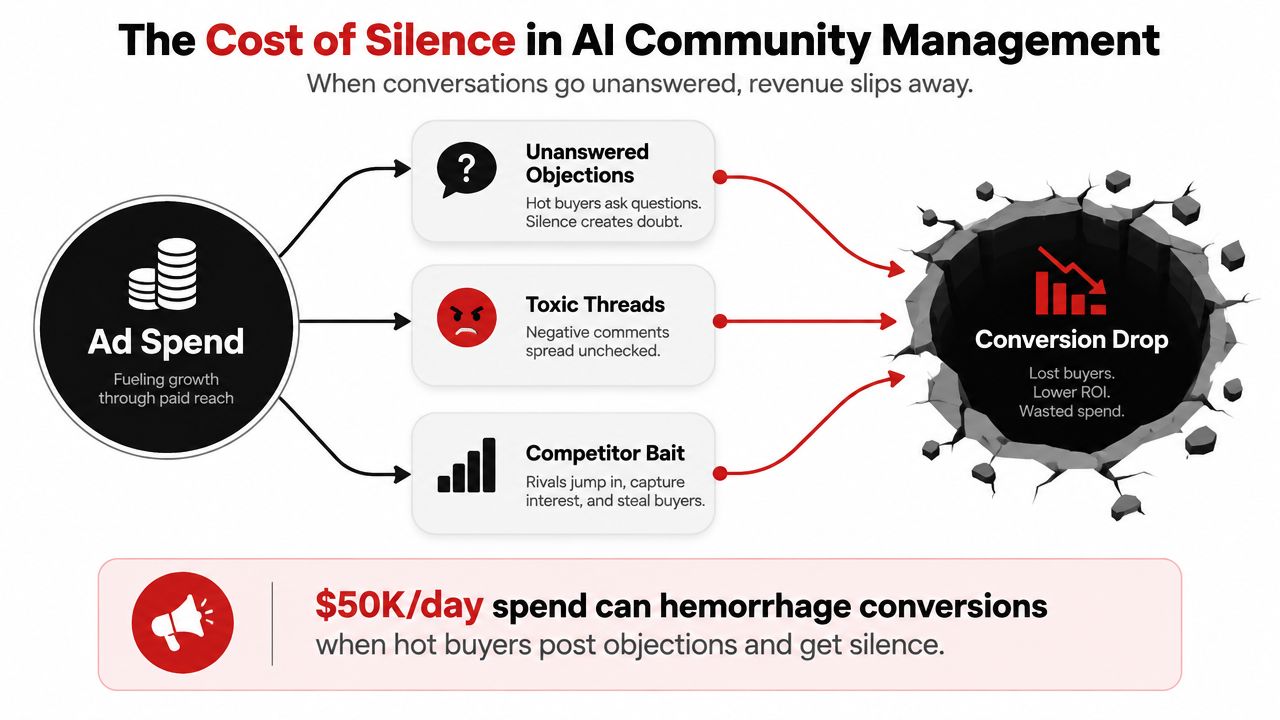
AI community management is the operating layer between paid social and the audience. It reads comments and DMs across Facebook, Instagram, TikTok, and website chat, then applies rules for public replies, moderation, routing, and purchase recovery. It isn't the same as placing a chatbot on a website. A website bot waits for inbound questions. An AI employee can work inside the conversation created by the ad.
The three jobs that matter
Replying means identifying intent and answering in the brand's voice. A useful system can distinguish a genuine product question from sarcasm, a complaint, or a sales opportunity. It can use approved product information, delivery policies, prices, and offers rather than making up an answer.
Moderating means removing content that distracts or harms the buying environment. Spam, scams, malicious links, and competitor promotions should follow predefined rules. Legitimate criticism should not be dismissed just because it's negative.
Recovering means moving a qualified conversation toward purchase. A comment can become a DM, and a DM can become a product recommendation or checkout path. The workflow should preserve the relationship between the original ad, the conversation, and the eventual transaction.
For teams designing the broader operating model, the iHatePosting AI agent guide offers useful context on how agents can handle social publishing workflows. The same principle applies here: automation needs a defined role, usable context, and boundaries for human intervention. Exerta's perspective on real-time customer engagement is relevant for the same reason. The response layer belongs close to the moment of intent, not in a delayed support queue.
The strongest implementation treats every comment as a possible funnel event. Some need a public answer. Some need hiding. Some need escalation. The value comes from making that decision consistently while the buyer is still paying attention.
Replies, Moderation and Sales Recovery at a Glance
The three jobs look similar in a dashboard, but they need different triggers and outputs. A reply workflow optimizes clarity. A moderation workflow protects the thread. A recovery workflow moves the buyer into a private path where the brand can resolve friction and complete the sale.
Job | Trigger Example | AI Action | Visible Output |
|---|---|---|---|
Replying | “Does this run small?” | Detects product intent, retrieves approved sizing guidance, and drafts or posts a response | A helpful answer in the public ad thread |
Moderating | A spam link, scam, or competitor promotion | Classifies the content against moderation rules and hides or escalates it | The harmful comment is removed from the visible thread |
Recovering | “Is the bundle still in stock?” | Checks approved inventory context, confirms the relevant offer, and opens a DM path | A public invitation to continue, followed by a private purchase step |
Public replies need restraint
A public comment has two audiences: the person who asked and every future buyer reading the thread. The answer should resolve the objection without exposing private order details or making a promise the brand can't verify.
For example, a sizing question might receive a concise answer that points to the correct size guidance and invites the shopper to share measurements in DM if they need help. A shipping question can follow the same pattern. Publicly answer the general policy, then move order-specific details to a private channel.
TikTok adds its own operating surfaces, including Q&A formats and creator reply threads. The language can be more conversational, but the decision logic stays consistent. Detect the intent, use approved information, and distinguish a response that helps the buyer from one that merely adds activity.
Moderation should protect buyers, not silence them
The dangerous shortcut is a single “negative” filter. Negative sentiment can indicate a real objection that deserves an answer. The better rule set separates abuse, spam, scams, competitor promotion, repeated disruption, and legitimate dissatisfaction.
The AI should read more than isolated keywords. It needs the comment text, the surrounding thread, and any relevant customer context the brand is permitted to use. It should also log the action and the rule that caused it, so a human can review false positives and adjust the policy.
A practical guide to the public side of this work is Exerta's explanation of Facebook comments on ads. The point isn't to answer everything publicly. It's to make the public thread useful enough that a qualified shopper can keep moving.
A Same-Day Playbook for Meta and TikTok Ads
The first day of a new creative creates a concentrated operations problem. Comments arrive before the team knows which objections will dominate, and the highest-intent questions can sit beside spam or abuse. A same-day playbook gives the AI employee clear actions while leaving sensitive decisions with a person.
Hour 0
Start with moderation rules before the creative receives meaningful traffic. Auto-hide obvious spam, malicious links, scams, and competitor promotions. Don't automatically remove every complaint. Route ambiguous content for review, especially when the comment could reveal a product or fulfillment problem.
Hours 1 through 4
Identify the comments receiving the strongest engagement and answer the objections that are likely to affect more buyers. If shoppers ask about size, shipping, ingredients, compatibility, or returns, use approved brand-voice templates and product data.
The answer should be short enough for a public thread. Avoid a generic “please contact support” response when the brand can resolve the question directly. Every unanswered objection becomes a reason for the next shopper to hesitate.
Hour 5
Route comments involving price, shipping, sizing, stock, or a specific product variant into DM when a private conversation is useful. The AI should carry the context forward, confirm the relevant SKU or offer, and provide the correct checkout path. Meta's messaging policy gives businesses a 24-hour window for free-form messages after a qualifying user action, and that window resets when the user interacts again (practical guidance on the Meta messaging window).
Hour 8
Escalate a sudden negative-sentiment spike, a repeated product complaint, or a regulated claim. A human should decide whether the issue needs a public response, creative adjustment, support intervention, or campaign pause.
TikTok needs the same sequence across its Q&A and creator reply surfaces, but operators should watch velocity closely. A fast-moving thread can change shape before a manual moderator opens the dashboard.
Operational rule: Reply while intent is warm. Don't wait for the daily community-management pass if the comment is attached to an active ad.
A 2025 consumer survey found that 52% of social media users expect a brand response within an hour, including 10% within five minutes, 22% within thirty minutes, and 20% within an hour (Marketing Charts survey summary). The exact service level depends on the campaign, but the direction is clear. Slow responses create conversion leakage.

AI Employees vs Chatbots vs Human Moderators
These categories solve different problems. Confusing them leads brands to buy a website chatbot when the actual bottleneck is an unpaid social comment, or to hire moderators for a workload that needs continuous automation.
Capability | AI Employees | Chatbots | Human Moderators |
|---|---|---|---|
Speed | Can respond quickly inside comments and DMs | Fast inside a defined chat flow | Slower when volume rises or queues build |
Coverage | Social comments, DMs, moderation, and recovery workflows | Website chat and structured FAQs | Broad judgment across channels |
Attribution | Can associate actions with campaigns and conversations when instrumented correctly | Often limited to chat events | Usually disconnected from ad-level revenue |
Cost model | Typically a flat SaaS fee | Commonly priced by seat or conversation | Hourly staffing or agency cost |
Best use | Repetitive intent, moderation rules, and purchase routing | Inbound questions with predictable paths | Sensitive complaints, exceptions, and cultural judgment |
Failure point | Sarcasm, ambiguity, and regulated claims | Questions outside scripted flows | Scale, consistency, and response speed |
Where AI employees earn their place
An AI employee lives inside the paid-social conversation. It can answer a product question publicly, hide a harmful comment according to policy, and continue a qualified buyer's path in DM. That combination matters because the buyer doesn't need to restart the conversation in a separate support channel.
It still needs limits. Sarcasm can invert the apparent sentiment. A health-related claim can require qualified human review. A discount or inventory statement must come from controlled data, not a guess.
For a deeper distinction between scripted chat and broader agent workflows, see Exerta's comparison of chatbots and AI. Teams evaluating sentiment systems can also use this overview of modern sentiment analysis approaches to understand why classification needs context rather than a simple positive-or-negative label.
Humans remain the escalation layer
Human moderators win when the issue involves nuance, reputation, policy interpretation, or a customer who feels wronged. They should review regulated claims, threats, unusual payment issues, influencer disputes, and complaints that could signal a wider operational failure.
The practical model isn't AI or humans. It's AI for repeatable decisions, humans for consequential ones, with an audit trail connecting both.
Why Comment Moderation Is a Paid Acquisition Lever
Comment moderation belongs inside the paid funnel because buyers see the thread before they decide whether to click, trust, or purchase. It isn't merely a brand-safety task handled after the media team has finished its work.
The scale of automated moderation on major networks shows why manual review alone isn't enough. A 2023 analysis of DSA transparency reports recorded 46,697,806 moderation decisions on Facebook, 76,298,413 on Instagram, 1,957,113 on X, and 3,999,960 on TikTok in a reporting period. Automation accounted for 93.95% on Facebook, 98.45% on Instagram, 74.07% on X, and 45.02% on TikTok (Platform Governance analysis). Those figures describe platform-level systems, but they underline the operating reality for advertisers. High-volume environments depend on automation.
The mechanism is straightforward
A successful ad attracts useful questions, repetitive objections, spam, and hostile content at the same time. If the brand leaves the thread untouched, a legitimate buyer may see misinformation or abuse before seeing an answer to the original product question.
Hiding harmful comments can improve the environment in which the ad converts. In the six-study Harvard Business School paper, automated comment management causally improved advertising outcomes across field experiments on Trustpilot, Instagram, and Facebook (Harvard Business School paper). The result isn't that every negative comment should disappear. It's that harmful spillover can affect the performance of the underlying campaign.
A clean comment thread is part of the landing experience when the ad itself carries the buyer into the conversation.
The second-order benefit is trust. A useful thread answers objections once for many future visitors. A polluted thread forces each buyer to perform more risk assessment, which weakens the path from impression to click.
Brands should also keep adjacent security controls in view. Guidance on Shopify security for merchants is useful when teams connect social traffic, checkout systems, and automated activity. The comment layer shouldn't become a new route for abuse or fraudulent requests.

DTC Brands vs Agencies - Workflows That Scale
A DTC brand and an agency can use the same AI employee category, but they shouldn't run the same workflow. A brand usually needs speed and simplicity across its own pages. An agency needs separation, approvals, reporting, and client-specific rules.
The DTC operating model
Start with a compact ruleset that the internal team can understand and change without a project plan:
Hide clear abuse and spam: Remove scams, malicious links, and competitor promotions automatically.
Answer routine objections: Use approved responses for shipping, sizing, pricing, product use, and returns.
Route sensitive issues: Send complaints, payment problems, and regulated topics to a named support owner.
Recover buying intent: Move qualified questions into DM with the relevant product and checkout path.
Review the exceptions: Sample automated actions and update rules when legitimate buyers are misclassified.
This model works when the brand owns the product data, support policy, and escalation destination. The AI doesn't need to imitate every employee. It needs a narrow job description and reliable information.
The agency operating model
Agencies manage variation. Each client may use a different tone, offer structure, fulfillment policy, and approval threshold. A single global prompt creates risk because the reply that works for apparel may be inappropriate for supplements, financial services, or lead generation.
An agency workflow should include:
Client-level templates for voice, products, offers, and forbidden claims.
Role-based approvals so account managers can't publish sensitive replies without client sign-off.
Named escalation paths for complaints, legal issues, and potential PR incidents.
A shared dashboard that surfaces comments and DMs across accounts without mixing data.
White-label reporting that connects moderation actions, recovered carts, and campaign outcomes to each client.
The trade-off is clear. Brands often want replies to ship immediately. Agencies need guardrails that match their contracts and approval obligations. A useful operating reference is Exerta's guide to social media management for agencies, especially for separating reusable workflow logic from client-specific controls.
KPI Tracking and Dashboards That Prove Impact
A dashboard that reports comment volume is not enough. Operators need to show whether automation protected the ad, preserved intent, or recovered revenue that would otherwise have disappeared.
Use four layers of measurement:
Layer | KPI | Source | Target |
|---|---|---|---|
Response | Reply latency | Comment and DM event logs | A defined service level during active ad flights |
Moderation | Hidden-comment rate | Moderation action logs | A reviewed rate that removes abuse without suppressing valid objections |
Recovery | DM-to-checkout conversion and attributed recovered revenue | DM events, checkout events, UTMs, and shop activity | A rising share of qualified conversations reaching purchase |
Campaign | Ad-level ROAS and contribution from managed conversations | Ad-set reporting joined to conversation IDs | Compare against a pre-automation control period |
Measure the path, not the activity
Reply latency tells you whether the system reaches buyers while they're active. Hidden-comment rate tells you how much content the rules are removing, but it doesn't tell you whether those decisions are correct. Review a sample of hidden and retained comments so the metric reflects feed hygiene rather than aggressive deletion.
For recovery, connect the conversation to the original creative. Use UTMs, campaign identifiers, product IDs, and checkout events wherever the platform and consent model allow it. If a buyer asks about a bundle in a comment, enters DM, receives a product link, and purchases, the dashboard should preserve that sequence.
Exerta reports 250+ brands, a 15% average sales lift, $2M+ recovered, and 99.9% uptime as product figures on its publisher information. Treat those as vendor-reported claims and validate them against your own baseline before using them in a forecast.
Build a control period
Don't launch automation and compare the next week with a convenient earlier month. Record a pre-automation period for the same account, campaign types, and operating hours. Then segment results by ad set and creative, not just by brand, so a strong campaign doesn't hide a weak thread.
A practical measurement framework should also separate assisted revenue from directly recovered revenue. Exerta's guide to conversion attribution provides a useful framework for making that distinction. The CFO needs a defensible number, not a dashboard full of activity metrics.
Risks, Limits and How to Vet a Vendor
AI community management fails when the system has authority without context. Common failure modes include tone drift in sensitive categories, invented discount codes, over-moderation that hides legitimate buyers, and broken event pipelines that don't connect conversations to campaign or conversion data.
The answer isn't to remove automation. It's to narrow the action space and make review visible.
Set boundaries before deployment
Keep low-risk work automated: routine product questions, approved shipping explanations, obvious spam removal, tagging, and initial routing. Require human approval for regulated claims, refunds, threats, unusual complaints, legal requests, and anything that could create a public commitment.
A vendor should explain how it handles uncertain classifications. “The system is accurate” isn't an operating policy. Ask what happens when the AI isn't confident, whether it can pause a workflow, and how a reviewer sees the exact source context behind a reply or moderation action.
Ask for evidence at the integration layer
Use this buyer checklist:
Training data provenance: Can you control which product, policy, and support materials inform replies?
Escalation rules: Can sensitive terms, categories, and sentiment patterns route to a named human?
Approval workflows: Can different brands, clients, or account roles have different publishing permissions?
Attribution fidelity: Can the system connect comment, DM, checkout, and ad identifiers without double-counting?
Action logs: Can you audit what was hidden, answered, routed, or sent, and why?
Access terms: What permissions does the vendor require for ad accounts, pages, shops, and customer data?
Failure handling: What happens if inventory, checkout, messaging, or event tracking is unavailable?
Contract controls: Can you define data retention, support obligations, service expectations, and account-access removal?
The best rollout starts with one campaign type and a narrow set of approved actions. Compare it with a control period, review edge cases, and expand only after the workflow proves it can protect both revenue and trust.
Exerta deploys AI employees that reply to comments and DMs, moderate harmful content, and recover purchase intent across Facebook, Instagram, TikTok, and website chat, with every action logged for attribution. Visit Exerta to see how your team can turn paid-social conversations into a measurable revenue workflow.