Ecommerce Customer Experience That Converts

18 min read

read

·

Ecommerce Customer Experience That Converts

An article by

You spend the night watching a profitable ad set stall. The creative earns attention, the landing page loads, and shoppers begin asking questions under the ad. Then a buyer posts, “Is this safe for sensitive skin?” and nobody answers until the next afternoon. The budget keeps running, but the conversation that could have closed the sale has already gone cold.

That's the operational reality of ecommerce customer experience for brands buying attention on Meta and TikTok. CX now starts before the click and continues through comments, DMs, website chat, checkout, delivery, returns, and repeat purchase. A 2025 systematic review defines online customer experience as the cognitive, emotional, and behavioral response created through interactions across digital channels, while academic work has modeled its connection to satisfaction and loyalty across online shopping journeys (Journal of Retailing research).

For DTC operators, the practical question isn't whether CX matters. It's which unanswered question, delayed reply, checkout field, or moderation decision is costing revenue today.

Table of Contents

Why Ecommerce Customer Experience Starts in the Comments

A skincare brand can spend $40,000 on a Meta ad set, generate a 2.8% click-through rate, and still watch sales flatten when a high-visibility question sits unanswered for 14 hours. Those figures describe the operating scenario, not a benchmark, but the failure pattern is common: paid media creates intent, then the comment section either strengthens or weakens it.

The shopper may need one answer about ingredients, shipping, sizing, returns, or payment safety. If the brand doesn't respond, another shopper may interpret the silence as the answer. A negative comment can also become the first thing prospects read when they open the ad, especially after the creative has accumulated engagement.
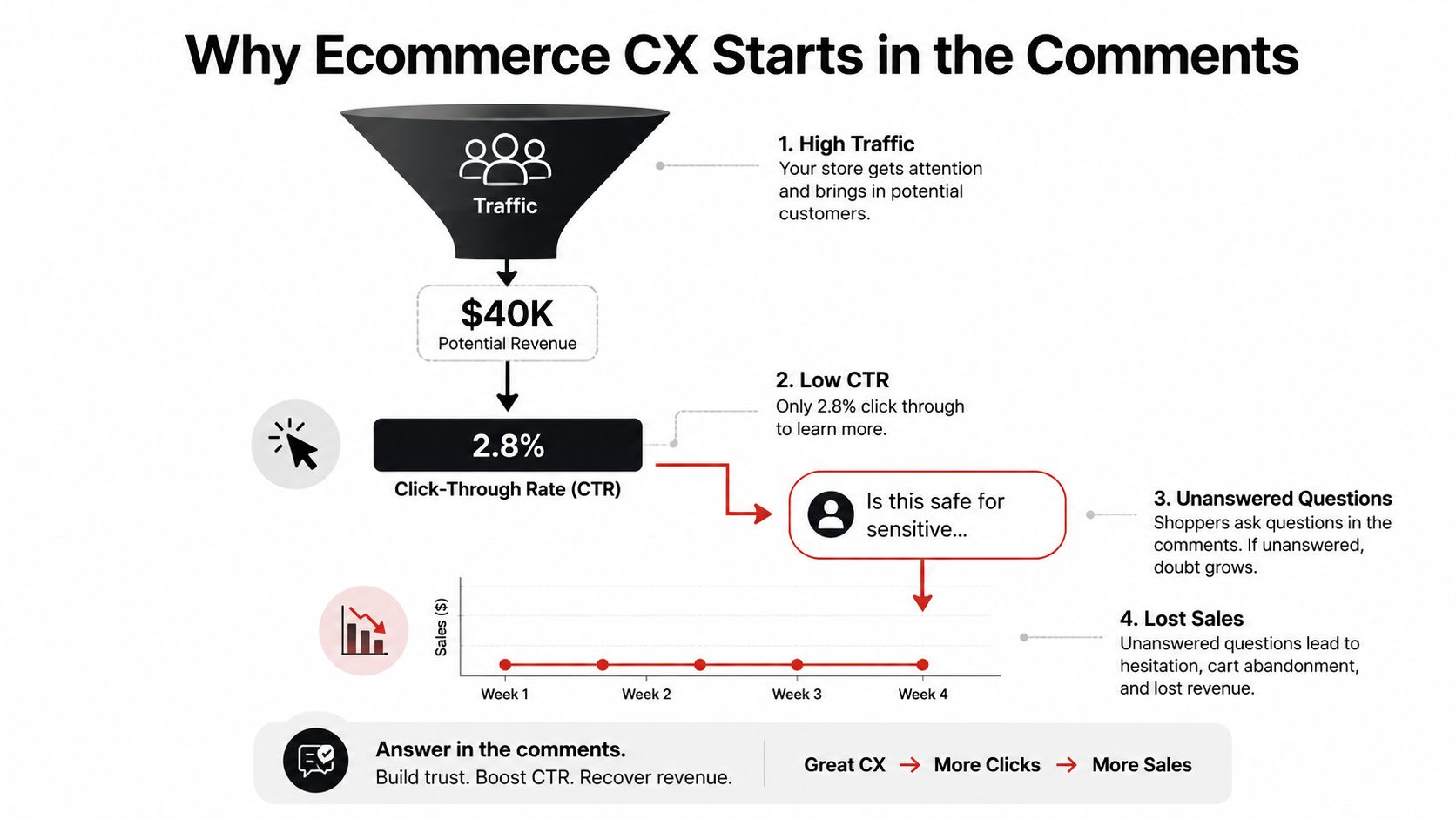
A marketing funnel infographic illustrating how answering ecommerce customer comments improves click-through rates and total sales revenue.

The comment is part of the ad

Paid social creates a conversational funnel. The ad earns the click, the public thread handles objections, the DM carries intent forward, and website chat removes final uncertainty. Treating comments as a support queue separates the exact interaction that influences conversion from the campaign buying the traffic.

Meta's messaging rules also make timing concrete. After a customer messages a business on Instagram or Messenger, the brand has a 24-hour window for free-form replies, and each new customer message resets that window. Once it closes, only approved message types can be sent (the 24-hour messaging window explained).

That window changes the workflow. A question about sensitive skin should receive a useful answer while the buyer is still evaluating the product. The reply can include the relevant product page, price, offer, or follow-up question. Waiting until the next shift turns an active buying conversation into a recovery attempt.

Measure the surface like revenue

Track first-response time, questions by objection type, public sentiment, hidden-comment volume, DM handoffs, and orders assisted by conversation. Don't report “community engagement” as a vague health metric while paid campaigns run without a view of what customers are asking.

A practical moderation process can also reduce manual effort. If you need a reference for how to manage Meta ad comments at scale, focus on workflows that distinguish spam, abuse, genuine objections, and buying signals. The right response isn't always deletion. A public answer often does more for conversion than hiding the question.

Your comment section also contains direct product research. Capture recurring questions and use them to improve creative, landing pages, FAQs, and offers. The comment section as free ad research becomes useful only when someone turns those observations into changes.

What Ecommerce Customer Experience Actually Covers

Ecommerce customer experience is the complete impression a shopper forms from the first ad interaction through post-purchase support. It isn't limited to customer service, and it isn't owned by one department. The product page, ad comment, checkout form, shipping update, and return conversation all shape the same relationship.

Start with the storefront. Page speed, mobile layout, navigation, product imagery, reviews, product details, delivery information, and payment choices determine whether a shopper can understand the offer and act on it. A product page that answers the wrong questions forces the buyer to open a comment thread or start a support conversation before purchasing.

The storefront layer

The storefront owns the first practical test of trust:

  • Page clarity: Explain what the product does, who it's for, how to use it, and what it costs.

  • Mobile usability: Make buttons, variants, address fields, and payment steps easy to complete with one hand.

  • Checkout transparency: Show shipping, taxes, returns, and delivery expectations before the buyer reaches the final step.

  • Trust evidence: Make reviews, guarantees, contact options, and payment information visible without burying them in navigation.

Product imagery matters, but it can't answer every objection. A short demonstration can clarify use, fit, texture, or setup faster than another polished studio image. Teams producing that asset can use a step-by-step product video creation process, then place the video where paid-traffic visitors make their first evaluation.
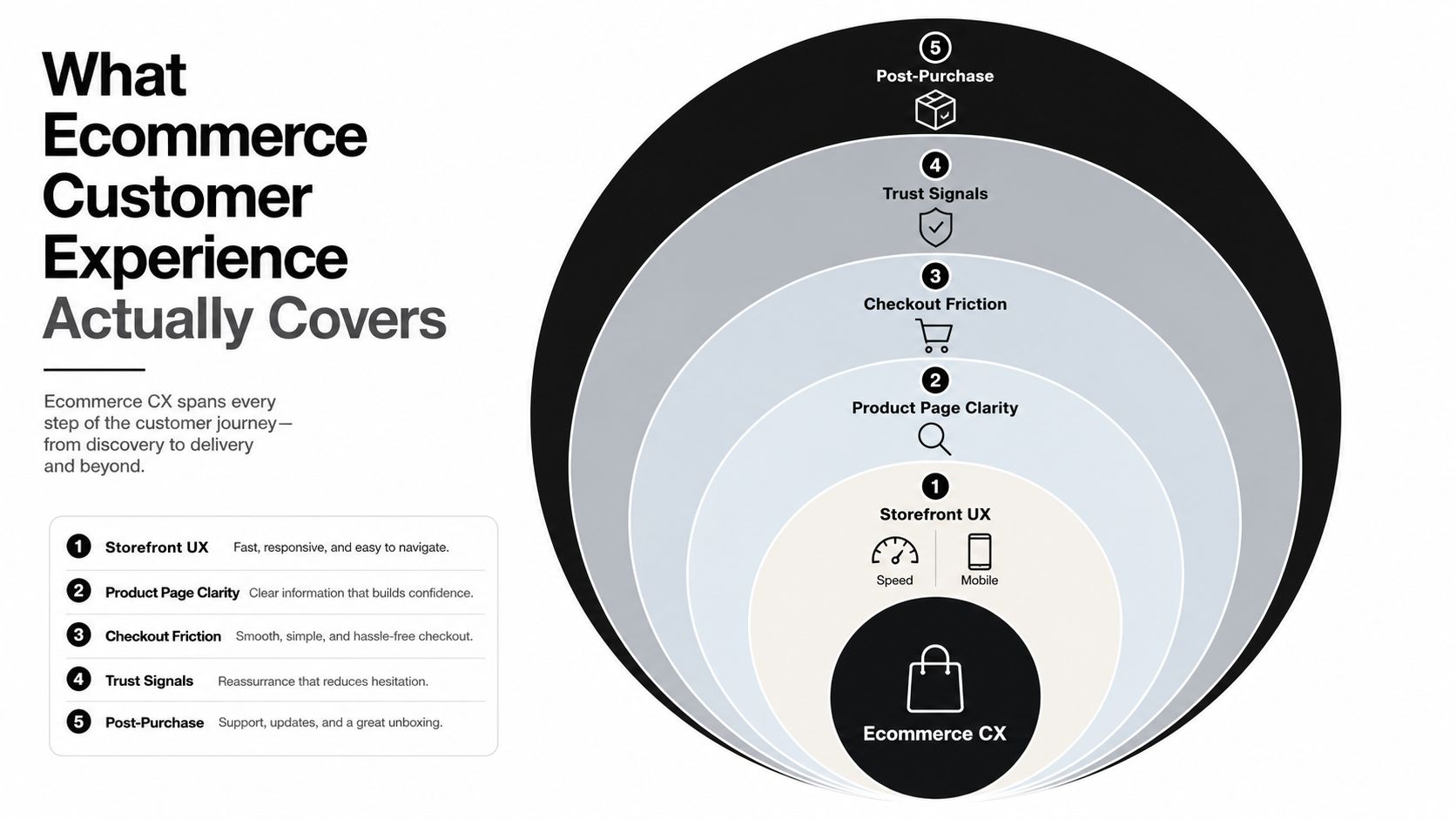
A circular diagram illustrating five key stages of the ecommerce customer experience from storefront to post-purchase.

The conversation layer

The messaging layer includes website chat, Facebook and Instagram DMs, TikTok comments, TikTok messages where available, and future owned channels such as SMS and email. Each surface needs access to the same product facts, prices, policies, promotions, and escalation rules.

A buyer shouldn't receive one answer under an ad and a contradictory answer from chat. Saved replies, product data, campaign context, customer history, and approval rules must connect. TikTok provides comment-management controls for filtering advertiser-defined terms, hiding unsuitable comments, turning comments off, and reviewing activity through a dashboard. Its published safety material also describes moderation coverage around the clock (TikTok comment-management controls).

The post-purchase layer

CX continues after payment. Order confirmation, tracking, delay notices, delivery instructions, returns, exchanges, review requests, replenishment reminders, and win-back messages determine whether the next interaction reinforces trust or creates more work.

Assign ownership by asset, not by department. Marketing owns campaign context and brand voice. Ecommerce owns product and checkout information. Operations owns inventory and delivery rules. Support owns policy interpretation and escalation. CRM owns triggers and lifecycle timing. A connected omnichannel customer engagement system makes those responsibilities visible instead of leaving them in disconnected inboxes.

The Buyer Journey From Discovery to Repeat Purchase

Paid social compresses the buyer journey. A shopper can see a product, read public objections, ask a question, open a DM, visit the product page, and purchase within one session. That means the comment thread sits between discovery and consideration, not after the marketing funnel has finished.

Discovery creates the first filter

At discovery, creative, creator content, imagery, offer framing, and public sentiment compete for attention. A question such as “Does this work for sensitive skin?” signals uncertainty. A clear answer can help other shoppers evaluate the ad without opening another tab. An unanswered complaint can change the perceived risk of the entire offer.

This is also where moderation matters. Remove spam, scams, and abusive content according to a documented rule. Keep legitimate criticism visible when a public response can demonstrate competence. Hiding every negative comment may make the thread look clean to the brand while leaving genuine objections unresolved elsewhere.

Consideration exposes information gaps

Once the shopper reaches the product page, the page must carry the conversation forward. It should answer the same questions appearing in comments: materials, ingredients, fit, use, delivery, returns, compatibility, and total cost.

Cart abandonment shows how much intent can still disappear after consideration. Baymard reports an average cart abandonment rate of 70.19%, meaning roughly seven in ten high-intent sessions don't reach payment completion (Baymard checkout research). The causes include checkout complexity, mobile usability, payment availability, transparency, and trust. That makes the cart a product experience problem, not just a pricing problem.

Conversion depends on the last interaction

Checkout should remove work. Offer guest checkout, preserve entered information where appropriate, validate addresses clearly, expose accepted payment options, and show the full cost before the final click. If a shopper asks about payment safety or returns in chat, answer without sending them through a maze of policy pages.

Baymard's synthesis also found that 18% of U.S. online shoppers abandoned a purchase because they didn't trust the site with their credit card information (Baymard trust and checkout findings). Website chat on a paid-traffic landing page can address that concern directly with accurate answers about payment handling, shipping, returns, and pricing.

Retention starts with delivery

The sale creates a new expectation. Send confirmation, explain fulfillment status, provide tracking, communicate delays before the customer asks, and make returns easy to understand. A poor delivery conversation can undo a strong ad and a clean checkout.

The same journey data should reach attribution. If a customer asks a question in a DM, receives a checkout link, and then orders, record the conversation as an assisted touchpoint. A conversion attribution framework helps teams distinguish direct clicks from conversations that influenced the purchase.

KPIs That Tell You If Your CX Is Working

A useful CX dashboard connects customer behavior to operating decisions. It shouldn't contain every available support metric. Track the measures that tell you whether paid traffic receives a fast answer, whether shoppers complete the purchase, whether buyers return, and whether public sentiment is improving.

The following targets are operating targets for a DTC team, not universal industry benchmarks. Set a baseline first, then use them to define ownership and escalation.

Category

KPI

Target

Speed

Comment and DM first response during business hours

Under 60 minutes

Speed

Response during active ad pushes

Under 15 minutes

Speed

Ad click to mobile checkout start

Under 90 seconds

Conversion

Checkout completion rate

Above 60%

Conversion

Add-to-cart rate

Above 8%

Conversion

Tracked comment-to-purchase rate

Report by handle and campaign

Retention

60-day repeat purchase rate

Track trend by cohort

Retention

Subscription churn

Track by product and cohort

Retention

Review submission rate

Above 10% of fulfilled orders

Sentiment

Positive comment ratio

Above 70%

Sentiment

Negative-comment response rate

Within 4 hours

Sentiment

Brand mention share of voice

Compare with the category

Speed tells you whether intent is still alive

Industry survey data gives stricter context than most internal service-level agreements. 96% of shoppers expect chat responses within five minutes, 94% expect email responses within 24 hours, and nearly half may leave a site when they don't see typing activity within one minute. For live support, about 90% say they'll wait no more than five minutes, while 60% cap the wait at two minutes or less (customer service wait-time research).

Use those expectations to set queue alerts. A campaign with high comment volume needs different coverage from a quiet evergreen ad. If the team can't meet the response target, reduce the traffic or change the routing before the inbox becomes a conversion liability.

Conversion and sentiment explain spend quality

Review checkout completion by device, campaign, landing page, and payment path. Pair it with comment-to-purchase data so media buyers can see whether a creative generates buying conversations or only cheap engagement.

Sentiment belongs beside CPM and click-through rate. A rising negative response rate can signal unclear claims, broken fulfillment expectations, or a product objection the creative failed to address. Don't assume the ad platform will reveal that problem through media metrics alone.

Common Pain Points for DTC Brands Running Paid Social

Most paid-social CX failures look like support problems on the surface. They become revenue problems when the team traces them back to the campaign, the buyer's timing, or the attribution report.

Unanswered criticism weakens the creative

A negative comment under an ad changes the context for every shopper who reads it. If the brand leaves a factual complaint unanswered, prospects have to decide whether the problem is real, unresolved, or being ignored. A public answer can clarify the policy, correct misinformation, or move a sensitive case into a private channel.

The cost isn't limited to one lost order. The thread can make the creative less persuasive, increase moderation workload, and force the media buyer to keep funding an ad whose public context has deteriorated.

The 24-hour window creates an overnight queue

The Meta messaging window rewards same-day engagement. A one-person team may handle normal support during working hours, then return to a backlog after a campaign runs overnight. By that point, the buyer may have forgotten the question, found another product, or lost access to the free-form reply path.

Set a queue owner for every active campaign. Route high-intent terms such as “price,” “link,” “shipping,” “discount,” and “where can I buy” differently from product complaints or refund requests. The rule should protect speed without allowing automation to make policy decisions it can't support.

Creative and CX often operate separately

A creative team can launch a strong UGC asset without receiving the objection list from the previous campaign. The support team then answers predictable questions manually, while the landing page still fails to address them. This creates repeated work and prevents useful customer language from improving the next ad.

Build a pre-launch packet with product facts, prohibited claims, approved offers, delivery rules, return language, and likely objections. Review it with media buying and CX before spend increases.

Pixel reporting misses conversation-assisted orders

A DM can answer the final objection and close the sale without appearing as a direct ad conversion. If the team reports only last-click or pixel activity, the creative may look weak and lose budget even though its comments are doing sales work.

Track campaign IDs, ad handles, UTM values, conversation timestamps, checkout links, and order IDs. The reporting system should show direct, assisted, and recovered revenue separately. For practical guidance on protecting public trust while handling these interactions, use a documented brand reputation protection process rather than ad hoc comment deletion.

Tactics You Can Deploy the Same Day

Start with the surfaces closest to the purchase. Don't redesign the entire store before fixing the question that appears under every active ad.

Fix the page before adding more traffic

On each paid landing page, collapse long product-page accordions, put shipping cutoffs above the buy button, and add a sticky add-to-cart control for mobile. Replace generic FAQ copy with answers taken from real comments. If shoppers repeatedly ask whether a product works for a specific use case, answer that question near the product selector instead of forcing them to search.

Then check the payment path as a buyer would. Use a guest path, test address validation, inspect the mobile keyboard behavior, and confirm that shipping costs appear before the final step. A fast ad cannot compensate for an unclear purchase decision.

Prepare the conversation layer

Pin a top-comment FAQ on every active ad creative. Write three approved DM templates for shipping, sizing, and returns. Add a human route for refund requests, sensitive complaints, medical or safety questions, and any conversation where the buyer's intent is clear but the answer needs judgment.

A useful reply has four parts:

  1. Answer the question: Lead with the exact information requested.

  2. Reduce the next step: Add the relevant product or checkout link.

  3. Set expectations: State delivery, return, or follow-up timing accurately.

  4. Record the intent: Tag the conversation by objection, campaign, and outcome.

Use TikTok's filtering, hiding, comment controls, and dashboard review to support moderation rules. Keep a public response when the question is legitimate and the answer can help other shoppers. Hide spam or abusive content according to the brand's documented policy.

Automate follow-up without removing judgment

Trigger an SMS or email within 10 minutes of cart abandonment, send a review request seven days after delivery, and tag orders by attribution source. Those timings are operating choices for the workflow, not universal benchmarks. Test them against consent requirements, product category, delivery cycle, and customer preference.

Use an AdCrunch campaign plan template to document campaign ownership, creative context, budget, response coverage, and escalation paths in one place. The template matters less than the discipline of assigning someone to the comments before the ad goes live.

Close the attribution loop

UTM-tag every ad. Attach campaign and ad identifiers to conversation records. Send DM-converted orders back as offline conversion events where the operating setup supports it. Review assisted revenue weekly, then compare it with comment volume, response time, and sentiment by creative.

A same-day test can be small: choose one active campaign, publish the FAQ, prepare the three replies, assign an escalation owner, and compare unanswered conversations with handled conversations. Don't wait for a full support transformation to learn whether the thread is influencing sales.

AI Employees vs Chatbots vs Human Moderators

The right moderation model depends on the work, not on the label. A DTC brand needs to compare response speed, objection handling, attribution, consistency, escalation quality, and operating cost.

Capability

AI Employee

Rule-Based Chatbot

Human Moderator

First response

Seconds

Fast for matched phrases

Depends on staffing and queue

Objection handling

Contextual responses within approved rules

Limited to predefined paths

Strong judgment for complex cases

Conversation attribution

Can connect replies and outcomes when integrated

Often fragmented

Usually manual unless systems are connected

Brand voice

Configured and monitored centrally

Repetitive and template-dependent

Varies by person and training

Overnight coverage

Continuous

Continuous

Requires scheduled coverage

Escalation

Routes defined cases to people

Often reaches a dead end

Handles the case directly

Main failure

Poor handoff on emotional or sensitive issues

Can't interpret nuance

Misses volume or timing under load

AI employees handle the first touch

The category is useful when the system can read campaign context, answer in the approved brand voice, provide links and offers, moderate according to rules, and record the outcome. Exerta is one example of an AI employee platform that handles comments, DMs, and website chat across Facebook, Instagram, TikTok, and web chat, with attribution and escalation workflows. SMS, email, and voice are planned channels.

The model works when the brand supplies accurate product information, current policies, prohibited claims, and clear handoff rules. It fails when teams expect automation to resolve emotionally charged complaints without a human path.

Rule-based bots still have a narrow role

A simple bot can deflect repetitive FAQ questions. It struggles when a buyer uses unexpected wording, combines several objections, or needs a policy exception. Keep it for tightly bounded information retrieval, not for sales conversations requiring context.

Human moderators provide judgment

People should own refunds, safety concerns, legal threats, unusual delivery failures, and high-value or high-risk escalations. They shouldn't spend their shift answering the same shipping question under every ad. Lead with fast automated coverage, then reserve human time for cases where empathy, discretion, or policy interpretation affects the outcome.

The practical decision rule is straightforward. Use an AI employee for first-touch speed, context, moderation, and attribution. Use people for defined escalations. Keep a basic chatbot only where the question and answer are both stable.

For a closer operational explanation, review what an AI employee actually does all day.

Your 30-Day CX Improvement Plan

Week one

Audit comment and DM response times by Meta placement, TikTok campaign, hour, and owner. Instrument the checkout funnel in your analytics setup. Ship two low-risk fixes immediately, reduce mobile checkout fields and add a sticky add-to-cart control on the product page.

Week two

Deploy an AI employee for first-touch comment and DM replies. Connect UTMs and campaign identifiers to the conversation record. Create escalation rules for refunds, sizing uncertainty, safety questions, and delivery exceptions. Review the first conversations manually and correct product facts before expanding coverage.

Week three

Launch post-purchase flows for order confirmation, shipping, delivery, and review capture. Add conditional branching based on order value, product type, delivery status, and whether the customer has already contacted support. Keep the messages factual and make it easy to reach a person when the automated path stops being useful.

Week four

Compare the four KPI groups against the baseline. Watch first response time under 60 seconds, checkout completion against your industry benchmark, repeat purchase trends, and assisted Meta conversion revenue week over week. Pause creatives whose comment sentiment and unanswered-question rate are dragging performance, then document the working rules in a one-page CX playbook.

The playbook should include approved answers, escalation triggers, moderation rules, campaign ownership, attribution fields, and the daily review schedule. Give it to media buying, creative, support, and agency partners so the ad and the customer experience operate from the same information.

Exerta deploys AI employees that reply to comments and DMs, moderate conversations, support website chat, and connect assisted purchases to campaign activity. Visit Exerta to see how your team can turn paid-social conversations into a measurable ecommerce customer experience workflow.

Get started today

Stop losing sales you already paid for.

Connect your channels in about a minute. Your AI employees start answering, moderating and closing the same day.

No credit card required

Live in under 5 minutes

250+ brands running

Cancel anytime

Get started today

Stop losing sales you already paid for.

Connect your channels in about a minute. Your AI employees start answering, moderating and closing the same day.

No credit card required

Live in under 5 minutes

250+ brands running

Cancel anytime

Get started today

Stop losing sales you already paid for.

Connect your channels in about a minute. Your AI employees start answering, moderating and closing the same day.

No credit card required

Live in under 5 minutes

250+ brands running

Cancel anytime

AI employees that answer every buyer, protect your ad spend and close sales around the clock.

All systems operational · 99.98% uptime last 90 days

SOC 2

Type II

GDPR

Compliant

99.9% SLA

Uptime

24/7

Support

1. Pricing and billing All prices displayed on exerta.ai are in US dollars and exclude applicable taxes unless stated otherwise. Prices are subject to change. Existing subscribers will receive at least 30 days’ written notice before any price increase takes effect on their account. Annual plan savings are calculated by comparing the annual billing rate to the equivalent monthly billing rate multiplied by 12.

2. Run and usage statisticsRevenue, engagement and success figures are based on aggregated platform data and customer-reported results across 250+ brands, and are updated periodically.

3. Time-to-value claims Statements such as “live in about a minute” reflect typical setup times observed for new accounts connecting through Meta Business Manager. Actual setup time may vary with the number of channels connected and the level of agent customization.

4. AI step suggestions Exerta’s AI features are powered by a blend of leading AI models, anchored by our own fine-tuned engagement model. Suggestion quality, accuracy and availability may vary. Exerta does not guarantee that AI-generated output will be accurate, complete or suitable for any particular use case. Review AI output before acting on it.

5. Integration availability The number of native integrations referenced on this website reflects integrations available at the time of last update. Integration availability may vary by subscription plan. Third-party integrations are subject to the terms, availability and API limitations of the respective third-party providers. Exerta does not guarantee the continued availability of any specific integration and is not responsible for disruptions caused by changes to third-party APIs or services.

6. Uptime and SLA The 99.9% uptime figure refers to our published Service Level Agreement (SLA) target for paid plan customers. Actual uptime may vary. Historical uptime statistics are available upon request.

7. Security and compliance certifications Exerta’s SOC 2 Type II (coming soon) certification covers the security, availability, processing integrity, confidentiality and privacy trust service criteria. GDPR compliance reflects our internal data protection practices and contractual commitments. HIPAA compliance is available exclusively on Enterprise plans and requires execution of a Business Associate Agreement (BAA). ISO 27001 certification is currently in progress. Compliance certifications are subject to annual renewal and audit. Copies of our most recent compliance reports are available to Enterprise customers under NDA upon request.

8. Customer testimonials and case studies Testimonials, quotes and case study results featured on this website reflect the experiences of individual customers. Results vary with ad spend, engagement volume, offer and configuration. Exerta does not guarantee that any customer will achieve similar results.

9. Third-party service marks and logos All third-party brand names, logos and service marks referenced on this website — including but not limited to Meta, Facebook, Instagram, TikTok, Shopify and Trustpilot — are the property of their respective owners. References to these services do not imply endorsement, sponsorship or affiliation.

10. Free plan limitations The Free plan does not require a credit card. Free plan usage is subject to the limits described on our pricing page, including a limited number of AI actions per month and comment hiding with stock replies only. Exerta reserves the right to modify the features and limits of the Free plan at any time.

11. Trial periods Free trial periods are available on paid plans as described at the time of signup. At the end of the trial period, the selected payment method will be charged at the applicable plan rate unless the subscription is cancelled before the trial expires. Trial periods are available once per customer and may not be combined with other promotional offers.

12. Data processing and privacy Exerta processes personal data in accordance with our Privacy Policy and Data Processing Agreement. Data residency options (US and EU) are available on all paid plans. The data residency region is selected at account creation and cannot be changed without contacting our support team. Customers responsible for processing personal data of EEA or UK residents are advised to execute our standard Data Processing Agreement, available at exerta.ai/legal/dpa.

13. Activity history retention Activity history is retained for 90 days on the Starter plan and for longer periods on larger plans, as described at signup. Exported data is the responsibility of the customer once downloaded.

14. AI model providers Exerta uses a blend of leading AI models together with our own fine-tuned engagement model, specialized for customer engagement. Model composition may change as we improve the product.

15. Mobile and desktop applications Exerta is available in the browser on desktop and mobile. Certain advanced configuration features are easiest on desktop. Application updates are released on a rolling basis.

16. Template library Prebuilt agent setups provided by Exerta are starting points and are not guaranteed to be suitable for any particular purpose. Customers are responsible for reviewing and testing agent behavior before enabling it on live channels.

17. Website content accuracy The information on this website is provided for general informational purposes only and is subject to change without notice. While we make every effort to keep the content accurate and up to date, Exerta makes no warranties or representations, express or implied, about the completeness, accuracy, reliability or suitability of the information contained on this website for any particular purpose.

18. Promotional offers and discounts Promotional pricing, discounts and special offers are subject to additional terms and conditions communicated at the time of the offer. Offers cannot be applied retroactively to existing subscriptions and may not be combined with other promotions unless explicitly stated. Exerta reserves the right to modify or discontinue promotional offers at any time.

19. Startup and non-profit programs Eligibility for our startup and non-profit discount programs is assessed at Exerta’s sole discretion based on the criteria described in our support documentation. Approved discounts apply to the base subscription price only and do not apply to add-ons, Enterprise features or professional services. Discount eligibility is subject to annual review.

20. Intellectual property This website is operated by Reascend LLC (d/b/a Exerta), a limited liability company formed in the State of Delaware, United States. References to “we”, “us” and “our” throughout this website refer to Reascend LLC (d/b/a Exerta). The use of this website and our Services is governed by the laws of the State of Delaware, United States, as described in our Terms of Service.

21. Accessibility Exerta is committed to making its website and application accessible to all users, including those with disabilities. We aim to conform to the Web Content Accessibility Guidelines (WCAG) 2.1 at Level AA. If you experience any accessibility barriers, please contact us at accessibility@exerta.ai and we will make every effort to provide an accessible alternative.

22. Governing jurisdiction This website is operated by Reascend LLC (d/b/a Exerta), a limited liability company formed in the State of Delaware, United States. References to “we”, “us” and “our” throughout this website refer to Reascend LLC (d/b/a Exerta). The use of this website and our Services is governed by the laws of the State of Delaware, United States, as described in our Terms of Service.

AI employees that answer every buyer, protect your ad spend and close sales around the clock.

All systems operational · 99.98% uptime last 90 days

SOC 2

Type II

GDPR

Compliant

99.9% SLA

Uptime

24/7

Support

1. Pricing and billing All prices displayed on exerta.ai are in US dollars and exclude applicable taxes unless stated otherwise. Prices are subject to change. Existing subscribers will receive at least 30 days’ written notice before any price increase takes effect on their account. Annual plan savings are calculated by comparing the annual billing rate to the equivalent monthly billing rate multiplied by 12.

2. Run and usage statisticsRevenue, engagement and success figures are based on aggregated platform data and customer-reported results across 250+ brands, and are updated periodically.

3. Time-to-value claims Statements such as “live in about a minute” reflect typical setup times observed for new accounts connecting through Meta Business Manager. Actual setup time may vary with the number of channels connected and the level of agent customization.

4. AI step suggestions Exerta’s AI features are powered by a blend of leading AI models, anchored by our own fine-tuned engagement model. Suggestion quality, accuracy and availability may vary. Exerta does not guarantee that AI-generated output will be accurate, complete or suitable for any particular use case. Review AI output before acting on it.

5. Integration availability The number of native integrations referenced on this website reflects integrations available at the time of last update. Integration availability may vary by subscription plan. Third-party integrations are subject to the terms, availability and API limitations of the respective third-party providers. Exerta does not guarantee the continued availability of any specific integration and is not responsible for disruptions caused by changes to third-party APIs or services.

6. Uptime and SLA The 99.9% uptime figure refers to our published Service Level Agreement (SLA) target for paid plan customers. Actual uptime may vary. Historical uptime statistics are available upon request.

7. Security and compliance certifications Exerta’s SOC 2 Type II (coming soon) certification covers the security, availability, processing integrity, confidentiality and privacy trust service criteria. GDPR compliance reflects our internal data protection practices and contractual commitments. HIPAA compliance is available exclusively on Enterprise plans and requires execution of a Business Associate Agreement (BAA). ISO 27001 certification is currently in progress. Compliance certifications are subject to annual renewal and audit. Copies of our most recent compliance reports are available to Enterprise customers under NDA upon request.

8. Customer testimonials and case studies Testimonials, quotes and case study results featured on this website reflect the experiences of individual customers. Results vary with ad spend, engagement volume, offer and configuration. Exerta does not guarantee that any customer will achieve similar results.

9. Third-party service marks and logos All third-party brand names, logos and service marks referenced on this website — including but not limited to Meta, Facebook, Instagram, TikTok, Shopify and Trustpilot — are the property of their respective owners. References to these services do not imply endorsement, sponsorship or affiliation.

10. Free plan limitations The Free plan does not require a credit card. Free plan usage is subject to the limits described on our pricing page, including a limited number of AI actions per month and comment hiding with stock replies only. Exerta reserves the right to modify the features and limits of the Free plan at any time.

11. Trial periods Free trial periods are available on paid plans as described at the time of signup. At the end of the trial period, the selected payment method will be charged at the applicable plan rate unless the subscription is cancelled before the trial expires. Trial periods are available once per customer and may not be combined with other promotional offers.

12. Data processing and privacy Exerta processes personal data in accordance with our Privacy Policy and Data Processing Agreement. Data residency options (US and EU) are available on all paid plans. The data residency region is selected at account creation and cannot be changed without contacting our support team. Customers responsible for processing personal data of EEA or UK residents are advised to execute our standard Data Processing Agreement, available at exerta.ai/legal/dpa.

13. Activity history retention Activity history is retained for 90 days on the Starter plan and for longer periods on larger plans, as described at signup. Exported data is the responsibility of the customer once downloaded.

14. AI model providers Exerta uses a blend of leading AI models together with our own fine-tuned engagement model, specialized for customer engagement. Model composition may change as we improve the product.

15. Mobile and desktop applications Exerta is available in the browser on desktop and mobile. Certain advanced configuration features are easiest on desktop. Application updates are released on a rolling basis.

16. Template library Prebuilt agent setups provided by Exerta are starting points and are not guaranteed to be suitable for any particular purpose. Customers are responsible for reviewing and testing agent behavior before enabling it on live channels.

17. Website content accuracy The information on this website is provided for general informational purposes only and is subject to change without notice. While we make every effort to keep the content accurate and up to date, Exerta makes no warranties or representations, express or implied, about the completeness, accuracy, reliability or suitability of the information contained on this website for any particular purpose.

18. Promotional offers and discounts Promotional pricing, discounts and special offers are subject to additional terms and conditions communicated at the time of the offer. Offers cannot be applied retroactively to existing subscriptions and may not be combined with other promotions unless explicitly stated. Exerta reserves the right to modify or discontinue promotional offers at any time.

19. Startup and non-profit programs Eligibility for our startup and non-profit discount programs is assessed at Exerta’s sole discretion based on the criteria described in our support documentation. Approved discounts apply to the base subscription price only and do not apply to add-ons, Enterprise features or professional services. Discount eligibility is subject to annual review.

20. Intellectual property This website is operated by Reascend LLC (d/b/a Exerta), a limited liability company formed in the State of Delaware, United States. References to “we”, “us” and “our” throughout this website refer to Reascend LLC (d/b/a Exerta). The use of this website and our Services is governed by the laws of the State of Delaware, United States, as described in our Terms of Service.

21. Accessibility Exerta is committed to making its website and application accessible to all users, including those with disabilities. We aim to conform to the Web Content Accessibility Guidelines (WCAG) 2.1 at Level AA. If you experience any accessibility barriers, please contact us at accessibility@exerta.ai and we will make every effort to provide an accessible alternative.

22. Governing jurisdiction This website is operated by Reascend LLC (d/b/a Exerta), a limited liability company formed in the State of Delaware, United States. References to “we”, “us” and “our” throughout this website refer to Reascend LLC (d/b/a Exerta). The use of this website and our Services is governed by the laws of the State of Delaware, United States, as described in our Terms of Service.

AI employees that answer every buyer, protect your ad spend and close sales around the clock.

All systems operational · 99.98% uptime last 90 days

SOC 2

Type II

GDPR

Compliant

99.9% SLA

Uptime

24/7

Support

1. Pricing and billing All prices displayed on exerta.ai are in US dollars and exclude applicable taxes unless stated otherwise. Prices are subject to change. Existing subscribers will receive at least 30 days’ written notice before any price increase takes effect on their account. Annual plan savings are calculated by comparing the annual billing rate to the equivalent monthly billing rate multiplied by 12.

2. Run and usage statisticsRevenue, engagement and success figures are based on aggregated platform data and customer-reported results across 250+ brands, and are updated periodically.

3. Time-to-value claims Statements such as “live in about a minute” reflect typical setup times observed for new accounts connecting through Meta Business Manager. Actual setup time may vary with the number of channels connected and the level of agent customization.

4. AI step suggestions Exerta’s AI features are powered by a blend of leading AI models, anchored by our own fine-tuned engagement model. Suggestion quality, accuracy and availability may vary. Exerta does not guarantee that AI-generated output will be accurate, complete or suitable for any particular use case. Review AI output before acting on it.

5. Integration availability The number of native integrations referenced on this website reflects integrations available at the time of last update. Integration availability may vary by subscription plan. Third-party integrations are subject to the terms, availability and API limitations of the respective third-party providers. Exerta does not guarantee the continued availability of any specific integration and is not responsible for disruptions caused by changes to third-party APIs or services.

6. Uptime and SLA The 99.9% uptime figure refers to our published Service Level Agreement (SLA) target for paid plan customers. Actual uptime may vary. Historical uptime statistics are available upon request.

7. Security and compliance certifications Exerta’s SOC 2 Type II (coming soon) certification covers the security, availability, processing integrity, confidentiality and privacy trust service criteria. GDPR compliance reflects our internal data protection practices and contractual commitments. HIPAA compliance is available exclusively on Enterprise plans and requires execution of a Business Associate Agreement (BAA). ISO 27001 certification is currently in progress. Compliance certifications are subject to annual renewal and audit. Copies of our most recent compliance reports are available to Enterprise customers under NDA upon request.

8. Customer testimonials and case studies Testimonials, quotes and case study results featured on this website reflect the experiences of individual customers. Results vary with ad spend, engagement volume, offer and configuration. Exerta does not guarantee that any customer will achieve similar results.

9. Third-party service marks and logos All third-party brand names, logos and service marks referenced on this website — including but not limited to Meta, Facebook, Instagram, TikTok, Shopify and Trustpilot — are the property of their respective owners. References to these services do not imply endorsement, sponsorship or affiliation.

10. Free plan limitations The Free plan does not require a credit card. Free plan usage is subject to the limits described on our pricing page, including a limited number of AI actions per month and comment hiding with stock replies only. Exerta reserves the right to modify the features and limits of the Free plan at any time.

11. Trial periods Free trial periods are available on paid plans as described at the time of signup. At the end of the trial period, the selected payment method will be charged at the applicable plan rate unless the subscription is cancelled before the trial expires. Trial periods are available once per customer and may not be combined with other promotional offers.

12. Data processing and privacy Exerta processes personal data in accordance with our Privacy Policy and Data Processing Agreement. Data residency options (US and EU) are available on all paid plans. The data residency region is selected at account creation and cannot be changed without contacting our support team. Customers responsible for processing personal data of EEA or UK residents are advised to execute our standard Data Processing Agreement, available at exerta.ai/legal/dpa.

13. Activity history retention Activity history is retained for 90 days on the Starter plan and for longer periods on larger plans, as described at signup. Exported data is the responsibility of the customer once downloaded.

14. AI model providers Exerta uses a blend of leading AI models together with our own fine-tuned engagement model, specialized for customer engagement. Model composition may change as we improve the product.

15. Mobile and desktop applications Exerta is available in the browser on desktop and mobile. Certain advanced configuration features are easiest on desktop. Application updates are released on a rolling basis.

16. Template library Prebuilt agent setups provided by Exerta are starting points and are not guaranteed to be suitable for any particular purpose. Customers are responsible for reviewing and testing agent behavior before enabling it on live channels.

17. Website content accuracy The information on this website is provided for general informational purposes only and is subject to change without notice. While we make every effort to keep the content accurate and up to date, Exerta makes no warranties or representations, express or implied, about the completeness, accuracy, reliability or suitability of the information contained on this website for any particular purpose.

18. Promotional offers and discounts Promotional pricing, discounts and special offers are subject to additional terms and conditions communicated at the time of the offer. Offers cannot be applied retroactively to existing subscriptions and may not be combined with other promotions unless explicitly stated. Exerta reserves the right to modify or discontinue promotional offers at any time.

19. Startup and non-profit programs Eligibility for our startup and non-profit discount programs is assessed at Exerta’s sole discretion based on the criteria described in our support documentation. Approved discounts apply to the base subscription price only and do not apply to add-ons, Enterprise features or professional services. Discount eligibility is subject to annual review.

20. Intellectual property All content on this website, including text, graphics, logos, icons, images, audio clips, digital downloads and software, is the property of Reascend LLC (d/b/a Exerta) or its content suppliers and is protected by applicable intellectual property laws. Exerta® is a registered trademark of Reascend LLC. Unauthorised reproduction, distribution or modification of any content from this website is prohibited without prior written consent.

21. Accessibility Exerta is committed to making its website and application accessible to all users, including those with disabilities. We aim to conform to the Web Content Accessibility Guidelines (WCAG) 2.1 at Level AA. If you experience any accessibility barriers, please contact us at accessibility@exerta.ai and we will make every effort to provide an accessible alternative.

22. Governing jurisdiction This website is operated by Reascend LLC (d/b/a Exerta), a limited liability company formed in the State of Delaware, United States. References to “we”, “us” and “our” throughout this website refer to Reascend LLC (d/b/a Exerta). The use of this website and our Services is governed by the laws of the State of Delaware, United States, as described in our Terms of Service.